Day 129: Rotational Inertia, Board Meeting, & Stoichiometry

AP Physics: Rotational Inertia

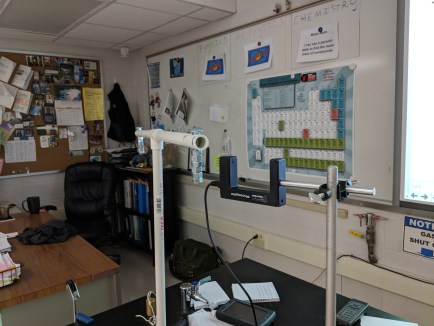
Students started a lab to find what affects the rotational inertia of a T made out of PVC. The number crunching on this lab gets hairy enough that I want to reevaluate this lab for next year. One option would be to have students apply a force by pulling with a spring scale or force sensor rather than dropping a hanging mass.
rot i.jpg

Physics: Board Meeting

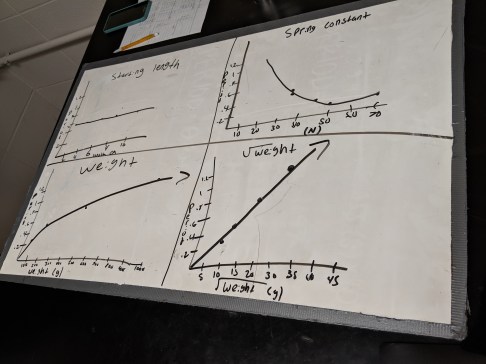
Students whiteboarded their graphs for the spring period lab. The results for spring constant didn’t come out as nicely as I hoped; a lot of groups struggled to find that value accurately. We ended up using units to reason through how spring constant plays in.
spring wb.jpg

Chemistry Essentials: Stoichiometry

Students did some written stoichiometry problems. Many of them needed more coaching than I’d hoped, but they were able to connect to yesterday’s lab and use particle diagrams to start putting the pieces together.
Day 128: Whiteboarding, Springs, & Stoich

AP Physics: Whiteboarding

Students whiteboarded some torque problems. I can tell the last week or so has been a little disjointed; I had a lot of students trying to use Universal Gravitation to find the force of gravity in the torque problems and some were having trouble with what we meant by the radius. I spent some time talking with those groups how to decide when to use each version of the force of gravity equation, and that helped resolve things.

Physics: Springs

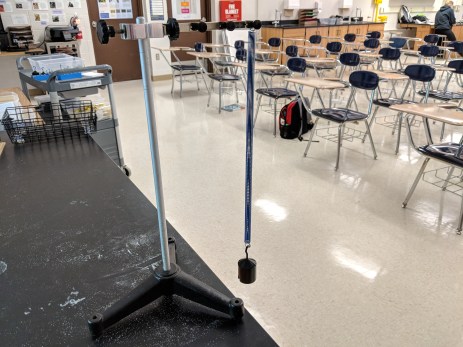
Students wrapped up collecting data for the period of a spring. I overheard a great conversation in a lab group; one student was griping a little about collecting data for the mass since he was convinced it shouldn’t matter based on the pendulum lab. Once they had a few data points, though, there was a moment when he lit up and made a beautiful connection to energy transformations to explain why mass mattered.

Maker:S,Date:2017-10-21,Ver:6,Lens:Kan03,Act:Lar02,E-Y

Chemistry Essentials: Stoich

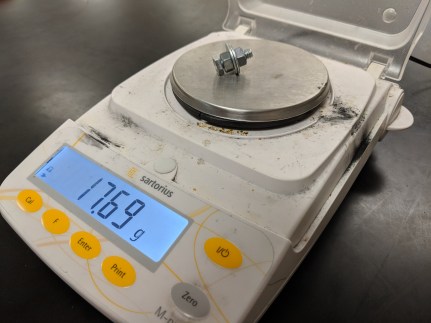
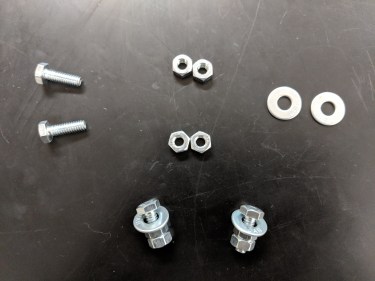
We got the hardware out again to start stoichiometry. Students assembled nuts, bolts, and washers into “molecules” and predicted how many grams of each molecule they should have after a chemical reaction. The manipulatives seemed to help a lot of students wrap their heads around what is going on in a stoichiometry problem, which I’m hoping will translate into success with the paper and pencil problems tomorrow.

stoich.jpg

Day 127: Levers, Springs, & Balancing

AP Physics: Levers

I showed students 2nd and 3rd class levers, then asked them to determine whether the rules for a balanced lever we found last week still work. There was a lot of variety in the type of graphs students opted to make to answer this question, but by the end there was a good consensus that these other types of levers still had balanced torques.lever

Physics: Springs

Students started collecting data to find what affects the period of a spring. I made sure to emphasize the parallels to last week’s pendulum lab, which seemed to help a lot of groups with the experimental design. There were also some great conversations as students tried to predict how certain variables would affect the period.

spring.jpg

Chemistry Essentials: Balancing

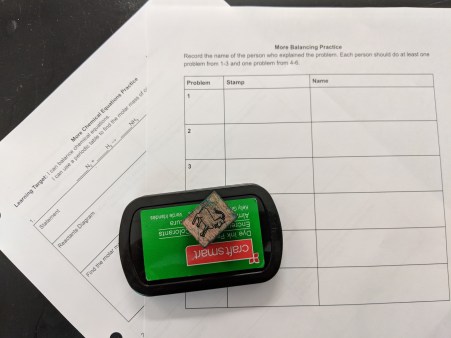
Friday’s quiz on balancing and molar mass was one that students either nailed or tanked, with very few in between, so today students got some more practice. A lot of students seem to be approaching groupwork with the idea that if someone at the table has the right answer, they are covered. I pushed back against that today by giving each table a stamp sheet they had to fill by having different members of the group explain to me how they got their answer. Students talked a lot more within their groups than usual, which is exactly what I was going for.

stamp.jpg

Day 126: Universal Gravitation, Pendulums, & Quiz

AP Physics: Universal Gravitation

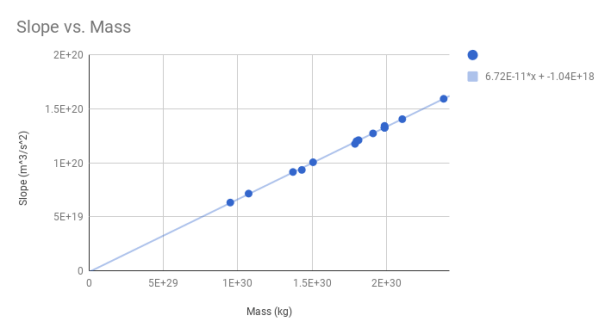
We discussed the results of the universal gravitation lab today. Once we got the inverse-square relationship, students quickly recognized the slope of their graphs seemed to be connected to the stellar mass. Prior to class, students entered their slopes and stellar masses into a spreadsheet, so I projected the data and sorted it to confirm the biggest slopes went with the biggest stellar masses. I also graphed students’ slopes vs. stellar mass to get a pretty good value for G.

chart (1)

Physics: Pendulums

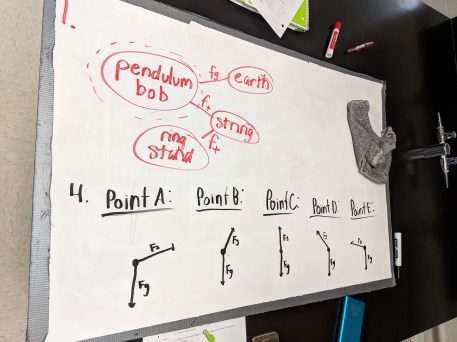
Students whiteboarded some problems from yesterday connecting pendulums to other models we’ve used so far this year, including momentum, forces, and energy. A few students needed some reminders, especially about the direction of tension forces, but were very successful in the end.

pend wb.jpg

Chemistry Essentials: Quiz

Students took a quiz on molar mass and balancing equations for chemical reactions. Based on a quick glance at their work and input from the para who worked with special education students on the quiz, I think I’m going to see a bi-modal distribution. I’m planning to start stoichiometry, and need to think about how I’m going to support the students who are still struggling with molar mass and balancing reactions when we are starting to use those skills together.

Day 125: Board Meetings & Molar Mass

AP Physics: Lever Board Meeting

We had the board meeting to discuss the results of the lever lab. A few groups were quick to notice the slope slope on the force graph was the ratio of the distances to the pivot, while the slope on the distance graph was the ratio of the masses they used, which lead nicely into a definition of torque.

lever wb.jpg

Physics: Pendulum Board Meeting

In my first hour, the board meeting was pretty rough with a lot of very long silences. I forgot this was the first board meeting of the trimester and about half of my students had the other physics teacher last tri, so I should have taken more time to set up the board meeting. My other hour is a little more talkative to begin with, but I also spent more time prepping for them discussion and things went much better.

Chemistry Essentials: Molar Mass

Students applied molar mass to some real-world problems, such as finding how many moles of chalk it took to write their name. Students are approaching the calculations for number of moles very algorithmically without much sense of why they divide the numbers they do. I need to think about how to make the why more apparent; I’ve discussed some analogies, such as bank tellers counting pennies by weight, but I wonder if it would be helpful to actually carry an analogy out in the lab.

chalk.jpg

Day 124: Levers, Pendulums, & Molar Mass

AP Physics: Levers

Most students did not finish their data collection on the Universal Gravitation lab, so I decided to postpone the discussion. A lot of students prioritized data collection on Monday, then ran into trouble doing calculations in a spreadsheet and weren’t comfortable asking for help electronically since they don’t have much experience with that. It was great to see, however, how many students were enthusiastic about trying their hand at spreadsheets.

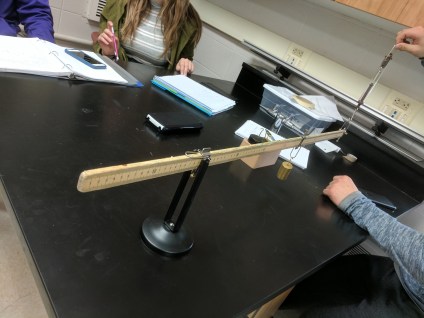
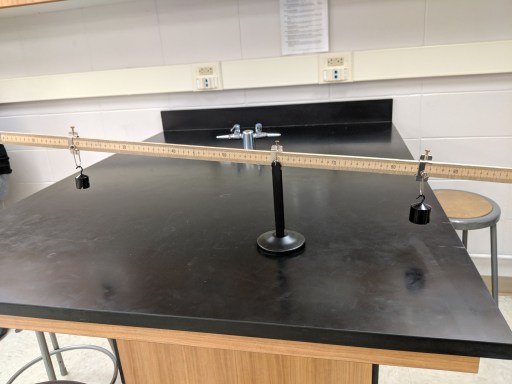
In place of the discussion, we jumped ahead to levers to introduce torque. Students first placed the clamps at set positions and found a relationship between the mass hanging from one side and the force required to balance the lever. Next, students picked two masses to use and found a relationship between the distances from each mass to the pivot required to balance the lever. One student commented the second part of the lab reminded her of using a triple beam balance.

lever.jpg

Physics: Pendulums

Students predicted the period of a pendulum at the main entrance using their data from Monday. A lot of groups used a linear fit and predicted a larger period as a result. We didn’t get to the board meeting today, so tomorrow we’ll have a chance to get into why that happened.

pendulum big

Chemistry Essentials: Molar Mass

Students practiced finding molar mass and the number of moles in a sample. When students get stuck, particle diagrams have been a huge help since they force students to break down what the formula actually represents.

Day 122: Universal Gravitation, Pendulums, & Formula Mass

Today was our first day back from spring break! We have kind of an odd start to the week since tomorrow freshmen and seniors have an off-campus learning day to accommodate state testing for sophomores and juniors.

AP Physics: Universal Gravitation

Students worked on an activity Lucas Walker presented at AAPT last summer using exoplanet data to find a relationship between centripetal acceleration and orbital radius. I was nervous about having students calculate the orbital velocity and acceleration in a spreadsheet since most of my students don’t have much experience with spreadsheets, but my students were very willing to dive in using the resources I provided and were very successful with the calculations.

Physics: Pendulums

Students collected data to model the impact of weight, drop angle, and mass on the period of a pendulum. I’m continuing to see students much more confident in their physics abilities than even the end of last trimester, and working more independently as a result.

pendulum.jpg

Using the environment to make measuring release angle easier

Chemistry Essentials: Formula Mass

Students started making sense of formula mass by predicting the mass of various combinations of nuts, bolts, and washers. I wanted to give them something pretty concrete they could test directly in the lab before diving into true stoichiometry. When we shifted to chemical formulas at the end of the hour, a few students got tripped up if they skipped the particle diagram, but the math was pretty obvious to everyone once they got that step.

molar mass lab.jpg

Day 121: Free Response, Practical, & Quiz

Today is the last day before spring break.

AP Physics: Free Response

We took some time to look at the free response problems from the tri 2 final exam. A lot of students ran out of time on the final, so we spent some time discussing strategies for time management and steps they can take even when they think they are lost on a problem. We didn’t talk about anything ground-breaking and even the physics seemed pretty clear once we got into it; I think the stress of finals got to students and made it tough to use skills they know.

Physics: Projectile Practical

Students wrapped up the horizontal projectile practical from yesterday. One of the advantages of doing projectiles after energy is I didn’t trip up any groups by switching out the marble for a lighter one. Usually, I get at least some groups that do some wild math to try and figure out what the mass changes, but this year’s students either pointed out the mass never showed up in their calculations or used conservation of energy to show it doesn’t matter.

Maker:S,Date:2017-10-21,Ver:6,Lens:Kan03,Act:Lar02,E-Y

Chemistry Essentials: Quiz

Students took a quiz on balancing and representing chemical reactions. I always have a few students in this course who have trouble staying quiet once they are finished; today, all of the conversations I shut down while students were testing were about problems on the quiz, which was pretty awesome. I felt a little bad telling them it wasn’t the right time for those conversations, especially with how passionate the conversations were.

Day 120: Practicals & Demos

AP Physics: Central Force Practical

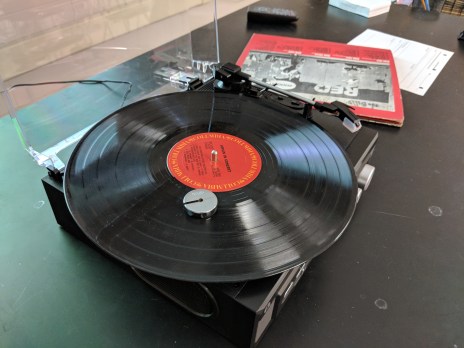
I got out the record player and, as a class, we found where a mass starts to slip when the player is at 33 1/3 rpm. Students then calculated what radius they should place the same mass at when the record player is at 45 rpm. Since the velocity depends on the radius, the math got a little hairy, but students were pretty successful working through it and making sense of how all the variables were connected.

record.jpg

Physics: Projectile Practical

Students rolled a marble down a short ramp to turn it into a horizontal and predicted where it should hit the floor. Both my classes were able to complete it with less support than I expected. After each group managed to hit the target (an old carbon-copy referral form), I asked them to predict where, relative to their first marble, a lighter one should land.

horiz proj.jpg

Chemistry Essentials: Demos

Students balanced a few different chemical reactions, then I demonstrated those reactions. Most of the students seem to be getting pretty confident with both skills and enjoyed the demonstrations. The thing I struggled with is the demos felt very separate from the balancing since they did confirm or otherwise add to the work students had done. I’m wondering if there is something I could have done differently to connect those two pieces better.

Day 119: Whiteboarding

AP Physics: Central Force Whiteboarding

Students whiteboarded some problems dealing with a central net force. My students who have taken Astronomy are pretty excited with the connections they are seeing to orbits. I also pulled up a simulation of Newton’s Cannon to talk about a problem that asks why the ISS doesn’t crash into the earth.

Physics: Projectile Motion Mistakes

We did the mistakes game, focusing on the diagrams and initial set-up for problems rather than all of the math. There are a lot of long silences, so I might try giving students some structure for additional pre-discussion with their lab groups next time. Maybe students could do a gallery walk and jot down some potential questions for each whiteboard. There are a lot of groups opting to use “vertical” energy to solve for key values, which is pretty cool.

Maker:S,Date:2017-10-21,Ver:6,Lens:Kan03,Act:Lar02,E-Y

Chemistry Essentials: Balancing Mistakes Game

We did the mistakes game with yesterday’s problems on balancing chemical equations. I’ve got the opposite problem of my physics class, where lots of students have things to say, which leads to too many people talking at once. Most of my contributions end up being to re-focus the discussion or redirect students, rather content-related questions to move things along. I’m okay with this problem, even if I’m not sure how to solve it yet.

2.jpg