Day 98: Kirchoff’s Laws, Board Meeting, & Chemical Formulas

AP Physics: Kirchoff’s Laws

Students started working on a lab for Kirchoff’s Laws. They measured the current and voltage at different points in the circuit to start looking for patterns. I overheard some good discussion about how the results connect to the Ohm’s Law equation we got earlier this week.

kirchoff.jpg

Physics: Board Meeting

Students whiteboarded their results for the impulse lab, but the slopes of their graphs were way off from what I expected. A lot of groups admitted that once they got their hands on the equipment, they ignored that we were interested in the change in velocity, rather than just the maximum or the minimum. I need to think about how to adjust pre-lab discussions in this course to keep students focused on the key ideas. We were able to get some qualitative ideas about impulse in place from the results, but I decided to have students collect data again tomorrow to get a quantitative understanding.

impulse board.jpg

Chemistry Essentials: Chemical Formulas

Students started writing chemical formulas given the name of the compound and the charges. I got out some beans for students to use as manipulative versions of Lewis dot structures, which helped a lot of students get beyond “flop and drop” when figuring out subscripts. Some students did get thrown by switching between electron diagrams and particle diagrams, so I need to work on keeping the types and purposes of diagrams distinct.

beans.jpg

Day 53: Multiple Choice, Quiz, & Polyatomic Ions

AP Physics: Multiple Choice

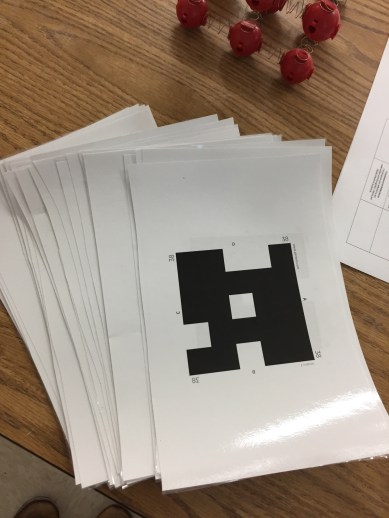
Students took their last quiz for the trimester, then we spent the rest of the hour using Plickers to practice multiple choice questions. Final exams are next week, so the multiple choice also served as a way to start reviewing for the exam. I continued my usual routine of having students answer individually, then talk to a classmate before answering again and both classes had some good conversations about the problems.

img_2398

Physics: Quiz

Students took their last quiz of the trimester over balanced force. A lot of students have been struggling to identify the direction of forces, and that is showing up on the quiz. When working on problems or labs, students were pretty successful when they went back to the language of the interaction stations we’d done, but the students who are struggling usually need prompting to think in those terms. I do some fairly general reflection in the course, but I’m thinking about how I can improve that next tri to help students recognize useful ways of thinking.

Chemistry Essentials: Polyatomic Ions

Students worked on writing formulas based on names that include polyatomic ions. Today, I added having students sketch particle diagrams for each compound, which helped them focus on the meaning of the various numbers. Yesterday’s activity with the Lewis dot beans also helped students think through today’s problems. Next tri, I think that will be my starting point for bonding.

Day 52: UBFPM Practical, CAPM Problems, & Lewis Dot Beans

AP Physics: UBFPM Practical

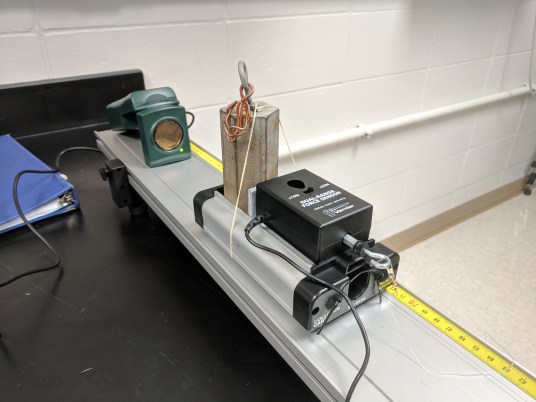
Students were tasked with finding the inertial mass of a lump of metal. While I left it open, students pretty quickly settled in to following the steps from their 2nd Law lab. In one of my classes, a lot of groups initially used the unknown mass to provide the force on their half-Atwoods setup, which has me thinking they were losing track of the significance of the measured quantities; I skipped over having them do an interaction diagram and free-body diagram on the original lab, which I’m betting would have helped.

ubfpm practucal.jpg

Physics: CAPM Problems

Students used whiteboards to revisit an earlier quiz on CAMP problems. I had them go through piece by piece, rotating who had the marker for each step. That seemed to help students feel a lot more confident on the problems. Tomorrow we’ll see if they can do them independently.

capm prob

Chemistry Essentials: Lewis Dot Beans

Yesterday, when we worked on formula writing, students were losing track of what the various numbers represented. One of the other chemistry teachers suggested I try Lewis dot structures with a manipulative, so today students used beans to check their answers to yesterday’s problems.

lewis dot beans

Day 51: Friction on Ramps, CAPM Card Sort, & Naming Compounds

AP Physics: Is Friction Negligible?

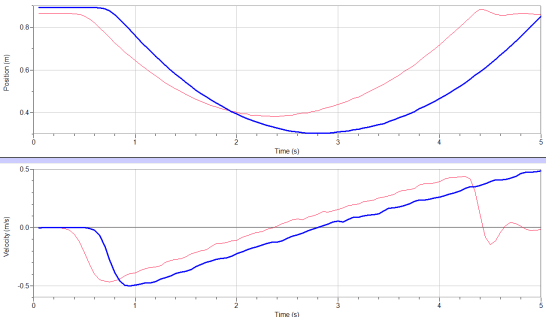
Students sketched free-body diagrams and vector addition diagrams for a cart on a ramp with friction, then were tasked with determining whether friction is negligible using a set of graphs recorded in LoggerPro. There were lots of great conversations connecting the force representations to the motion ones.

friction on ramp grpahs

Physics: CAPM Card Sort
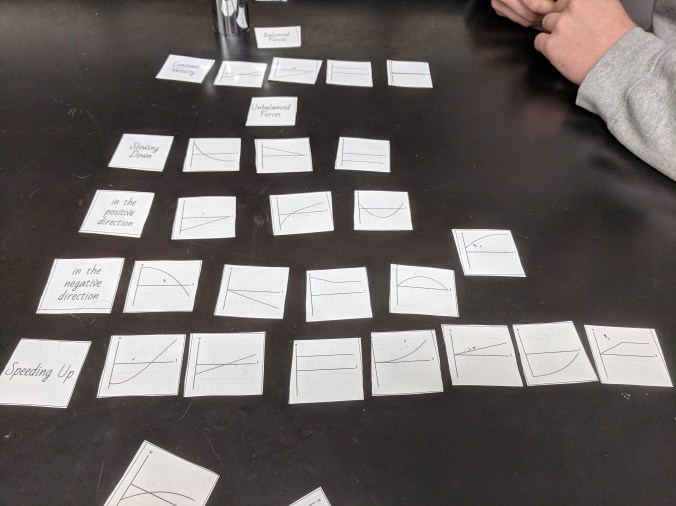
I want to revisit CAPM this week, so we started with Kelly O’Shea’s card sort. A lot of groups needed some nudging to differentiate between constant velocity and constant acceleration on the velocity-time and acceleration-time graphs, but that was no surprise. While students were bothered by the idea that there was no one right answer, they had some great conversations. I think it also helped that I assigned them to random groups, which interrupted some of the usual patterns.

card sort 5.jpg

Chemistry Essentials: Naming Compounds

Students worked on going between formulas and names for compounds. A few groups asked if they could use the cards from Friday to help figure out how many of each atom a compound needs, and I happily got them out. I think a lot of students lost track of what is going on conceptually with the bonding, so I need to think about better ways to reinforce that.

bonding cards.jpg