Day 145: Review, Whiteboarding, & Legos

AP Physics: Review

A lot of my students will be taking the AP Chem exam on Monday, so it was the last time the whole class was together before Tuesday’s AP Physics 1 exam. One class asked if we could spend the whole hour on multiple choice, so we worked through a bunch of problems I’d loaded into Plickers. My other section asked for more time to work on the 2017 free response problems, so they got into small groups for that after 20 minutes of multiple choice practice.

Physics: Whiteboarding

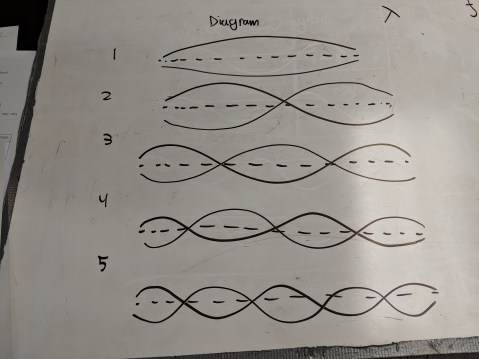
Students whiteboarded some of the problems we’ve been working on prior to taking a quiz. A few students have started talking in terms of patterns for the number of notes and anti-nodes which is great. Students are also seeing the diagrams as a tool in ways they have not with previous types of diagrams.
wave diagrams.jpg

Chemistry Essentials: Lego Reaction Types

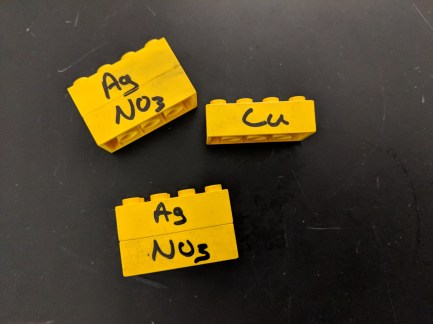
Students used Legos to represent ions in chemical reactions to get a better understanding of the different reaction types. Manipulating the blocks seemed to help students get a sense of how the ions are rearranging in a chemical reaction and tie some meaning to the terms from yesterday. I’m wondering if this lab could be reworked to start the unit and motivate the language, rather than simply being an opportunity to practice the terms.
lego.jpg

Day 144: Choice Labs, Tuning Forks, & Reaction Types Reading

AP Physics: Choice Labs

Today, I set up kits for a variety of labs targeting different topics and had students pick which labs to complete. I also had one last set of free-response problems, and most groups picked to work on those rather than the labs. I think they see a clearer link between the written problems and the test than they see between the labs and the test. In one of my classes, several students left their lab group to go talk to a peer they see as an expert on a topic they wanted to work on, which was awesome.

Physics: Tuning Forks

Students did a lab playing with tuning forks and singing glasses to start building some ideas about sound. This was the most animated I’ve seen my students this tri, which was a lot of fun. Students also made some great observations; one noticed that when a tuning fork vibrates in water, the water shoots mostly to the sides and use that to help justify which way the tuning fork vibrates.

tuning forks.jpg

Chemistry Essentials: Reaction Types Reading

We got out the textbooks for students to start building some vocabulary for different types of reactions. I could tell students weren’t latching on to the vocabulary in the same way they do when we establish a concept before the language. Tomorrow, we’ll be doing an activity using Legos to practice recognizing the different reaction types, but I wonder if there is a way I can rework the Lego activity to put it first and motivate naming different types of reactions.

Day 143: Mistakes Game, Wave Whiteboarding, & Assessment

AP Physics: Mistakes Game

Students put the finishing touches on their whiteboards from yesterday, then presented to the class for the mistakes game.  I gave students copies of the scoring guides to use during the discussion today. They were quieter than usual during board meetings, mostly because the whiteboard for a full free-response problem felt a little overwhelming.

IMG_20180502_121406.jpg

Physics: Wave Whiteboarding

Students whiteboarded yesterday’s problems. A lot of students were having trouble visualizing the standing waves, but sketching multiple wavelengths and marking the notes and anti-nodes seemed to help a lot of students.

stand wave wb.jpg

Chemistry Essentials: Quiz

Students took their limiting reactants quiz. I picked a problem where the numbers work out pretty nicely, and, glancing over the quizzes, it looks like the students who sketched particle diagrams nailed the problem.

Day 142: Mistakes Game, Standing Waves, & Lab Results

AP Physics: Mistakes Game

We spent about 15 minutes using Plickers to discuss some multiple choice from the practice test students took last week, then started working on the 2016 free response. Students started prepping whiteboards that we’ll use for the mistakes game tomorrow. Most groups got to the point where they felt they had a good solution on their whiteboard, so will need a few minutes tomorrow to add a mistake.

ap fr mistake.jpg

Physics: Standing Waves

We got out the singing rod to reason out what must be the pattern for standing waves on a resonator free to vibrate at both ends, then students started working on some problems. A lot of students struggled to relate wavelength to the length of the resonator, in part because many of them were looking for a specific equation rather than using the diagrams the worksheet asked for as a reasoning tool. I need to think about how I can help students see the value of their diagrams tomorrow.

singing rod.jpg

Chemistry Essentials: Lab Wrap-Up

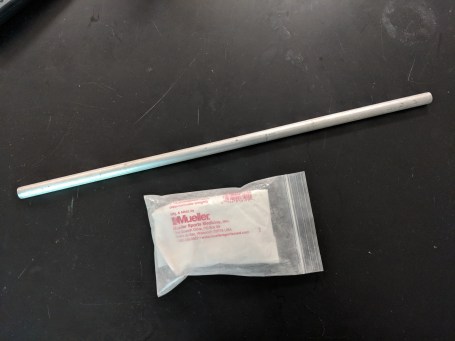
The copper from yesterday’s lab needed some time to dry, so today students got the mass and worked on their calculations. A lot of groups had balled up their aluminum foil yesterday, which lead to some big chunks of unreacted foil, even for groups where it should have been the limiting reactant. This ended up being a great opportunity for students to use a particle model for chemical reactions to think through why that happened.

dried cu.jpg

Day 141: Free Response, Longitudinal Waves, & Limiting Reactant Lab

AP Physics: Free Response

Students whiteboarded some released free-response problems, then reviewed their work with a scoring guide and presented to the rest of the class. We spent some time discussing the patterns in the scoring guide, like making sure you articulate every detail to get all the points. I especially made sure we spent some time discussing the experimental design problem from this set; a lot of students have been coming up with fairly complicated experiments on these problems, so we looked at the kind of simple approaches that can be very effective.

ap.jpg

Physics: Longitudinal Waves

Students played with slinkies to see if what we’ve figured out about transverse waves so far works for longitudinal. A lot of groups got tripped up by the wording of my question on whether the relationship we previously found between wavelength and frequency still works. I think a lot of it is I’m having trouble getting across to students this year what I mean by a relationship between two variables.

Chemistry Essentials: Limiting Reactants Lab

Students did a reaction between aluminum foil and a solution of copper (II) chloride dihydrate. I assigned each group to use a different set of masses for their reactants so that different groups would have different limiting reactants. There was a pretty dramatic difference in the color of the solution at the end, which made for a pretty cool visual of the limiting reactant. Time got tight, though; next time, I need to spend about half a period pre-labbing, then get students actually doing the lab the next day. For this course, it could also be good to simply ask students to come up with an explanation for why different groups have different colored solutions without asking students to do the number crunching.


Day 139: Free Response, Standing Waves, & Whiteboarding

AP Physics: Free Response

We are starting to review proper for the AP Physics 1 exam. Today, I gave students the 2015 free response and asked each group to sign up for a problem they will become the experts on. There was lots of good discussion about reading carefully and parsing what the question is really asking.

Physics: Standing Waves

We got out the wave generator and a strobe light to get a few more ideas in place about standing waves. The strobe light helped a lot with talking about the particle motion since it became possible to track the movement of the string.

Maker:S,Date:2017-10-21,Ver:6,Lens:Kan03,Act:Lar02,E-Y

Chemistry Essentials: Whiteboarding

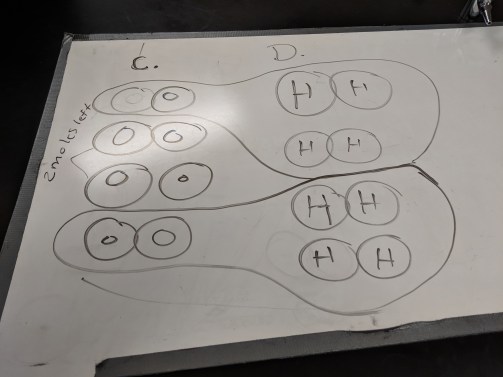
We spent some time whiteboarding yesterday’s problems. We spent a lot of time on the first problem, which had nice whole number mole ratios, so we could look at how the particle diagrams show what math needs to be done.

chem limit.jpg

Day 121: Free Response, Practical, & Quiz

Today is the last day before spring break.

AP Physics: Free Response

We took some time to look at the free response problems from the tri 2 final exam. A lot of students ran out of time on the final, so we spent some time discussing strategies for time management and steps they can take even when they think they are lost on a problem. We didn’t talk about anything ground-breaking and even the physics seemed pretty clear once we got into it; I think the stress of finals got to students and made it tough to use skills they know.

Physics: Projectile Practical

Students wrapped up the horizontal projectile practical from yesterday. One of the advantages of doing projectiles after energy is I didn’t trip up any groups by switching out the marble for a lighter one. Usually, I get at least some groups that do some wild math to try and figure out what the mass changes, but this year’s students either pointed out the mass never showed up in their calculations or used conservation of energy to show it doesn’t matter.

Maker:S,Date:2017-10-21,Ver:6,Lens:Kan03,Act:Lar02,E-Y

Chemistry Essentials: Quiz

Students took a quiz on balancing and representing chemical reactions. I always have a few students in this course who have trouble staying quiet once they are finished; today, all of the conversations I shut down while students were testing were about problems on the quiz, which was pretty awesome. I felt a little bad telling them it wasn’t the right time for those conversations, especially with how passionate the conversations were.

Day 116: Multiple Choice, Reaction Time, & Conservation of Mass

AP Physics: Multiple Choice

Students took a quiz on rotational kinematics and we fired up Plickers to discuss some multiple choice problems a lot of students got wrong on the final. There were a lot of great conversations and students generally felt very comfortable pointing out errors in their own thinking. There were a few problems that most students got right on their first try today, which was interesting. I asked my students about it, and they said they were feeling pretty mentally fried during their final, especially since it was on the second day of exams, which makes sense.

img_2398

Physics: Reaction Time

Students dropped rulers to calculate their reaction times. Students were pretty successful at designing an experiment and sketching a velocity vs. time graph for the ruler, but annotating and setting up equations was much more challenging than I’d hoped.  Doing the math with v-t graphs just isn’t sticking for a lot of students this year. I think the problem is a lot of them are not attaching meaning to the variables or numbers, which makes the annotations on the graphs and the formulas we use something to memorize. I need to keep working on supporting my students in using the graphs and other diagrams as tools for meaning-making.

ruler.jpg

Chemistry Essentials: Conservation of Mass

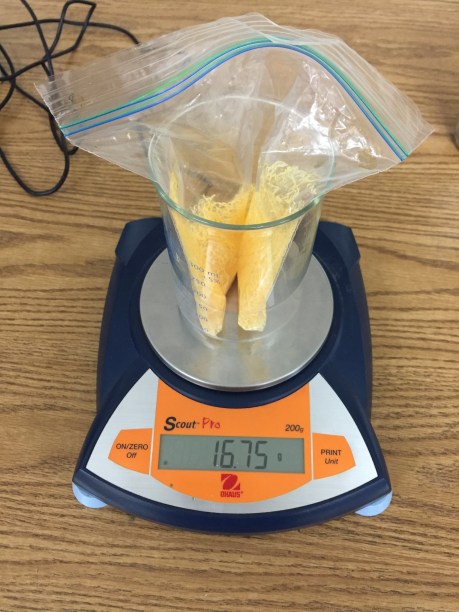
Students did a chemical reaction in a plastic bag to see the conservation of mass and practice translating between different representations of chemical reactions. Time got a little tight because I was not able to have a balance at every table; next time, I would be better off delaying the lab if another class needs the balances on the same day. Students still got a kick out of the chemical reaction.

IMG_1737

Day 109: Free Response & Review

Yesterday was a snow day and tomorrow is the start of final exams, so today was a little tricky.

AP Physics: Free Response

With the AP exam looming, I gave students most of a practice exam as their final. Today, they took the free response portion. I took out a few problems to make sure there was no rotation and to get it reasonable for a 55 minute class period.

Physics: Final Review

Students worked on a final review that asked them to apply several different models to the same scenario. A few groups opted to work on whiteboards, instead of on paper, which was just fine with me. A lot of students went back to drawing their free-body diagrams without sketching in context, like the surface of a hill or ramp, which lead to some mistakes, but most students were able to get on track once they added in that surface.

Chemistry Essentials: Final Review

Students worked on a pretty traditional final review. The particle diagrams finally seem to be clicking for a lot of my students, which is great to see. I am seeing some students check out since it is fairly set whether they will pass or fail; if I teach this course next year, I need to spend some time this summer thinking about how to make final exams meaningful to my students.

Day 108: Experimental Design, Collisions, & Particle Diagrams

AP Physics: Experimental Design

Yesterday, students worked on an experimental design problem from the 2017 AP exam. Today, they exchanged work and used the scoring guide to assign points and give each other feedback. A lot of students were pretty nervous about giving their work to someone else; I think the simple act of recording points on a very tough problem raised the stakes more than I expected. Students still said they found the activity useful, so that may help ease the discomfort if we trade papers again.

Physics: Collisions

Students whiteboarded some of yesterday’s problems before taking a quiz on conservation of momentum. I had some students who actually consider conservation of momentum easier than impulse on a single object; one student told me its just like energy, but they don’t have to think about the different types.

mom wb.jpg

Chemistry Essentials: Whiteboarding

Students have been struggling with what particle diagrams are intended to show, so we started by brainstorming a list of characteristics of a good particle diagram and having some discussion about why they are useful. Afterward, we whiteboarded yesterday’s problems and did a gallery walk. This seemed to help reinforce the purpose of a particle diagram for a lot of students.