Day 73: Force Vector Addition & Magnets

AP Physics: Force Vector Addition

Students worked some problems with balanced forces in two dimensions. We also had some discussion about whether you could have a mass hanging from a perfectly horizontal rope and used some hanging masses and string to experiment with some of the ideas. Not surprisingly, they really wanted it to work with a small enough mass in the center and a large enough force on either side, but once they started drawing free-body diagrams, it became very clear that the rope has to flex.

tension.jpg

Physical Science: Magnets

Students played with some bar magnets and steel filings to start building some ideas about magnetic fields. Every year, my 9th graders struggle to see patterns in the filings, even when they are very clear to me. I usually have them start with the filings, then get out a compass to compare the patterns. Next year, I might have them plot the orientations of a compass arrow first, giving them some specific positions around the magnet to check, then get out the filings. That should give them an idea of what to look for in the filings.

magnet

Day 72: Vector Addition & Electric Power

AP Physics: Vector Addition

I shamelessly stole an activity that Casey Rutherford shared on Twitter. I gave students some free-body diagrams drawn to scale, and had them use pipe cleaners to rearrange the vectors and do some graphical vector addition. The activity not only reinforced graphical vector addition, but I was pleased with how it drove home the difference between forces that are balanced and forces that are equal.

vectors

Physical Science: Electric Power

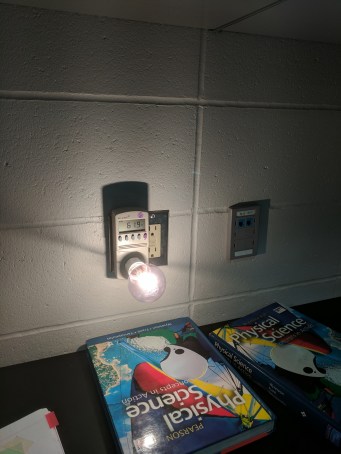
Students plugged different light bulbs into Kill-A-Watt monitors to find the power each one used. To emphasize the connection to energy, I also had students sketch energy bar charts for each light bulb, using light and thermal energy as their energy types. This lead very nicely into a comparison of the efficiency of different light bulb types.

killawatt

Day 71: Quiz & Circuits

Today was our last day of classes before break!

AP Physics: Quiz

Students took a quiz on projectile motion. My collaborative team’s goal is related to experimental design, to I included a problem to give my students some practice and feedback on designing on an experiment entirely on paper. I planned to have them play with some Mystery Tubes after the quiz, but it went longer than I expected, so I will save those for another day.

Physical Science: Circuits

I got out the light bulbs and batteries for students to build real-life circuits and see if the models they developed with the simulation still work. Not all of our light bulbs are identical, and I didn’t check the kits before class, so some groups had bulbs with different resistances. Next year, it could be interesting to use that as a feature, rather than a bug, and ask students to rank the resistance of their light bulbs based on qualitative observations.

circuit

Day 70: Hoop Practical & Circuits

AP Physics: Hoop Practical

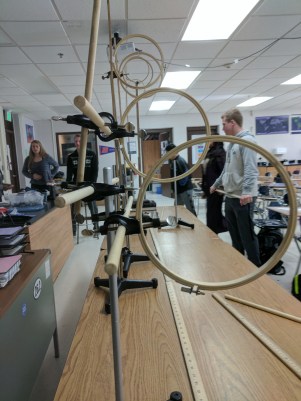
We finished up a lab practical on angled projectiles. Each group had a different distance from the launcher and figured out how high above the ground to place a hoop. In both classes, some groups had to shift their hoop to one side or the other, but eventually managed to get the projectile though all the hoops. I also had some goal-less problems to try and shift students away from needing to be able to picture the full solution to be able to progress. The problems mostly got ignored, because it was more exciting to watch the parabola of hoops come together and it took most of the hour to get all the hoops in place.practical

Physical Science: Series vs. Parallel Circuits

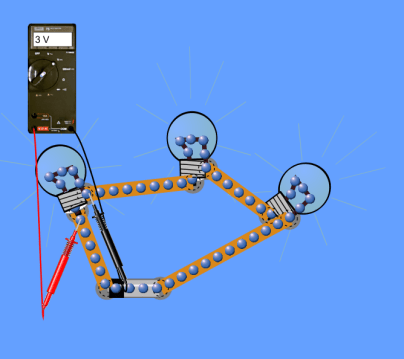
Students used the PhET circuit construction kit again, this time using a lab on series and parallel I modified from Eugenia Etkina’s PUM curriculum. I think students  were getting the big ideas, but its very tough to circulate with a full class in the computer lab, so I feel a little blind. Last year, I was able to do the PhET sims on netbooks in the classroom, so it was easy for me to listen i on student conversations and pull them together at the end of the hour to discuss some big ideas. Next year, I might re-work my calendar to make time for a day in the classroom so my students and I have a chance to make sure they are on track.

circuit

Day 69: Angled Projectile Practical & Ohm’s Law

AP Physics: Angled Projectile Practical

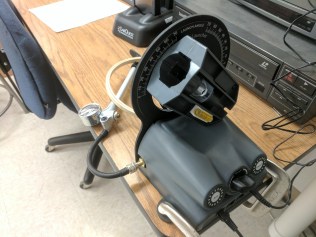
We wrapped up yesterday’s mistakes game, then started a lab practical. Each group got a different distance from the launcher, and needs to determine how high off the ground to place a hoop so that the projectile will travel through it. Tomorrow, we’ll setup the hoops so students can see the results. In both this practical and the problems we’ve been doing, I’ve found some of my strongest students get stuck. They usually know what they’re doing, but don’t see their way to the answer yet. I need to keep reminding my students that they can play with the pieces, even if they don’t know what the full picture will look like yet. I might look for a good goal-less problem to combine with the practical tomorrow to help push them towards thinking about what else they can do, rather than what the answer must be.

launcher

Physical Science: Ohm’s Law

I’ve found I really like having students use PhET’s circuit construction kit before we get out the batteries and bulbs, so today we went to the computer lab to find a relationship between current, voltage, and resistance. I left the directions fairly open so that students would be designing their own experiments. Since I don’t talk much about units in this course, the simulations ammeter felt like a black box to a lot of the students. I was really intrigued by one student who measured current by counting how many blue dots passed a selected point in one minute, which connects really nicely to the definition of current as the flow of electric charge.ohms-law

Day 68: Mistakes Game & Light the Bulb

AP Physics: Mistakes Game

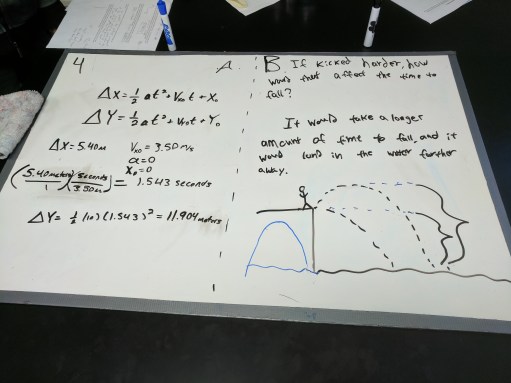
My students LOVE using the mistakes game to go over problems (a few have even decided to sneak in mistakes when they whiteboard problems in calculus), but it doesn’t lend itself nicely to complicated calculations like projectiles. To get around that, I tried having students whiteboard just the set-up to Friday’s problems for the mistakes game. Students embraced it and we had some good discussions about the physics without getting bogged down in the algebra. Since students did not see full solutions to the problems during class, I posted the answers, along with my complete solution to one of the problems, on Google Classroom.

wb

The artist made sure I saw the person on the bottom floor (where they physics room is) is happy and focused, while the history student on the top floor is angry enough to throw a book

Physical Science: Light the Bulb

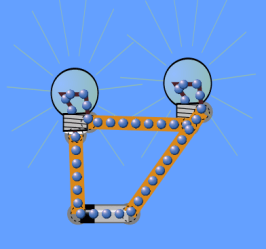
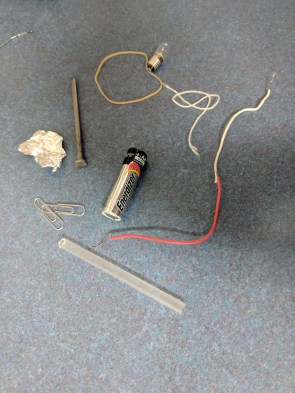
Students were given an assortment of materials and tasked with lighting a light bulb. Afterward, we watched a clip from Minds of Our Own of MIT graduates attempting the same task. Students were pretty successful at picking out some of the key ideas about what a circuit is. Tomorrow, we’re using the PhET circuit construction kit, and I’ll probably have them start with the same task in the sim to reinforce that a circuit is a closed path since its not obvious with the light bulb.

bulb-lab

Day 67: Projectiles With v-t Graphs & Static Electricity

AP Physics: Projectiles With v-t Graphs

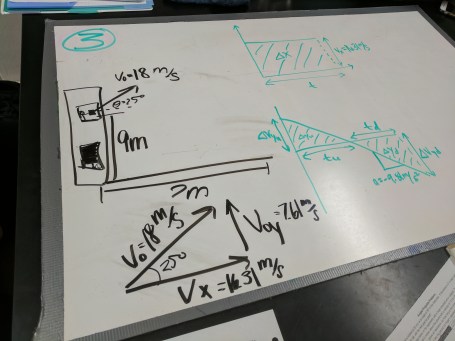
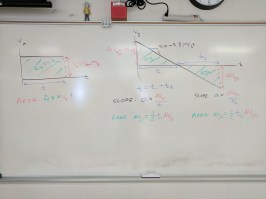
Students took their first crack at projectiles launched at an angle. As with the rest of motion, I’m having them solve from velocity vs. time graphs, rather than the typical equations. I’ve had a number of students tell me they feel like this topic is easier than acceleration, which is a nice opportunity to show students the progress they’ve made so far this year.

vt projectile.jpg

Physical Science: Static Electricity

Students did their first lab on static electricity today. I modified a lab from Eugenia Etkina’s PUM curriculum to make use of the static electricity kits we have. Most of the tests involved hanging a rubber rod from a string, so students had some trouble telling whether the rod was spinning due to static forces or due to tension in the string. Students pretty quickly figured out they could check by trying to repel the hanging rod in the opposite direction, they made some good observations. It was also tough to build up really big charges on the rods, so I might consider switching the equipment next year.

static-lab

Day 66: Projectile Practical & Seismic Accelerator

AP Physics: Projectile Practical

Students wrapped up a lab practical today, predicting where a horizontally launched marble will hit the floor. Once they pulled it off, I pulled out a lighter marble and asked them to predict where it would hit without taking any new measurements. Last year, most groups spent a fair bit of time debating what should happen and trying lots of different calculations before they figured it out. This year, as soon as I pulled out the lighter marble, every group confidently stated it should hit the same spot and gave beautiful explanations for why. Its clear I’ve done a better job this year of giving students opportunities to confront that misconception.

carbon-paper

The retired referral forms work well as carbon paper

Physical Science: Seismic Accelerator

I showed students the seismic accelerator and asked them to predict what would happen when I dropped it, presenting their answer as a CER. Groups consistently drew nice bar charts, but, since we haven’t done anything quantitative with energy, it was tough for many students to recognize the tiny bouncy ball should fly above the original height. I like this as a follow-up to the bouncy ball lab, but next year, instead of having them make predictions, it might work better to show them what the seismic accelerator does, then have them draw bar charts and explain why the red ball goes so high.

Day 65: Writing Methods & Bouncy Ball Energy

AP Physics: Writing Methods

Today, students started working on a lab practical to predict where a marble will hit the floor when it rolls off the edge of a table. Since my PLC is focusing on experimental design this year, I had each group write a method they could use to consistently release the marble and find its horizontal velocity. Then, I collected a method from each group, shuffled them, and gave each group a method they had to try and follow. In my second section, I told students they should actually find the horizontal velocity, then write the method in a way that the next group should get the same result, which really seemed to help students decide how much detail to include. This also very naturally lead to a lot of groups talking about how big their uncertainty is so they could decide if the group using their method was “close enough.”img_20161214_120111

Physical Science: Bouncy Ball Energy

Students measured the rebound heights as various bouncy balls bounced to look at the energy lost. While students really like the lab (bouncy balls are fun!), they don’t have to do much thinking about energy, even though I added some bar charts and energy questions. Tomorrow, I might pull out the seismic accelerator to have them make some predictions about a stack of bouncy balls in order to get them thinking about energy in these systems a little more.

img_20161214_084217

Day 64: Mistakes Game & Bar Charts

AP Physics: Mistakes Game

We whiteboarded yesterday’s problems using the Mistakes Game. Most groups came up with their mistake by either talking about what they thought the most common wrong answer would be or by picking a mistake they made on the way to solving the problem. The highest math class had a field trip today, so a fair number of students were missing, but some students who are normally very quiet stepped up and spoke quite a bit, so I didn’t have to say much during either discussion. I was also pretty happy when the group presenting pointed to the “momentum force” on their free-body diagram and another student quoted Inigo Montoya from The Princess Bride.

IMG_20161213_093130.jpg

Physical Science: Bar Charts

Students worked on drawing energy bar charts. Some students are struggling with how to tell which types of energy are present, but most got the hang of it once they revisited the definitions of the different types of energy. I do want to keep thinking about how I introduce energy in that class