Day 147: Test Day, Board Meeting, & Reaction Types

Today was a strange day; a lot of students were impacted by some unexpected news last night.

AP Physics: Test Day

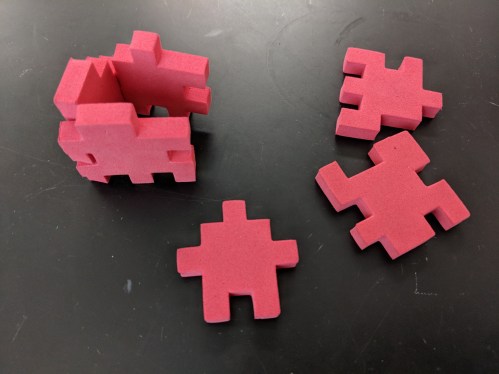
Today was the AP Physics 1 exam. However, we were able to give students the option of taking the make-up exam later this month and the majority of my students took this option. In my morning section, I’d planned to make today a game day for students to relax and have some fun before the exam, and decided to stick with that in both sections. Most students opted for some puzzles the calc teacher loaned me.
puzzle.jpg

Physics: Board Meeting

Students whiteboarded their results for yesterday’s speed of sound lab. The data came out very nice in both classes. Afterward, we had time for students to get the snakey springs out to start exploring wave superpositions. Even though I didn’t mention it in the prompts, one group got curious and tried to figure out whether the pulses reflect or pass through each other.

sound wb.jpg

Chemistry Essentials: Reaction Types

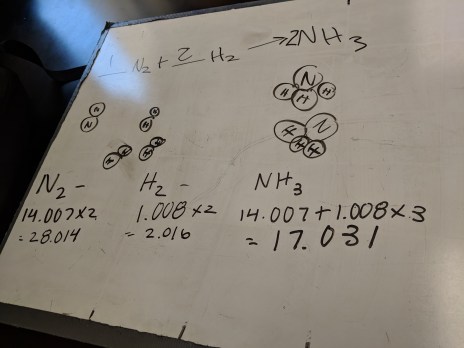
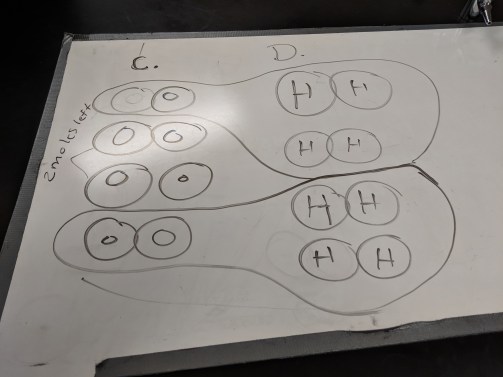
Classroom management gets tricky during labs with this class, so I decided to push back the lab I’d planned for today. Instead, I moved up a worksheet for students to practice identifying reaction types from chemical equations. One student was excited to show me an alternative representation she came up with for balancing chemical equations; its always exciting to not only have students coming up with their own ways of thinking about problems, but proud enough of their work to want to show it off.

bal shortcut.jpg

Day 146: Multiple Choice, Speed of Sound, & Whiteboarding

AP Physics: Multiple Choice

With the AP exam tomorrow, I asked students which of several options they thought would be most useful and both classes requested we use Plickers to review multiple choice. Most students weren’t at their most focused today, but there were still some good discussions.

img_2398

Physics: Speed of Sound

Students worked on the classic speed of sound lab. Since several labs lately have been pretty rough, I structured the pre-lab discussion more like the way I do in September to get back to basics of experimental design and made sure sketches of the set-up made it onto the main whiteboard. I also took advantage of the fact that students have made other wavelength vs. frequency graphs to emphasize that students should graph as they go to see if their results make sense. My 1st hour got a lot farther than my 5th, but their slopes are coming out very nicely.

speed of sound.jpg

Chemistry Essentials: Whiteboarding

The limiting reactant quiz last week did not go as well as I hoped, so we spent some time today whiteboarding a problem, emphasizing the role of particle diagrams. The students who were engaged seemed to get a lot out of the whiteboarding.

chem lr wb.jpg

Day 145: Review, Whiteboarding, & Legos

AP Physics: Review

A lot of my students will be taking the AP Chem exam on Monday, so it was the last time the whole class was together before Tuesday’s AP Physics 1 exam. One class asked if we could spend the whole hour on multiple choice, so we worked through a bunch of problems I’d loaded into Plickers. My other section asked for more time to work on the 2017 free response problems, so they got into small groups for that after 20 minutes of multiple choice practice.

Physics: Whiteboarding

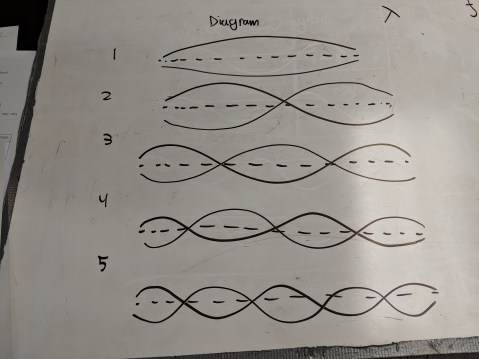
Students whiteboarded some of the problems we’ve been working on prior to taking a quiz. A few students have started talking in terms of patterns for the number of notes and anti-nodes which is great. Students are also seeing the diagrams as a tool in ways they have not with previous types of diagrams.

wave diagrams.jpg

Chemistry Essentials: Lego Reaction Types

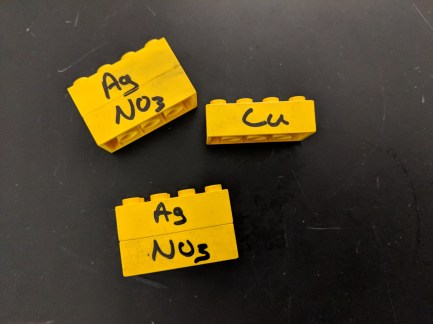
Students used Legos to represent ions in chemical reactions to get a better understanding of the different reaction types. Manipulating the blocks seemed to help students get a sense of how the ions are rearranging in a chemical reaction and tie some meaning to the terms from yesterday. I’m wondering if this lab could be reworked to start the unit and motivate the language, rather than simply being an opportunity to practice the terms.

lego.jpg

Day 144: Choice Labs, Tuning Forks, & Reaction Types Reading

AP Physics: Choice Labs

Today, I set up kits for a variety of labs targeting different topics and had students pick which labs to complete. I also had one last set of free-response problems, and most groups picked to work on those rather than the labs. I think they see a clearer link between the written problems and the test than they see between the labs and the test. In one of my classes, several students left their lab group to go talk to a peer they see as an expert on a topic they wanted to work on, which was awesome.

Physics: Tuning Forks

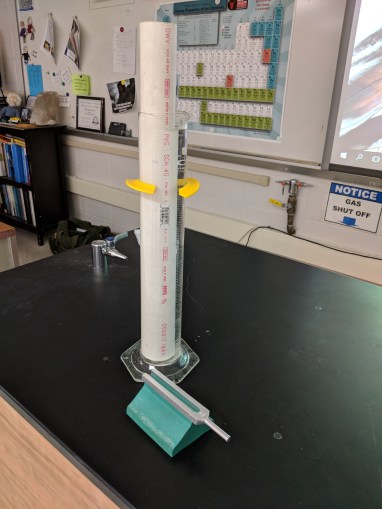
Students did a lab playing with tuning forks and singing glasses to start building some ideas about sound. This was the most animated I’ve seen my students this tri, which was a lot of fun. Students also made some great observations; one noticed that when a tuning fork vibrates in water, the water shoots mostly to the sides and use that to help justify which way the tuning fork vibrates.

tuning forks.jpg

Chemistry Essentials: Reaction Types Reading

We got out the textbooks for students to start building some vocabulary for different types of reactions. I could tell students weren’t latching on to the vocabulary in the same way they do when we establish a concept before the language. Tomorrow, we’ll be doing an activity using Legos to practice recognizing the different reaction types, but I wonder if there is a way I can rework the Lego activity to put it first and motivate naming different types of reactions.

Day 143: Mistakes Game, Wave Whiteboarding, & Assessment

AP Physics: Mistakes Game

Students put the finishing touches on their whiteboards from yesterday, then presented to the class for the mistakes game.  I gave students copies of the scoring guides to use during the discussion today. They were quieter than usual during board meetings, mostly because the whiteboard for a full free-response problem felt a little overwhelming.

IMG_20180502_121406.jpg

Physics: Wave Whiteboarding

Students whiteboarded yesterday’s problems. A lot of students were having trouble visualizing the standing waves, but sketching multiple wavelengths and marking the notes and anti-nodes seemed to help a lot of students.

stand wave wb.jpg

Chemistry Essentials: Quiz

Students took their limiting reactants quiz. I picked a problem where the numbers work out pretty nicely, and, glancing over the quizzes, it looks like the students who sketched particle diagrams nailed the problem.

Day 142: Mistakes Game, Standing Waves, & Lab Results

AP Physics: Mistakes Game

We spent about 15 minutes using Plickers to discuss some multiple choice from the practice test students took last week, then started working on the 2016 free response. Students started prepping whiteboards that we’ll use for the mistakes game tomorrow. Most groups got to the point where they felt they had a good solution on their whiteboard, so will need a few minutes tomorrow to add a mistake.

ap fr mistake.jpg

Physics: Standing Waves

We got out the singing rod to reason out what must be the pattern for standing waves on a resonator free to vibrate at both ends, then students started working on some problems. A lot of students struggled to relate wavelength to the length of the resonator, in part because many of them were looking for a specific equation rather than using the diagrams the worksheet asked for as a reasoning tool. I need to think about how I can help students see the value of their diagrams tomorrow.

singing rod.jpg

Chemistry Essentials: Lab Wrap-Up

The copper from yesterday’s lab needed some time to dry, so today students got the mass and worked on their calculations. A lot of groups had balled up their aluminum foil yesterday, which lead to some big chunks of unreacted foil, even for groups where it should have been the limiting reactant. This ended up being a great opportunity for students to use a particle model for chemical reactions to think through why that happened.

dried cu.jpg

Day 141: Free Response, Longitudinal Waves, & Limiting Reactant Lab

AP Physics: Free Response

Students whiteboarded some released free-response problems, then reviewed their work with a scoring guide and presented to the rest of the class. We spent some time discussing the patterns in the scoring guide, like making sure you articulate every detail to get all the points. I especially made sure we spent some time discussing the experimental design problem from this set; a lot of students have been coming up with fairly complicated experiments on these problems, so we looked at the kind of simple approaches that can be very effective.

ap.jpg

Physics: Longitudinal Waves

Students played with slinkies to see if what we’ve figured out about transverse waves so far works for longitudinal. A lot of groups got tripped up by the wording of my question on whether the relationship we previously found between wavelength and frequency still works. I think a lot of it is I’m having trouble getting across to students this year what I mean by a relationship between two variables.

Chemistry Essentials: Limiting Reactants Lab

Students did a reaction between aluminum foil and a solution of copper (II) chloride dihydrate. I assigned each group to use a different set of masses for their reactants so that different groups would have different limiting reactants. There was a pretty dramatic difference in the color of the solution at the end, which made for a pretty cool visual of the limiting reactant. Time got tight, though; next time, I need to spend about half a period pre-labbing, then get students actually doing the lab the next day. For this course, it could also be good to simply ask students to come up with an explanation for why different groups have different colored solutions without asking students to do the number crunching.


Day 140: Post-Test & Speed Dating

AP Physics & Physics: Post Test

Both of my physics classes took the FCI post-test. Not surprisingly, the scores in my AP class were much higher, but there was significant growth from the majority of the students in both courses.

Chemistry Essentials: Speed Dating

Students did some whiteboard speed dating on limiting reactant problems. The speed dating had mixed results; there were a lot of mistakes finding the molar mass, and most students weren’t comfortable changing the previous group’s work. This did lead into some good discussion on the value of showing your work and what clear work looks like. I also ended up working an example, which several students had requested at the start of the hour, but after the speed dating, I was able to address specific issues and challenges and students were more engaged than I think they would have been early on.

Day 139: Free Response, Standing Waves, & Whiteboarding

AP Physics: Free Response

We are starting to review proper for the AP Physics 1 exam. Today, I gave students the 2015 free response and asked each group to sign up for a problem they will become the experts on. There was lots of good discussion about reading carefully and parsing what the question is really asking.

Physics: Standing Waves

We got out the wave generator and a strobe light to get a few more ideas in place about standing waves. The strobe light helped a lot with talking about the particle motion since it became possible to track the movement of the string.

Maker:S,Date:2017-10-21,Ver:6,Lens:Kan03,Act:Lar02,E-Y

Chemistry Essentials: Whiteboarding

We spent some time whiteboarding yesterday’s problems. We spent a lot of time on the first problem, which had nice whole number mole ratios, so we could look at how the particle diagrams show what math needs to be done.

chem limit.jpg

Day 138: Tic Tac Bounce, Board Meeting, & Problems

AP Physics: Tic Tac Bounce

As part of the toilet paper practical, I asked students to calculate the final velocity of their unwinding roll using a v-t graph and using an LOL diagram. The discrepancy between the two velocities prompted some good discussion, which lead nicely into Kelly O’Shea’s bouncing Tic Tac demo and the idea of rotational kinetic energy.

Physics: Board Meeting

Students whiteboarded their data from the snakey spring lab. There were still more groups than I’d like who had results that were definitely not an inverse relationship between wavelength and frequency. The big problem seems to be in finding the frequency; we haven’t made much use of that term, so I think students are not attaching much conceptual meaning to it, in spite of the pre-lab discussions. We also didn’t do as much as I usually do with position vs. time graphs for simple harmonic motion, which seems to be making wavelength a tough concept to grasp. Next year, I need to rethink my unit on springs and pendulums to build a better foundation.

Chemistry Essentials: Limiting Reactant Problems

Students worked on some written limiting reactant problems. It was a much tougher leap than in past years; this class isn’t as comfortable with using particle diagrams as a tool for thinking, and I think that made limiting reactants feel more like something new than a natural step in what we’ve been doing.