Day 7: Angular Velocity & Currents

AP Physics: Angular Velocity

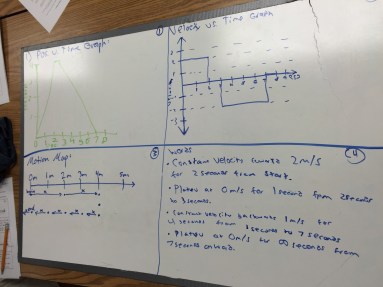
I’ve decided to try embedding circular motion with kinematics, rather than introducing it as a separate unit, so today I introduced constant angular velocity. Students used a Direct Measurement Video of a rotating disk to plot both angle vs. time and distance vs. time for dots at different radii. I also introduced them to doing calculations in a spreadsheet since some of the number crunching they needed to do could be repetitive. Spreadsheets, high speed video, and some new physics was a lot to take in at once, so I gave more structure than usual, and my students rolled with it well.

rotating-disk-dmv

Earth Science: Currents

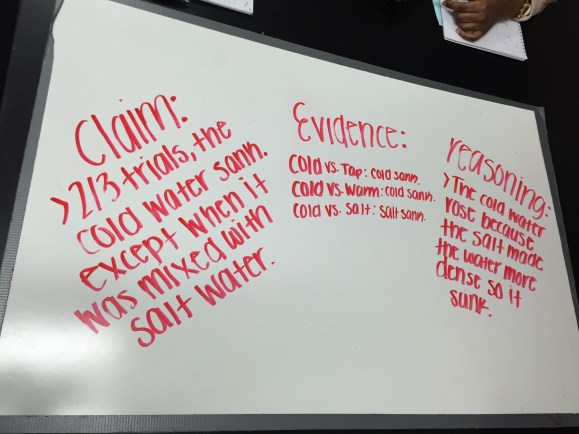
Students prepped whiteboards with their conclusions to yesterday’s lab using the claim-evidence-reasoning framework. Students seemed excited to share their work with the class. Afterward, we made some connections to ocean currents.

IMG_2184.JPG

Day 6: Dueling Buggies & Currents

AP Physics: Dueling Buggies

We finished discussing the whiteboards students prepped yesterday, then students started working on the dueling buggies practical, where they must predict the position where a pair of buggies will collide given their starting position. My favorite moment was when a student was explaining his approach to his group, and I realized he’d come up with relative velocity. One student asked if he could cheat and just graph the lines and find the intersection, so we talked about the fact that using tools from class on a problem in class is never cheating 🙂 A lot of groups asked me if they were taking the “easiest” approach, so I want to plan some time to talk about what that means when we test their answers on Thursday.

Earth Science: Currents

Students designed experiments to look at how water temperature or salinity drive currents. Students embraced designing their own experiments and it was a lot of fun listening to them discuss how density and other concepts from middle school connect to the lab. Before the lab, I asked them about what makes a good experiment. My students listed things like a procedure, that they’re often asked to turn in, and pieces like a hypothesis that are steps of the “classic” scientific method. I want to keep revisiting this during the trimester to move them towards deeper characteristics of a good experiment.

img_2181


Day 5: Lab Group Contracts & Branches of Earth Science

AP Physics: Lab Group Contracts & Mistakes Game

We started by talking about some of the skills that highly effective lab groups tend to demonstrate. From there, I asked each lab group to write a short contract for themselves they could use to help develop those skills and hold each other accountable. Most of the contracts are fairly broad or vague, I think because I was vague about what I wanted, but groups had some good conversations about their strengths and weaknesses. My favorite item is the group that agreed to “criticize everything.”

After that, students got their first taste of the Mistakes Game. I started by using a recent cooking disaster to discuss the value of examining mistakes, rather than ideal solutions, then introduced the mistakes game. Students readily embraced this approach; I spoke less and heard better questions than much later in the year last year.

img_2177

Earth Science: Branches of Earth Science

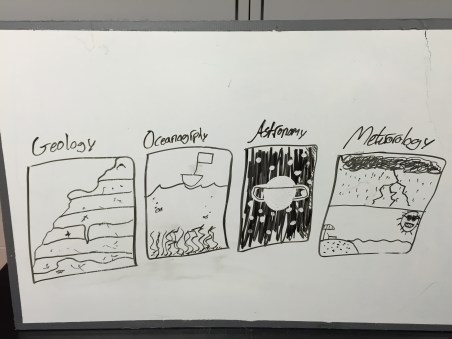
Students attempted to answer the question “what is earth science?” I asked each group to make a visual representation of their answer, including something to indicate the four main branches of the field. Students worried about their artistic abilities at first, but ended up getting into it. I had them use whiteboards, and it was great to see groups really talk to each other instead of each disappearing into their own papers.

img_2176


Day 4: Board Meeting & Earth’s Spheres

AP Physics: Board Meeting

We discussed the buggy lab today for our first board meeting of the year. I followed Casey Rutherford’s Observations, Claims, Evidence framework and my students were eager to dive in, but I think they didn’t know enough about what other groups did really dig into some of the discussion points. I usually just have students put their graph and equation on the whiteboard in an effort to make it readable by 30+ people, but I want them to share more about their experimental design next time and am toying with a couple ideas. I’m leaning towards either doing a gallery walk prior to the whiteboard discussion, so that we can sacrifice some readability in favor of more information on the whiteboards, or getting a few more whiteboards so that groups can have one for results and one for the set-up of their experiment. I thought about starting the discussion with each group giving a 1-2 min description of their experiment, but I worry with 8-12 lab groups in a class, that will be too much information to keep track of.

Earth Science: Earth’s Spheres

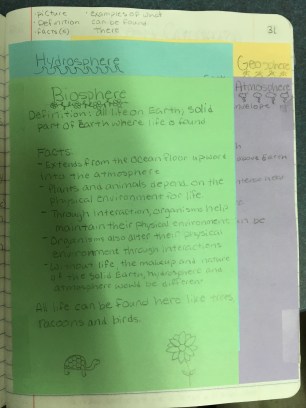
Students did a foldable interactive notebook activity to compare the biosphere, atmosphere, geosphere, and hydrosphere. I think both my students and I were a little frustrated to set aside the really good thinking they’ve done on ocean currents the last few days to work on something that didn’t feel connected. I’m teaching in a colleague’s classroom and following his sequence, in large part because we only have one class set of lab equipment and multiple sections of the course every period, so scheduling labs gets tricky, but I need to work around that to give my class more sense of coherence.

img_2165

Day 3: Uncertainty & Ocean Currents

AP Physics: Uncertainty

I did a short lecture on uncertainty (I know, ugh, but I didn’t have any bright ideas for a better approach), then students figured out the uncertainty on their buggy lab measurements and prepped whiteboards. Tomorrow, as we dig deeper into the physical meaning of the graphs, we’ll translate the equations for the lines into physics-speak.

buggy-whiteboard

Earth Science: Ocean Currents

Students made some observations of a video of convection currents in a tank of water, then worked on combining those observations with a map of ocean temperatures and what they know about the Coriolis Effect to predict what the major ocean gyres should look like.

img_2152-1

Day 2: Buggies & Coriolis Lab

Day 2 and I already forgot to take photos!

AP Physics: Buggies

We finished collecting data and graphing in the buggy lab. Every group produced two graphs: one with a full-speed buggy moving forward from 0; one with some other set-up. When I gave some groups half-speed buggies, I was pleased to see their first instinct was to make some observations before collecting any data. Here’s some of the things they noticed besides the speed:

  • “This one doesn’t light up.”
  • “This one is a lot quieter than the first one.”
  • “The wheels turn a lot slower on this one.”

Earth Science: Coriolis Lab

Students finished making observations on the Coriolis Effect lab, then wrote some rules to describe an object on a spinning surface. We also talked a little about the underlying skills, namely making observations and looking for patters to make a rule.

Day 1: Buggies & Coriolis

AP Physics: Buggies

Students started collecting data on the buggy lab today. Some groups ended up collecting several trials of the buggy traveling for the same amount of time, so their graph would only have one point. I’ll need to clarify that tomorrow.

img_2149

Science 9: Coriolis Effect

Students got into the lab long enough to start predicting the path of a marble on a spinning table. Tomorrow, we’ll actually use the tables to see what happens.

Day 173: Year End Reflection

Its the last day of school, but I’ve got no students today, so its a good opportunity for me to look back at this year. Plus, after managing to keep up with this blog all year, I couldn’t miss the very last day of school!

Classroom Culture

I’ve written about this before, but this year I was much more intentional about building a classroom culture and getting students to see the value in a student-centered approach. Students were much more willing to take intellectual risks early in the school year and were very positive about the course. I also heard a lot more growth mindset talk from my students. The time I spent on class culture was time well spent.

I was a little worried about culture building in my sections of 9th grade physical science and Chemistry Essentials since I only got 12 weeks with each of those sections, but getting students to buy-in and take risks was much quicker and easier than in my honors-level physics classes. I think a lot of it has to do with each groups prior experiences with school. The students who take physics have typically been very successful in school, so I’m changing the rules of a game they’ve been winning. My chemistry students tend to struggle in school, so the game of school seems broken to them and it can be a relief when a teacher does something different. I had my 9th graders their first trimester of high school, so it seemed natural that my science class was different.

Next year, I want to work on explicitly teaching students how to work collaboratively and building in more individual accountability. I had some lab groups that didn’t really know how to approach a task collaboratively where one person would take the lead while others acted as sponges. Not surprisingly, the students in these groups tended to get lower grades and show less growth on the Classroom Test of Scientific Reasoning. This summer, I’m going to spend some time working on how I can help students build the skills to truly work collaboratively.

Grading

This year I made the switch to standards-based grading (SBG) in my physics class, and I’m very happy with the change. A lot of students talked about how this approach encouraged them to really learn the material and they liked that they were encouraged to go back to what they didn’t understand. I think SBG also helped build the positive, growth-oriented classroom culture I was after.

The big question when I talk to colleagues about SBG is always how to get students to do the daily work. In physics, students figured out pretty quickly that they needed the daily work to prepare for the assessments. In chemistry, I had a lot of students who I never got out of the mindset that not graded means not worth doing; the students who expressed this belief most strongly were also the ones most surprised by what appeared on assessments. While I don’t want to start putting everything students do in the gradebook, giving students more feedback on their daily work could add some value to the daily work in students’ eyes.

I think this is also part of a larger pattern I saw in the course where many students seemed to view individual lessons as completely separate from each other; if each day stands alone, then why should what students do in class on Thursday affect how they do on the assessment Friday? I did some having students write summaries of the lesson and complete a warm-up at the start of the next, but I didn’t do it consistently and I didn’t put the time or effort into making it truly meaningful. If I teach a course like this one again, I need to put in the work to make the summaries and warm-ups more valuable so that the course shifts in the students’ eyes from being a series of isolated lessons to a coherent whole.

Day 172: Final Exam

Chemistry: Final Exam

My students took a pretty traditional comprehensive final today, with some problems and questions from each unit of the trimester. I don’t like this final as much as my physics one; I tried some new things in my physics finals this year, and feel like those finals were pretty in line with the rest of the course, while the chemistry final feels very separate from the collaborative, hands-on elements of the course. One of the barriers to changing that is many of the students in this chemistry course have an IEP that includes testing accommodations that I need to be creative to apply to a lab-based or collaborative final. A lot of IEPs call for students to take assessments in the special education resource room, but I’m betting the case managers of these students would be willing to help me find a solution. A little trickier is the students who take their tests orally; that could get tricky for an individual, lab-based final. If I teach this course again, I should sketch out the final I’d like to give well in advance, then talk to some members of the special education department to come up with a plan to comply with the IEPs while giving a more meaningful exam.