Day 17: Assessment Reflection & Movie Day

I’m spending the day at a district strategic planning session, so my students have a sub.

AP Physics: Quiz & Problems

Students took their quiz on constant acceleration. Our math teachers have been integrating reflection into their assessments and seeing some good things as a result, so I decided to steal the idea. On the first quiz, most students rated themselves lower than the score I gave, so it will be interesting to see what happens this time. After the quiz, students tackled some acceleration problems using graphical solutions, including a goal-less problem and what Etkina calls Equation Jeopardy, where students are given an equation, and have to come up with a scenario that fits.img_2249

Earth Science: Movie Day

The curriculum in my building calls for a video on Mt. Everest as part of the unit on the atmosphere, which is a perfect fit for a sub day.

Day 16: Annotating Graphs & Solar Collectors

AP Physics: Annotating Graphs

The bulk of the class period was spent annotating velocity time graphs and writing equations based on them. I’ve become a big fan of graphical problem solving, but find students need some practice just going from a graph to equations before they’re ready to go from word problem to graph to equations. For the first time, I had some students who really wanted to stick with x, y, and m as variables, rather than using the physics terms. Once we spent a few minutes really talking about the physical meaning of the graph characteristics, they were more willing to budge. Next time I introduce annotating, I need to do a better job of emphasizing the meaning up front.

img_2245

Earth Science: Testing Solar Collectors

Students tested their solar collectors by measuring the temperature change in front of a lamp. Several groups had pretty small temperature changes, so I need to consider either having students place their collectors closer to the lamp or doing a test longer than the 5 minutes I used today. I had them connect back to the science one more time by proposing some ways to improve their design and justifying their proposal with some science.

img_2241


Day 15: Mistakes Game & Solar Collectors

AP Physics: Mistakes Game

We played the mistakes game using problems translating between representations for constant acceleration. While I didn’t have to say much and there were some great questions asked, it ended up being a few people in each section who asked most of the questions. The students are pretty good about trying to call on new people, but I want to think about how to encourage more people to raise their hands or offer something during those discussions.

img_2236

Earth Science: Solar Collectors

To apply what students learned this week, they started a short engineering design challenge to design solar collectors. I had them start by coming up with some ideas individually, then working as a group on a whiteboard to come up with a group design. At both stages, I had students fill out an evidence-based reasoning template my team developed at EngrTEAMS a few years ago to scaffold them to make connections between the science and their ideas.


Day 14: Board Meeting & CER

AP Physics: Board Meeting

We had our board meeting on the ramp lab. This time, I had students do a gallery walk of the whiteboards prior to the discussion to give them a chance to take a close look at all of the whiteboards. That preview gave students the opportunity to make some more detailed observations, which added nicely to the discussion.

img_2232

Earth Science: Writing CERs

Both Wednesday and Thursday, we ran out of time to do any wrap-up on the labs, so that was our focus today. Students wrote CERs for both of the labs. This was a good opportunity to think about what makes good reasoning, since we were using lamps, beakers, sand, and thermometers to make statements about Earth’s atmosphere.

Day 13: Whiteboard Prep & Greenhouse Effect

AP Physics: Whiteboard Prep

We finally finished data collection on the ramp lab; using the dynamics tracks and the LabQuests for the first time along with working through uncertainty took longer than I expected. Students also prepped their whiteboards today, so tomorrow we can start by talking through the results.

IMG_2232.JPG

Earth Science: Greenhouse Effect

Students did a lab to compare heating in a covered and uncovered beaker as an analogy for the greenhouse effect. We had some great discussion beforehand about what needed to be controlled in this experiment. While there were some good contributions, they came from a limited number of students, so I may try randomly calling on some students after they’ve had a chance to think independently and talk to a neighbor the next time we look at something like this.

img_2231

Day 12: Linearization & Heating

AP Physics: Linearization

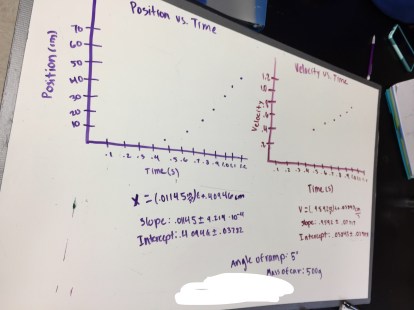
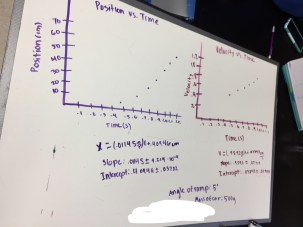
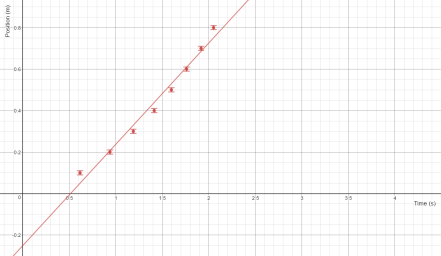
Most students finished their position vs. time graphs, so we took some time to talk about linearization. I really like the ways that uncertainty played into the discussion. In particular, students were quick to recognize that the line of best fit doesn’t go through the error bars and that the intercept is much further from 0 than the uncertainty. This motivated nicely that, even though the line had a good r2 value, it wasn’t good enough.

ramp-lab-graph

Earth Science: Heating

Students placed thermometers at different angles in front of a lamp to simulate the sun striking the surface of the earth at different angles. I like that this lab starts with a question, namely  “Why is it hotter at the equator?” Next time, I’d like to involve students in more conversation about how we can model that in the lab since I think many lost the connection between the question and the data they were collecting.

Day 11: Photogates & Atmosphere

AP Physics: Photogates

To introduce constabt acceleration, students used photogates to collect data for position vs. time and velocity vs. time graphs for a cart on a ramp. A lot of students were a little intimidated by the LabQuests at first, but, by the end of the hour, they declared my decision to get probeware instead of textbooks was the right one.


Earth Science: Layers of the Atmosphere

Students plotted altitude vs. temperature for Earth’s atmosphere, which lead nicely into the different layers. Some students were bothered by the fact that their graph didn’t pass the vertical line test for a function, so we had some discussion about the different purposes a graph can serve and why it might make sense to sometimes break certain rules.

Day 10: Assessment Day!

Both my classes took their first assessments today.

AP Physics

On a problem where students were asked to determine the change in position from a velocity vs. time graph, I had a lot of students describe the motion of the object, instead. We spent more time in class describing motion than calculating, which probably primed students to jump straight to describing. A recurring theme at my AP Summer Institute is that students should read back over the question to make sure they are answering what is being asked, so this will be a good opportunity to discuss that strategy.

Earth Science

After the quiz, we spent some time talking about what makes an effective lab group. I need to keep reminding myself that collaboration is a skill and time spent on those conversations does pay off.

Day 9: Board Meeting & Review

AP Physics: Board Meeting

Students sketched their distance vs. time and angle vs. time graphs from the rotating disk Direct Measurement Video. I’d assumed students would just use the frames displayed in the video to find the time directly, but a lot of groups decided to treat when a dot was at a position of zero as t = 0, which gave us a good opportunity to talk about some experimental design decisions, which reinforced what the intercept represents on a graph like this.


Earth Science: Review

As a school, we’ve been working on having students write meaningful questions as part of our focus on Cornell notes. While I don’t do many notes, I decided to piggy back on this by having students write possible test questions for each learning target. Periodically, I had groups trade whiteboards and work on answering the questions another group had come up with. At this point, the questions were fairly superficial, which isn’t surprising since we just skimmed the surface of the topics in this unit and students haven’t had much practice or feedback writing questions yet.

Day 8: Dueling Buggies & Tides

AP Physics: Dueling Buggies

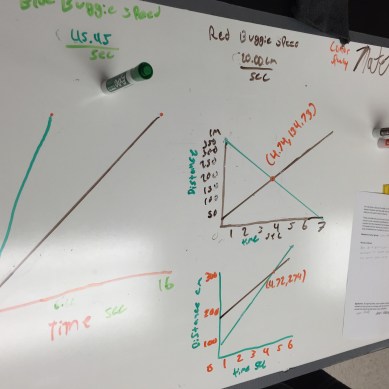
We finished up the dueling buggies lab practical today. We also talked a little about what it means for a given approach to be “better”.

img_2211

Earth Science: Tides

I gave students a one-month tide chart for Olympic National Park and had them look for patterns. I really like that their tide charts include the moon phases, so my students were making some connections between the biggest changes in the tides and the phase of the moon. We also talked about how to make sure the patterns were valid, which lead to looking at the tide charts for some additional months.