Day 97: Energy & Free Fall

AP Physics: Energy

We had a board meeting on the two energy labs from this week. The kinetic energy groups tended to get very nice results; I had them check their model with multiple cart masses and ramp angles, and they saw the results were consistent. I had the elastic energy groups use multiple springs, but they didn’t see as clear a difference between the slopes as I would have liked. I’m wondering if the results would be less muddy if I had them plot gravitational potential energy on one axis rather than just plotting height. I shortchanged some of the pre-lab discussion, and I think that lead to students forgetting to do things like measure the cart’s starting height or measure both the starting and ending height from the same end of the cart.
kinetic.jpg

Physical Science: Free Fall

I got out washers, manila folders, and a few other things and tasked students with determining what affects the time an object takes to fall. In the pre-lab discussion, a student suggested the fluid an object falls through could affect the time, so next year I might make sure I have graduated cylinders and some different liquids available. I offered to grab materials if a group wanted to try that, but I think asking me to get stuff felt like an extra hurdle.

free-fall

Day 96: Angular Momentum & Average Velocity

Today, I was chaperoning a field trip so I missed most of my classes.

AP Physics: Angular Momentum Quiz

Students took a quiz on angular momentum, then worked on finishing yesterday’s lab. One of the problems is based on a story that before jumping a motorcycle over the Snake River Canyon, Evel Knievel said his biggest fear was accidentally hitting the brakes in mid-air. I was back in time for 4th hour, so I showed students a demo of the problem using an RC motorcycle.

Physical Science: Average Velocity

Students worked on some problems interpreting position vs. time graphs. One of the questions asks them to invent average velocity by coming up with multiple ways to define the average velocity, then use each approach to make a prediction and decide which definition is the most useful.

Day 95: More Energy & Sledding Problem

AP Physics: More Energy

I split the class in half with some groups doing a lab for elastic energy and others doing a lab for kinetic energy. The groups looking at elastic energy looked for a relationship between how much a spring launcher is compressed and the maximum height above the table the launched cart reaches. The groups doing kinetic energy looked for a relationship between the starting height of a cart above the table and the speed at the bottom of the track.

phys lab.jpg

Physical Science: Sledding Problem

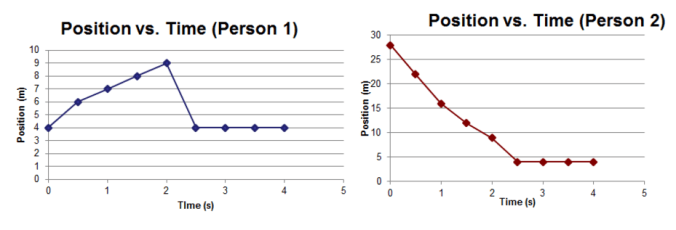
I gave students two position vs. time graphs that I said describe two people sledding, and had them do some interpretation. Students started by describing the motion of each sledder, then identifying where they collided. Finally, each group prepared a CER for who’s fault the collision is, which we then used for a short philosophical chairs where students made their case to the rest of the class. This lead nicely into a brief discussion of assumptions and they role they play in generating an explanation or a claim in science.

The sledding story made the coordinate system tricky for students. I wish I’d spent time discussing the descriptions of the motion so we could make sense of them moving in opposite directions.

sledding-graphs

Day 94: Intro to Energy & Motion Graphs

AP Physics: Intro to Energy

Students picked a height to raise their cart above the table, then made a rough force vs. displacement graph and repeated for additional angles. We compared the areas of the graphs, then defined that area as the change in gravitational potential energy. The biggest hangup is that students are so used to graphing their data that I have trouble getting across that I want a description of an individual run, instead. I might try some additional discussion prior to the lab next time.

As a side note, it was interesting to watch what looked like some gender dynamics in one of my classes. All but one of my all-male groups picked a fairly high point to raise their carts to, then used very steep angles, getting their tracks nearly vertical. The one all-female group in the class picked the lowest point they could, then did very shallow angles. I also had one mixed-gender group, and they picked both a height and angles right in the middle.


Physical Science: Motion Graphs

We finished whiteboarding results from the video analysis, following each up with a similar case on the motion detector. I should have broken up the discussion a bit more, which reinforces what I was already thinking about with going low-tech for constant velocity, then introducing video for constant acceleration. I also had students move away from their lab tables for the group discussion, and talked a bit about why I was doing it, and students were much more focused on the whole-class discussion this time.

Day 93: Whiteboards & More Whiteboards

AP Physics: Whiteboarding Angular Momentum

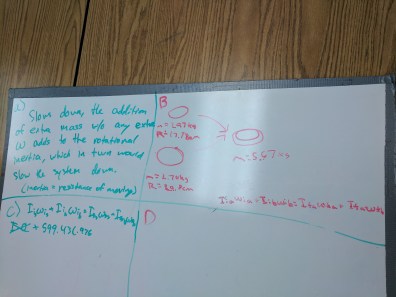
Thanks to a reminder from Dan Burns, I kicked class off with a clip from The Simpsons where Principal Skinner uses conservation of angular momentum to save Ralph. Afterwards, students whiteboarded and discussed yesterday’s problems. I focused on the conceptual problems, and I was pleased by how many students opted to use tools like SOS diagrams to guide their thinking, whether or not the problems asked for them. I also had some groups use analogies to linear momentum to answer questions since they found it easier to visualize. I got really excited when a couple of groups used Newton’s 3rd Law to solve one of the problems, though I didn’t think to take a photo of their boards.12th.jpg

Physical Science: Whiteboarding Motion Graphs

Students whiteboarded their video analysis results for constant velocity. This was the first time I’ve had them talking about graphs, and they made a lot of great observations. After the discussion, we used Logger Pro to look at a constant speed buggy in front of a motion detector and refine some some of the things we saw in the video analysis; after seeing me change the axes on the v vs. t graph from the motion detector, most groups looked at the scale on their v vs. t graphs and decided they should be horizontal lines. It was also fun to see the expressions on some faces when I found the slope of the buggy’s x vs. t graph and they saw it was the speed.

9th

Day 92: Angular Momentum & Motion Graphs

AP Physics: Angular Momentum

Students took a  quiz on conservation of momentum, then we finished yesterday’s discussion to introduce the idea of angular momentum. I showed them a Direct Measurement Video of two people on carts pushing off each other, followed by one of a rotating iPod to get a clear analogy for conservation of angular momentum. I think this would be worth taking the time to make a more student-centered discussion with students whiteboarding explanations next time around.ipod-rotates

Physical Science: Motion Graphs

Students used Vernier Video Physics to do some simple video analysis of a mini hover disk and start looking at position vs. time and velocity vs. time graphs. I had them stay in Video Physics to view the graphs, but students are struggling to make sense of their graphs for constant velocity with the auto scale. I’m debating how I want to change it for next year. I’m leaning towards spending 1-2 days doing constant velocity with a low-tech, breadcrumb approach. I’d probably have students calculate the speed over each interval to make a velocity vs. time graph. Then, we can switch over to video analysis for constant acceleration.

ramp

Day 91: Whiteboarding & Engineering

AP Physics: Whiteboarding

Students whiteboarded some problems from Friday and yesterday’s Direct Measurement Video. There was some good discussion about a problem about a collision between a Hummer and a VW Bug, comparing the force, the change in momentum, and the acceleration of each. A lot of students did some really good wrestling with the conceptual distinctions between those ideas. There was also some good discussion about whether momentum is conserved when an object starts rotating. All the groups that said rotation takes some momentum had a calculation, while the groups who said rotation does not impact conservation of momentum used a few different approaches, which gave a nice opportunity to talk not only about uncertainty, but the value of multiple lines of evidence.

Physical Science: Engineering

I decided to expand the big engineering project we have this trimester to include both motion and forces, so today we introduced the project. We spent some time talking about what engineers do, and I was very excited that collaborate was the first thing a student mentioned. We also did some problem scoping, where I gave students a fictitious memo from our “client” and had them use the information to describe the problem, the criteria for success, and the constraints we’ll have to work within, as well as start brainstorming some of the science knowledge they will need for the project. I’ve tended to skip problem scoping, since a fake client feels cheesy to me, but it was interesting to see students really analyze the fairly short text of the memo; it was also interesting that students are thinking about the constraints as reasonable client requests instead of arbitrary obstacles I imposed (at least for now).

engineers

Day 90: Angular Momentum & Mirror Mazes

AP Physics: Angular Momentum

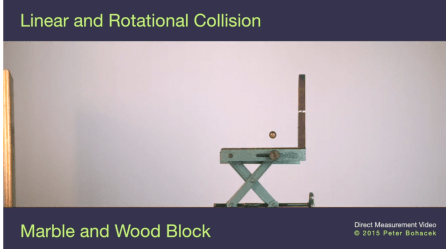
Students used a Linear and Rotational Collision Direct Measurement Video to get some practice with conservation of momentum. In the first question, I asked students to determine whether momentum was conserved in a certain collision using a calculation, and I was surprised by how many students struggled to understand the question. I might change up wording on some of the problems we did to explicitly have them state whether momentum is conserved or if there is an external force, similar to how I approach force problems by first asking students whether the forces are balanced.

I also asked some questions about whether momentum is conserved in collisions where the block starts to spin, and I heard some great conversations about uncertainty, external forces, and other big ideas that have me really looking forward to tomorrow’s discussion.

momentum-dmv

Physical Science: Mirror Mazes

Students used what they know about refection to solve some mirror mazes. I had some where students were given the placements of the mirrors and had to place the target and others where they were given the target’s location and had to place the mirrors. Since we haven’t done much with ray diagrams, this seemed to really solidify what I mean by the path of light.

obstacle

Day 89: Conservation of Momentum & Refraction

AP Physics: Conservation of Momentum

Students worked on some problems using conservation of momentum. I used some problems that require them to shift how they are define their system, which students found challenging at first, but once they got the hang of it, many seemed to appreciate how shifting their system can make a problem easier.

Physical Science: Refraction

Students did a lab making lots of observations of objects in a clear cup of water. Afterwards, we shifted to making some observations as a whole-class of a laser pointer in a fish tank. Once they summarized the big ideas based on observations, I set up a washer in the bottom of a fish tank and aimed a PVC tube to view the washer. Students predicted where, relative to the tube, they should aim a dowel and a laser pointer in order to hit the washer. I was very pleased at how successful students were at this task; I do wish I’d had them write a CER for this problem since a lot of students struggled to explain their prediction.

Day 88: Collisions & Mirrors

AP Physics: Collisions

Students finished collecting data to compare momentum before and after a collision of two carts, then had just enough time to talk through results. I just gave students a data table from the Modeling Instruction curriculum, but I think my students could have handled something more open-ended as long as I can plan how I will make sure students get a good variety of collisions. I ended up falling into a pretty teacher-centered “discussion” after the lab to limit how much time we spent, but I think we missed out on a really good opportunity to talk about uncertainty and assumptions. Next year, I might have each group do just a few collisions so we spend more time discussing the results.

lab

Physical Science: Mirrors

I gave students three questions about the images formed by a mirror and tasked them with writing a CER for each question. This is the least structured lab I’ve given students so far this year, which made some students nervous, but I was pleased with the results. I had students whiteboard their CERs so we could have some discussion, but I had students stay at their lab tables and a lot of students kept going back to small group discussions. I think this was because I’ve established a very clear routine where the desks are for whole-class discussion and the lab tables are for lab group discussions. Next time, I’ll probably keep the discussion in the lab area, but have students stand up and move away from their tables to get the physical cue that its time to shift focus to the whole class.