Day 7: Dueling Buggies, Board Meeting, & Volume

AP Physics 1: Dueling Buggies

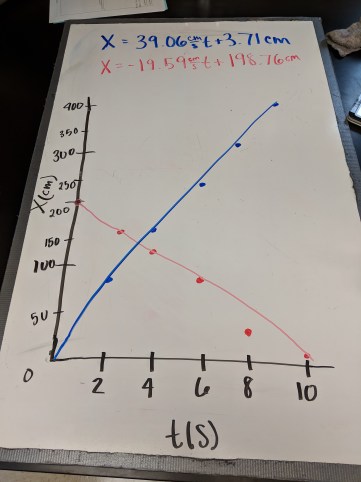
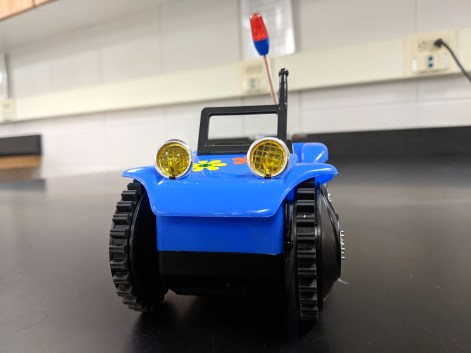
Students predicted where two buggies would collide based on their starting points and speeds. It was interesting to see how different sections approached this problem; most of the groups in my 2nd hour used motion maps while almost all of my 4th hour used position vs. time graphs. When my 4th hour discussed the buggy paradigm lab, students brought up the fact that some of the graphs intersected, with one even bringing up that position vs. time graphs can be used to elegantly solve the classic two trains problem.

Physics: Board Meeting

Students wrapped up the buggy lab and we had our board meeting. Before the board meeting, I once again had students do a gallery walk and jot some notes down on their lab sheet, which lead to some really good conversation during the board meeting. The downside is students are using the gallery walk to ask questions I’d normally hope to hear during the whole-class board meeting, like asking about what a group was doing when they collected data that gave a negative slope, but students bringing up those points during the whole-class phase, so it doesn’t feel like a big downside.

buggy lab

Chemistry Essentials: Volume

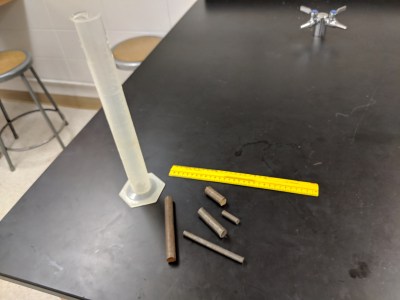
Today, students found a relationship between the amount of water displaced and a solid’s volume in cubic centimeters to get at the equivalence of milliLiters and cubic centimeters. I haven’t had great results with the Modeling Instruction volume lab, so this year I cut some rods from the metals teacher into short sections so that students only needed to find the volume of cylinders. I like that the lab I did today uses the same version of water displacement they’ll use later on, but the math was a struggle for a lot of students. About half of my groups finished data collection and the other half only got one data point because they were caught up calculating the volume. I need to keep working on how to make this lab accessible to all of my students.

volume lab


Day 6: Mistakes, Buggies, & Mass of Gas

AP Physics 1: Mistakes Whiteboarding

Students did mistakes whiteboarding, where groups include intentional mistakes in their solution, then the rest of the class asks questions to try to understand the mistake. I had a lot of groups pick mistakes they’d made working on the problems, which is perfect. In my big class, some students started turning to talk to their peers, which I let go at first since there were good conversations, but it quickly got hard to follow the main conversation and it was hard to shut the side conversations down once I let them start. Next time, I might try having some designated times for talking to a peer vs. talking as a whole class.

ap mistake

Physics: Buggy Lab

Students collected data for the buggy lab. I’ve found students are often very resistant to adjusting their procedure once they have any data written down, even if its only one point, so on the lab template we’re using, I have a step for students to test their procedure without recording any data. This time did exactly what I wanted today and I saw a lot of groups trying multiple approaches before settling on their steps.

buggy

Chemistry Essentials: Does Gas Have Mass?

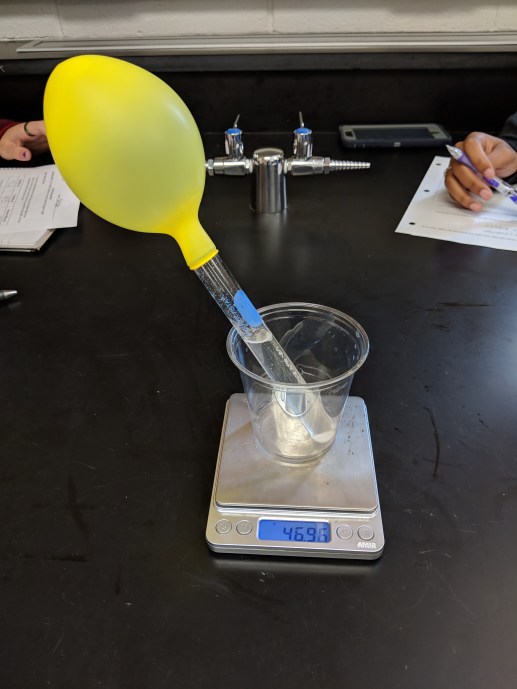
Students dropped Alka Seltzer into water, then measured the change in mass with and without a balloon on the test tube. This year, even though I had an approach in mind, we had some pre-lab discussion about possible strategies, and students had some neat ideas. There were a few things students came up with that provided a nice seque into this lab.

alka Seltzer

Day 5: Problems, FCI, & Problems

AP Physics 1: Problems

Students started working on some problems translating between constant velocity representations. Usually, I see a big difference between those who did and didn’t take calculus last year, but the gap seemed much smaller this year; my students who didn’t take calculus last year seemed very comfortable working with graphs and thinking through problems they aren’t entirely sure how to answer yet, which was great to see. My students are also already very collaborative, with students quick to step in when the realized a peer was stuck.

Physics: FCI

Students took the force concept inventory today. It was interesting that my students in this course seemed much more nervous about the pre-test than my AP students did on Friday. The pre-test is useful for the goal setting my district asks PLCs to do and I find looking at the gains, especially on specific questions, useful, but it does take a toll on students settling in to a challenging course to have a challenging pre-test so early on.

Chemistry Essentials: Particle Diagrams

We started by making and discussing histograms for Friday’s labs. There were some great observations and potential ideas to explain some of the changes we saw. Afterward, students got into groups to work on sketching particle diagrams for the experiments we’d done. I also introduced students to the group roles I’m using this year; I don’t think I did enough training to get the full benefit of the roles, but it did seem to help reinforce the idea that every group member has something to offer.

burning steel wool.jpg

Burning steel wool

Day 4: FCI, Board Meeting, & Mass and Change

AP Physics: FCI

Students took the FCI pre-test. When I asked what they thought of it, several students said it was fun, which bodes really well for the rest of the year.

Physics: Board Meeting

Students whiteboarded the dowel lab we’ve been working on for a board meeting. Time got tight, especially the last period of the day, partly because I was wiped out and didn’t keep as on top of my students as I needed to at this point in the year. In the lab template I’m using, students have a space to do a gallery walk with their lab group and start jotting down some observations, which seemed to help with the discussion during the actual board meeting.

dowel lab board

Chemistry Essentials: Mass and Change

We continued the mass and change sequence today with water melting into ice and a chemical reaction that forms a precipitate. Students consistently resist setting their ice aside to melt while they work on other parts of the lab, so I need to think about how to make things like that feel comfortable.

mass and change

Day 3: Board Meeting, Lab Template, & Burning Steel Wool

AP Physics: Board Meeting

We did the first real board meeting using yesterday’s results from the buggy lab. Once again, I borrowed Casey Rutherford’s Observations, Claims, & Evidence structure. Some of the chemistry teachers have been integrating techniques from Modeling Instruction, and I got to reap rewards in a really good first board meeting. There was some discussion about whether some intercepts were small enough to call zero, which, along with a whiteboad where students plotted multiple trials, lead really nicely into an introduction to uncertainty. Next year, I think that would go even smoother if I push all groups to truly make time the independent variable and complete multiple trials.

Physics: Lab Template

For the second round of the dowel lab, I had students follow the lab template we’ll be using this year. I also changed the guiding question to “What is the relationship between the mass and volume of these dowels?” since that more naturally motivates measuring multiple dowels and is closer to the kind of guiding questions we’ll have on future labs.

dowels.jpg

Chemistry Essentials: Burning Steel Wool

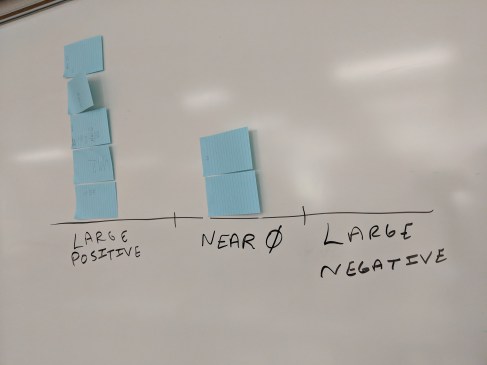
We wrapped up yesterday’s lab by making a post-it histogram of the results students got yesterday, then had some discussion on the significance of those results. Afterward, we continued the mass and change sequence from Modeling Instruction by measuring changes in mass as steel wool burned.

steel wool.jpg

Day 2: Buggies Redux, Dowels, & Coffee Can

AP Physics 1: Buggies Redux

Today we repeated the buggy lab, but with a focus on preparing whiteboards that would make a meaningful comparison across groups. I had each group collect data for a standard buggy moving forward from zero and one other variation. One thing I’m really excited about is several groups played with ways to represent multiple trials on a single graph and one group came up with Frank Noschese’s effortless error bars on their own, which will be a great introduction to uncertainty.

Physics: Dowels

This class is also doing two rounds of the first real lab. Today, I asked students to use a bunch of small dowels to collect data that would let them predict the mass of a much larger dowel made out of the same type of wood and represent their data on a whiteboard. The majority of groups used proportions, which was great, but very few measured multiple small dowels on their own and no one thought to try a graph. In most labs, I ask students to find a relationship, and I wonder if that would be a more interesting prompt here.

Chemistry Essentials: Coffee Can

We did the exploding coffee can demo to introduce particle diagrams. I had a few students who were really willing to propose ideas to explain the changes in the can’s behavior as the flame burned, which was awesome.

coffee can

Day 1: Buggies, Broken Circles, & Mystery Tubes

AP Physics 1: Buggies

I took a page from Frank Noschese and embraced the idea that “Any lab worth doing is worth doing twice.” I gave groups the very vague directive to collect data on the buggy’s motion, then represent it on a whiteboard and turned them loose. My students seemed very comfortable with the ambiguity and dove right in, which was fantastic. I had a good mix of data tables and graphs on whiteboards, along with a lot of variations on graphs, which led to some good conversation on what would make it easier for us to compare results. Tomorrow, we’ll re-do the lab with a focus on being able to compare results. I talked more than I’d like today, but that’s pretty typical of when I do a new discussion.

buggy

Physics: Broken Circles

To start building class culture and learning how to collaborate, I started today with Frank Noschese’s subversive lab groups. Once they were in groups, students did the broken circles activity from Designing Groupwork: Strategies for the Heterogeneous ClassroomEach student got an envelope with pieces of a circle inside. As a group, they had to assemble four complete circles without talking. Afterward, we had some discussion about what skills groups needed to complete the task.

broken circles

Chemistry Essentials: Mystery Tubes

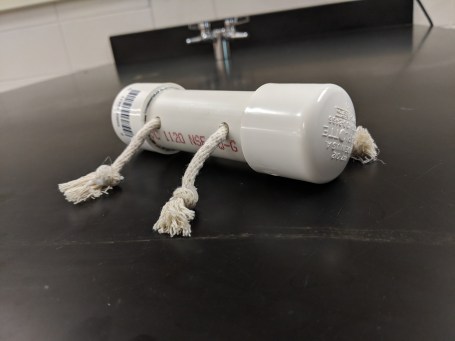
Today was also about class culture in chemistry. This class also started with subversive lab grouping, but  I stepped in more than I did in physics. There were more students in this class who seemed nervous about approaching their peers and it was tougher for them to identify other possible solutions when a group got too big. Afterward, we got out the mystery tubes. I could tell I didn’t make the goal as clear as I sometimes do; while there were a lot of groups who were very engaged and had great conversations, others had trouble getting started.

mystery tube

Day 0: New Year

My district wrapped up our welcome back week for staff yesterday and school begins on Tuesday, so I’m taking some time today to think through what I’m going to focus on this year.

Physics: Class Culture

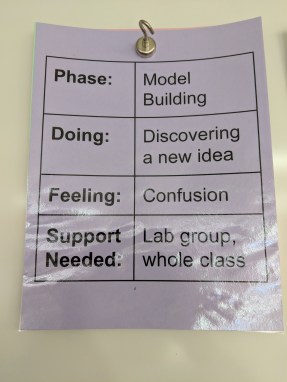
I think a lot of the things I struggled with in this course last year can be attributed to falling short on building a good culture in my classes, so am trying to be much more intentional in that department this year. In particular, I really had trouble shifting students away from the belief that being confused at a given moment means they are bad at physics. I’m going to try posting signs for phases of the modeling cycle that have some information on how I expect students to feel and what supports they are likely to need. Especially during the first weeks of school, I’m planning to reference the sign as part of my introduction to what we will be working on that day.

model phases.jpg

The other thing I want to work on is embedding more reflection into my class. Last spring, the other physics teacher and I worked on a cover sheet for our unit packets that will have space for students to track their progress on each learning target. I also put together a short reflection on collaboration that will be the last page of each packet. On at least the first few packets, I need to take time to respond to students’ comments on both the progress tracker and collaboration reflection to drive home that these tasks are worth their time.

I also need to remember it isn’t enough to have this very explicit, intentional focus on class culture at the start of the school year. Typically, a large fraction of the physics students will switch between the other physics teacher and me when we start a new trimester. Even though we stay very in-sync, our classes can feel very different to our students and they don’t automatically transfer skills and mindsets between our classrooms. I need to treat the start of each trimester like the start of the school year.

Chemistry Essentials: Collaboration

I’m thinking about collaboration in this course from a few different angles. First, I’ll be co-teaching the class for the first time this year. My co-teacher is a special education teacher; while he has a limited background in science, I expect his expertise in adapting and differentiating curriculum to be very valuable since many of the students in the course have unique academic needs. This is my first experience co-teaching, so I’m thinking a lot about how to make sure I’m using his expertise while sharing my knowledge of science teaching.

I’m also thinking a lot about collaboration on the student side. I think most of my chemistry students have very limited experience with effective groupwork, so I need to make sure I’m spending time teaching them how to collaborate effectively. During the first week, I’m planning to spend at least a few minutes each day having some discussion on collaboration, but I need to think about what it will look like to carry that through the entire term.

AP Physics 1: Lab Write-Ups

While I’m planning to bring some of the work I’m doing on class culture and collaboration into AP Physics, as well, they aren’t as big a need in this course right now. My biggest frustration last year was actually around lab reports; students didn’t see them as valuable and it showed in their writing. My students were very engaged in doing the labs and had fantastic board meetings, so I think the individual processing in the lab report just didn’t help much. I’m going to try replacing more traditional write-ups with some prompts inspired by the work Kelly O’Shea has done with journals in her class (she linked some blog posts on the subject in the comments). I’m wondering if some prompts like asking students to describe how their thinking has changed or to connect what they learned in the lab to something else they are thinking about would be a more valuable lab write-up. I’m not sure yet how to balance that with giving students practice with the kind of writing that shows up on the AP exam, like writing procedures or making claims based on a graph, but it takes a few weeks before we get to the first lab where I’d ask for a write-up, so I have some time to think and even get input from my students.

Day 167: Final Exam

Today is the last day of school and the day of my Chemistry Essentials final. We have an altered schedule with 90 minute periods during final exams and, no matter how long I’ve made the test, I’ve never had students take more than an hour on a final for this course. I think a lot of students just hit a wall where they can’t focus on a written test any longer, especially since I usually teach the class during the last period. Instead of fighting that block, the other teacher and I agreed to split the exam period into a shorter written final and a lab. We picked a fairly straightforward exothermic reaction lab that we ran out of time for during the regular unit. This is definitely an approach to final exams I want to keep in the course, if not shift to an entirely lab-based final.

chem final.jpg

Day 166: Year-End Reflections

Tomorrow is our last day of school, but, with our finals schedule, I don’t have any students today, so its a good time for me to look back on the school year.

AP Physics

Overall, I’m very happy with how this year went. I felt more confident my second time through the AP curriculum and my students came into the course eager for lots of collaboration, discourse, and reasoning.

One of the big changes I made this year was starting with momentum. In terms of conceptual development, I liked how that worked out and enough of my students took calculus last year that students were able to implicitly make sense of constant velocity. However, the first labs I did were a tough starting point. The bowling balls and mallets were a fun way to start the course, but coming up with a rule or pattern at the end was a bigger intellectual risk that most students were ready for on day 1 before I’d done much culture setting. The first quantitative lab was on impulse and had lots of little details going on that made it very challenging when students were also getting one of their first experiences designing physics experiments. Next year, I think I’m going to start with a brief constant velocity unit where I can set the class culture and start working on science practices when the content is relatively easy.

This summer, I want to spend some time rethinking how I approach lab write-ups. Write-ups were officially due a few days after the board meeting for a lab, but I have some philosophical objections to deducting points for late work, so I ended up getting almost all of the lab write-ups the last week of the trimester, which has not been an issue in my classes in the past. I think in the past, doing the write-up helped students finish the sense-making process, but this year, students took to board meetings very quickly, so there was less intellectual work left for them to do on the write-up. On a survey I gave this spring, one student put it well when they said the lab write-ups “feel more like an assignment than a learning tool.” Abandoning lab write-ups isn’t a great option; my school mandates at formative category in the gradebook that the labs work well in and a few colleges in the area request lab portfolios before granting AP credit. I don’t have any bright ideas yet, but I want to think about ways to make lab portfolio more of a learning tool.

Physics

The other physics teacher and I got a lot of feedback that students felt like they had a good experience in the course, but we both struggled to get our students to move away from dependent learning patterns. We’re talking about how to better scaffold skills and habits next year, including working on a template we can give to students for model-building labs. I also started to get better whole-class discussions this year when I was very conscious about the time I gave students to pre-talk with their groups. I found I needed to have students move to their lab tables and write ideas down to get the best results; it took me a good chunk of the year to figure that out, so next year I want to start that form of pre-talk with the very first board meeting.

This year I had more students switch teachers at trimester than in the past with this course, which drove home how much I rely on long-term results, ranging from big things like class culture and quality discourse, down to the smaller nuts and bolts, like submitting a meaningful retake request. For some pieces, like requesting a retake, there are relatively easy fixes; the other physics teacher and I have agreed on a procedure for next year that’s a hybrid of what we’ve each been doing. For the bigger issues, like building a strong class culture and teaching students how to talk and write about physics, its going to be a lot tougher. The other physics teacher and I are going to start PLC-ing together again next year to give ourselves some space to dig into these issues.

Chemistry Essentials

This year was the first time I taught the first half of the course, so it was rough. The existing curriculum is heavily influenced by our textbook and approaches a lot of topics as very discrete ideas. This summer, I want to spend some time working on weaving a more meaningful storyline for the course. I also want to do a better job of embedding Modeling Instruction into the course, which I think will help with the storyline in addition to the other benefits of the Modeling approach.

My other big source of frustration was grading. This was the only course where I was not using standards-based grading, and I consistently felt like my students did not have as clear an idea of where they are at or what they need to work on as I’d like them to. I also found many students improved on skills that appear throughout the course, like balancing reactions or finding molar mass, but was frustrated the grading system did not have an avenue for me to acknowledge their growth. The other Chemistry Essentials teacher is excited about the idea, so its time to take the plunge.

Looking ahead to next year, most of my sections will be co-taught with a special education teacher. There’s some question about who I will be co-teaching with, but it will most likely be someone with a limited science background. I’m starting to think about how to introduce whoever my partner is to my vision and goals for the course. I am excited to collaborate with someone much more knowledgeable than I am about special education; typically, about half of the students in the course qualify for special education and many other students have other significant needs, so the skills many special education teachers have with adapting and scaffolding curriculum could add a lot to the course.