Day 98: Whiteboarding Galore

AP Physics 1: Oscillating Spring Whiteboarding

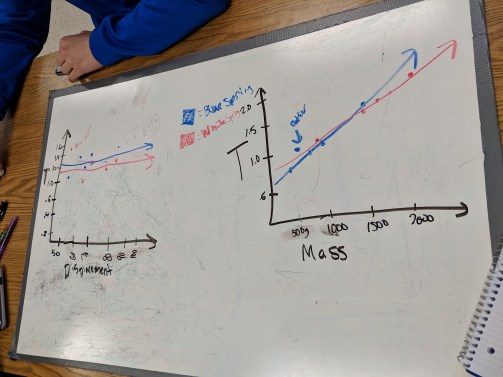
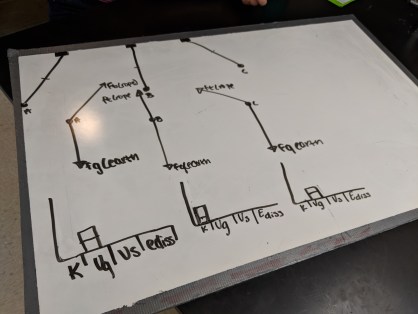
Students whiteboarded some problems for a mass on a vibrating spring. They are recognizing the parallels to pendulums and successfully connecting a lot of the ideas I want them to connect.

ap bar charts.jpg

Physics: Projectile Whiteboarding

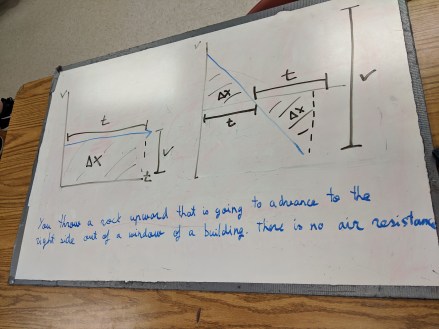
Students whiteboarded some problems for horizontally launched projectiles. A lot of students are making good use of energy to simplify the math on the vertical motion and things seemed to click for a lot of students today.

phys wb.jpg

Chemistry Essentials: Bohr Model Whiteboarding

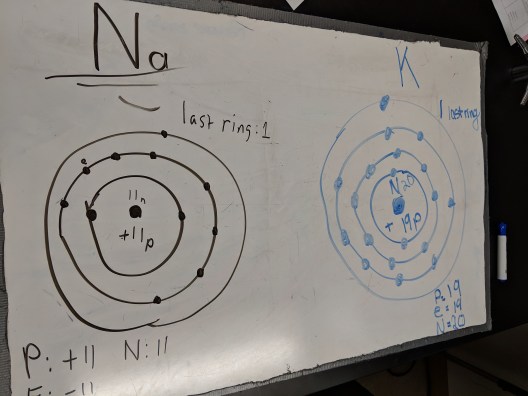
Students used the Bohr model of the atom to whiteboard structures for some of the first 20 elements, also bringing in what we figured out yesterday about isotopes. I ask students to predict the two most common isotopes, which requires rounding the average mass both up and down, and a few students had some trouble with rounding to predict isotopes like H-2, but they were able to get there with some support.

chem bohr.jpg

Day 97: Assessment, Problems, & Penny Isotopes

AP Physics 1: Assessment

Students took their pendulum assessment, initially scheduled for last Friday. They’ve been very quick to grade since students did really well.

Physics: Problems

Students worked projectile motion problems. A lot of students needed some coaching to remember how to solve problems from a velocity vs. time graph, which tells me we could stand to do a little more spiraling content in the course, but students were pretty successful overall. There was a great moment where a few students were feeling much more confident than usual who objected when someone at their table tried to get help from me before talking about their question with the rest of the table.

Chemistry Essentials: Penny Isotopes

Students used pennies to represent different isotopes of an atom, comparing the average mass of their whole set to the average mass of each type of penny. Because I distributed the pennies pretty randomly, all of the groups ended up with more post-1982 pennies, but I think it would have driven the point home a little stronger if some groups had more pre-1982 pennies.

pennies.jpg

Day 96: Lots of Whiteboarding

AP Physics 1: Spring Period Board Meeting

We had a board meeting for the lab on the period of a spring. With all the days we’ve lost due to weather (and the potential for more in the forecast…), I cut it a bit short. My students aren’t in a place where they linearize automatically, but we did have some good conversation about the fact that the intercepts on the period vs. mass graph don’t make sense and students were very quick to come to a consensus that it sure looks like a square root relationship.

ap spring lab.jpg

Physics: Projectile Calculations

We revisited last week’s problem about an orange dropped from a tower to transition into projectile calculations. Students got into groups and whiteboarded solving for the time the orange took to fall and its final velocity. In each section, I had one group that opted to use conservation of energy to find the final velocity of the orange, which was a great way to contrast two different approaches. From there, we gave the orange some horizontal velocity to flesh out the calculations. This approach really drove home that students are being asked to remix old skills, not do something new.

phys calc.jpg

Chemistry Essentials: Bohr Model Whiteboarding

Students did a short worksheet figuring out the Bohr model structure of elements near the beginning of the periodic table. Afterward, students whiteboarded their answers for a gallery walk. I had each group do two elements from the same family to help the pattern in the number of valence electrons pop out.

bohr

Day 95: Springs, Graph Jeopardy, & Build an Atom

AP Physics 1: Spring Period

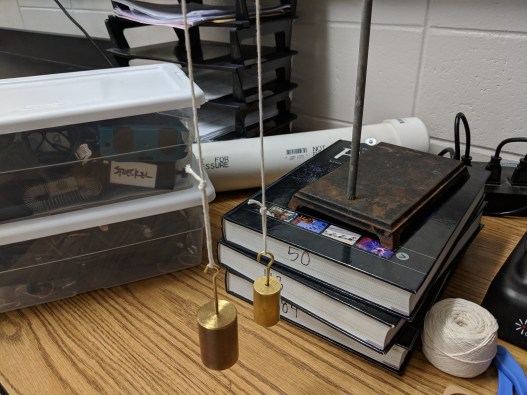
Students collected data to determine what impacts the period of a spring. I always get a kick out of how often I overhear students predicting that the mass won’t matter since it didn’t for a pendulum, only to be surprised.spring.jpg

Physics: Graph Jeopardy

I have this class the first and last hours of the day, which means it was more impacted by last week’s weather than my other classes. I had a quiz on sketching graphs for projectiles today and decided to do some Jeopardy whiteboarding to make sure everyone was in the groove. Each group sketched a pair of velocity vs. time graphs for a projectile, then another group had to come up with a situation that matched the graphs.

phys jeopardy wb.jpg

Chemistry Essentials: Build an Atom

Students used PhET’s Build an Atom simulation to explore the Bohr model. This was their first exposure to atomic models in the course, but students were able to pick up on all of the big ideas I wanted by playing with the simulation.

phet build atom.PNG

Day 93: Pendulums, Projectile Graphs, & Periodic Table Predictions

Today was a little strange; we had some snowfall that gradually got heavier over the course of the day. While our official release was only 15 minutes early, a lot of kids were excused earlier by their parents. The unofficial gradual release likely made the parking lot much safer after school, but it did make afternoon classes tricky.

AP Physics 1: Pendulum Problems

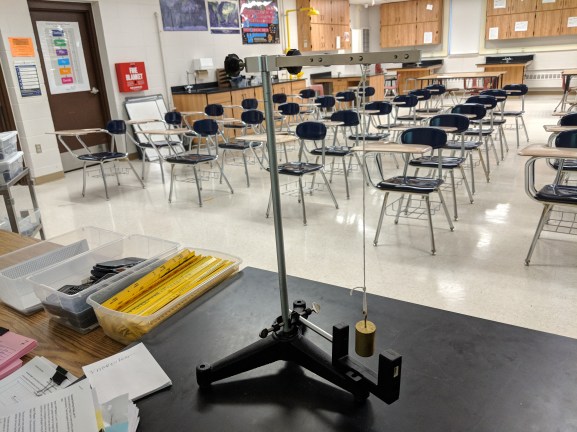
We used a pendulum in front of a motion detector to take a look at the position vs. time and velocity vs. time graphs for a pendulum, then students worked on some problems connecting earlier topics to the motion of a pendulum. Students made some great connections, with one group having a very involved conversation about how their experiences on a swing connect to what they know about pendulums.

ap pend.jpg

Physics: Projectile Graphs

Some discussion about a kickball tossed over a motion detector was just what students needed to connect the Pivot Interactives activity from earlier in the week to yesterday’s work on a falling orange. Afterward, students worked on some problems sketching velocity vs. time graphs for various projectiles.

projectile graphs.jpg

Chemistry Essentials: Periodic Table Predictions

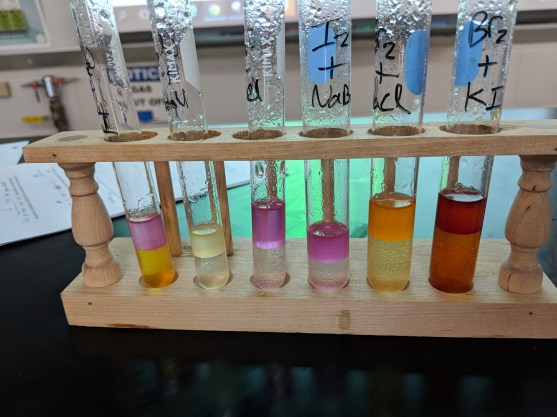
One of the periodic trends we’ve been looking at is how likely an element is to react. Today, students made a prediction ranking several halogens based on the likelihood of a reaction, then we mixed samples with mineral oil and various salts to see which one was most likely to react. Students were excited that they could make an accurate prediction based on what they know about the periodic table.

chem halide.jpg

Day 91: Pendulums, Projectile Graphs, & Periodic Table Card Sort

AP Physics 1: Pendulums

Students collected data for variables that affect the period of a pendulum. This was a day where I could tell students are getting better at experimental design and more comfortable with being independent; groups were able to work through challenges and surprises with very little input from me.

Maker:S,Date:2017-10-21,Ver:6,Lens:Kan03,Act:Lar02,E-ve

Physics: Projectile Graphs

Students whiteboarded their results from yesterday’s activity in Pivot Interactives. They had to shake some of the dust off their skills on interpreting motion graphs, but it came back quickly and students made the connections I was after very successfully.

phys pivot wb.jpg

Chemistry Essentials: Periodic Table Card Sort

Students worked on a card sort to introduce the periodic table. A few students were really eager to know what some of the features of the cards represented, which lead to some great conversations in lab groups about patterns they saw with those numbers.

chem card sort.jpg

Day 160: Graphite Wire, Pendulum Review, & Energy Bar Charts

Today was the start of seniors’ last week of school.

AP Physics: Graphite Wire

Students continued to work on their final projects. One student used a graphite pencil to sketch “wires” on a sheet of paper and worked on collecting data on the potential difference at the LED. I wasn’t sure if a pencil would leave a thick enough layer of graphite, so got pretty excited when she got this to work.

IMG_20180529_115842.jpg

Its hard to see, but the LED is glowing!

Physics: Pendulum Review

With the final exam starting on Thursday, we took some time today to start reviewing. I started with some pendulum questions that I expected to be pretty quick and easy, but it took a lot longer than I hoped. I didn’t do as nice a job of spiraling as I would have liked this spring, so students were very rusty on some of the concepts they needed.


pendulum wb.jpg

Chemistry Essentials: Energy Bar Charts

Students worked on energy bar charts for chemical reactions. The hardest part for a lot of students was parsing what exactly was happening at each snapshot for the energy bar carts; in general, I haven’t pushed the idea that some representations are like a photo that shows a specific instant while others are like a movie that shows change over an extended period, which would have helped today.

Day 158: Multiple Choice, Concave Lenses, & Energy in Reactions

AP Physics: Multiple Choice

I used Plickers to go through some practice multiple choice with student who will be taking the AP Physics 1 exam tomorrow. The conversations were less animated and less focused than earlier in the year, but that’s not a surprise right now. A lot of courses have wound down at this point, and its been tough for students to split their focus between the final project and reviewing for the exam.

I also found myself wishing I’d shifted the due dates for the final project proposal and qualitative description to earlier to give students a little more in-class time to work on their data collection.

plicker

Physics: Concave Lenses

Since yesterday’s ray diagrams were mostly convex lenses, we did a little qualitative work with concave lenses today. After talking about what students saw on a screen in Monday’s lab when they used a concave lens, I asked students to sketch a ray diagram that would explain their observations and was pretty pleased with the results.

Maker:S,Date:2017-10-21,Ver:6,Lens:Kan03,Act:Lar02,E-Y

Chemistry Essentials: Energy in Reactions

Students worked on a worksheet to work with the idea of energy in chemical reactions, especially for exothermic and endothermic reactions and factors that affect reaction rate. I like that focusing on energy gives a why for a lot of observations students have made so far this year; I want to spend some time this summer making energy a much stronger theme in the curriculum for this course.

Day 157: Final Projects, Lens Ray Diagrams, & Reaction Rates

AP Physics: Final Projects

We went to a computer lab today for students to continue working on their final projects. The majority of students are making good progress; they had a milestone due today, and I’m looking forward to reading their progress. One student is analyzing a scene from one one of the Fast and the Furious movies to determine whether the physics is plausible. He spent some time today getting measurements from Google Maps to help with his analysis.

I gave feedback on project proposals electronically, and ran into an issue where one student hadn’t read the feedback to see their project needed some significant changes. I wish I’d taken time to have individual conferences with students about their proposals to make sure students were aware of my feedback.

Physics: Lens Ray Diagrams

Students worked on some qualitative ray diagrams for lenses today. Students are continuing to do very well with ray diagrams, though I wish we’d spent a little more time on planar refraction. A lot of students had trouble with the idea that a lens bends the light the same amount, regardless of characteristics like the location of the screen.

Chemistry Essentials: Reaction Rates

We spent some time discussing yesterday’s lab, using particle diagrams to think about why certain factors sped up reactions. A few ideas from earlier in the year, like the fact that particles move faster when they are at a higher temp, came up, which was great. Afterward, students did a reading and answered some questions to try and focus on the role of energy in affecting reaction rates.

Day 156: Final Project, Lenses, & Reaction Rates

AP Physics: Final Project

Students continued to work on their final projects. In another class, two students built a pretty serious launcher for balsa wood planes and have decided to make their physics final project about explaining some of the things they’ve noticed with their launcher. The majority of students are making good use of their class time; I think it helps that I gave clearer expectations for what students should turn in partway at key points partway through the project.

I also had a free response problem for students to work on that we talked through at the end of class. I didn’t have a whole lot of students who opted to work through the problem themselves, I think partly because I used a secure practice test that students can’t take home.

Physics: Lenses

Students did a qualitative lab experimenting with the images produced by lenses. I had electric candles to use as light sources, but students got really excited when I suggested they could try a picture on their phone. I loved the surprise when students covered up part of the lens and saw no change in the image.

lens.jpg

Chemistry Essentials: Reaction Rates

Students worked on a lab to test how certain changes affect the rate of a reaction. The lab I used was pretty structured, but students had a lot of great ideas about how to effect the rate of a reaction during the pre-lab discussion. I think this lab would work very well as a modeling-style lab next time around.

reaction rate.jpg