Day 113: Board Meeting, Spring Period, & Representing Reactions

AP Physics 1: Coulomb’s Law Board Meeting

We had a board meeting to discuss the results of yesterday’s lab. Students were quick to buy into the inverse square relationship and to recognize how their results support that like charges repel and opposites attract. I haven’t found a great way to get at the meaning of the slope, but its at least pretty intuitive that the amount of charge should affect the size of the force.

ap wb

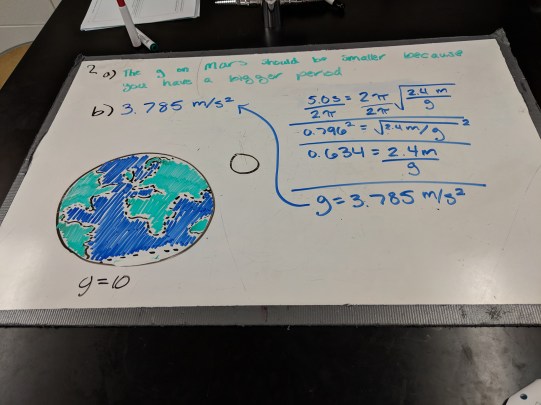
Physics: Spring Period

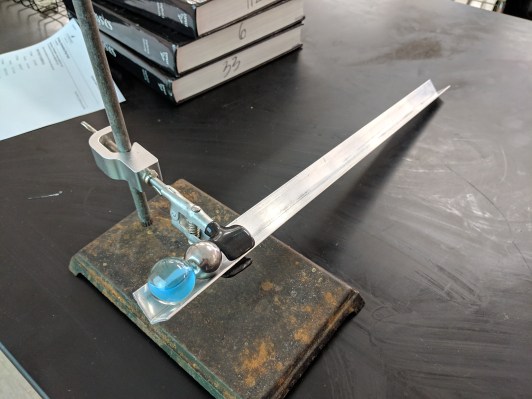
Students collected data to figure out what affects the period of a mass oscillating on a spring. Today was one of the days when the progress my students have made in designing an experiment was very apparent, which made it a lot of fun to listen to them plan and troubleshoot their approaches.

spring

Chemistry Essentials: Representing Reactions

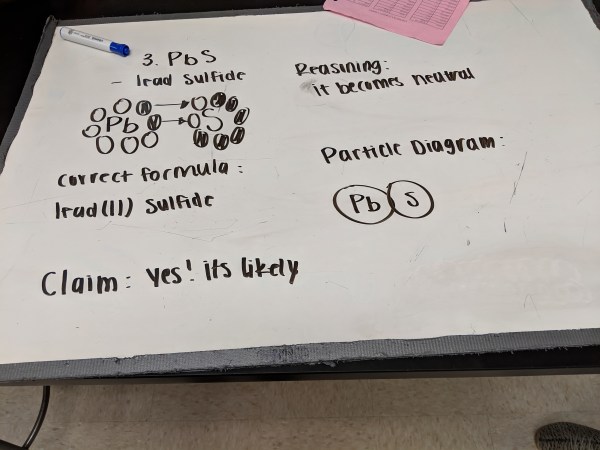
Students practiced translating between reaction equations, statements, and particle diagrams. One of the big challenges is my students were in very different places, especially when it came to particle diagrams and switching between names and formulas. About a third of my students took Chem Ess A with me last tri, so they were just extending some fairly recent learning. Another third took Chem Ess A with me tri 1, so have seen these skills, but haven’t used them in a few months. The rest of the students came to me from other teachers who don’t use particle diagrams and several haven’t had chemistry since last year, which gave them a much higher mental load. Most tables had a mix of students from each group, which meant there was a lot of peer teaching today, which helped with the variation quite a bit.
Day 112: Coulomb’s Law, Spring Force Revisited, & Skew Dice

Today was our first day back from spring break and the first day of a new trimester.

AP Physics 1: Coulomb’s Law

I am a part of the Pivot Interactive’s Chemistry Fellows program.

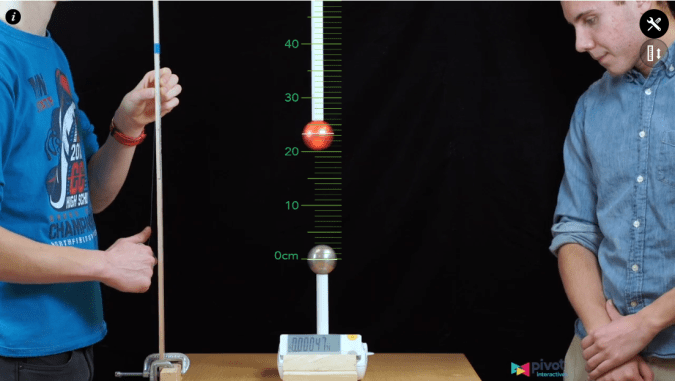
We dove right in with a lab on Pivot Interactives to discover Coulomb’s Law. We’re going to be cutting it pretty close on squeezing everything in before the AP exam, so I was much more direct than usual about what needed to be done by the end of the hour and how long I expected tasks to take, and that seemed to help students meet the timeline I had in mind. I need to make that a habit for the next few weeks.

pivot coulomb.PNG

Physics: Spring Force Revisited

We’re getting ready to start vibrating springs, so today we revisited Hooke’s Law. I asked students to make some predictions about how the slope of two different springs should compare before collecting any data, which was tricky since they haven’t thought about what the spring constant actually means for a while, but I think they got where I want them to be.

Chemistry Essentials: Skew Dice

A lot of my students either haven’t had chemistry since trimester 1 or came to me from the other Chemistry Essentials teacher, so I treated today like the first day of school and tried to set a tone for the term. I tasked students with writing a CER to answer whether skew dice are fair. In the past with this activity, I’ve had some trouble convincing students they need a lot of data, so I started by asking students to collect evidence that a regular dice is fair before we got out the skew dice, and students pretty easily recognized they needed a lot of rolls with the regular dice to get a distribution that makes sense.

skew dice.jpg

Day 106: Assessment Bonanza

Tomorrow was originally scheduled to be a staff development day, so all three of my classes took assessments wrapping up their last topic.

AP Physics 1: Waves Assessment

This quiz included an experimental design problem off a past AP exam. My students still find those kinds of problems really intimidating, but I’m really pleased with the work on the quizzes I’ve looked at so far. In general, both this year and in the past, I’ve had a lot of trouble helping my students feel as confident as I think they should when it comes to the AP Physics 1 exam, and I think their reaction to experimental design problems is one symptom. I have noticed that one of my sections is much more confident, and I don’t think its coincidence that they are also a MUCH smaller section. As we get into the home stretch to May 7, I need to give some thought to how I can help all of my students recognize the progress I’ve seen in them.

Physics: Pendulum Assessment

Students took their quiz on pendulums, then started working on a final review.

Chemistry Essentials: Formula Writing Assessment

Students quizzed over formula writing. Most were feeling very good about their work at the end of the quiz, which is a great place to be at the end of the term.

Day 105: Standing Waves, Whiteboarding, & Covalent Bonding

AP Physics 1: Standing Waves

Students worked on some problems for standing waves in pipes. Students seemed to be getting the hang of waves, which is good since we need to wrap up this topic tomorrow!

Physics: Whiteboarding

Students whiteboarded yesterday’s pendulum problems. One problem describes g on the ISS as “close to zero”, with the intention that students treat it as if g were zero, but the wording was enough to trip up a lot of students. I’ve been pushing them to read carefully and pay attention to details in the problem, so this was a good problem to have.

phys wb (1).jpg

Chemistry Essentials: Covalent Bonding

Students worked on translating between names, formulas, and particle diagrams for compounds with covalent bonds. We didn’t get into how to figure out the formulas from the number of valence electrons, so this ended up being pretty easy compared to the ionic bonding we’ve been working on.

Day 104: Standing Waves, Pendulum Problems, & Polyatomic Ions

I dropped the ball on taking photos today.

AP Physics 1: Standing Waves

We discussed the pattern in the number of wavelengths that appeared on a rope fixed at both ends, then I tasked students with determining whether the same pattern applies in other situations. Students were able to recognize the 1/2 wavelength pattern falls apart in some situations. Tomorrow, we’ll firm up the 1/4 wavelength pattern that fits these situations.

Physics: Pendulum Problems

Students worked on calculations and conceptual problems for pendulums. A lot of students were making good use of units to verify their work.

Chemistry Essentials: Polyatomic Ions

Students worked on writing formulas and sketching particle diagrams for compounds that include polyatomic ions. Students made good use of the simplified Lewis dot structures we’ve been using to work out the correct formulas and were able to make the leap to distributing subscripts for the polyatomic ions.

Day 103: Whiteboarding

AP Physics 1: Waves Whiteboarding

Students whiteboarded problems from Friday. There was some great discussion about particle motion in a longitudinal wave in one class, and we ended up getting out a slinky and tieing a ribbon to one of the rings to try and see the motion first-hand.

Physics: Pendulum Representations Whiteboarding

We whiteboarded and discussed some problems sketching representations of a pendulum’s motion, including free-body diagrams, energy bar charts, and motion graphs. Students made a lot of good connections over the course of the discussion. On some of the questions, there were multiple approaches to the answer, which was great to see.

phys fbds.jpg

Chemistry Essentials: Chemical Formula Whiteboarding

I gave students some problems where they had to decide whether a given chemical formula is likely, then we whiteboarded their answers for some discussion and a gallery walk. I especially liked the discussion that came out of a a couple of problems that included metals, like lead and copper, that can form multiple charges during ionic bonding.chem formula wb.jpg

Day 102: Problems, Board Meeting, & Making a Compound

AP Physics 1: Wave Problems

Students worked on some problems dealing with waves.

Physics: Board Meeting

We had part 2 of a pendulum board meeting where students shared their linearized graphs. I use the units to work from the slope students got to the full pendulum equation, but I’ve never been all that happy with how it goes. I need to keep thinking about how to improve the way I approach this lab.

phys pend WB.jpg

Chemistry Essentials: Making a Compound

Students made some observations of iron and sulfur to figure out whether it formed a new compound after mixing or after being heated. Students were pretty successful at figuring out when the key change happened.

chem lab.jpg

Day 101: Board Meetings & Mistakes Whiteboarding

AP Physics 1: Wave Board Meeting

Students whiteboarded their results from Tuesday’s lab. They pretty quickly made the connection that the slope is the wave speed and saw the relationship I wanted between tension and wave speed. I’d planned to use Pivot Interactives to do some wave superposition basics, but our internet was out district wide for part of the day, so ended up doing some pretty teacher directed stuff with a snakey spring.

wave wb.jpg

Physics: Pendulum Board Meeting

Students whiteboarded their results for the pendulum lab. I didn’t have any groups decide to linearize on their own, so we had some discussion about the intercept to decide we needed to linearize.

phys pend.jpg

Chemistry Essentials: Formula Mistakes Whiteboarding

We did some mistakes whiteboarding with Tuesday’s worksheet on formula writing and particle diagrams. A lot of students seemed to be getting the hang of this skill today, which was great.

I’m seeing some students checking out, which is typical for this point in the trimester; I think students see it as set by now whether or not they will pass the course. My co-teacher and I have reduced how many students are in that place by having individual grade conferences with each student, which has been especially important for helping students who aren’t passing to make a plan.

chem formula.jpg

Day 100: Standing Waves, Pendulums, & Formula Writing

AP Physics 1: Standing Waves

I am a part of the Pivot Interactive’s Chemistry Fellows program.

Students used Pivot Interactives to find a relationship between wavelength and frequency for a standing wave. Students had trouble with some of the vocabulary and with visualizing one wavelength; I usually start with a day of qualitative observations with snakey springs, but skipped that to make up for the week our school was closed. Students were still able to figure out what they needed, it just took a little more coaching than usual.

pivot standing wave.PNG

Physics: Pendulums

We had some discussion to brainstorm what could impact the period of a pendulum, then students went to work collecting data. There was some good discussion of how much variation was enough to matter when students were working on angle and mass.

pend

Chemistry Essentials: Formula Writing

Students practiced translating between names, formulas, and particle diagrams. We got out some beans to use as manipulatives in simplified Lewis dot diagrams to help make ionic bonding a little more concrete.

electron diagram.jpg

Day 99: Quiz, Projectile Practical, & Quiz

Classes were a little shorter than usual today due to our winter week pep fest.

AP Physics 1: Quiz

Students took their oscillating particle model quiz on springs. The ones I’m grading so far look great, which is nice to see.

Physics: Projectile Practical

Students worked through a practical to predict where a horizontally launched projectile will hit the floor. Once students got a success, I had them predict which way they should move their target for a relatively light marble.

phys proj prac

Chemistry Essentials: Quiz

Students took their quiz on the Bohr model of the atom. Students are starting to feel pretty comfortable reading their periodic tables and anticipating key properties, which bodes well as we move into formula writing.