Day 78: Pendulums, Bar Charts, & Quiz

AP Physics: Pendulums

Students collected data for what variables affect the period of a pendulum. When we discussed what might be worth testing, one class was very quick to dismiss mass on the grounds that “mass never matters in physics”, which has me really excited for the period of a spring lab.
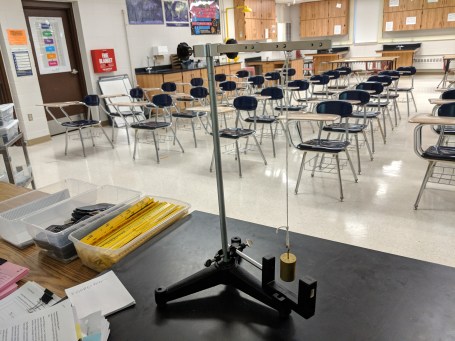
pendulum.jpg

Physics: Bar Charts

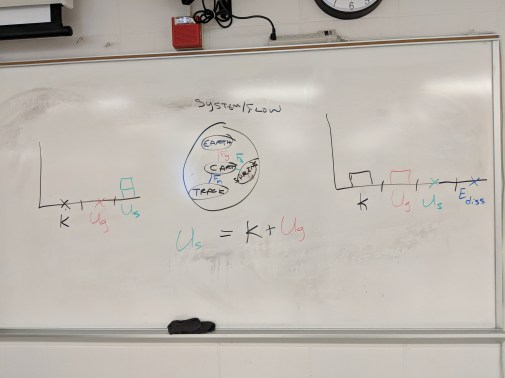
Students worked on representing energy with bar charts and switching between different systems. I had a sub for one section, but the section I was here was able to make the leap pretty independently, which was great to see.
Maker:S,Date:2017-10-21,Ver:6,Lens:Kan03,Act:Lar02,E-ve

Chemistry Essentials: Quiz

Students took their quiz on gas laws with a sub. This year, I framed the gas laws as proportional rules, rather than equations, and I’ve been pleased with how that’s impacted the math. I’m looking forward to see how that shows up on the quiz.
Day 139: Free Response & Earthquakes

AP Physics: Free Response

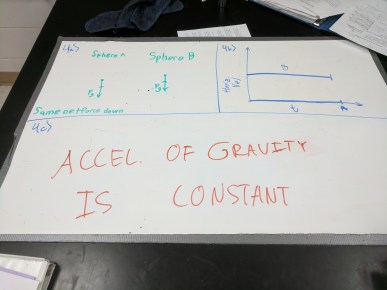
Students whiteboarded a couple of free-response problems off the 2015 exam, then used the released scoring guides to see how they did. All of it happened in small groups, so some groups dug more carefully into their errors than others. Tomorrow, I was planning to do some more free response, and I think I will build in some presentations to the whole class to add a layer of accountability.

wb (4)

Earth Science: Earthquakes

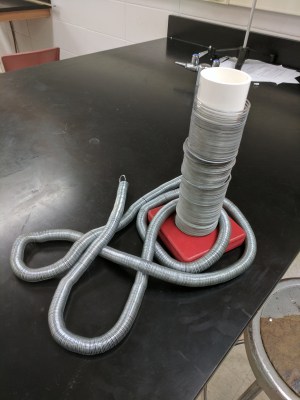
We started establishing some ideas about earthquakes. I pulled out the slinky and snakey spring to model the different types of waves. It was all pretty teacher-directed, so I’d love to come up with a way for students to build more of those ideas on their own.

slinky.jpg

Day 135: Closed Pipe Waves & Porosity

AP Physics: Closed Pipe Waves

I started class by showing students a few examples of sound waves in open pipes to establish that standing sound waves follow the same rules we saw last week for a standing wave on a string fixed at both ends. Then, I had students use our speed of sound materials to find the pattern for sound waves in a closed pipe. To keep the follow-up discussion short, I went back to standing at the front of the room and asking students to share their general results. In one class, students spontaneously started answering my questions by pointing out a lab partner who’d said something interesting and asking them to share, which lead to some students who don’t always speak up in whole-class settings getting their voices heard, which was pretty cool.

standing wave (1).jpg

Earth Science: Porosity

Students designed their own experiments to compare the porosity of sand, gravel, and Play-Doh. Students needed a little more scaffolding on how to measure the amount of water absorbed, but they ended up with nice results overall. Tomorrow, we’ll spend some time connecting these results back to the structure of aquifers.

aquifer

Day 134: Board Meeting & Artesian Wells

AP Physics: Board Meeting

Students whiteboarded the results of yesterday’s lab. Several students had already seen λ=c/f in AP Chemistry, and I was pleased to hear them discussing how their results fit with that formula.

wave wb

Earth Science: Artesian Wells

Students simulated an artesian well to find how the change in elevation affects the flow rate. I wish I’d spent more time on the pre-lab discussion to help set up what students should measure and why. I really liked the connections to energy it was possible to make; a few of the students I had last tri sketched bar charts and were able to generate some very nice explanations for why the big elevation change produced a high flow rate.

well

Day 133: Standing Waves & Glaciers

AP Physics: Standing Waves

Today started the standing waves unit. I gave a quick overview of standing waves using a simple sim in Desmos, then we got out the wave generator to collect data for a relationship between wavelength and frequency. To save time, we collected data as a class, but students felt very little connection to the results. Last year, I had students use a Direct Measurement Video to get the same kind of data, then used the wave generator to test some ideas, and I think I’d like to go back to that approach next year.

standing wave.jpg

Earth Science: Glaciers

Students used the textbook to dig into how glacial features are formed. While I wish I’d been able to come up with something more tangible, there were some good conversations about how to effectively use the textbook.

Day 132: Problems & Glaciers

AP Physics: Problems

Students worked on some oscillating particle problems. Students had some really good discussion about a cart on an angled ramp oscillating on a spring; a lot of groups really dug into what should happen when the angle of the ramp changes. At the end of the hour, we tested their predictions. I wasn’t paying much attention to when I started data collection, but still got a set of graphs my 2nd hour considered applause-worthy.


Earth Science: Glaciers

I gave students a brief overview of some glacial features, then had them use some sand in the stream tables to make a recreational area with a variety of glacial features. Students liked the activity, but they did not connect the vocabulary to how the features form or how they are related. I think I’d prefer to do this at the end of a glacier unit, where students would have the background to tie the features they are using together. At this point in the unit, I’d rather focus on how these features form to give some basis for naming them.

glacier

Day 131: Pendulums & Springs & Dam Removal

AP Physics: Pendulums & Springs

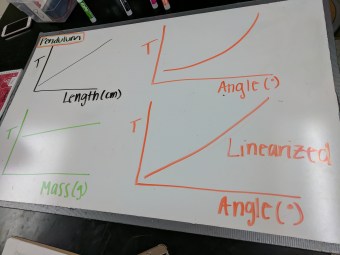
Students wrapped up their labs on what affects the period of  springs and pendulums, then whiteboarded the results. I could tell I was rushing the lab more than I have in the past and I ended up taking over a lot of the post-lab discussion and got a bit hand-wavy. As I rush through the last few topics, I haven’t been doing as much with uncertainty, and this is a lab where it would have really helped. I also skipped having students predict the period of a 5 m long pendulum, which made it much tougher to settle on which relationship works best for the length of a pendulum. Going into waves, I need to think about how I will balance the need to keep moving with giving students time to truly engage with the content.

pendwb

Earth Science: Dam Removal

Students continued work on their dam removal project. Today, they looked at a gradual release, which we modeled by removing one lay of foam at a time. I was very pleased at some of the detailed observations students made and how engaged they were in trying to think about why their observations happened. I’d love to re-work this unit to give students a better grasp of sediment transport in rivers before looking at dams specifically to give them more tools for thinking about the project.

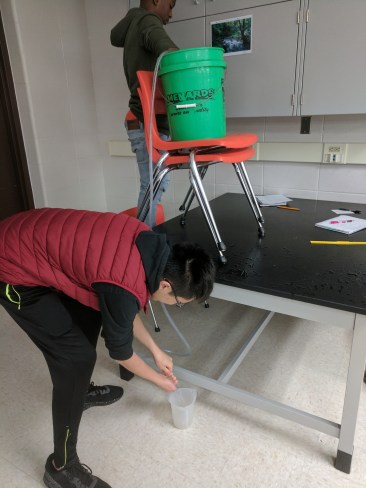
dam

Day 129: Period & River Features

AP Physics: Period

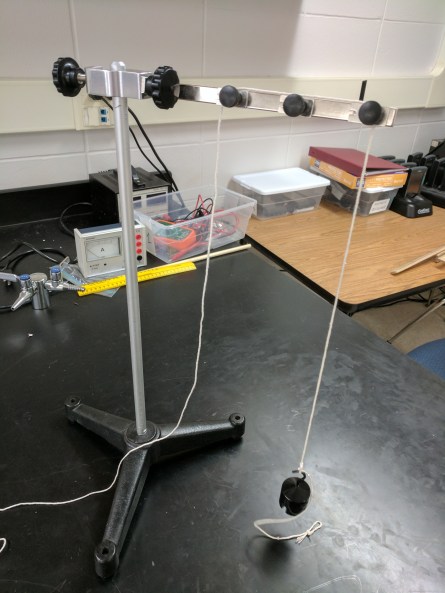
Half the class did experiments to model the period of a pendulum, while the other half did experiments to model the period of a spring. We have three types of springs, and their spring constants are different enough that you can’t test all three with the same mass. Next year, I might have students start by using one spring to test how amplitude and mass affect period, then check their model with a second spring.

pend

Earth Science: River Features

Today, the curriculum called for notes on typical river features, followed by students looking for those features in topographic maps to classify rivers as young or old. Before we did any notes, I had students sort the rivers based on their own categories. They based their categories on things like width or windiness that resulted to very similar sorts to young and old and lead nicely into the vocabulary. When students went back to their groups to sort the rivers by age, I noticed students got less accurate, largely because they interpreted small curves as meanders, making rivers seem older.

topo

Day 128: SHM Energy & Floods

My classes had a sub while I chaperoned a field trip today, so no photos.

AP Physics: SHM Energy

Students worked on some problems on the role of energy in simple harmonic motion. While there aren’t any circular motion problems today, I’ve been liking the connections we’ve made to circular motion and I’m spending the bus ride thinking about if and how I want to connect today’s work to circular motion.

Earth Science: Floods

Students watched a video and answered some questions on flooding.

Day 127: Oscillating Particle Model & Problem Scoping

AP Physics: Oscillating Particle Model

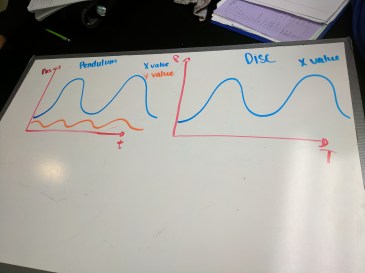
Students whiteboarded their video analysis results for the trio of objects in simple harmonic motion. I haven’t done a lot of circular motion in the past, so when we discussed the spinning disk, I was intrigued by how many students were convinced the angle in the video was responsible for the changing velocity. On a whim, I had students sketch the disk from directly above, then had them sketch velocity vectors, including components, at a few points around the disk, which nicely convinced students that they would see similar graphs for the horizontal motion no matter what the viewing angle.

shm trio

Earth Science: Problem Scoping

This unit includes an engineering project to plan removing a dam from a river. I gave students a memo from their imaginary client and had them do some problem scoping. One of the questions I ask is what background knowledge they will need, which can nicely set up a unit, but students did not identify anything about rivers or erosion as useful knowledge on this project. The memo mentions sediment transport as a major challenge in removing the dam, but I don’t think students saw that as something that would require background knowledge to understand. Even when I handed out the unit’s learning targets, students did not name the target about describing river behavior as one that will be useful. I need to think about how I will address that during the unit.