Day 62: Mistakes Game & Balancing Reactions

Physics: Mistakes Game

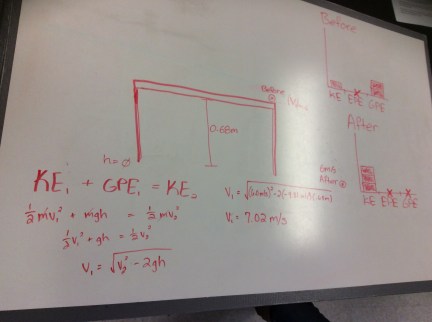
We played the mistakes game with yesterday’s conservation of energy problems. For students who had the other physics teacher last trimester, this was their first experience with the mistakes game. I was pleased with the way the students I had last tri took the lead, helping their peers come up with interesting mistakes and modeling good questions.
IMG_0317

The mistake is a subtle sign error, but lead to some great discussion about determining whether an answer is reasonable.

Chemistry: Intro to Balancing Chemical Equations

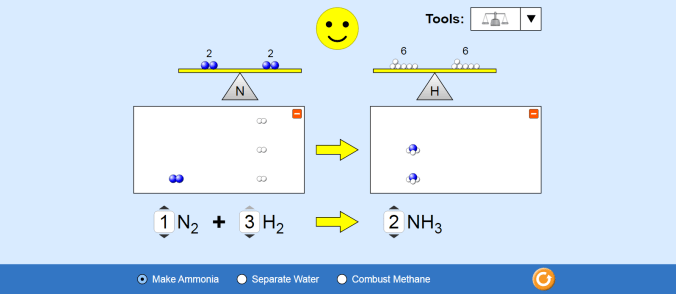
I took advantage of the visuals in PhET’s Balancing Chemical Equations sim to introduce my students to this process. I had them start by playing in the introduction to figure out what the different representations tell them about the chemical equation. After students had some time to play, we came back together. My students were able to articulate pretty clearly what it means for a reaction to be balanced, and what it has to do with conservation of mass. Students then spent some time testing their understanding by playing the game built into the simulation. Based on the conversations I overheard as they played, students were getting a much better understanding of not just how to balance chemical equations, but what all those numbers in the equation mean. I was also pleased to see the confidence my students gained while playing the game. I think a lot of them have started to assume they don’t understand things in the classroom, so seeing that immediate, consistently positive feedback from the game helped them see the way they’re thinking about these reactions really is useful.
phet balancing

Day 37: Kirchoff’s Rules & Vector Addition Diagrams

Physical Science: Kirchoff’s Rules

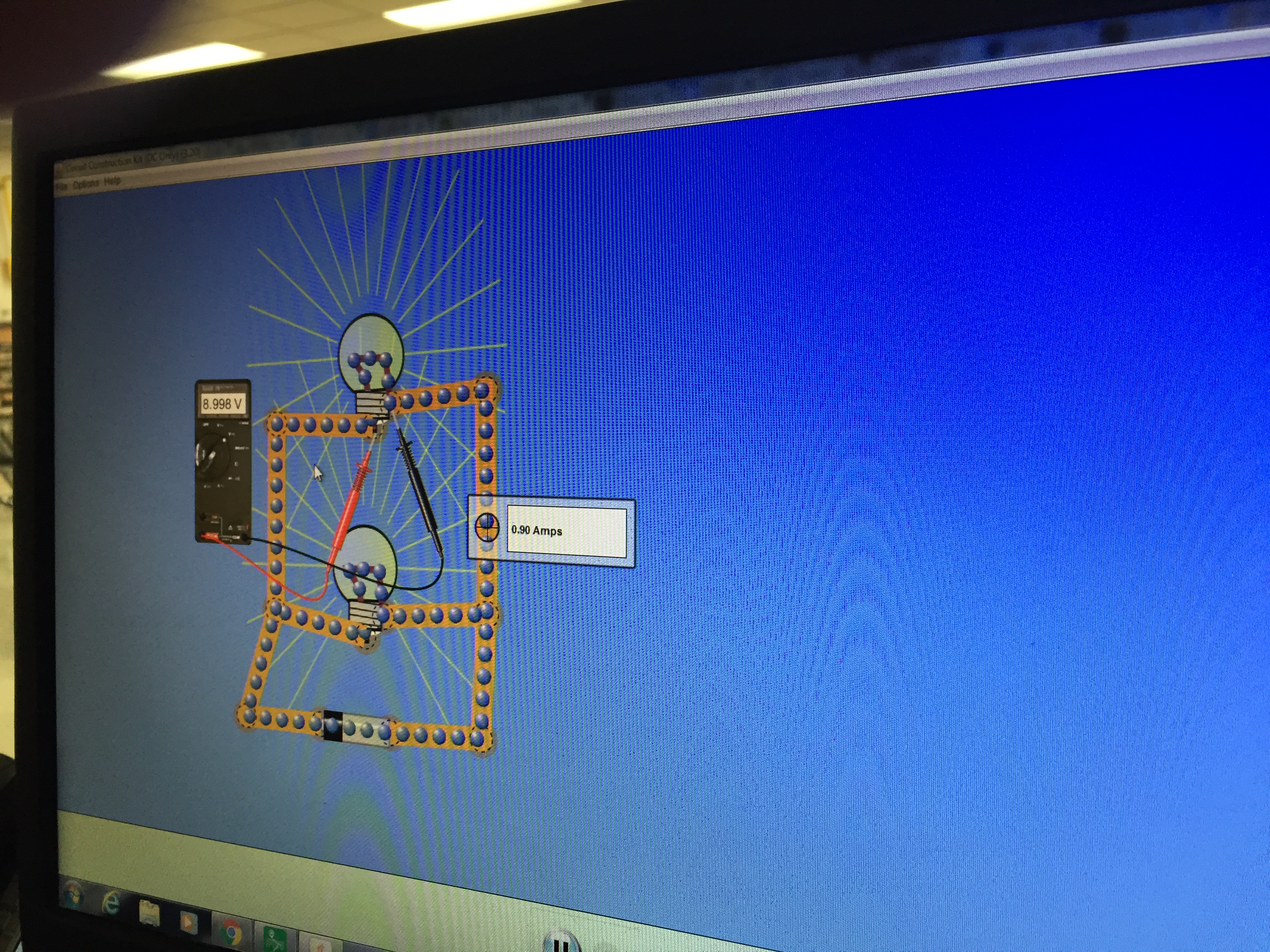
With my 9th graders, I’ve always done series and parallel circuits pretty superficially where they try a few things in the lab, then memorize a couple of key behaviors. This year, my students have been thinking about the energy in circuits in some interesting ways that seem useful for getting at Kirchoff’s Rules, so I decided to give it a go. Today, students used PhET’s circuit kit to compare the voltage and current in different parts of each type of circuit. Students were able to articulate very nicely their own versions of Kirchoff’s Rules based on the energy in the circuit.

IMG_1337

Physics: Vector Addition Diagrams

Today, students took their first look at forces in 2D and drew some vector addition diagrams to scale. The problems, lifted from Kelly O’Shea, were all on a grid to keep things straightforward. This gave students the opportunity to practice drawing vector addition diagrams and start thinking about what they mean without getting bogged down in the math. Tomorrow, we’ll start crunching numbers with the diagrams.

Day 35: Series vs. Parallel Circuits & Board Meeting

Physical Science: Series vs. Parallel Circuits

Students used PhET’s circuit construction kit to explore the differences between series and parallel circuits. When I’ve used batteries and bulbs, students really struggle to see (let alone articulate) what’s going on with the current, so the visible “electrons” in the simulation were a huge help in getting students to understand why certain changes happened.

Physics: Board Meeting

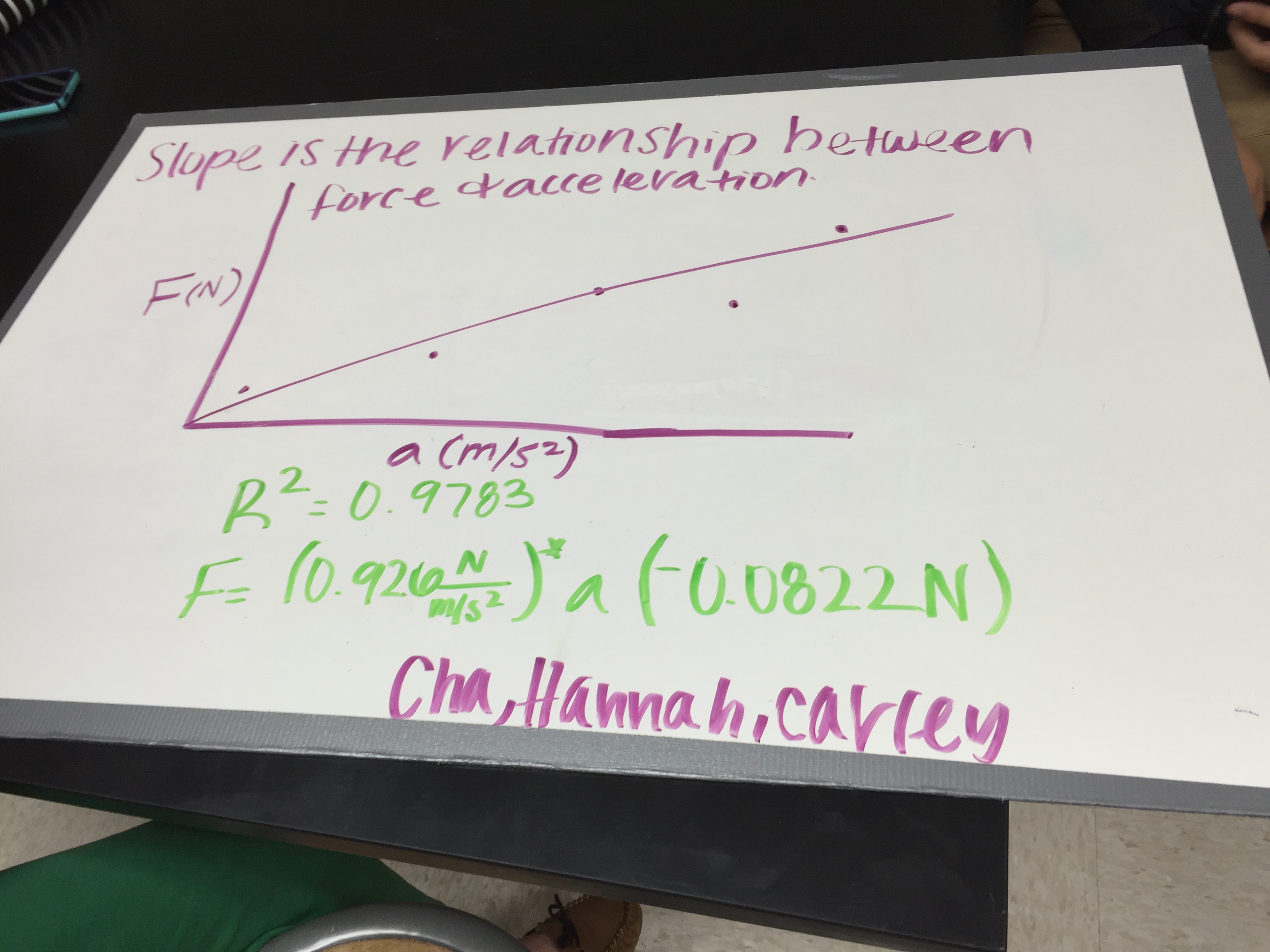
We discussed as a class the results of the Newton’s 2nd Law lab. I need to have students practice talking about the slope more; they were able to get to “The force needed to accelerate 1 m/s2“, but it took some pushing on my part; I think the issue is just lack of practice. I was pleased by the discussion; students are doing more articulating of the big ideas. I was really excited by the discussion students had about the intercept. I’d planned to declare the intercept zero and move on, but in both sections students seemed interested in talking about it. They decided it would be reasonable to have a non-zero intercept on this experiment and it would be equal to the amount of friction you have to overcome to start the cart moving.

IMG_1333

Day 5: Energy Conservation & Motion Maps

I forgot to take pictures during class today, so words will have to do.

Physical Science: PhET Energy Conservation

After going over the definitions students worked on Friday, we went back to the PhET skate park simulation to look more specifically at energy conservation. I had several different scenarios where I asked students to predict what the energy bar charts would look like for key positions of the skater. The plan was for students to then check each of their predictions using the simulation, but very few groups got to that point thanks to assorted tech issues. I overheard some great conversations where students were really digging into the definitions of the different types of energy along with the details of the skater’s motion to not only make predictions, but find evidence to make supporting arguments. Since it can be tricky to get computer access, I’m planning to project the simulation tomorrow to test the predictions as a class.

Physics: Intro to Motion Maps

Today students added motion maps to their representations of the constant velocity model and practiced translating between representations using the motion detector lab from the Modeling Instruction materials. Once they got rolling, most of my students seemed to get comfortable with this new representation pretty quickly. I think I drove a few of them a little nuts, though. Inevitably, students came up to me to ask if their answers were right and, rather than just saying yes or no, I tried to stick to asking questions about their representations. My goal during class is always to get students to think harder than me (at least about the physics), so I want to get them to analyze any work they aren’t confident about, even if their answer is already perfect. The trick is they’re used to only being asked to think about their wrong answers, so as soon as I started questioning a lot of students panicked and assumed they were way off. I started prefacing each conversation with a reminder that I was asking questions because I wanted to understand their thinking, not necessarily because their result was wrong. That little reminder seemed to help a lot of students to focus on what I was asking rather than immediately start searching for their mistake, which I think made the conversations more valuable even when their was a mistake for the student to find. I’m sure that as students get used to being asked to explain their thinking (and I get better at probing for their reasoning), the instinct to panic and start searching for the error will fade.

Day 3: Defining Types of Energy & First Board Meeting

Physical Science: Energy Types

Students used PhET’s Energy Skate Park sim to begin exploring energy. Their directions were to open up the bar graph, then find as many ways as they could to change the size of each bar. Tomorrow, their observations will lead into the definitions for kinetic and potential energy.

Energy skate park screenshot

PhET’s Energy Skate Park

Physics: First Board Meeting

Students prepped whiteboards with their results from the Buggy Lab, then we had our first board meeting. I talked more than I wanted to during the meeting, partly because I was rushing to get students ready for a sub tomorrow and partly because I didn’t take enough time to set expectations or let students pre-discuss in smaller groups. Next time, I want to try using Casey Rutherford’s Observations, Claims, & Evidence structure to provide students with a little more scaffolding. My students were very willing to speak up and take risks during the board meetings, so I’m excited to see how future ones go!

Student whiteboard

Student whiteboard

IMG_0198

Another student whiteboard