Day 69: Angled Projectile Practical & Ohm’s Law

AP Physics: Angled Projectile Practical

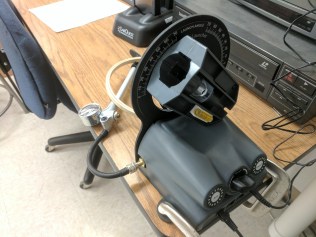
We wrapped up yesterday’s mistakes game, then started a lab practical. Each group got a different distance from the launcher, and needs to determine how high off the ground to place a hoop so that the projectile will travel through it. Tomorrow, we’ll setup the hoops so students can see the results. In both this practical and the problems we’ve been doing, I’ve found some of my strongest students get stuck. They usually know what they’re doing, but don’t see their way to the answer yet. I need to keep reminding my students that they can play with the pieces, even if they don’t know what the full picture will look like yet. I might look for a good goal-less problem to combine with the practical tomorrow to help push them towards thinking about what else they can do, rather than what the answer must be.
launcher

Physical Science: Ohm’s Law

I’ve found I really like having students use PhET’s circuit construction kit before we get out the batteries and bulbs, so today we went to the computer lab to find a relationship between current, voltage, and resistance. I left the directions fairly open so that students would be designing their own experiments. Since I don’t talk much about units in this course, the simulations ammeter felt like a black box to a lot of the students. I was really intrigued by one student who measured current by counting how many blue dots passed a selected point in one minute, which connects really nicely to the definition of current as the flow of electric charge.ohms-law

Day 63: Projectile Problems & Energy Conservation

AP Physics: Projectile Problems

For most of the hour, students worked on some problems for projectiles launched horizontally. A few students needed reminders to start by sketching and annotating their velocity-time graphs, but students were pretty successful once they remembered to use the graphs. Students also checked to make sure I’m not going to do anything crazy tomorrow, like go over the problems, when they’ve much rather do the Mistake Game.

On Friday, students requested slow-motion video of the race between a horizontally launched marble and a marble in free-fall, so I recorded some video before school.


Earth Science: Energy Conservation

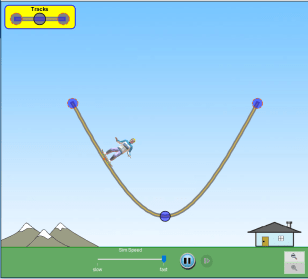
Students whiteboarded their predictions for the scenarios in PhET’s Energy Skate Park I’d given them Friday, then we tested predictions and discussed the results. We especially focused on the total energy bar to get the idea of conservation of energy.

img_20161212_082543

Day 62: Board Meeting & Energy Types

AP Physics: Board Meeting

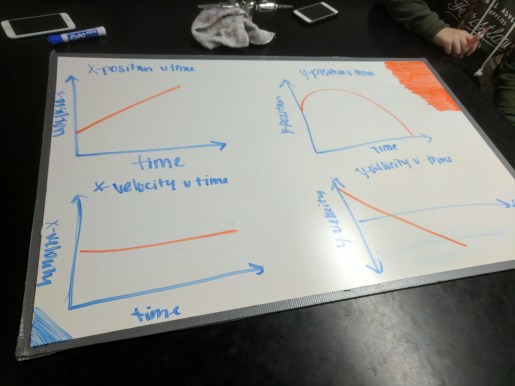
Today, students whiteboarded the results of yesterday’s video analysis. Since my 2nd hour had quite a bit of discussion and worked through much of the sense-making while they were in the computer lab yesterday, I skipped some of the structure I’ve been using in board meetings and we got to the big ideas pretty quickly, which left time to whiteboard CERs of predictions for a demo that drops one marble straight down while launching a second horizontally. In my 2nd hour, I barely had to speak as the students spoke to each other and had some fantastic discussion that accomplished exactly what I hoped it would. In my 4th hour, my students were much more hesitant to speak up. They are a naturally quieter group and had a lot less dialogue in the computer lab, so I think they would have benefitted from some pre-discussion in their lab groups and a little more structure, like Casey Rutherford’s Observations, Claims, & Evidence which I’ve used to frame most of the board meetings this year.

projectile graphs.jpg

Physical Science: Energy Types

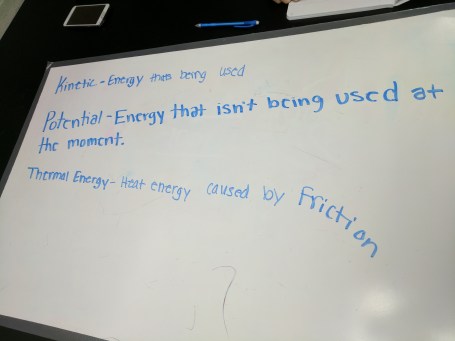
We had some discussion about what seemed to be key characteristics of the energy types in yesterday’s simulation to form a basis for some definitions. I took a page from Modeling Instruction and defined potential energy as coming from interactions, then had some discussion about what constitutes an interaction. In the past, I’ve used stored energy as the definition for potential in 9th grade, but I like that interaction energy solidifies the connection between potential energy and forces.

energy-defs

Day 61: Projectile Video Analysis & Energy Skate Park

AP Physics: Projectile Video Analysis

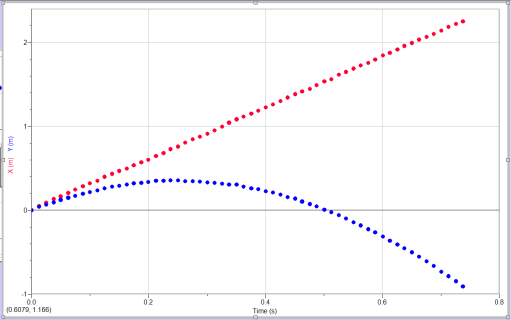
I gave students two videos of some students tossing a basketball and a video analysis guide I put together, then tasked them with getting the position vs. time and velocity vs. time graphs for each video of the basketball. I had a bunch of students who got genuinely excited when they looked at the velocity vs. time graphs and started putting together what they know so far to begin a model of projectile motion. One group even cheered when the slope of their y-velocity vs. time graph matched what their model so far!

vid-analysis

Physical Science: Energy Skate Park

Students played with PhET’s Energy Skate Park simulation to look for how they could change the size of the various bars in the bar chart. Students pretty enthusiastically played with as many options as they could find, and made some nice observations, like how the motion of the skater changes when they switch to the moon or Jupiter.

skate-park

Day 44: Central Forces & Orbit Wrap-Up

AP Physics: Central Forces

Students whiteboarded their results from Monday’s activity. In the computer lab, there was a lot of debate about what forces were acting on the weight, so I had students include an FBD for the weight on their whiteboards, which lead to some fantastic discussion in my second hour. Students had strong opinions on whether or not there should be a force to balance the tension and were quick to offer an argument one way or another. Even better, a number of students who are usually quiet during whole-class discussions put ideas and arguments out there. Along the way, students connected this back to the bowling ball lab, where one of their tasks was to get the bowling ball to travel in a circle using a rubber mallet. This was the first time I really felt like I got to just sit and listen while my students figured out something important together, and it was fantastic. As the class came to a consensus, one student captured his take with the “mind blown” gesture and sound effect.img_2473

Earth Science: Orbit Wrap-Up

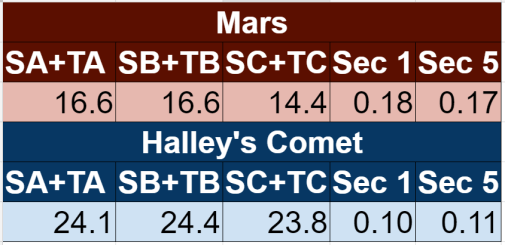
Students took a few minutes for students to finish their measurements for the look at the orbit of Halley’s Comet, and we discussed the results. Interestingly, when we looked at the total distance to the focal points, the class averages for Halley’s Comet was better than the class averages for Mars. When I played with the data on my prep, I saw that one group got dramatically different results from the rest of the class. Tomorrow, I’d like to take some time to look at that with my students to get at the idea of outliers and how to handle them in science.

comet-results

Day 41: Central Force & Comet Orbits

AP Physics: Central Force

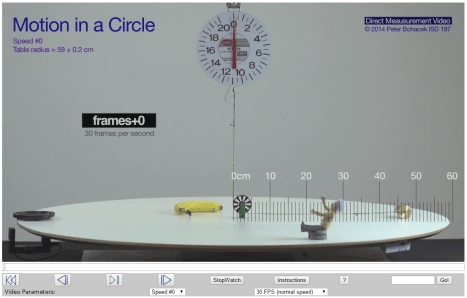
Students used a Direct Measurement Video of a weight on a rotating table to find a relationship between force and tangential velocity. One of the first questions on my activity was to draw a free-body diagram of the weight and determine whether there is any net force. A lot of groups had some great discussion as they tried to rectify the fact that the table rotates with a pretty constant speed with the fact that their free-body diagrams showed a net force on the weight. There were also some groups that asked questions like how the speed of the banana compared to the speed of the weight, bringing them back to a Direct Measurement Video of a rotating disk we’d used earlier in the year.

motin-in-a-circle-dmv

Earth Science: Comet Orbits

A major theme this week is comparing different kinds of solar system objects, so I decided to take an idea Michael Lerner gave me last week and have students compare the orbit of Halley’s Comet to Mars. I used an ellipse drawer to give students the orbit of both objects, then had them start by making some observations. Today, most groups only had time for the qualitative questions about the two orbits.

comet-orbit

Day 22: Wrap-Up & Review

AP Physics: Lots of Wrap-Up

Today was a lot of wrapping things up. We started by whiteboarding both the accelerated disk and free fall Direct Measurement Videos with some brief discussions about each. At this point, I was just trying to get students to recognize the parallels between angular acceleration and linear acceleration, so that didn’t feel too rushed. The discussion on free fall did skip over some important points, so I’ll be revisiting that topic next week. This is the first year I’ve included uncertainty in my class, and I could tell during the discussion that my students are starting to internalize those concepts, which added some nice layers to the discussion.

We also took some time to try and finish the lab practical we started Monday. Students are rolling a steel marble down a ramp with the goal of landing it in a tumble buggy driving by. Today, I threw them for a loop by adding that they need to pull off the same thing with glass and acrylic marbles, but the only new measurements they can take are mass. With the time for discussions, only a few groups got to test, so I’ll be making some adjustments next week to make sure students have a chance to finish.


Earth Science: Review

Students have another quiz tomorrow, so I repeated my review activity from last time. Students worked in groups to write a few questions for each learning target, then periodically traded whiteboards with another table to try and answer another group’s questions. This time, students were coming up with some deeper questions, which was great to see.

Day 21: Angular Acceleration & Satellite Data

AP Physics: Angular Acceleration

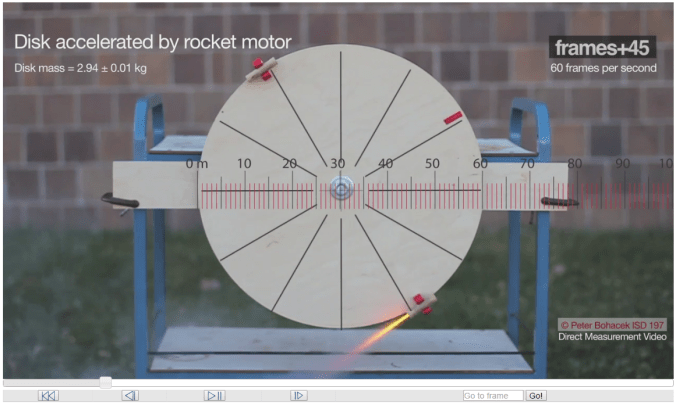
This year, I’m embedding circular motion concepts as we wrap up their linear motion analogues, so today students took their first look at angular acceleration. Students used a Direct Measurement Video to plot angle vs. time for a disk with a rocket motor attached. Students were quick to notice their graph looked a lot like position vs. time for an object with linear acceleration, and were able to extrapolate a lot from there.

rotating disk.PNG

Earth Science: Satellite Data

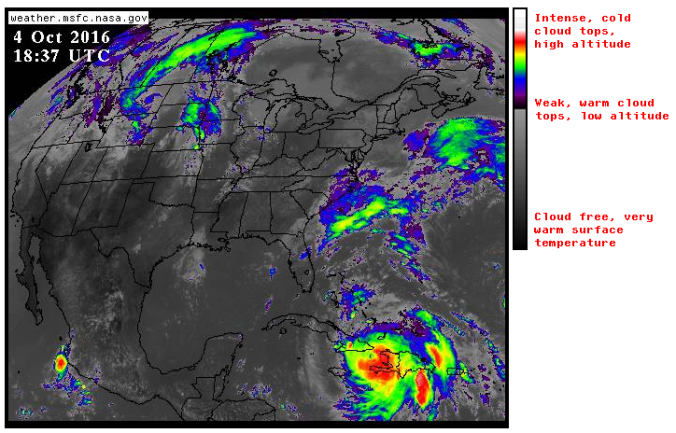
Students looked at some images of cloud cover produced by NASA’s GOES satellite to make some claims about the cloud cover and associated weather in a few areas of North America. I didn’t use my evidence-based reasoning graphic organizer today, and I don’t think its a coincidence that many students just stated their claims without any evidence. I need to keep being explicit about what good reasoning looks like and stay on students to keep including that in answers.

goes-infrared

Day 19: Free Fall & Humidity

AP Physics: Free Fall

Students worked on plotting position vs. time using a Direct Measurement Video of five different spheres in free fall. This is the first year I’ve had students use uncertainty, and I’m finding I really like how it shapes conversations. A lot of students were looking for specific times in the video, then estimating the position of the sphere at those times, but a quick conversation about the large uncertainty that produces in position quickly got them to see the value in switching their approach.

five objects.PNG

Earth Science: Humidity Analogy

Students worked through some questions using beakers of water as an analogy for air at different temperatures and how that impacts humidity. It was pretty tricky for many students to predict what should happen to the water level when a given amount was moved to a larger or smaller beaker, so I think I’d like to get out actual beakers and water the next time I do this activity to make it a little more concrete. They did seem to get the analogy and were able to make some good predictions about humidity and dew points by the end of the hour.

Day 11: Photogates & Atmosphere

AP Physics: Photogates

To introduce constabt acceleration, students used photogates to collect data for position vs. time and velocity vs. time graphs for a cart on a ramp. A lot of students were a little intimidated by the LabQuests at first, but, by the end of the hour, they declared my decision to get probeware instead of textbooks was the right one.


Earth Science: Layers of the Atmosphere

Students plotted altitude vs. temperature for Earth’s atmosphere, which lead nicely into the different layers. Some students were bothered by the fact that their graph didn’t pass the vertical line test for a function, so we had some discussion about the different purposes a graph can serve and why it might make sense to sometimes break certain rules.