Day 82: Mapping Electric Potential & Stoich Practice

Physics: Mapping Electric Potential

Students used Plotly to make contour maps of the data they collected yesterday. I was out on a field trip, so students followed along with a video I made last year. Based on my sub’s report and what the students I ran into said, the video went much more smoothly than when I’ve tried to give live instruction since students could pause and rewind the video to make it go at their pace. Tomorrow, we’ll do some talking about the results.

Electric Potential in a Water Tray- Pennies in Corners (1)

Chemistry: Stoich Practice

I left students two stoich problems broken up to try and help them think conceptually about the process. According to my sub, students struggled with the problems. Tomorrow, I’m planning to spend a lot of class time discussing the problems.

Day 81: Mapping Electric Potential & Stoich

Physics: Mapping Electric Potential

Students collected data for the Modeling Physics lab on mapping electric potential.

IMG_1601

Chemistry: Stoich

Students finished the lab from Friday. The idea was to work through a stoichiometry problem, using nuts, bolts, and washers to represent atoms. My goal was to get students to think concretely about the process so that the math would make more sense. While students got closer to understanding the process, almost none of them saw the connection between their materials and the math they were doing. I need to re-work some of the questions and directions to explicitly prompt them to use the materials at key points. I also need to think about how I could have students use the manipulatives to answer the most frequent questions I got, so I can give them that nudge next time instead of focusing on the math.

IMG_1602

Day 80: Projectile Launchers & Return to Stoich

Physics: Projectile Launchers

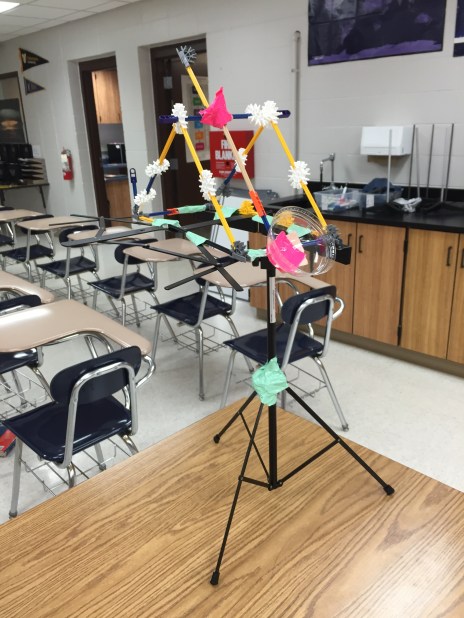
Students tested the final versions of their projectile launchers today. I picked random target distances in three different ranges, and groups had to pick one target to try and hit. I really enjoyed seeing the creativity in the materials students used. On group built a basic launcher out of K’Nex and decided to take a slushie break as they tried to come up with something to hold the ping pong ball, only to realize the lids from their slushies were the perfect size and shape. They also decided an adjustable height would make it easier to hit the target and came up with attaching the launcher to a music stand.

While students applied a lot of good data analysis to the project, the connections to energy and projectile motion weren’t as strong as I’d like, which I think has a lot to do with the way I broke up the project. I tried to squeeze energy into the two weeks between the start of tri 2 and winter break, and the project ended up bleeding into electrostatics. Next year, I may try starting the project with projectile motion, then working the redesign into the energy unit. There will be some administrative challenges, since the project will be split across two terms and a lot of students switch class periods, but I think it will pay off with students seeing a stronger connection to the physics content.
IMG_1595

Music stand, K’Nex, and a slushie lid

Chemistry: Return to Stoich

The next unit covers percent yield and limiting reagents, but scores were low enough on the assessment I gave before winter break that I want to revisit stoichiometry before we try any percent yield problems. Today, students started a lab to predict masses for an imaginary reaction using nuts, bolts, and washers in place of actual atoms. I wanted to give them something they could manipulate and measure very directly to get some conceptual understanding of stoich before we try any more problems. I wrote the lab with the intention of helping students work piece by piece through the process and questions frequently rely on information from a previous answer. A few groups, I think in an effort to be collaborative, tried to divide and conquer, and the students working on the later portions of the lab found they were stuck. Before we finish the lab next week, I’m planning to have a conversation with them about the shortfalls of the divide and conquer strategy and to come up with some more effective collaboration strategies.

IMG_1599

Day 69: Projectile Launchers & More Stoich

Physics: Projectile Launchers

Instead of writing a lab report on an energy lab, I’m having students build projectile launchers that convert gravitational potential energy into kinetic energy. Today, students brought in their prototypes and had some time to test how well their prototype worked, as well as collect data on how at least two different variables affect the range of their launcher. When we do the final tests of the launchers, groups will need to hit a target at a randomly selected distance, though groups can chose between a small, medium, and long range. The launchers ranged from very simple, like a paper ramp with a meter stick spine, to more complicated, like the full-blown trebucet.

Chemistry: More Stoich

My plan had been to give students 15 minutes or so to work on the last two problems from Friday’s worksheet, then have them write an example problem where they would include a written description of the steps along with their work, but nearly all of my students needed the whole hour to finish Friday’s problems. Most of them were really focused on the steps they needed to follow and, not surprisingly, students are overwhelmed by how many steps there are and losing track of a lot of details. Next time, I need to start with some activities to help students to better connect the concepts to the process. I might do something with the nuts, bolts, and washers I used to introduce molar mass to make things more concrete at the start.

Day 68: Work & Stoich

Physics: Work

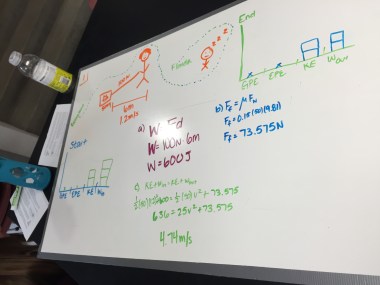
Students did some problems where the energy of the system is changing. The other physics teacher and I skipped having students define their system due to time constraints, but some of the mistakes I’m seeing could be fixed by having students take that step, so I will be going back to the full LOL diagrams next year.

IMG_1539

Chemistry: Stoich

Students did some problems calculating theoretical yield for chemical reactions. When we first started balancing chemical equations, I required students to sketch a diagram of the atoms involved to emphasize that the atoms are just being rearranged. Today, I left it up to students whether they wanted to include the sketch or not, and it drove home for me how important concrete, conceptual tools are when nearly every student still drew the diagrams.

Day 67: Work & Molar Mass

Physics: Work

Students picked a specific height above the lab table and calculated how much energy a dynamics cart would have at that point. Then, they set up ramps at three different angles and sketched force vs. displacement graphs to represent pulling the cart up the ramp to the height above the table they picked earlier. Finally, they calculated the area of the force vs. displacement graphs. This lead nicely to a definition of work as the cart’s change in energy and the area of a force vs. displacement graph.


Chemistry: Molar Mass

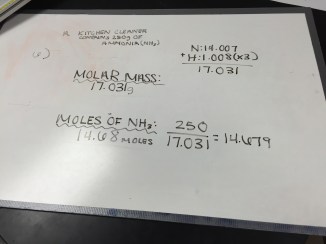
Students worked on some word problems using molar mass. While no diagrams made it onto whiteboards, a lot of students sketched molecules the same way they’d done when balancing equations to help determine when they needed to multiply a mass from the periodic table.

IMG_1532

Day 66: Bouncy Balls & Molar Mass

Physics: Bouncy Ball Energy

Students worked on collecting data to determine whether a bouncy ball looses more energy while its in the air or when it hits the table. There are lots of different approaches, and groups spent the majority of their time trying to figure out what might be useful to measure, which lead to some great discussions. The most elegant approach I saw was a group that did some video analysis in Logger Pro and produced a position vs. time graph. They argued that since each bounce’s parabola is symmetrical, the bouncy ball must be at the same speed for a given height on that bounce, so the energy stays the same while its in the air. Then, they compared the steepness of the parabolas for each bounce to show that the energy changes after the bouncy ball impacts the table.bounce graph

Chemistry: Molar Mass

Students practiced using electronic balances and switching between mass and moles. One of their tasks was to determine how many atoms of chalk it took to write their name on a lab table. The best part of today, however, was the ways I saw my students starting to come together as a class. I saw a lot of students, including some with a reputation for typically checking out in school, having great conversations about the quiz I returned or the day’s assignment. A few students even took over the whiteboard at the front of the room and started adding to what I’d put up there as they tried to make sense  of their measurements. I’ve been having a lot of conversations with these students about what effective collaboration looks like, since many have not really experienced it, and its great to see those conversations translating into the actions of my students.

IMG_1529

Day 65: Bouncy Balls & Molar Mass

Physics: Bouncy Balls

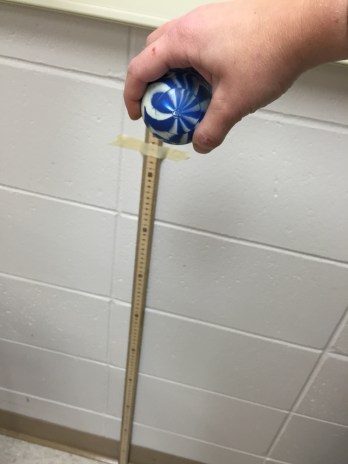
I gave students a bouncy ball and two tasks. First, they had to come up with their own quantitative definition of efficiency, then take measurements to determine the efficiency of their bouncy ball. Most groups are finding a ratio of the rebound height to the drop height.

Second, they need to determine whether the bouncy ball looses its energy while in the air or when it collides with the table and need to support their answer with quantitative data. Since we also had a quiz today, most groups only got to the point of deciding what kinds of energy the bouncy ball should have at different points in its path and starting to consider what they could measure related to those energies.

IMG_1527

Chemistry: Molar Mass

I’m trying to start each new concept with something concrete, so to introduce molar mass, I had students build “molecules” from bolts, nuts, and washers. They found the total mass of all the components, then compared that to the mass of the molecule.

IMG_1523

A “molecule” of NW2B2