Day 81: Exploding Carts & Speed of Sound

AP Physics: Exploding Carts

Students worked on the exploding carts lab to build momentum. I rushed through the intro in my 4th hour since they didn’t have a chance to start collecting data, and students struggled with some pieces as a result, especially with what it looks like to graph ratios instead of numbers. I could also tell it’s been a while since we did a true model-building lab; a lot of groups got very focused on specific numbers, rather than the overall pattern. I need to do a better job of making sure we do those kinds of labs regularly.
explosion-1

Physical Science: Speed of Sound

Students used a closed pipe to find the speed of sound. As a result of some of the changes I made this year, students had a much better conceptual understanding of the lab than in the past. The calculation to get the speed didn’t quite seem to fit, though.

While students worked, I conferenced with students about their progress on a project. I met with every student, whether or not they had a draft. I really liked getting a chance to talk to each group; I think it gave a few students a push to stop procrastinating.


Day 80: Exploding Carts & Sound

AP Physics: Exploding Carts

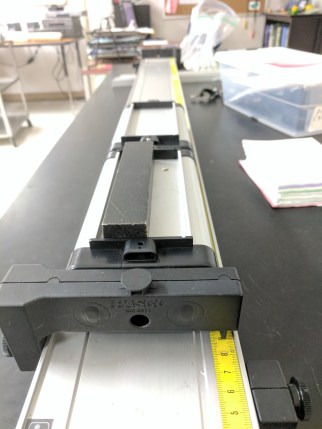
Today’s quiz took longer than I expected. One of my classes had some time to start collecting data on two carts in a mechanical explosion. They are plotting the ratio of the cart masses to the ratio of their speeds after a spring-loaded plunger launches them apart. I thought about using some probeware to measure the velocity, but went low-tech and had them use the ratio of the distances when the carts reached the end simultaneously. I like that this approach encourages students to start looking for patterns as they collect their data.

explosion

Physical Science: Sound

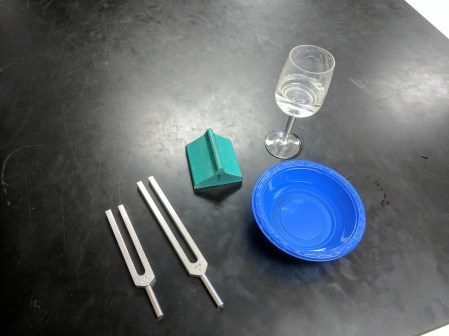
Students used tuning forks and wine glasses to explore some ideas about sound. Students made a lot of great observations and had good discussions with their lab groups and were able to bring some of that back to the whole-class discussion. One of the instructional coaches came by to give some input on helping my students adjust to my approach, and he had a couple of ideas I want to try. Since I keep relationships very qualitative in 9th grade, I ask a lot of questions with limited options, such as whether a variable increases, decreases, or stays the same when another variable changes. The coach suggested I have students physically move to a specific part of the room based on their answer to make it harder to opt out and to facilitate some additional conversations between students. I also like this because it is more obvious to students that we’re doing something different than going over answers like they’re used to. I tend to skip whiteboards in 9th grade, but my conversation with the coach has me thinking they would have some of the same benefits. I need to give some thought to how I can make time for whiteboards in a very tight curriculum.

I also got an idea from grading notebooks this afternoon. I use interactive notebooks, but have gotten very lazy about doing the left side/right side stuff. One of my students has started having a page for each lab, then using the facing page for a summary of the big ideas. That was a good reminder that the left side/right side can actually fit pretty well with what I’m trying to do in the class and I should be having students do those lab summaries.

sound

Day 78: Flying Pig & Quiz

AP Physics: Flying Pig

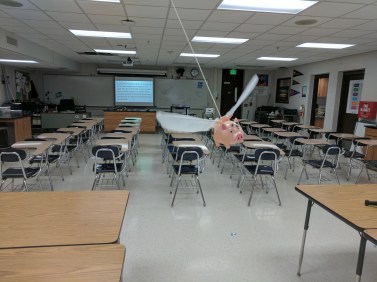
Today, I got out the flying pig for a lab practical. I had students measure the length of the string and the height of the cone, then use what they know about forces and circular motion to predict the time for the pig to make 10 revolutions.

pig

Physical Science: Quiz

Students took a quiz on magnetism. Afterward, we took a few minutes to review vocabulary for talking about waves that students learned during first trimester. It was pretty teacher directed, but I didn’t want to spend much time on terms students should have mastered earlier this year.

Day 77: Friction on Ramps & Energy Sources

AP Physics: Friction on Ramps

Students whiteboarded a few of the questions from yesterday’s activity examining motion graphs for a cart on a ramp. Usually, most of my students rotate their vector addition diagrams so that the legs of any right triangles are parallel to the edges of their paper. Today, I didn’t see any rotated diagrams; I don’t think its a coincidence that today was also the first time I saw students consistently make very strong connections to the physical situation they describe. Now I’ve got a chicken and egg question; did students leave the orientation of their diagrams because they saw the physical meaning, or did they see the physical meaning because they left the orientation?

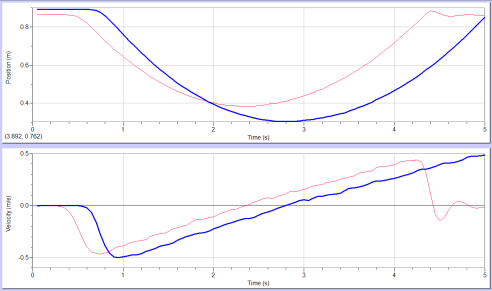
I also had students write a CER on whether friction is negligible in the data I gave them. I ended up really liking how small the accelerations are; the acceleration when the cart is moving upward is only about 0.05 m/s/s larger than the acceleration when the cart is moving downward, but it works out to a 25% difference, so students had some great conversation about uncertainty and how big a difference is big enough to matter.


Physical Science: Energy Sources

Students signed up for a topic and started researching different energy sources for a short presentation. Minnesota has a standard about comparing and contrasting different energy sources, so I have them research the pros and cons of their energy source. I need to think about what I want to have students do when the are watching presentations at the end of the project.

Next year, I might introduce this project at the start of the electricity unit. I like connecting the energy sources to what students know about electromagnetism, but I think I can maintain that connection if I make the project due after the unit has ended. I always have at least some students without internet access at home, so I try to provide some in-class worktime for the project. Since I do several simulation labs during the electricity unit, I could build in some worktime by encouraging students who finish the lab early to work on their research.

Day 76: Unbalanced Forces & Motors

AP Physics: Unbalanced Forces

I borrowed an activity from my AP Summer Institute where students get a position vs. time graph and a velocity vs. time graph for a cart on a ramp. At the institute, we were tasked with finding the angle of the ramp and force of friction, but I decided to take a more conceptual approach and tasked students with writing an argument on whether friction is negligible. This was a little ambitious for their first experience with 2D unbalanced forces; I think it would have gone smoother if we’d spent some time practicing free-body diagrams and vector-addition diagrams for unbalanced 2D forces first.

cart-on-ramp

Physical Science: Motors

Students built electric motors, then did some simple experiments to drive home the connection between electric currents and magnetic fields. They seemed to get the connection between today’s lab, the electromagnet lab from Friday, and basic electricity generation.

I also took some time during class to talk with my students about what I want from them during a post-lab discussion and what I’m trying to accomplish during those discussions. I saw a lot more students participating in today’s discussion, both by raising their hands and by adding to their notebook entries. I’m planning to keep reminding them of what the post-lab time should look like, as well as share a little more about why I do things differently than the other 9th grade teachers. I need to remind myself that even if I’ve been in this routine for a full trimester, this is still new to most of my students.


Day 75: Whiteboarding & Electromagnets

AP Physics: Whiteboarding

Most of my students were on a field trip today, so classes were pretty small. We whiteboarded some problems from earlier in the week on balanced forces in 2D. While the problems had a lot of calculations, I just had students whiteboard their diagrams and set-up, including some intentional mistakes. Later, I’ll post correct answers to the class website so students can check their calculations.


Physical Science: Electromagnets

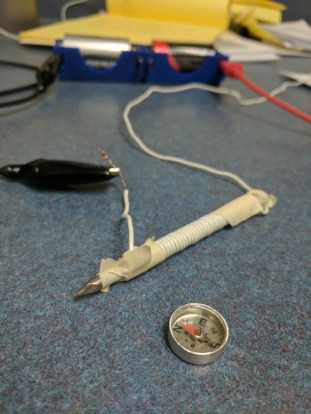
Students built electromagnets, then made some observations about the magnetic field and strength of the magnet.To visualize the field, most groups opted for the compass over the filings, which reinforces my thinking earlier this week that I should start students with the compasses to see the bar magnet’s field.

This week, I’ve been thinking a lot about the fact that I’m really struggling to engage students the way I’d like, especially in post-lab discussions. The last couple of years, I’ve been able to get almost immediate buy-in from my 9th graders, but I think that’s because I only taught them during 1st trimester, when I got to set their expectations for high school science. Most of my students right now had a different teacher 1st tri, so I’m upending their expectations just when they were starting to get comfortable with high school and need to be much more intentional about helping students adjust. On Monday, I want to start with some conversation with the class about my observations and why I do things differently than their other science teachers. I’m also going to start thinking about how I can smooth the transition 3rd trimester, when about 2/3 of the class will be new to me again.

electromagnet

Day 74: Balanced Force Practical & Field Lines

AP Physics: Balanced Forces Practical

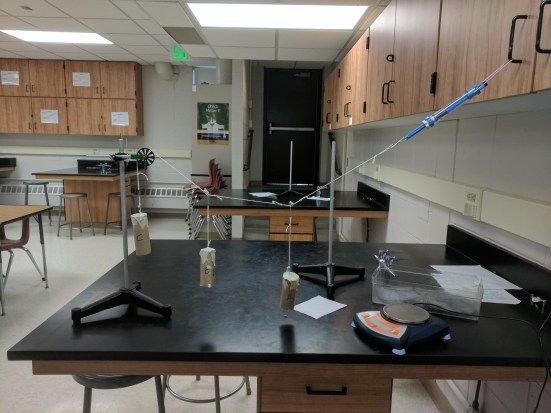
I tasked students with figuring out the unknown masses in a set up with several strings at different angles. Groups found they had to be very clear about what they defined at their system, which as a nice element of the task. Different groups defined their systems differently and took different approaches to solving their vector addition diagrams, which lead to some fantastic conversations when groups who finished early compared results. I got really happy when I overhead a student slowing down his group down by telling them the process is more important than the answer, and even used the fact that I couldn’t remember the masses I used as evidence.

During prep today, I got a kick out of grading quizzes. I’ve been asking students this year to self-assess and do a short reflection on each quiz, and several students took that into specific problems on this quiz. These students wrote down some really interesting, specific metacognition right alongside their solutions without any extra prompting. It was really interesting to read. I might start having students do some journaling later this tri to explicitly encourage that kind of thinking.

practical-1

Physical Science: Field Lines

To help make sense of magnetic field lines, I had students connect gravitational energy to a topographic map of a hill, then went back to the magnetic field lines we saw yesterday to talk about magnetic energy. I haven’t done any forces with this class yet, but they are fairly solid on energy, so magnetic energy seemed to help ground the material in a way I don’t think forces would have. I also like that the topographic map helped link back to some of the map interpretation students did first tri in Earth Science.

field-lines

Day 73: Force Vector Addition & Magnets

AP Physics: Force Vector Addition

Students worked some problems with balanced forces in two dimensions. We also had some discussion about whether you could have a mass hanging from a perfectly horizontal rope and used some hanging masses and string to experiment with some of the ideas. Not surprisingly, they really wanted it to work with a small enough mass in the center and a large enough force on either side, but once they started drawing free-body diagrams, it became very clear that the rope has to flex.

tension.jpg

Physical Science: Magnets

Students played with some bar magnets and steel filings to start building some ideas about magnetic fields. Every year, my 9th graders struggle to see patterns in the filings, even when they are very clear to me. I usually have them start with the filings, then get out a compass to compare the patterns. Next year, I might have them plot the orientations of a compass arrow first, giving them some specific positions around the magnet to check, then get out the filings. That should give them an idea of what to look for in the filings.

magnet

Day 72: Vector Addition & Electric Power

AP Physics: Vector Addition

I shamelessly stole an activity that Casey Rutherford shared on Twitter. I gave students some free-body diagrams drawn to scale, and had them use pipe cleaners to rearrange the vectors and do some graphical vector addition. The activity not only reinforced graphical vector addition, but I was pleased with how it drove home the difference between forces that are balanced and forces that are equal.

vectors

Physical Science: Electric Power

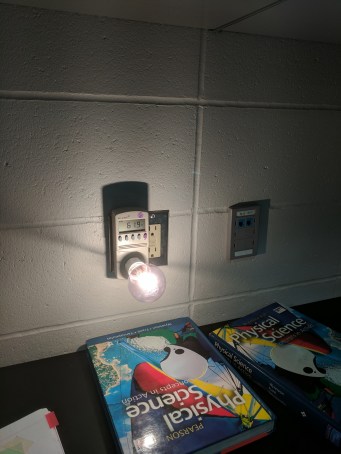
Students plugged different light bulbs into Kill-A-Watt monitors to find the power each one used. To emphasize the connection to energy, I also had students sketch energy bar charts for each light bulb, using light and thermal energy as their energy types. This lead very nicely into a comparison of the efficiency of different light bulb types.

killawatt

Day 71: Quiz & Circuits

Today was our last day of classes before break!

AP Physics: Quiz

Students took a quiz on projectile motion. My collaborative team’s goal is related to experimental design, to I included a problem to give my students some practice and feedback on designing on an experiment entirely on paper. I planned to have them play with some Mystery Tubes after the quiz, but it went longer than I expected, so I will save those for another day.

Physical Science: Circuits

I got out the light bulbs and batteries for students to build real-life circuits and see if the models they developed with the simulation still work. Not all of our light bulbs are identical, and I didn’t check the kits before class, so some groups had bulbs with different resistances. Next year, it could be interesting to use that as a feature, rather than a bug, and ask students to rank the resistance of their light bulbs based on qualitative observations.

circuit