Day 90: Angular Momentum & Mirror Mazes

AP Physics: Angular Momentum

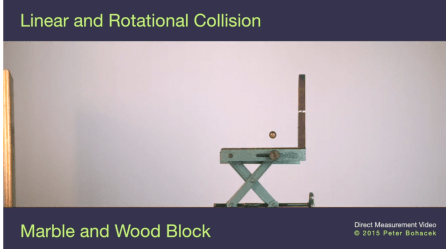
Students used a Linear and Rotational Collision Direct Measurement Video to get some practice with conservation of momentum. In the first question, I asked students to determine whether momentum was conserved in a certain collision using a calculation, and I was surprised by how many students struggled to understand the question. I might change up wording on some of the problems we did to explicitly have them state whether momentum is conserved or if there is an external force, similar to how I approach force problems by first asking students whether the forces are balanced.

I also asked some questions about whether momentum is conserved in collisions where the block starts to spin, and I heard some great conversations about uncertainty, external forces, and other big ideas that have me really looking forward to tomorrow’s discussion.
momentum-dmv

Physical Science: Mirror Mazes

Students used what they know about refection to solve some mirror mazes. I had some where students were given the placements of the mirrors and had to place the target and others where they were given the target’s location and had to place the mirrors. Since we haven’t done much with ray diagrams, this seemed to really solidify what I mean by the path of light.

obstacle

Day 89: Conservation of Momentum & Refraction

AP Physics: Conservation of Momentum

Students worked on some problems using conservation of momentum. I used some problems that require them to shift how they are define their system, which students found challenging at first, but once they got the hang of it, many seemed to appreciate how shifting their system can make a problem easier.

Physical Science: Refraction

Students did a lab making lots of observations of objects in a clear cup of water. Afterwards, we shifted to making some observations as a whole-class of a laser pointer in a fish tank. Once they summarized the big ideas based on observations, I set up a washer in the bottom of a fish tank and aimed a PVC tube to view the washer. Students predicted where, relative to the tube, they should aim a dowel and a laser pointer in order to hit the washer. I was very pleased at how successful students were at this task; I do wish I’d had them write a CER for this problem since a lot of students struggled to explain their prediction.

Day 88: Collisions & Mirrors

AP Physics: Collisions

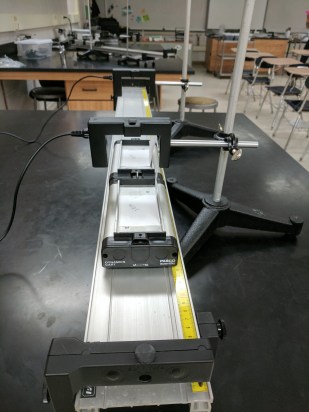
Students finished collecting data to compare momentum before and after a collision of two carts, then had just enough time to talk through results. I just gave students a data table from the Modeling Instruction curriculum, but I think my students could have handled something more open-ended as long as I can plan how I will make sure students get a good variety of collisions. I ended up falling into a pretty teacher-centered “discussion” after the lab to limit how much time we spent, but I think we missed out on a really good opportunity to talk about uncertainty and assumptions. Next year, I might have each group do just a few collisions so we spend more time discussing the results.

lab

Physical Science: Mirrors

I gave students three questions about the images formed by a mirror and tasked them with writing a CER for each question. This is the least structured lab I’ve given students so far this year, which made some students nervous, but I was pleased with the results. I had students whiteboard their CERs so we could have some discussion, but I had students stay at their lab tables and a lot of students kept going back to small group discussions. I think this was because I’ve established a very clear routine where the desks are for whole-class discussion and the lab tables are for lab group discussions. Next time, I’ll probably keep the discussion in the lab area, but have students stand up and move away from their tables to get the physical cue that its time to shift focus to the whole class.

Day 86: Collisions & Presentations

AP Physics: Collisions

Today, we started expanding the momentum transfer model to cases where two objects are moving before the collision. We got out the photogates so students could find the velocity before and after various collisions of two carts. I got a kick out of how exciting it was for some students to use .

collisions.jpg

Physical Science: Presentations

Students presented their research projects on different energy sources. I like the sort-of-public forum to share their work, but it is tough for students to sit through a bunch of presentations, even though I never spend more than half the class period on them. For next year, I want to put some thought into other formats that might balance the public accountability with more active engagement. Maybe a poster session with some kind of task for students as they view each others’ work.

Day 85: Impulse & Color

AP Physics: Impulse

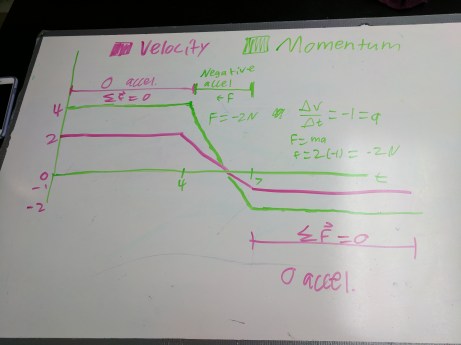
I introduced impulse today by rolling a cart into a force sensor with a bumper to look at the momentum vs. time and force vs. time graphs. I did this as a demo since we only have one bumper. In my 2nd hour, we got pretty nice data and students easily saw that the area of the force vs. time graph equaled the change in momentum, but my 4th hour got pretty ugly data and I’m not sure why. Afterwards, I borrowed from Michael Lerner again and had students work on solving some impulse problems using SOS diagrams.

bumper

Physical Science: Color

Students wrapped up the lab on color. Using some colored paddle filters, they observed white light bulbs, colored light bulbs, white paper, and colored felt. Next time, I might have them look at the felt under the colored light bulbs, as well, to strengthen their ideas about colored objects under different light sources. After the lab, we confirmed some observations using a diffraction grating on an overhead projector to get colored light. Finally, we revisited the video I’d shown them before the lab to refine and expand their initial explanations. In what is probably old news to people familiar with the role of phenomena in NGSS, the concrete goal of explaining an unexpected observation seemed to help students participate more, as well as give them a firmer grasp on what it looks like to understand the learning target. I’m wondering if using phenomena to frame more labs could help students coming to me from another teacher adapt to my classroom.

filters

Diffraction grating with paddle filters

Day 83: Momentum-Time Graphs & Longitudinal Waves

AP Physics: Momentum-Time Graphs

I’m taking a page from Michael Lerner and having my students use momentum vs. time graphs. Today, they worked on translating a p vs. t graph into a v vs. t graph, then do some interpretation. I also asked them about the meaning of the slope on the p vs. t graph, and I was pleased with how many students went immediately to the units to look for hints; in past years, my students needed much more prompting to look there. This year, I’ve been working a lot on getting students to look for meaning in graphs, and its fun to see them taking ownership of those skills.

pt-graph

Physical Science: Longitudinal Waves

Students whiteboarded some problems about longitudinal waves. I steered a lot of questions toward the parallels between longitudinal waves and transverse waves since it is usually a big leap for 9th graders to apply principles we discovered with transverse wave to other types. We also talked about why it might be useful to model something like sound that we know is a longitudinal wave as a transverse wave.

waves

Day 82: Board Meeting & Experimental Error

AP Physics: Board Meeting

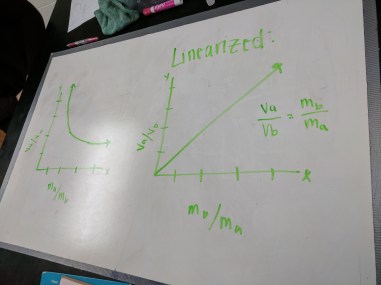
Students whiteboarded their results from the cart explosion lab to start building the momentum transfer model. I can tell its been a while since we’ve done a true model-building lab, so students needed some reminders about how to linearize or “translate” y=mx+b, but those skills came back pretty quickly. I did wish I’d had students linearize a bigger variety of graphs so far this year; a lot of students went straight to squaring a variable, so I may want to think about how to get more variety early in the year next year.

When we discussed the lab, a few groups had linerized based on a quadratic relationship and had a fairly large intercept. To decide whether the large intercept made sense, one student suggested exploding the plunger cart off empty space to get a mass ratio of zero and show the velocity ratio must also be zero.

img_20170118_092249

Physical Science: Experimental Error

We spent some time discussing yesterday’s speed of sound lab, focusing on error in measurements. I tried having students stand in different parts of the room based on how they thought frequency affects the speed of sound. When students were picking their spots, there was a lot of great conversation, including some contrasting frequency and speed, which was a great side effect. As we talked about error and what it means for values to be “close”, I had a lot of students ask to move because they changed their mind about what the answer should be.

Day 81: Exploding Carts & Speed of Sound

AP Physics: Exploding Carts

Students worked on the exploding carts lab to build momentum. I rushed through the intro in my 4th hour since they didn’t have a chance to start collecting data, and students struggled with some pieces as a result, especially with what it looks like to graph ratios instead of numbers. I could also tell it’s been a while since we did a true model-building lab; a lot of groups got very focused on specific numbers, rather than the overall pattern. I need to do a better job of making sure we do those kinds of labs regularly.

explosion-1

Physical Science: Speed of Sound

Students used a closed pipe to find the speed of sound. As a result of some of the changes I made this year, students had a much better conceptual understanding of the lab than in the past. The calculation to get the speed didn’t quite seem to fit, though.

While students worked, I conferenced with students about their progress on a project. I met with every student, whether or not they had a draft. I really liked getting a chance to talk to each group; I think it gave a few students a push to stop procrastinating.


Day 80: Exploding Carts & Sound

AP Physics: Exploding Carts

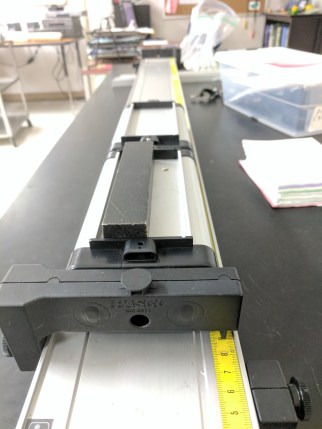
Today’s quiz took longer than I expected. One of my classes had some time to start collecting data on two carts in a mechanical explosion. They are plotting the ratio of the cart masses to the ratio of their speeds after a spring-loaded plunger launches them apart. I thought about using some probeware to measure the velocity, but went low-tech and had them use the ratio of the distances when the carts reached the end simultaneously. I like that this approach encourages students to start looking for patterns as they collect their data.

explosion

Physical Science: Sound

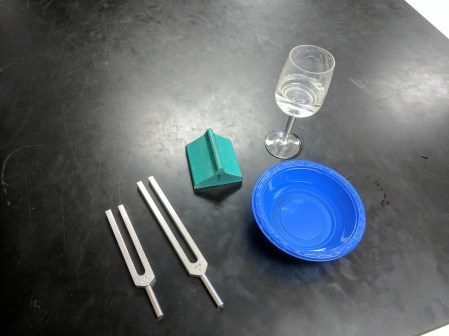
Students used tuning forks and wine glasses to explore some ideas about sound. Students made a lot of great observations and had good discussions with their lab groups and were able to bring some of that back to the whole-class discussion. One of the instructional coaches came by to give some input on helping my students adjust to my approach, and he had a couple of ideas I want to try. Since I keep relationships very qualitative in 9th grade, I ask a lot of questions with limited options, such as whether a variable increases, decreases, or stays the same when another variable changes. The coach suggested I have students physically move to a specific part of the room based on their answer to make it harder to opt out and to facilitate some additional conversations between students. I also like this because it is more obvious to students that we’re doing something different than going over answers like they’re used to. I tend to skip whiteboards in 9th grade, but my conversation with the coach has me thinking they would have some of the same benefits. I need to give some thought to how I can make time for whiteboards in a very tight curriculum.

I also got an idea from grading notebooks this afternoon. I use interactive notebooks, but have gotten very lazy about doing the left side/right side stuff. One of my students has started having a page for each lab, then using the facing page for a summary of the big ideas. That was a good reminder that the left side/right side can actually fit pretty well with what I’m trying to do in the class and I should be having students do those lab summaries.

sound