Day 111: TIPERs & Half-Life

Physics: TIPERs

Students worked through some questions related to magnetic forces from TIPERs. I overheard a lot of good discussions, and students shifting their ideas as they went.

IMG_1711

Chemistry: Half Life

We spent some time going over the results of yesterday’s lab, then students worked on some half-life problems. Based on conversations with my students, many were struggling to connect the definition of half-life to the process for solving problems. I need to rework the lab discussion for next time to try and help students really get what half-life means.

Day 106: Whiteboarding & pH Lab

Physics: Whiteboarding

Students whiteboarded their solutions to yesterday’s problem. In my class of 15, I had students present while in my class of 35, I tried a gallery walk, instead. I really liked the gallery walk with the big class; it gets hard to hear from everyone with that many people in the room, so talking about each board in smaller groups made it possible for more students to both ask and answer questions.

IMG_1682.JPG

Chemistry: pH Lab

Students did a lab to find the pH of household chemicals. Students did a nice job of connecting the properties of each chemical to the properties of acids and bases.

Day 105: Magnetic Force Problems & Gallery Walk

Physics: Magnetic Force Problems

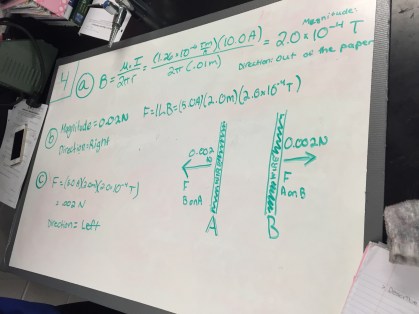
Students worked on some problems calculating the magnetic force on a current-carrying wire and a moving charge. Tomorrow, we’ll whiteboard the problems.

One of my students was eager to tell me about his visit to University of Minnesota-Duluth on Friday. He got a chance to hear from a physics professor about the use of inquiry, collaboration, and discovery learning in the physics courses, including why UMD takes that approach. The student was very excited to tell me UMD’s intro physics sounds just like my class, but with calculus, and that I must know what I’m doing if I’m teaching the same way as a professor. February and end of tri are always draining, so it was nice to get this boost from a student.

Chemistry: Gallery Walk

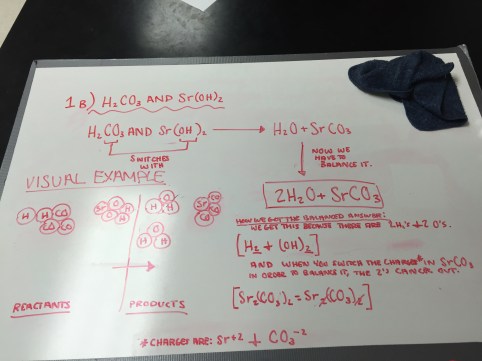
A lot of students in this class are very uncomfortable presenting whiteboards, so I decided to do a gallery walk. Each pair prepared a whiteboard of their solution to one of the problems and I checked their work. Then, one partner took their sheet and visited other whiteboards while the other partner stayed put to answer any questions on their solution. One student went above and beyond writing out the work for their solution, so her board was a very popular stop!
IMG_1680

Day 104: Electromagnets & Neutralization

Physics: Electromagnets

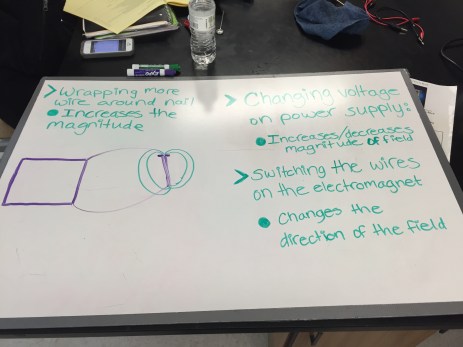
We finished Friday’s lab exploring electromagnets and students compared results. I had students look for as many ways as they could to change the properties of the field around the electromagnet. I was surprised to have several groups decide to try flipping the nail in their electromagnet to test what effect that had. I was glad they did, because it reinforced that the nail itself was not the source of the magnetism.

IMG_1677

Chemistry: Neutralizaiton

I did some grade checks during class on Friday, so the students weren’t asking very many questions on the neutralization worksheet and, as a result, almost no one had gotten past the example I did on Friday. We spent some time revisiting how to write the equation for a neutralization reaction and students got some time to work.

Day 102: Kirchoff’s Rules Revisited & PPM

Physics: Kirchoff’s Rules Revisited

Since the last quiz over Kirchoff’s Rules didn’t go as well as I’d hoped, we took some time to revisit the concepts and try a few more problems. Students left a lot more comfortable. They also really responded to an analogy I got from Kelly O’Shea thinking of current as people flowing through a hallway. It was pretty easy to get them to see that adding a new route in the halls made it easier to get around, which helped them get that adding a parallel branch actually reduces the resistance.IMG_1674

Chemistry: Parts Per Million

Today, students did some calculations using parts per million as a measure of concentration. They were pretty surprised at how small a number you get when you convert ppm into a percent concentration by mass, along with the fact that those low concentrations are really pretty significant in their impacts.

Day 99: Magnets & Concentration 

Physics: Magnets

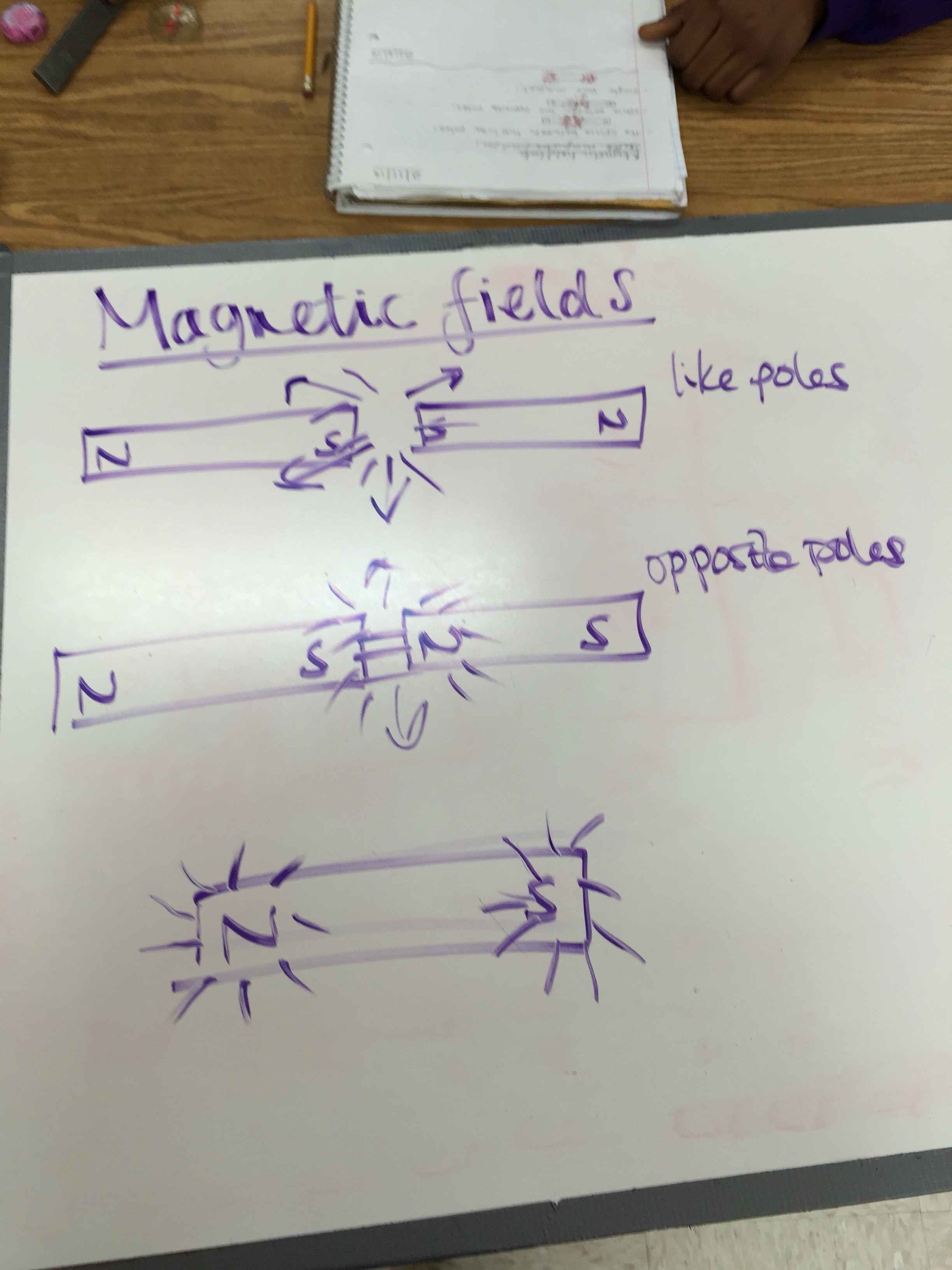
Students used yesterday’s observations to start sketching magnetic field lines. I also had them try to magnetize different materials; a lot were surprised to find that copper wire didn’t respond to their magnets. I ended by dropping a strong magnet through a copper pipe to give them something to puzzle over during the long weekend.

Chemiatry: Concentration

Students worked some concentration problems. I tried to take the opportunity to focus on more familiar contexts for problems, basing problems on what you could get at a drug store or grocery store, and the concrete settings seemed to help a lot of students.

Day 97: Speed Dating

Physics: Circuits Speed Dating

We did some whiteboard speed dating for compound circuit problems. I put different problems at different tables and, compared to when I’ve done all groups working on the same problem, it seemed like students were more willing to try and make sense of what their peers did. One of my favorite side effects is as students get frustrated trying to follow what a classmate did, they get more careful about showing their own work clearly. By the end of the hour, students seemed much more confident with these problems.

IMG_1649

Chemistry: Empirical Formulas Speed Dating

This class also did whiteboard speed dating, but with empirical formulas. In my physics classes, the students who are struggling with a concept try to take advantage of this activity by asking a lot of questions when they’re with someone who has it down and working through at a comfortable pace when they’re with someone else who is struggling, which contributes to the value of the activity. In my chemistry class, I saw something very different. When my students struggling with the topic were with a stronger student, they tended to mostly watch what their partner was writing without much interaction or conversation. When they were with another student struggling with the material, both would seem to shut down and wait for the next rotation. I need to keep working with students on what effective collaboration looks like and how their actions in class day-to-day contribute (or not) to their performance on assessments.


Day 93: Parallel Circuits & Reaction Rates

Physics: Parallel Circuits

Students did the real world version of the parallel circuits lab and put the patterns they’d come up with on whiteboards. After seeing that, in series circuits, the ratio of the resistance to the potential difference across a bulb had some significance, I saw more groups paying attention to the relationship between resistance and the current through a bulb in parallel.

IMG_1633

Chemistry: Reaction Rates

Students finished up the reaction rates lab from yesterday, and we discussed the results. Students are getting more comfortable sharing their ideas and finding their own connections to the material, which mean there were more students contributing to the discussion and I heard a greater range of ideas shared.

Day 91: Real Life Circuits & Energy in Equilibrium

Physics: Real Life Circuits

Continuing the circuit patterns set of labs from the PUM curriculum, students used power supplies and resistors to build series circuits and test the patterns they found in the simulation yesterday. Class ended with each group summarizing their rules on a whiteboard. Several groups used proportions to come up with a rule for how much potential difference goes to each resistor; for next year, I want to think about the questions I’m asking to try and get more groups to take a similar leap.


Chemistry: Energy in Equilibrium

Students did a short reading from the book to look at the role energy plays in chemical equilibrium and to help explain some of the results in yesterday’s lab. It also ended up being a nice set-up for the reaction rates lab we’ll be doing tomorrow.

Day 89: Cost Effectiveness of Light Bulbs & Vocab Intro

Physics: Cost Effectiveness of Light Bulbs

After a brief introduction to electric power, I tasked students with figuring out which of several light bulbs is the most cost effective. I provided them with the cost and estimated lifetime for each bulb and the current rate the local electric company is charging, along with some Kill-A-Watts they could use to take some measurements.

Chemistry: Reversible Reactions

After a quiz on limiting reactants, students used the textbook to start defining reversible reaction and equilibrium.