Day 6: Mistakes, Buggies, & Mass of Gas

AP Physics 1: Mistakes Whiteboarding

Students did mistakes whiteboarding, where groups include intentional mistakes in their solution, then the rest of the class asks questions to try to understand the mistake. I had a lot of groups pick mistakes they’d made working on the problems, which is perfect. In my big class, some students started turning to talk to their peers, which I let go at first since there were good conversations, but it quickly got hard to follow the main conversation and it was hard to shut the side conversations down once I let them start. Next time, I might try having some designated times for talking to a peer vs. talking as a whole class.

ap mistake

Physics: Buggy Lab

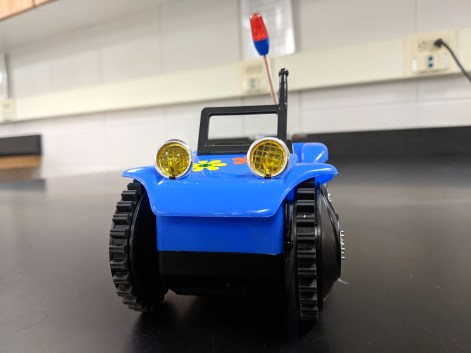
Students collected data for the buggy lab. I’ve found students are often very resistant to adjusting their procedure once they have any data written down, even if its only one point, so on the lab template we’re using, I have a step for students to test their procedure without recording any data. This time did exactly what I wanted today and I saw a lot of groups trying multiple approaches before settling on their steps.
buggy

Chemistry Essentials: Does Gas Have Mass?

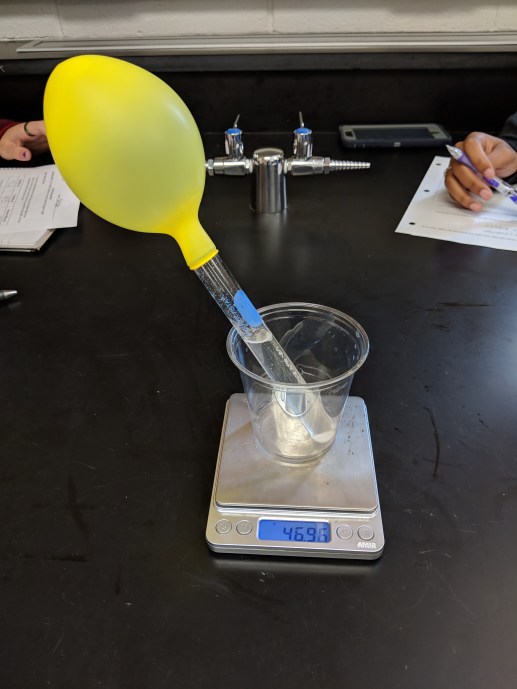
Students dropped Alka Seltzer into water, then measured the change in mass with and without a balloon on the test tube. This year, even though I had an approach in mind, we had some pre-lab discussion about possible strategies, and students had some neat ideas. There were a few things students came up with that provided a nice seque into this lab.
alka Seltzer

Day 161: Project Work & Whiteboarding

There was some extra chaos today and I dropped the ball on getting photos.

AP Physics: Project Work

Students worked on wrapping up their final projects. A lot of them are getting excited about presenting tomorrow. There are several students who had very ambitious proposals that I encouraged to scale back their project who have ended sticking with their original plan because they are enjoying the project, which is awesome. One student worked out the force on his legs at several key points during a hurdle race, along with trying to find the optimal launch speed for jumping over a hurdle.

Physics: Review Whiteboarding

Students did some more whiteboarding to review for tomorrow’s final. When sketching diagrams for a spring, a lot of groups had trouble with which direction the spring force was acting.

Chemistry Essentials: Whiteboarding

Students whiteboarded yesterday’s problems. The two hours before this class, there had been some excitement related to senior pranks, so the students were much more keyed up than usual and it was tough for them to stay focused. I also found students were having trouble keeping track of  a lot of the details on the bar charts, which isn’t surprising given how quickly we’ve been moving through this content.

Day 154: Resistivity, Ray Diagrams, & More Activity Series

AP Physics: Resistivity

This year, I skipped over resistivity, so my students who took the AP Physics 1 exam last week had some trouble with free-response problem 2. Today, we took some time to look at the problem and discuss strategies for solving without any knowledge of resistivity. The students who took the test last week were very willing to share how they approached the problem, which was better than anything I could have said.

Physics: Ray Diagrams

Students worked through a worksheet on ray diagrams for pinholes. Students worked pretty quickly and confidently, so we had time to whiteboard answers for a gallery walk. There were some great conversations where students brought up their observations from the lab the past few days to decide whether their ray diagrams made sense.

Maker:S,Date:2017-10-21,Ver:6,Lens:Kan03,Act:Lar02,E-Y

Chemistry Essentials: More Activity Series

Students worked on some additional problems identifying probably reactions using an activity series. I also had students predict the products of the reactions; since we haven’t done formula writing in a while, a lot of students needed a refresher. Once they got started, however, the problems quickly became pretty easy for students.

Day 150: Final Project Work, Whiteboarding, & Quiz

Its been a rough week, and I spaced out on taking pictures today.

AP Physics: Final Project Work

Students finalized their proposals for the final projects. A lot of students this year are interested in the idea of digging into a movie scene to see if the physics is realistic. I got out my copy of James Kakalios’ The Physics of Superheroes for interested students to take a look at since Kakalios does something similar with comic books.

Physics: Whiteboarding

Students whiteboarded selected problems from yesterday before taking their quiz on sound. A lot of students had trouble with a problem to determine whether an organ pipe is open or closed given the first three frequencies that produce standing waves; I think they weren’t connecting the sketches of standing waves we’ve been doing to the written problems.

Chemistry Essentials: Quiz

Students took a quiz on reaction types, as well as a second attempt at limiting reactant stoichiometry. Glancing over the quizzes, many of my stronger students relied heavily on particle diagrams, which is great to see. I need to keep working on helping all of my students connect those diagrams to the math.

Day 149: Final Project, Problems, & Whiteboarding

AP Physics: Final Project

Students continued refining their proposals for the final project. Lots of students have ideas I’m really excited to see. A few students are working on ideas where it may be interesting to look at dissipated energy, so we got out the infrared camera to play a little. It turns out some glasses block a lot of IR.

ir selfie

Physics: Problems

Students worked on some sound wave problems. Things seem to be clicking for most students.

Chemistry Essentials: Whiteboarding

We spent some time talking about the observations students made during yesterday’s lab and drawing explicit connections to the equation for the chemical reaction. My students don’t have a great sense for what certain chemicals look like, so it ended up being more teacher directed than I’d like. Students also weren’t sure when a chemical will show up as a gas, since I’ve dropped the subscript g in order to simplify the equations we’re looking at, but I’m not sure that is a useful simplification.

After the discussion (or, more accurately, lecture with student responses), student whiteboarded some limiting reactant problems. The students who were engaged made some good progress.

Maker:S,Date:2017-10-21,Ver:6,Lens:Kan03,Act:Lar02,E-Y

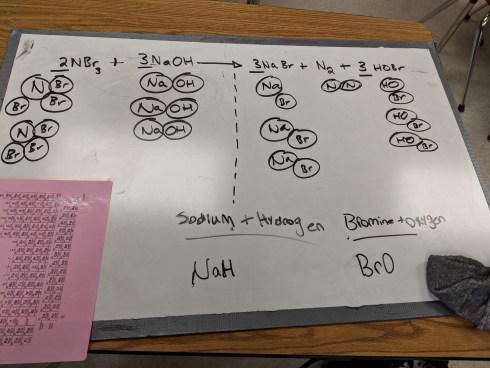
This student asked me if I could write the symbols for sodium hydride and bromine oxide

Day 146: Multiple Choice, Speed of Sound, & Whiteboarding

AP Physics: Multiple Choice

With the AP exam tomorrow, I asked students which of several options they thought would be most useful and both classes requested we use Plickers to review multiple choice. Most students weren’t at their most focused today, but there were still some good discussions.

img_2398

Physics: Speed of Sound

Students worked on the classic speed of sound lab. Since several labs lately have been pretty rough, I structured the pre-lab discussion more like the way I do in September to get back to basics of experimental design and made sure sketches of the set-up made it onto the main whiteboard. I also took advantage of the fact that students have made other wavelength vs. frequency graphs to emphasize that students should graph as they go to see if their results make sense. My 1st hour got a lot farther than my 5th, but their slopes are coming out very nicely.

speed of sound.jpg

Chemistry Essentials: Whiteboarding

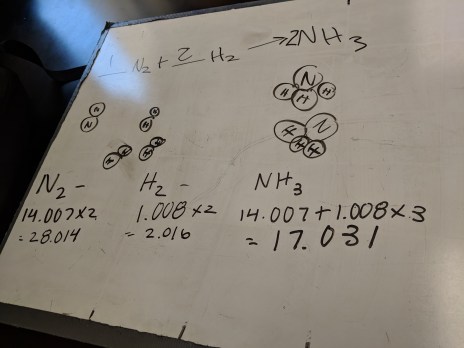
The limiting reactant quiz last week did not go as well as I hoped, so we spent some time today whiteboarding a problem, emphasizing the role of particle diagrams. The students who were engaged seemed to get a lot out of the whiteboarding.

chem lr wb.jpg

Day 145: Review, Whiteboarding, & Legos

AP Physics: Review

A lot of my students will be taking the AP Chem exam on Monday, so it was the last time the whole class was together before Tuesday’s AP Physics 1 exam. One class asked if we could spend the whole hour on multiple choice, so we worked through a bunch of problems I’d loaded into Plickers. My other section asked for more time to work on the 2017 free response problems, so they got into small groups for that after 20 minutes of multiple choice practice.

Physics: Whiteboarding

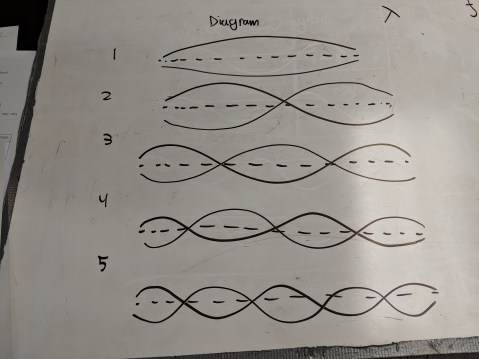
Students whiteboarded some of the problems we’ve been working on prior to taking a quiz. A few students have started talking in terms of patterns for the number of notes and anti-nodes which is great. Students are also seeing the diagrams as a tool in ways they have not with previous types of diagrams.

wave diagrams.jpg

Chemistry Essentials: Lego Reaction Types

Students used Legos to represent ions in chemical reactions to get a better understanding of the different reaction types. Manipulating the blocks seemed to help students get a sense of how the ions are rearranging in a chemical reaction and tie some meaning to the terms from yesterday. I’m wondering if this lab could be reworked to start the unit and motivate the language, rather than simply being an opportunity to practice the terms.

lego.jpg

Day 143: Mistakes Game, Wave Whiteboarding, & Assessment

AP Physics: Mistakes Game

Students put the finishing touches on their whiteboards from yesterday, then presented to the class for the mistakes game.  I gave students copies of the scoring guides to use during the discussion today. They were quieter than usual during board meetings, mostly because the whiteboard for a full free-response problem felt a little overwhelming.

IMG_20180502_121406.jpg

Physics: Wave Whiteboarding

Students whiteboarded yesterday’s problems. A lot of students were having trouble visualizing the standing waves, but sketching multiple wavelengths and marking the notes and anti-nodes seemed to help a lot of students.

stand wave wb.jpg

Chemistry Essentials: Quiz

Students took their limiting reactants quiz. I picked a problem where the numbers work out pretty nicely, and, glancing over the quizzes, it looks like the students who sketched particle diagrams nailed the problem.

Day 142: Mistakes Game, Standing Waves, & Lab Results

AP Physics: Mistakes Game

We spent about 15 minutes using Plickers to discuss some multiple choice from the practice test students took last week, then started working on the 2016 free response. Students started prepping whiteboards that we’ll use for the mistakes game tomorrow. Most groups got to the point where they felt they had a good solution on their whiteboard, so will need a few minutes tomorrow to add a mistake.

ap fr mistake.jpg

Physics: Standing Waves

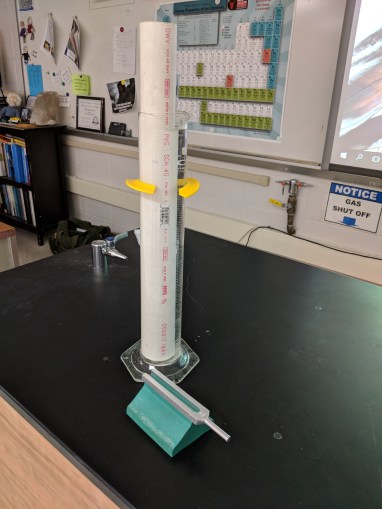
We got out the singing rod to reason out what must be the pattern for standing waves on a resonator free to vibrate at both ends, then students started working on some problems. A lot of students struggled to relate wavelength to the length of the resonator, in part because many of them were looking for a specific equation rather than using the diagrams the worksheet asked for as a reasoning tool. I need to think about how I can help students see the value of their diagrams tomorrow.

singing rod.jpg

Chemistry Essentials: Lab Wrap-Up

The copper from yesterday’s lab needed some time to dry, so today students got the mass and worked on their calculations. A lot of groups had balled up their aluminum foil yesterday, which lead to some big chunks of unreacted foil, even for groups where it should have been the limiting reactant. This ended up being a great opportunity for students to use a particle model for chemical reactions to think through why that happened.

dried cu.jpg

Day 140: Post-Test & Speed Dating

AP Physics & Physics: Post Test

Both of my physics classes took the FCI post-test. Not surprisingly, the scores in my AP class were much higher, but there was significant growth from the majority of the students in both courses.

Chemistry Essentials: Speed Dating

Students did some whiteboard speed dating on limiting reactant problems. The speed dating had mixed results; there were a lot of mistakes finding the molar mass, and most students weren’t comfortable changing the previous group’s work. This did lead into some good discussion on the value of showing your work and what clear work looks like. I also ended up working an example, which several students had requested at the start of the hour, but after the speed dating, I was able to address specific issues and challenges and students were more engaged than I think they would have been early on.