Day 118: Board Meeting, Projectile Problems, & Balancing

AP Physics: Board Meeting

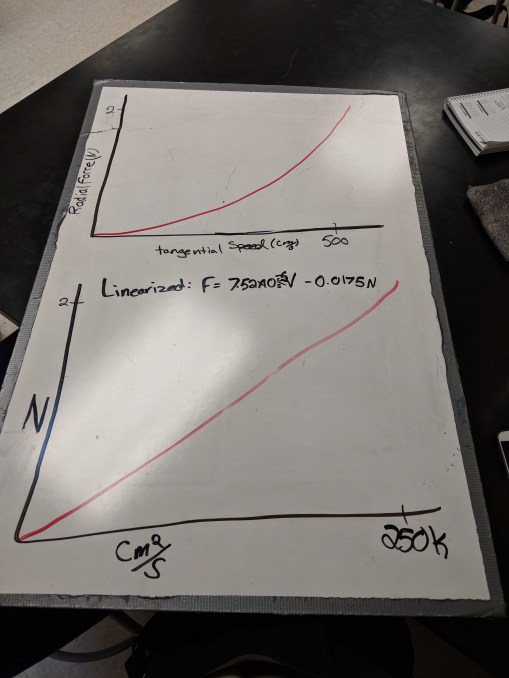
We had our board meeting for yesterday’s lab on centripetal force. I approached it as three mini board meetings since students had done experiments for how three different variables affect the force. The units on slope ended up being a very powerful way for students to see the connections between their three graphs. It was especially exciting when we got to the force vs. mass graph and students saw the connections to Newton’s 2nd Law. One class noticed the slope on the force vs. 1/radius graph has units of Joules, but I’m not sure of the significance of that yet.
force vs t.jpg

Physics: Projectiles

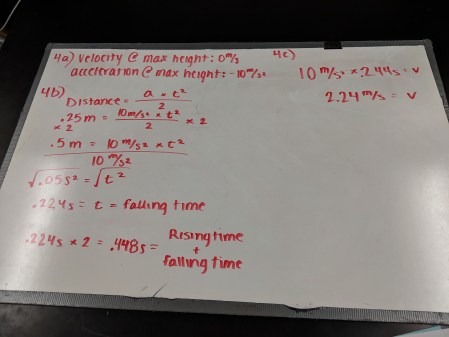
Students whiteboarded yesterday’s problems for a gallery walk. They are consistently viewing free-fall as just a special case of models we’ve already covered, which made the problems pretty easy.  Afterward, students started working problems for horizontal projectiles.
projectile prob.jpg

Chemistry Essentials: Balancing Reactions

After some discussion about the labs from the past few days, students worked on some problems balancing chemical equations. The students who started by sketching a particle diagram were generally very successful at seeing how to balance. A few students got tripped up determining when individual letters in a formula represent individual atoms, especially when the formula included a polyatomic ion, but were getting the hang of it after a couple problems.

balancing prob 1.jpg

Day 112: Rotation, Free-Fall, & Skew Dice

Today was the first day of a new trimester.

AP Physics: Rotation

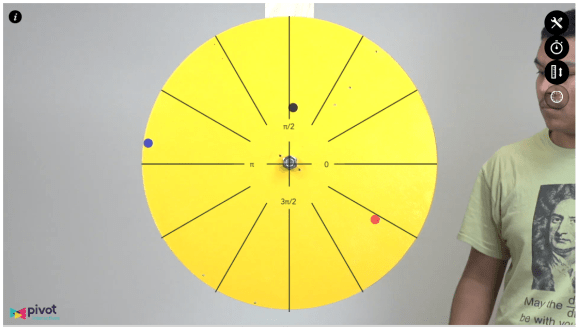
Students used Pivot Interactives to make angular position vs. time graphs for several points on a disk with a constant angular velocity and a point on an accelerating disk. Back in September, my students who took calculus last year were able to make a lot of connections when we did graphs for linear motion. One of the great things about returning to circular motion now is my students currently taking calculus now have enough background knowledge that they were able to make some very similar connections today.

pivot.PNG

Physics: Free-Fall

To kick off projectile motion, students worked through a worksheet I got from Michael Lerner where they were asked to describe the motion of a falling orange using a variety of tools from earlier in the year. This seemed to help some student synthesize and connect a lot of ideas from earlier in the year.

Chemistry Essentials: Skew Dice

A lot of my students haven’t had chemistry since first trimester, so I wanted to reestablish some class norms. I used Frank Noschese’s subversive grouping to get students into group, then had them whiteboard a CER to answer whether skew dice are fair. Time got a little tight, so a lot of groups collected less data than I normally would push for, but in the follow-up discussion, that gave us the opportunity to talk about the value of getting as much data as possible.

Day 110: Final Exams

Today is day 1 of final exams.

AP Physics

Students took  the multiple choice portion of an AP practice exam. I left the rotation and circular motion questions in, even though we haven’t touched those topics yet, since students have a 1 in 4 chance of getting them right and it will give me some information on their existing ideas. I made sure to communicate this to students in advance, including that I will adjust my grading accordingly, which helped students approach those questions calmly.

Physics

About half of the period was spent on an individual exam that was pretty traditional and the other half was a lab practical that students completed in small groups. Due to limits on equipment and space, about half the class was doing each portion at a time, which made for a noisy testing environment than usual. If we take this approach again, I might see if another teacher could accommodate my students working on the individual portion. I also think the individual and lab practical portions of the final represent two very different purposes; I think that is a reflection of my counterpart and I both being stretched a little thin this year and not having many opportunities to talk about why we’re doing things a certain way.

Maker:S,Date:2017-10-21,Ver:6,Lens:Kan03,Act:Lar02,E-Y

Chemistry Essentials

Students took a pretty traditional final exam. No matter how long I make the test, it consistently takes students about an hour to finish; I think a lot of students simply reach a point where they can’t focus anymore, especially since this tends to be their last final (honestly, I usually have trouble concentrating by this point during finals). I decided to plan for an hour-long final and used the first 30 min of the block to whiteboard portions of the final review. I think that helped some students build confidence and it felt like a relief for many of them to have some collaborative time.

Day 109: Free Response & Review

Yesterday was a snow day and tomorrow is the start of final exams, so today was a little tricky.

AP Physics: Free Response

With the AP exam looming, I gave students most of a practice exam as their final. Today, they took the free response portion. I took out a few problems to make sure there was no rotation and to get it reasonable for a 55 minute class period.

Physics: Final Review

Students worked on a final review that asked them to apply several different models to the same scenario. A few groups opted to work on whiteboards, instead of on paper, which was just fine with me. A lot of students went back to drawing their free-body diagrams without sketching in context, like the surface of a hill or ramp, which lead to some mistakes, but most students were able to get on track once they added in that surface.

Chemistry Essentials: Final Review

Students worked on a pretty traditional final review. The particle diagrams finally seem to be clicking for a lot of my students, which is great to see. I am seeing some students check out since it is fairly set whether they will pass or fail; if I teach this course next year, I need to spend some time this summer thinking about how to make final exams meaningful to my students.

Day 108: Experimental Design, Collisions, & Particle Diagrams

AP Physics: Experimental Design

Yesterday, students worked on an experimental design problem from the 2017 AP exam. Today, they exchanged work and used the scoring guide to assign points and give each other feedback. A lot of students were pretty nervous about giving their work to someone else; I think the simple act of recording points on a very tough problem raised the stakes more than I expected. Students still said they found the activity useful, so that may help ease the discomfort if we trade papers again.

Physics: Collisions

Students whiteboarded some of yesterday’s problems before taking a quiz on conservation of momentum. I had some students who actually consider conservation of momentum easier than impulse on a single object; one student told me its just like energy, but they don’t have to think about the different types.

mom wb.jpg

Chemistry Essentials: Whiteboarding

Students have been struggling with what particle diagrams are intended to show, so we started by brainstorming a list of characteristics of a good particle diagram and having some discussion about why they are useful. Afterward, we whiteboarded yesterday’s problems and did a gallery walk. This seemed to help reinforce the purpose of a particle diagram for a lot of students.

Day 107: Experimental Design, Conservation of Momentum, & Particle Diagrams

I had a sub for half the day today.

AP Physics: Experimental Design

Students worked on an experimental design problem off the 2017 AP Physics 1 exam, then did their choice of problems from a packet involving multiple models.

Physics: Conservation of Momentum

Students started working on some problems using conservation of momentum. In the hour I was here for, students were much more confident than I’ve seen them on new problem types all year, which was exciting. When I talked to groups, a lot of them were using connections to energy conservation to think through the problems.

Chemistry Essentials: Particle Diagrams

Students reviewed sketching particle diagrams. A lot of students have struggled with these this year and tend to loose track of what a particle diagram is intended to represent, so I want to make sure they get one more shot before the final

Day 106: Model Summaries, Collisions, & Gas Laws Review

AP Physics: Model Summaries

To help review for the final, students whiteboarded model summaries for the mechanics topics we’ve done so far. I just asked for key diagram types, along with relevant annotations, and key equations. For the first time, I saw a lot of groups including pieces of the force models, including free-body diagrams, system schema, and Newton’s 2nd Law, in summaries for other models. I’m excited that students are seeing and valuing the connections between different models.

Physics: Collisions

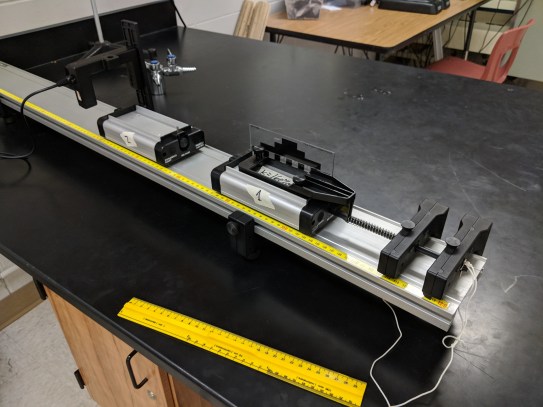
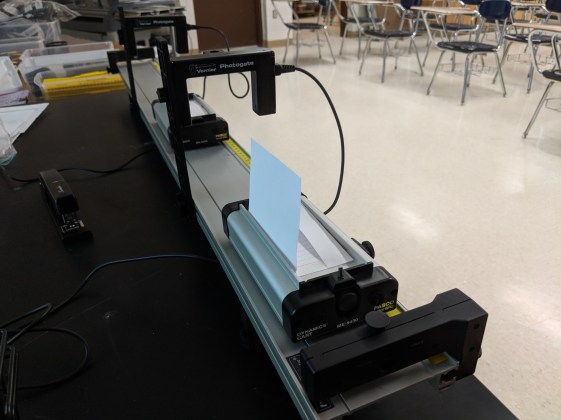
Students continued the cart collisions lab from the Modeling Instruction materials. A lot of groups struggled with interpreting the graphs produced by the photogates, which has been pretty common this year. The classic graph matching lab always seems to help students make sense of what the motion detectors are recording; I’m wondering if it would be worthwhile to have a lab that’s essentially play with photogates next year.

Maker:S,Date:2017-10-21,Ver:6,Lens:Kan03,Act:Lar02,E-Y

Chemistry Essentials: Vacuum Chamber

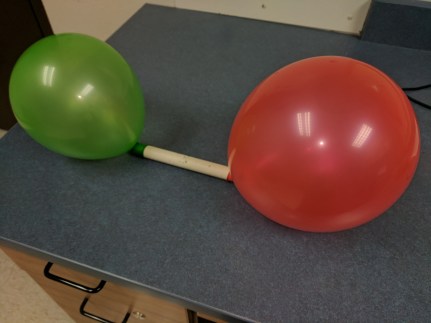
I got out the vacuum chamber and a few other demos, including balloons linked by a pipe, to revisit gas laws and pressure today. Sticking with pretty hands-on review seems to be helping a few students stay engaged as we approach the final exam.
balloons

Day 105: Multiple Models, Collisions, & Density Review

AP Physics: Multiple Models

With finals next week, students started working on some problems that require them to use multiple models simultaneously. We also spent some time talking through strategies for these kinds of problems; my students are a little more resistant than usual to sketching diagrams, so I made sure to emphasize the value of that step.

Physics: Collisions

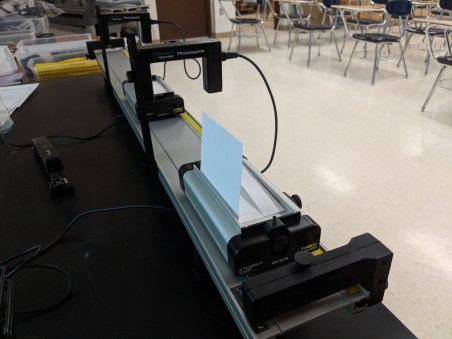
Students started working on a lab with colliding carts to get at conservation of momentum. The lab is going more slowly than I’d hoped, which has me nervous about whether students will be ready to assess on this topic by the end of the week.

collisions.jpg

Chemistry Essentials: Density Review

I have a little more time for review than normal in this class, so I decided to use some potential labs I skipped over this tri. Today, to review density, I had several unknown liquids students had to identify by making a mass vs. volume graph. I had them write their own procedure, which I haven’t done in a while, and students needed a lot more pre-lab discussion to be ready for that.

I’m also starting to struggle more to keep students on task during the lab and to keep them from having side conversations during whole-class instruction. I’ve seen it before with this course; I think a lot of students see it as settled whether they will pass or fail the course once final review begins and get off track as a result.

Day 103: Mystery Circuits, Explosions, & Formula Relay

AP Physics: Mystery Circuits

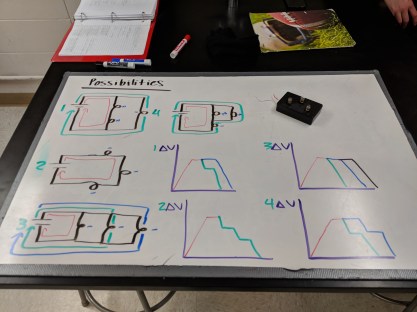
Students did a lab practical from The Physics Teacher to figure out how three light bulbs were wired together without opening the boxes. I did a little extra front-loading by asking students to sketch circuit paths and KVL diagrams, which set them up nicely to figure out what was going on in their box. A lot of students are disappointed that this is effectively the end of our circuit unit; its too bad I can’t direct my students towards the electronics courses in the IT department since they are seniors.

mystery circuit.jpg

Physics: Cart Explosions

Students started collecting data on a series of cart explosions to introduce conservation of momentum by plotting the ratio of the cart masses vs. the ratio of the distance each traveled in order to hit the end stops simultaneously. I didn’t overhear any groups anticipating where to start their carts, which is unusual for this lab, but some groups were able to make limited predictions with a little prompting.

explosion.jpg

Chemistry Essentials: Formula Relay

Students did some more formula writing practice. Today, I had them work on whiteboards and required them to rotate who did the writing. A lot of my groups have fallen into a pattern where one or two people do most of the intellectual heavy lifting, and it was clearly challenging for them to have to articulate what to do instead taking the marker. There were also some students who have been relatively passive during group activities who seemed like they started to get the hang of formula writing, which is exactly what I hoped.

Day 102: Whiteboarding

AP Physics: Circuits Whiteboarding

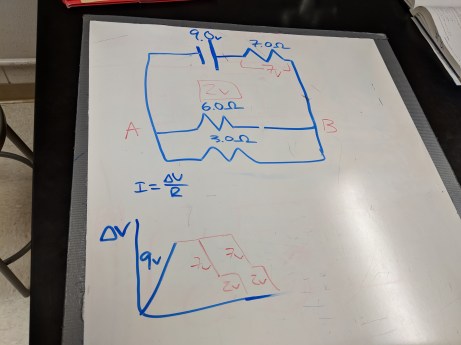
Students whiteboarded yesterday’s problems on circuits. Students are recognizing the value of sketching circuit paths and KVL diagrams more quickly than some of the other diagrams this year. My students say its because the value of the diagrams is very obvious, but I think its a factor that they’ve come around to the value of other diagrams in the class.

circuit wb.jpg

Physics: Impulse Whiteboarding

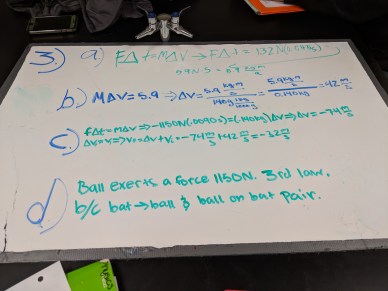
Students whiteboarded yesterday’s problems. A lot of students referred back to last week’s paradigm lab on impulse and Friday’s qualitative problems, which was fantastic. I also had some students who couldn’t remember doing either the lab or problems and struggled quite a bit today as a result; I need to keep working on helping these students see the value in being an active participant in their lab group.

impulse (1).jpg

Chemistry Essentials: Formula Writing Whiteboarding

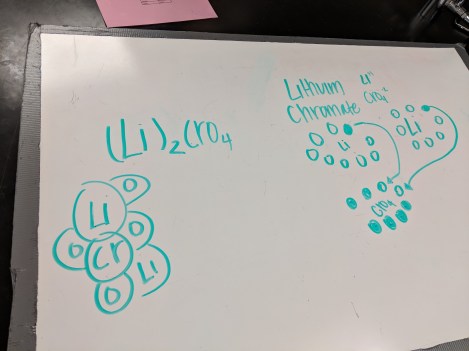
Students whiteboarded yesterday’s problems naming formulas with polyatomic ions. Each day, things are clicking for a few more students. One of the big keys is understanding the relationship between the charge and the electron diagram. At this point, I’m leaving it up to students whether to sketch the electron diagram, but many are choosing to sketch it because they find it helpful.

IMG_20180221_142216.jpg