This week, our big focus was on using Newton’s 2nd Law. Students were very successful at using vector-addition diagrams with unbalanced forces and did a nice job playing around with different systems on problems involving Atwood’s machines. We wrapped up the week with an extremely open-ended lab practical. I tasked students with finding the mass of a dynamics cart with a force sensor attached and left it at that. I did ask students to get my okay before they started data collection so I could make sure every group was on a good track. I was really pleased that groups ended up using several different approaches. Some did something similar to our model-building lab with a half-Atwood’s machine, some set their track at an angle to apply a force to their cart, and some manually pulled the cart. On Monday, I want to take a few minutes to make sure we talk about the different approaches, including the different ways uncertainty showed up in each.
Instructional Strategies
Days 27-31: Balanced Force Practical & Newton’s 2nd Law Model-Building
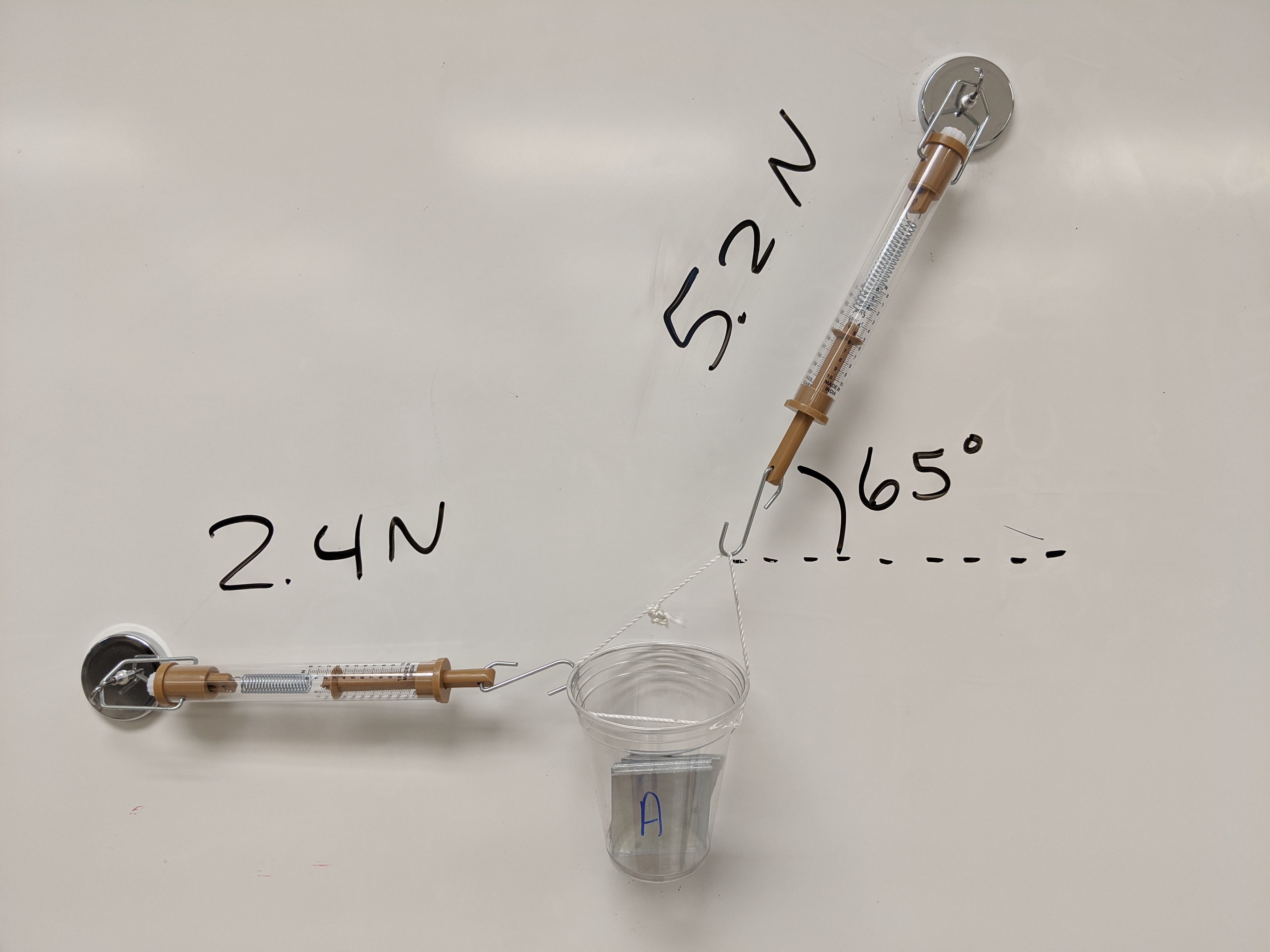
This week we wrapped up balanced forces with a practical. I used some magnetic hooks to attach spring scales to the whiteboard and let students measure the forces and any angles they wanted. Even though I only had two setups and five groups, different groups ended up taking different approaches, which was great for students to see in some discussion after the practical. We also had some good discussion about uncertainty when we measured the actual mass and students were initially disappointed with how far their calculations were off before, which lead to the realization they’d actually been pretty on target!
After the practical, we started Newton’s 2nd Law with a paradigm lab using the standard modified Atwood’s machine. There was some messiness in the value of the slope that students got, which is pretty typical from when I’ve done this lab. One of these days I’ll figure out how to coach students to really high-quality results! Students did really well at translating the equations for their line of best fit into something that had units and variables that matched the experiment and did a nice job in the board meeting making sense of their slope and intercept.
Days 24-26: Force Diagrams
This week was only 3 days due to the state union conference held this week.
This week we started working some balanced force problems using vector addition diagrams. I noticed my students were struggling with getting the interaction diagrams and free-body diagrams correct, which then made the rest of the problem trickier. In the middle of the week, we stepped back from the problems to really dig into setting up the interaction diagrams, free-body diagrams, and vector addition diagrams on whiteboards for a range of situations with the hover puck. We got to revisit some important ideas, like the idea that forces must be an interaction, and dig into some things that didn’t come up on previous problems, like how whether you include something like the air cushion under the puck as part of your system can change your diagrams. This day seemed to really help students see the value of some of the thinking I’ve been asking for and to feel more confident in drawing and using these diagrams, which is just what they needed!

Days 20-23: Mathematical Force Models
This was a short week due to a PD day on Friday.
This week, we focused on building mathematical models for the force of gravity and spring force. My students have taken very nicely to writing equations for lines of best fit in “physics” where they add units to their slope and intercepts as well as use variables that match their experiment. My students are also taking nicely to using “for every” statements like “the force goes up 10 N for every 1 kg of mass” to think conceptually about the meaning of their slopes. Students have also done really well with turning their intercept into statements like “the intercept is the size of the force when the mass is 0 kg” to think about what kind of intercept makes sense.
With the spring force experiment, I had students stretch their springs both vertically and horizontally to see the graph had the same slope in both directions. This usually seems to help address conceptions about the role of gravity in the behavior springs that come up when we get to energy and simple harmonic motion.

Days 15-19: Building a Force Model
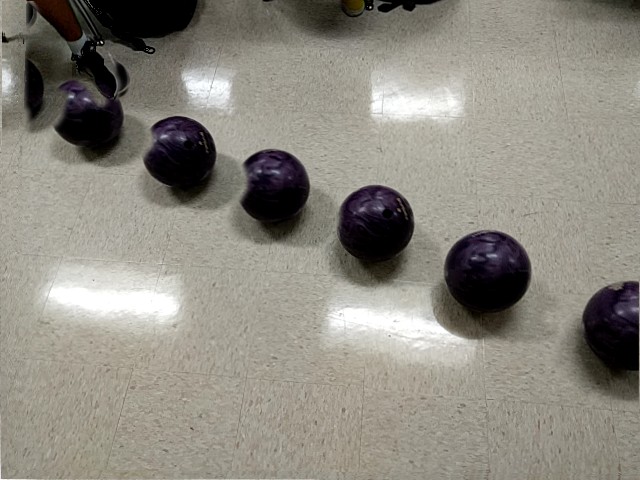
This week was all about starting to build a model of forces. We started by tapping bowling balls with mallets, using a version of the activity based on Frank Noschese’s. Students were quicker than usual to recognize that they had to juts leave the bowling ball alone once it was moving to keep it moving at a constant speed, but I still pulled up an old image I made with motion shot to get some additional evidence. After that, we moved into a version of interaction stations from Kelly O’Shea where students identified forces based on stretch, compression, and shear. Finally, we wrapped up the week with some mistakes whiteboarding with force diagrams. When I introduced system schema and free-body diagrams, I didn’t emphasize enough that the free-body diagram only needs to show forces that cross the system boundary, but that lead to some great conversations during the whiteboarding as students figured out what they needed to include. One student commented that almost all of their mistakes related to including more than they needed to, which lead to some nice discussion about the fact that the hardest part of physics is often figuring out what is relevant.
Days 10-14: Building CAPM
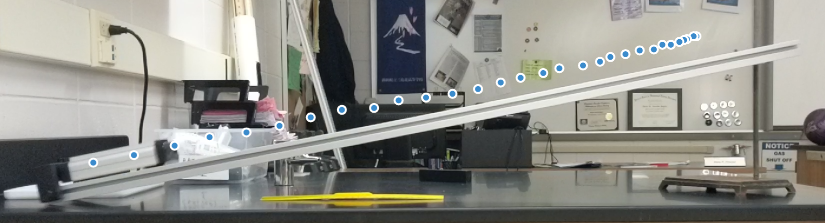
This week, students did a lab with ramps to start building the constant acceleration of a particle model. Students used Vernier Video Analysis to get their graphs, and I really love how the video analysis tracks set up motion maps for constant acceleration. Students seemed to feel pretty good about some of the math-y skills in this lab, including linearization and “translating” their line of best fit into a version that has variables that match the experiment and units on the slope and intercept. We then did some mistakes whiteboarding with problems translating between different representations of constant acceleration, which my students continued to do fantastic with.
One thing I think is worth thinking about it it feels like because this is our first experience with linearization, the later days of this lab feel very focused on the math. Then, it feels like we set the heavy math aside while working on translating between representations, only to circle back once we are ready to start doing problems. I wonder if there is a way to structure the constant acceleration unit differently to make it feel more coherent. We have the Vernier motion encoder carts, so I wonder if one option could be to start by having students more or less play with carts on ramps to focus on the shape of graphs, then work on translating representations. Then once students are solid on the representations, do the more standard ramp lab to bring in mathematical representations.
Days 5-9: Deploying CVPM
This week was all about using the constant velocity of a particle model. We started with some problems translating between different representations that we went over using mistakes whiteboarding. Last year, I had some classes where it helped to do a gallery walk before the whole class discussion, so I decided to try that from the start this year. This class did a great job with the gallery walk and every student was able to say something about every whiteboard. They also did a great job during the whole class discussion. There was one whiteboard that sparked some great student-to-student talk where I could hear students getting a better understanding of motion maps as they talked.
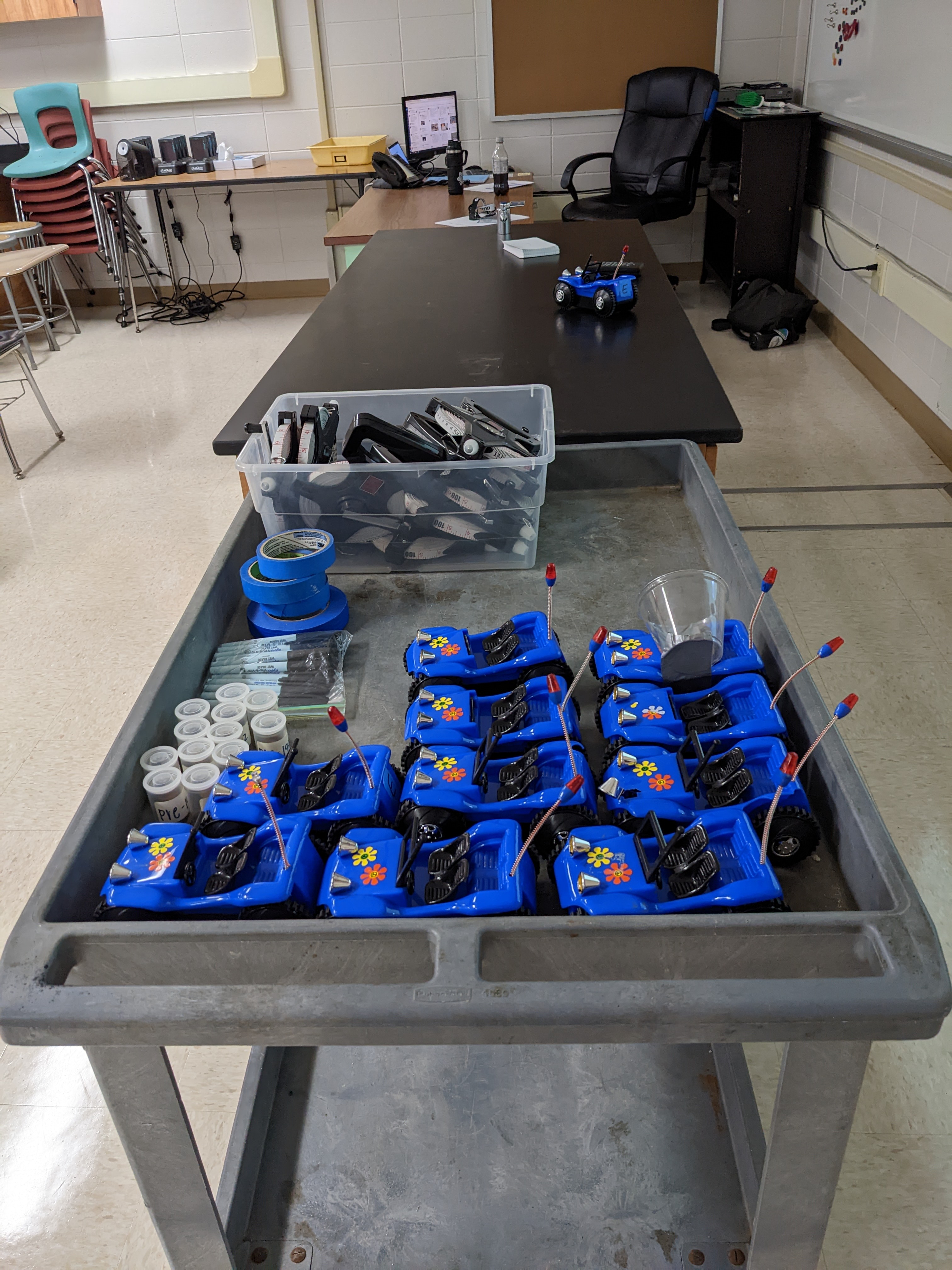
We wrapped up the week by predicting where two buggies would collide. I told students there was a range of possible approaches, and one group took that as a challenge to find as many different approaches as they could. A homecoming pepfest on Friday meant we ran short on time to have students share how they approached the practical, but I want to make sure and revisit that next week.
I also set aside some time this week to work on good collaboration. That is something I was not very consistent about last year, and I think it contributed to how much some students struggled in groups. We spent some time discussing the different kinds of contributions that were useful this week to ensure students are seeing a variety of ways they can be good at physics. Next well, I’m planning to introduce group roles.
Days 1-4: Buggy Lab
I’d expected to give this blog a break for this year, but a last-minute resignation meant I’m back in the classroom for at least part of this year. At the moment, I’m just teaching one section of AP Physics 1.
Like usual, I started with the buggy lab. Like I’ve been doing for a few years, on day 1, I asked students to make a graph that models the motion of their buggy with almost no other instruction, then had a board meeting that focused on what we would need to change in order to set ourselves up better to compare results across groups. Then, the next day, we repeated the lab with some agreements about things like units and graph axes so we could compare results. Every group collected one set of data with a full-speed buggy moving forward from zero and one set of data with a variation I assigned them. In the board meeting, students easily recognized the slope represented he speed and the intercept represented the starting position.
In the past, I’ve insisted students use time as the independent variable and collect data at even time intervals, but I skipped that this year. I ended up regretting it because the ways students measure when time is the independent variable lead so nicely into a motion map, so that could make next week trickier since only a few students have had that experience.
Days 15-19: Applying CAPM
This week was all about applying the constant acceleration of a particle model. Students worked some problems, including a few from the AP Physics 1 workbook. I had more students than usual try to use the formula sheet, but they pretty quickly shifted to relying on velocity vs. time graphs to solve problems, which I am all for. When we did some mistakes whiteboarding, I tried to keep the focus on setting up the problem by asking students to make a mistake in the velocity vs. time graph, annotation, or setting up an equation. I posted my solutions for the problems on Schoology after class so students could check their algebra later.
The highlight of the week was the catch the loot practical, where students figured out where to start a marble on a ramp so that it would land in a buggy driving by. This year’s students were much more invested than last year’s in getting a successful result, which makes me think they are more comfortable with hands-on work than my students at this point last year.
Days 167-170: Pendulum Practicals & Final Project
This was the last week of school for seniors! Since they are around 90% of my students, this was the last week of instruction in my classes. Next week, the juniors in my classes will have time to finish anything they still need to for my class or prepare for finals in their other classes.
Physics: Pendulum Practicals
This week we did two lab practicals using pendulums. First, we had students determine the length of a pendulum using only a stopwatch, which went really smoothly. Next, we had students figure out where to start a buggy so that the pendulum bob would collide with a passenger in the buggy. The big thing I noticed was students treating the period of a pendulum as three different equations, depending on which variable they were solving for. This fit with a general pattern this year of students struggling with using math in physics. While I think the unique challenges of last year are a factor, I think it would also be worth looking at our curriculum to see how we could do a better job of not just using math, but helping students develop a conceptual understanding of the math we are using. I won’t be able to work on that directly next year since I will be out of the classroom working as a high school science content specialist, but I’d like to think about how I can support teachers interested in that work. There will also be a high school math content specialist, and I think it will be worth having some conversations with him to think about how our departments could collaborate.
AP Physics 1: Final Projects
Students met with me about their final project drafts, then presented them to the class. I feel like while these students are phenomenal in small groups, I’ve struggled to build a whole-class community this year. During the presentations, however, there was a lot of joking around from both presenters and the audience, and several presentations included references to Throckmorton, who appears in many of our problems. I think we had more of a whole-class community this year than I realized, it just looked different than in previous years. It was really nice to have that so apparent on our last day together.
 stoeckel180