Day 166: Random Presenter & Mistakes Game

Physics: Random Presenter

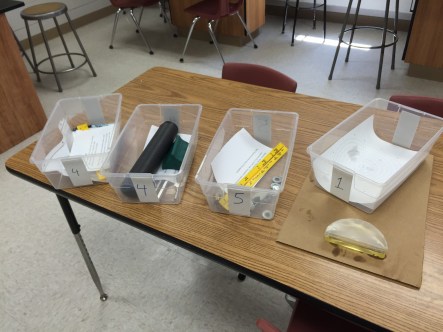
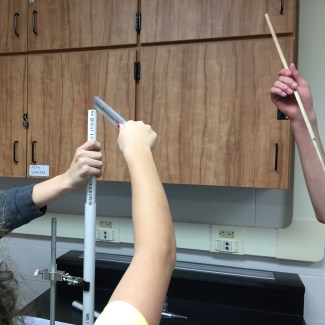
I had each lab group whiteboard and present their solution to one of the lab practical stations. I assigned which practical each group would present so I could make sure we saw all four stations. I also, when possible, tried to pick groups that used different approaches, like the two groups in the photo who had to find the mass of some washers using a known mass, a spring, a ruler, and a stopwatch. In one of my classes, I tried rolling a dice to decide who would talk on behalf of the group, and I saw some students who tend to let someone else in their group figure things out really engaging to make sure they knew enough to present if picked. I need to use this strategy more often.


Chemistry: Mistakes Game

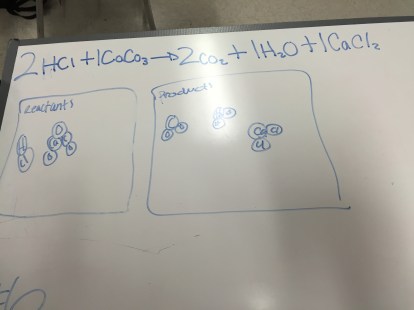
Students worked on writing equations for nuclear reactions, then we played the mistakes game with some problems.
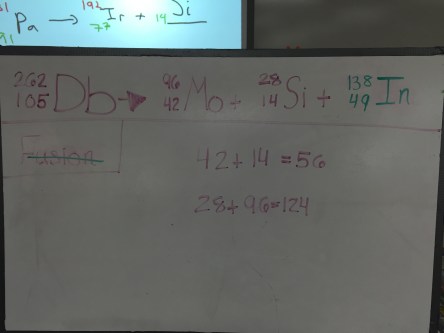
IMG_1930

Day 165: Final Review & Isotopes

Physics: Final Review

Students continued working through the lab practicals to review for the final exam. Overall, I’m pretty happy with how the review has been doing, though a lot of groups were confused about what they were being asked to do on the standing waves practical. I need to revise the directions to make it clearer that they should calculate the length of the tube needed to resonate, then use the materials to test it.


Chemistry: Isotopes

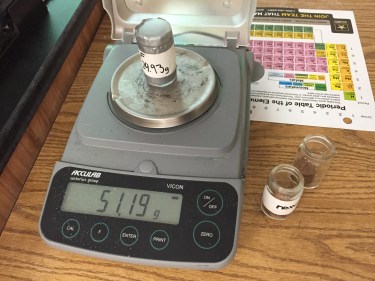
Students used what they know about isotopes to determine how many pennies in a sealed container were made before 1982 vs. after. They struggled to make the connection between the lab and what we’ve done so far on isotopes, so I need to make some changes to help students better build that link.

IMG_1916

Day 163: Final Review & Half Life Data Analysis

Physics: Final Review

Students started reviewing for next week’s final exam. I put together a lab practical for each of the four major topics from this trimester, and groups can pick and chose which ones they complete.

  • Simple Harmonic Motion: Given a 50 g mass, spring, ruler, and stopwatch, find the mass of a set of washers.
  • Mechanical Waves: Predict what length an adjustable tube needs to be for a given tuning fork to resonate when (a) both ends are open and (b) one end is plugged.
  • Reflection: Given the placement of a laser pointer and a target, use at least three mirrors to direct the beam to the target.
  • Refraction: Determine the index of refraction of oil.

There was a lot of demand for the simple harmonic motion and mechanical waves practicals since those were the oldest content. I’d prepared three sets of equipment for each practical, and ended up putting together a few more simple harmonic motion sets during my largest class, especially since they just did the index of refraction task for water yesterday.

IMG_1901

Chemistry: Half Life Data Analysis

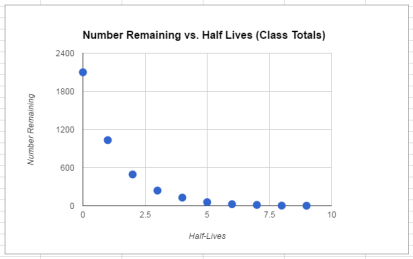
Students graphed their half life data from yesterday, then we compared their results to their predictions and the class totals, including data from previous years. We had some good conversation about the role randomness plays in the lab and why its useful to have data that relies on thousands of pennies, rather than just the 100 students had.

half life class data

Day 162: Snell’s Law & Half Life

Physics: Snell’s Law

I got out the refraction dishes and showed students how to use them to find a refracted angle. Then, I asked them to get me a graph where the slope is the index of refraction of water. This is the first time I asked students to start with an equation (in this case, Snell’s law) and pick their axes to get a certain value as the slope, but they were pretty successful.

IMG_1899

Chemistry: Half Life

Students measured the “decay” of pennies by shaking them up, then setting aside any that came up tails. Each group make a graph of pennies remaining vs. half lives and submitted their results via a Google Form so we could produce a graph of the class average. Tomorrow, we’ll use that to have some conversations about randomness.

Day 115: Final Exams

Physics: Collaborative Exam

Since physics is both very lab-based and very collaborative, we decided the final should be as well. We planned lab practicals based on the models from this trimester. Students are getting a test to complete individually that has descriptions of each lab practical, but no numbers. Students will have about an hour to set up equations and plan what they will need to do in the lab. For the last half hour, students will be placed into groups where they will actually complete each of the lab practicals.

IMG_1733

Chemistry: Final Exam

I went with a fairly traditional written exam, though there was enough time that I could have done a two stage collaborative exam. I might try that next trimester, though I’ll need to think about how I will make sure students make effective use of the collaborative time. I also need to rethink how I approach the review assignment. I allowed students to use their review on the final, and several students answered some questions by just copying over their answer from the review, even when the test question was looking at a different reaction or element. Many of my students read below grade level, so I’m wondering if that was a factor in students who missed the ways the test was different from the review.

Day 64: Energy Practical & Mistakes Game

Physics: Energy Practical

Students were given an elastic string to hang from the ceiling. Students had to find k for their string, then figure out how high above the ground to hold an action figure attached to the end so that, when they dropped it, the figure would just barely hit the ground. In the past, I’ve used a bucket of water and we go by the sound (“splash, but no thud”). This year, the other physics teacher suggested using a force plate and looking for a small spike in the force vs. time graph. While students like the splashing, the force plate is a lot easier to move around, and makes it possible to capture slow-motion video.

Chemistry: Mistakes Game

To go over Friday’s practice problems for balancing chemical equations, I had them do the mistakes game. Students focused on making their error an inconsistency in their representations of the reaction. I appreciated how willing my students were to try something new; they seemed to especially appreciate the safety inherent in the mistakes game.

IMG_1513

Day 53: Reflection & Projectiles Practical

Physical Science: Reflection

Students used reflectors (like this one) to explore reflection. I gave them some very general questions and directed them to collect evidence that would allow them to answer the questions. Students had some trouble getting started, but did a nice job overall.

Physics: Projectile Practical

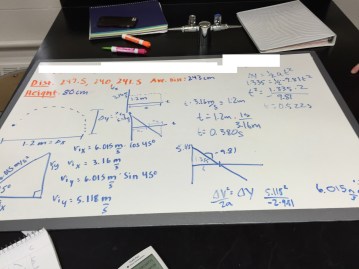
Yesterday, each group was given a distance from a projectile launcher and had to calculate how high above the ground the projectile should be. Today, students placed embroidery hoops at their predicted height and we fired the launcher.

nofaces

Day 52: Color & Projectile Practical

Physical Science: Color

Students used colored filters, felt, and light sources to find patterns in what determines what color they see. By the end of the hour, students were able to use what they saw in the lab to accurately explain their observations in the filters puzzle video.

IMG_1435

Physics: Projectiles Practical

Students began a lab practical for projectile motion. First, we fired a projectile launcher horizontally and measured the range and starting height to determine the launch speed. Then, each group got a different distance from the launcher and calculated how high off the ground the projectile will be at that point if the launcher is fired at an angle of 45 degrees. Tomorrow, each group will place an embroidery hoop at their given distance and calculated height.

IMG_1445

Day 47: Speed of Sound & Projectiles Practical

Physical Science: Speed of Sound

Students worked on the classic speed of sound lab using a closed resonance tube. Since this is one of the first labs my 9th graders do that has an accepted value, it provides a great opportunity for discussion on experimental error, which will happen once students finish the lab tomorrow.

IMG_1377

Physics: Projectiles Practical

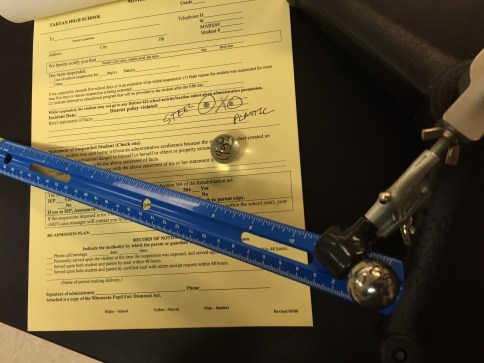
Students did a lab practical for projectile motion where they had to predict where on the ground a marble would land after being sent down a short ramp. In the past, I’ve used a cup, but most students hit the side rather than landing in it, so this year I used the school’s retired referral forms as carbon paper. I also pulled a jerk physics teacher move. After students got a successful prediction, I gave them a marble with a different mass and had them predict where the new marble would land without allowing them to make any new measurements. Most groups had to wrestle with it for a while and even try some calculations before realizing it should land in the same spot. I decided I need to keep this extra challenge in the practical when one student victoriously declared “Misconception changed!” after hitting their prediction with the new mass.

IMG_1393

Day 41: Motors & Forces Practical

Physical Science: Motors

Students built very simple electric motors, then did some playing around with them to start figuring out some of the underlying principles. This will set up some discussion for Monday on how most electricity is generated.

Physics: Forces Practical

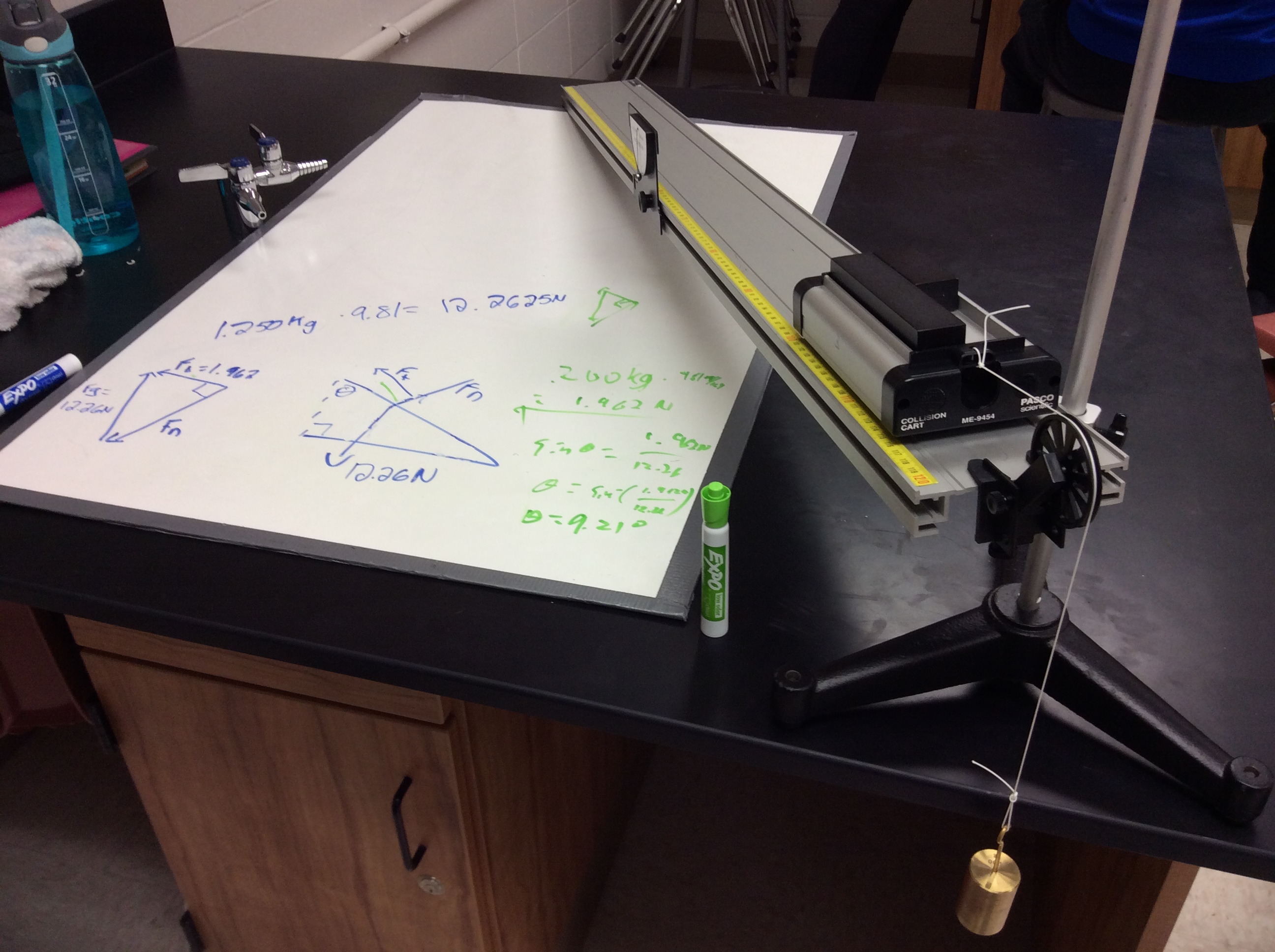
Each lab group got a cart mass and a hanging mass, then had to figure out what angle they should set their ramp to in order to balance the forces. I wasn’t sure how into it students would get since the goal was, pretty literally, to make nothing happen, but there were still cheers when they let go and everything stayed put. My students are now convinced they can do these problems in a way that just getting the right answer doesn’t accomplish. In one period, several groups finished quickly, so I had those groups keep the same angle and cart mass, but add to their hanging mass and calculate how much time it should take for the cart to make it up the ramp. I didn’t set up the photogates, since I wasn’t sure how many groups would get through this part, but students were able to get within 0.2 seconds of their prediction using a stopwatch.

practical 2