Day 66: Projectile Practical & Seismic Accelerator

AP Physics: Projectile Practical

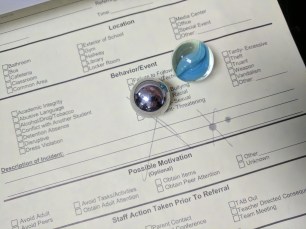
Students wrapped up a lab practical today, predicting where a horizontally launched marble will hit the floor. Once they pulled it off, I pulled out a lighter marble and asked them to predict where it would hit without taking any new measurements. Last year, most groups spent a fair bit of time debating what should happen and trying lots of different calculations before they figured it out. This year, as soon as I pulled out the lighter marble, every group confidently stated it should hit the same spot and gave beautiful explanations for why. Its clear I’ve done a better job this year of giving students opportunities to confront that misconception.
carbon-paper

The retired referral forms work well as carbon paper

Physical Science: Seismic Accelerator

I showed students the seismic accelerator and asked them to predict what would happen when I dropped it, presenting their answer as a CER. Groups consistently drew nice bar charts, but, since we haven’t done anything quantitative with energy, it was tough for many students to recognize the tiny bouncy ball should fly above the original height. I like this as a follow-up to the bouncy ball lab, but next year, instead of having them make predictions, it might work better to show them what the seismic accelerator does, then have them draw bar charts and explain why the red ball goes so high.

Day 56: Toilet Paper Drops & Review

AP Physics: Toilet Paper Drops

Students wrapped up yesterday’s lab practical and got  chance to try dropping their toilet paper rolls. Groups were very successful. Especially in my second hour, I was really pleased that, without any prompting, the students in groups that finished early split up to look for other groups that could use some help.


Earth Science: Review

I had students review for Friday’s final by generating some possible test questions for each unit on a whiteboard, then trading boards with another group. When I put up the title of the first unit, there was a moment of panic as students tried to remember what it was even about, but they pretty quickly turned to their notebooks to remind themselves of the major concepts and look for ideas of questions to ask, which is exactly was I was hoping for.

img_20161130_083834

Day 55: Toilet Paper Drop & Galaxy Sorting

AP Physics: Toilet Paper

Students started a lab practical I got from Frank Noschese’s blog. Students were given a height they will drop one toilet paper roll from and are tasked with figuring out where to drop an unrolling toilet paper roll so it hits the ground at the same time. I’m trying to emphasize the ways that students are using forces and constant acceleration in the practical to make sure this is doubling as a review for the final exam.

tp

Earth Science: Galaxy Sorting

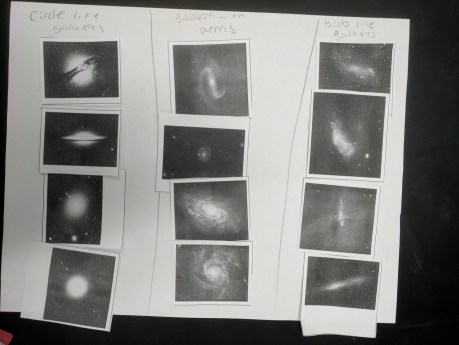
Students were given pictures of a dozen galaxies and tasked with putting them into categories and naming each category. Most groups came up with something pretty close to the three official categories. I can’t decide if I’m happy about that. On the upside, my students are very comfortable with the vocabulary. On the downside, the fact that so many groups got similar results tells me there was limited thinking required.

galaxy-sort

Day 42: Mass & Comet Orbits

AP Physics: Mass

Students finished the lab practical we started on Thursday where they used a modified Atwood’s machine to find an unknown mass. Today, once they had an answer, we checked their result using a spring scale. One of my goals this year is to work on hearing from every student, so I tried posting three questions about the lab (one for each group member). Then, before groups could check their result, I would roll dice to decide which group member had to answer each question. Since there are three students in each group, I was able to hear from every student. Groups did a really nice job of making sure all three group members could answer all three questions, which is exactly what I hoped would happen.

img_2469

Earth Science: Comet Orbits

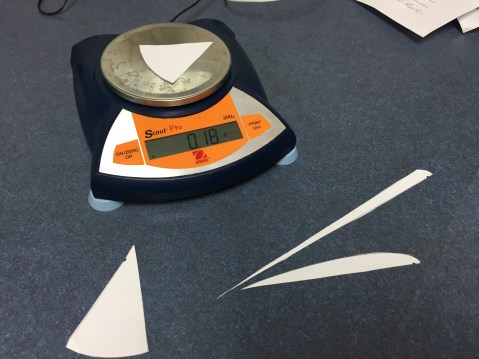
Students finished up yesterday’s lab contrasting Mars’ orbit with Halley’s Comet’s orbit. A lot of groups were surprised when they realized that the patterns from Kepler’s Laws worked equally well for both orbits, especially when they used mass as a proxy to compare the areas of two sections that represent equal times. Next time, I might see if I can get my hands on some card stock or other heavier paper to make it a little more convincing that the small differences are negligible. I also will probably re-work my Kepler’s Law introduction to include Halley’s Comet right off the bat, rather than waiting until we introduce comets.

img_2468

Day 40: Mass & Craters

AP Physics: Mass

Students worked on a lab practical to find the mass of an unknown object using a modified Atwood’s machine. My plan is to use spring scales to verify the mass the determined, then use this to introduce the difference between inertial mass and gravitational mass, but time got tight and most groups need a little longer to finish their calculations.

img_2456

Earth Science: Craters

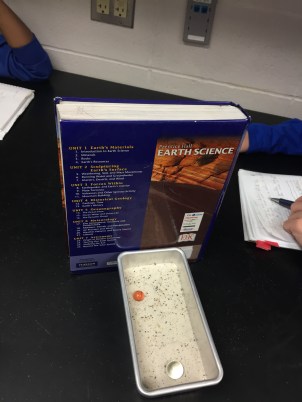
During yesterday’s lab, it quickly became clear that my students did not have much sense of how craters are formed. Today, I got out some trays of sand and an assortment of marbles and we explored how mass and impact speed affect the crater size. I was really excited when the groups who finished early started asking new questions, like how the depth of the sand or angle of impact changes the crater, and coming up with experiments to answer those questions. This is why I love freshmen! We also dropped a shot put into a bigger tray of sand and got some slow-motion video just because its cool.

img_2452

Day 22: Wrap-Up & Review

AP Physics: Lots of Wrap-Up

Today was a lot of wrapping things up. We started by whiteboarding both the accelerated disk and free fall Direct Measurement Videos with some brief discussions about each. At this point, I was just trying to get students to recognize the parallels between angular acceleration and linear acceleration, so that didn’t feel too rushed. The discussion on free fall did skip over some important points, so I’ll be revisiting that topic next week. This is the first year I’ve included uncertainty in my class, and I could tell during the discussion that my students are starting to internalize those concepts, which added some nice layers to the discussion.

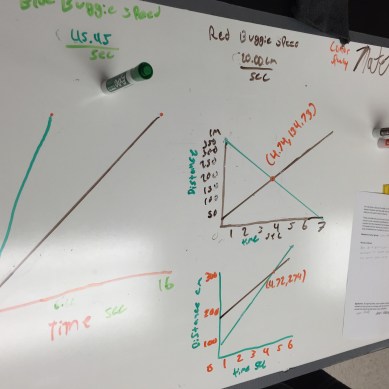
We also took some time to try and finish the lab practical we started Monday. Students are rolling a steel marble down a ramp with the goal of landing it in a tumble buggy driving by. Today, I threw them for a loop by adding that they need to pull off the same thing with glass and acrylic marbles, but the only new measurements they can take are mass. With the time for discussions, only a few groups got to test, so I’ll be making some adjustments next week to make sure students have a chance to finish.


Earth Science: Review

Students have another quiz tomorrow, so I repeated my review activity from last time. Students worked in groups to write a few questions for each learning target, then periodically traded whiteboards with another table to try and answer another group’s questions. This time, students were coming up with some deeper questions, which was great to see.

Day 20: Lab Practical & Clouds

AP Physics: Lab Practical

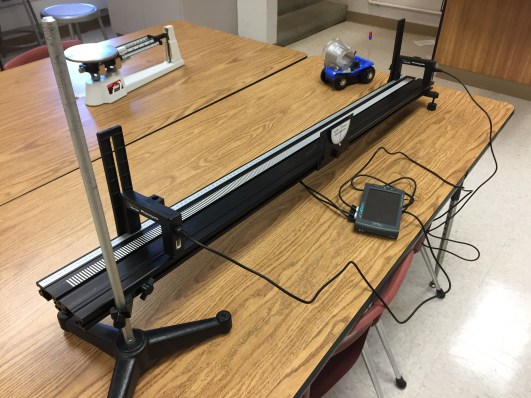
We started working on a constant acceleration lab practical today. A marble will roll down a track while a constant speed buggy drives past. Given the starting point of one, students need to find the starting position of the other such that the marble will land in a cup taped to the buggy. I had a couple of administrative things to deal with at the start of class, so we only got to collect the data students need to complete the calculation. I’ve got a computer lab reserved tomorrow, so we’ll test their calculations on Wednesday.

img_2265

Earth Science: Clouds

Students were introduced to the different types of clouds today. I added some questions to focus on patterns in the names of the cloud types. Students were pretty successful at picking out the key roots and prefixes that show up in cloud names and reasoning out what they must mean.

Day 8: Dueling Buggies & Tides

AP Physics: Dueling Buggies

We finished up the dueling buggies lab practical today. We also talked a little about what it means for a given approach to be “better”.

img_2211

Earth Science: Tides

I gave students a one-month tide chart for Olympic National Park and had them look for patterns. I really like that their tide charts include the moon phases, so my students were making some connections between the biggest changes in the tides and the phase of the moon. We also talked about how to make sure the patterns were valid, which lead to looking at the tide charts for some additional months.

Day 6: Dueling Buggies & Currents

AP Physics: Dueling Buggies

We finished discussing the whiteboards students prepped yesterday, then students started working on the dueling buggies practical, where they must predict the position where a pair of buggies will collide given their starting position. My favorite moment was when a student was explaining his approach to his group, and I realized he’d come up with relative velocity. One student asked if he could cheat and just graph the lines and find the intersection, so we talked about the fact that using tools from class on a problem in class is never cheating 🙂 A lot of groups asked me if they were taking the “easiest” approach, so I want to plan some time to talk about what that means when we test their answers on Thursday.

Earth Science: Currents

Students designed experiments to look at how water temperature or salinity drive currents. Students embraced designing their own experiments and it was a lot of fun listening to them discuss how density and other concepts from middle school connect to the lab. Before the lab, I asked them about what makes a good experiment. My students listed things like a procedure, that they’re often asked to turn in, and pieces like a hypothesis that are steps of the “classic” scientific method. I want to keep revisiting this during the trimester to move them towards deeper characteristics of a good experiment.

img_2181


Day 168: Final Exam & Radiation Dose

Physics: Final Exam

Today is the last day of school for seniors, so we finished the final exam. For the lab practicals, students completed four stations, one for each of the major topics we covered this trimester. Students worked individually and had about 10 minutes at each station.


Chemistry: Radiation Dose

Students used some information from the Department of Energy to calculate their average dose of radiation in a year, then we took the assessment on nuclear reactions. A little less than a third of my class is seniors; to keep things simple, I decided to excuse those students from the final and make today’s quiz the last entry in their grades.