Day 71: Board Meeting, Practical, & Density Again

AP Physics: Board Meeting

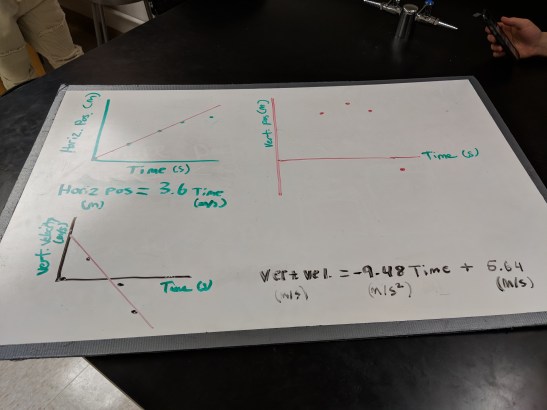
Students whiteboarded their graphs from yesterday’s video. Once I had my 2nd hour find a class average for the slopes of their vertical velocity vs. time graphs, everything fell beautifully into place and there were even gasps when one student sketched a free-body diagram. In my other hour, a lot of groups skipped the directions for making the v-t graph and tried to take shortcuts that didn’t work, so I had to step in a little more. This reinforces my thoughts yesterday that I should have spent some time discussing the midpoint method.
pm graphs.jpg

Physics: Unbalanced Forces Practical

Students started a practical to predict the time it will take a cart to roll down a ramp given the cart’s mass and the ramp angle. For the first time, I had several students ask if I could just do a diagram or calculation for them, so I left the pen I usually carry at my desk and kept my hands in my pockets to avoid encouraging that.

ramp prac.jpg

Chemistry Essentials: Density Misconceptions

Today, I have students blocks of the same material, but different volume, and asked them to determine whether volume affects density. A lot of groups had trouble funding the volume with a ruler, rather than later displacement, so I should have spent a little more time on a pre-lab discussion connecting yesterday’s volume measurements to today’s.

density (1).jpg

Day 56: Final Exams

Final exams are today and tomorrow.

AP Physics: Mini AP Exam

Since I mostly give short, weekly assessments, finals are a good time to give my students something longer. The other AP Physics teacher and I modified a practice exam to cut the content we haven’t covered yet and get it down to 90 minutes. This is their first assessment with a time limit, so I’m curious to see how they do with pacing.

Physics: Two-Stage Exam

The other physics teacher and I agreed on a hybrid approach to the final. The first half, worth 75% of the exam grade, is a pretty traditional written final with some problems from throughout the trimester. The second half, worth 25% of the exam grade, is a lab practical that students are completing with a partner. During the lab portion, I overheard several groups talking about whether their answer is reasonable and how they know, which got me really excited since students have struggled to connect physical meaning to the math this year.

phys final.jpg

Chemistry Essentials: Written Exam

I’m giving a pretty traditional written exam. My students said they were hoping for multiple choice, but I stuck with short answer so the questions will read more like the other assessments they’ve taken. A few of my students are annoyed because they say multiple choice is easier, but I have never had it go well when I suddenly use multiple choice at the end.

Pretty consistently when I teach this course, all of my students finish with about 30 minutes left in the final block, regardless of the length of the test. As usual, I had a significant number of students who left large portions of the test blank. I think my finals in this course run short not because I don’t make them long enough, but because a lot of students have trouble focusing on a written test for 90 minutes (honestly, I have trouble focusing on a written test for 90 minutes). This reinforces that it is worth moving away from a traditional final in this course.

Day 55: Design a Practical & Review

AP Physics: Design a Practical

Groups set up the lab practicals they’d planned yesterday, then got a chance to try the lab practicals other groups had come up with. It was a lot of fun seeing how much pride students took in watching their peers complete a practical they’d designed. A lot of students said they enjoyed this approach to review, and I liked the thinking it took to design a good practical.

Physics: Review

Students finished up the review assignment they got yesterday, then were able to check answers against my key. Its not my favorite way to review, but it is familiar and comfortable for my students, which I think helped them feel more confident going into the final exam.

Chemistry Essentials: Review

I also went pretty traditional in this class today, giving them some questions to review atomic models and formula writing, especially since we haven’t had a stand-alone quiz on this topic.

Day 52: UBFPM Practical, CAPM Problems, & Lewis Dot Beans

AP Physics: UBFPM Practical

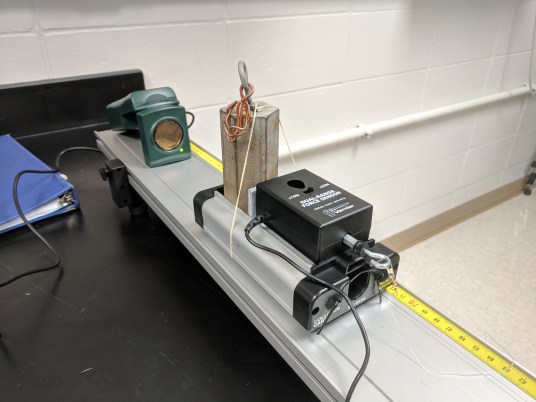
Students were tasked with finding the inertial mass of a lump of metal. While I left it open, students pretty quickly settled in to following the steps from their 2nd Law lab. In one of my classes, a lot of groups initially used the unknown mass to provide the force on their half-Atwoods setup, which has me thinking they were losing track of the significance of the measured quantities; I skipped over having them do an interaction diagram and free-body diagram on the original lab, which I’m betting would have helped.

ubfpm practucal.jpg

Physics: CAPM Problems

Students used whiteboards to revisit an earlier quiz on CAMP problems. I had them go through piece by piece, rotating who had the marker for each step. That seemed to help students feel a lot more confident on the problems. Tomorrow we’ll see if they can do them independently.

capm prob

Chemistry Essentials: Lewis Dot Beans

Yesterday, when we worked on formula writing, students were losing track of what the various numbers represented. One of the other chemistry teachers suggested I try Lewis dot structures with a manipulative, so today students used beans to check their answers to yesterday’s problems.

lewis dot beans

Day 48: Unbalanced Forces, Quantitative Interactions, & Bohr Model

AP Physics: Unbalanced Force Problems

Students started some problems on unbalanced forces. I started by having a group demonstrate their success on last week’s lab practical, then asked students what should happen if we swapped out a lighter marble. Once we tried it, we used vector addition diagrams to find the acceleration of each marble and show the mass doesn’t matter.

Physics: Quantitative Interactions

I borrowed an idea from Kelly O’Shea (I think she’s planning a blog post) and, instead of doing balanced force problems on a worksheet or out of the textbook, I gave students 5 different stations to work through. Several groups went back to their force of gravity lab to figure out the first station, which was great for reinforcing that the labs and problems are connected. The downside is I used a mass today that many used on their lab, so they were able to just read off their data table.

Chemistry Essentials: Bohr Model

Students used PhET’s Build an Atom simulation to play with the Bohr model. The activity took a little longer than I thought, so no one was able to finish, but students were having some good questions about the changes as they added pieces to their atoms and how that fit with patterns on the periodic table. At the end of the hour, I got out the gas tubes and diffraction gratings so students could see some of the evidence for the Bohr Model. They had a lot of questions we didn’t have time to answer, but I’m hoping that will make for a good way to start class tomorrow. I’ve been trying to put something engaging and thought-provoking at the end of the hour to combat students trying to line up at the door or slip out of the classroom in a positive way, and its had the side effect of making it easier to start class the next day since students show up with questions they are excited about answering.

gas tube

Day 44: Practical, Spring Force, & Vocab Review

AP Physics: CAPM Practical

Students figured out where to start a buggy so that a marble rolling down a ramp would land in it. Some groups had some trouble translating their strategies for yesterday’s problems to this lab practical, which has been pretty common this year. However, once students got going, there was a lot of success!

Physics: Spring Force

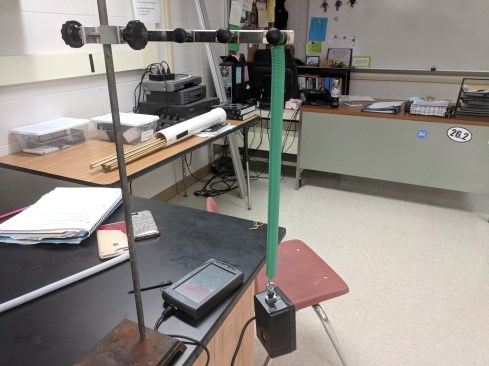
Students worked through the spring force lab I’d previously done with my AP Physics classes. We used force sensors to stretch the spring instead of spring scales or hanging masses so that students could pick one of their springs to also stretch horizontally. From what I saw in notebooks, results are coming out pretty nicely.

spring.jpg

Chemistry Essentials: Vocab Review

This unit has had more vocabulary and factual knowledge than many of the others, so we took some time to review key terms and reinforce connections between the different ideas.

chem vocab.jpg

Day 37: Dueling Buggies, Dueling Fan Carts, & Chemical Change

AP Physics: Dueling Buggies

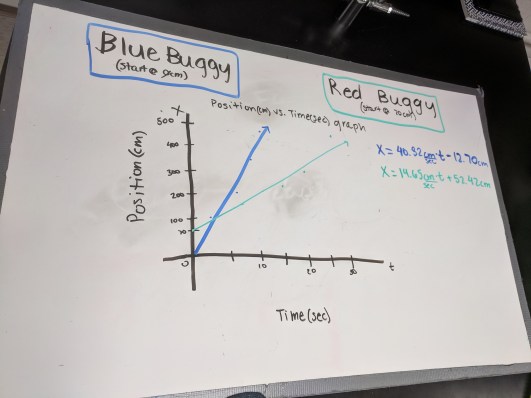
Students wrapped up the dueling buggies lab practical with very satisfying results. Usually, most of my students look for the intersection of the position vs. time graphs, but this year I had a lot of groups decide to solve the system of equations. I think that is just an artifact of doing the lab later than usual, when students are in the routine of connecting math and physics, and of moving pretty quickly through the CVPM worksheets.


Physics: Dueling Fan Carts

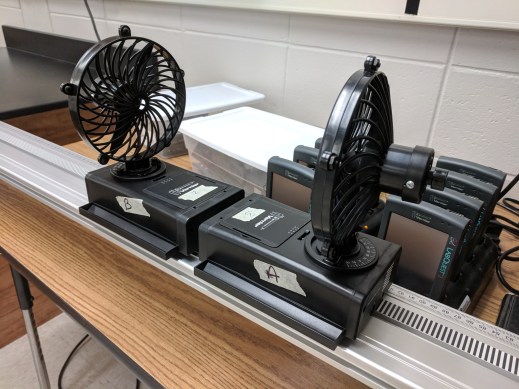
We talked about the rules students had for tapping and motion after yesterday’s bowling ball lab, then moved into a version Frank Noschese’s dueling fan carts. Frank’s activity calls for high vs. off, but I added in off vs. high as a separate scenario to help with the idea of directionality. This is the first time I had groups revise their rule after the fan carts, and I was really pleased with how that went. I think that approach also helped cement the connections between the bowling ball lab and the fan carts, and the connections are something I’ve seen missing so far.

fan carts,

Chemistry Essentials: Chemical Change

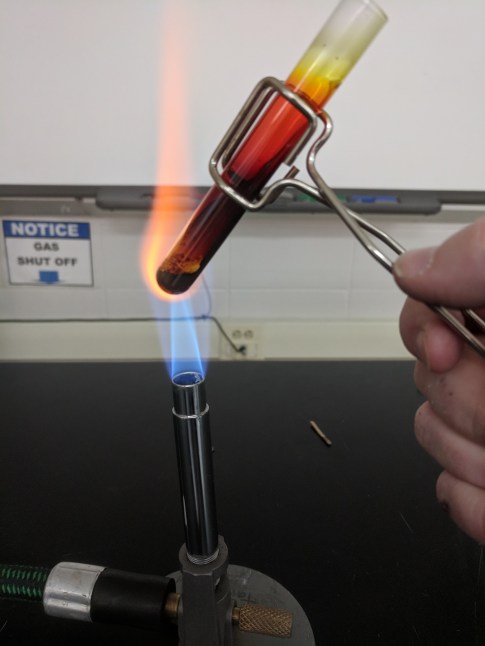
Students heated yesterday’s mixture of iron and sulfur to see if the properties changed. Just about everyone was very excited about using fire, but it was tough to keep them focused on making and interpreting their observations. Since I only had a few questions, I projected them, rather than making a handout, but something about a handout seems to give my students more sense of individual accountability. I think the handout serves as a physical reminder of the questions they need to answer, so I will try to stick with making handouts.

chem change

Day 36: Dueling Buggies, Bowling Balls, & Properties of Mixtures

AP Physics: Dueling Buggies

We did an abbreviated whiteboard session on Thursday’s problems since students had correct answers and were feeling pretty confident on the material. Afterward, we started working on the dueling buggies lab practical. I had several groups decide to have different people try different approaches, then compare answers as a way to check their work. Tomorrow, we’ll actually crash the buggies.

buggies.jpg

Physics: Bowling Balls

I started class today by talking a little about why I use Modeling Instruction and the kinds of actions that make a student successful in this type of classroom. Students seemed receptive and the atmosphere in the room was much more positive than it has been in a while. I think moving on to forces was a good call.

Students worked on the bowling ball and mallets lab to start building ideas about forces. I also gave students roles within their groups and explained this was to help them learn how to be a productive member of the group, even when they don’t know the answers. Students were much more consistently engaged than I’ve seen this year and a lot of great conversations were happening in groups.

bowling

Chemistry Essentials: Properties of Mixtures

As a demo, I asked students to observe properties of water and ethanol before and after mixing. The whole class discussion got a little rocky because a lot of students had great questions and great observations, but it was tough to keep them from talking over each other (or me). That’s something I need to keep working on with this class, but its a good problem to have.

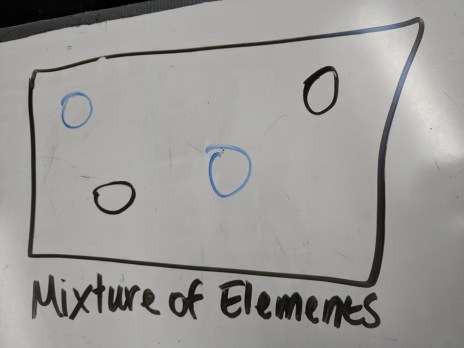
Afterward, students did something very similar with solid sulfur and iron. Again, there were a lot of great observations. Students seem pretty clear on the idea that a mixture has a combination of properties from both materials.

fe s.jpg

Day 35: Motion Representations, Lab Practical, & Mystery Tubes

AP Physics: Motion Representations

Students started practicing translating between different representations of constant velocity. Students have already done some similar problems with momentum vs. time graphs, so things went very smoothly.

Today’s quiz also included the first free response problem from an AP exam that students have worked. Afterwards, as they discussed their answers, there were a lot of kids high-fiving each other while another student told me she enjoyed the quiz. Its great to see students getting the hang of physics and feeling good about it.

Physics: Lab Practical

Students continued work on yesterday’s lab practical. I only had a few groups finish and was running into a lot of the same roadblocks I’ve been seeing for most of the unit. Both my students and I feel like we are beating our heads against the wall with this unit; since we’ll get another crack at acceleration with unbalanced forces, I think its best to cut our losses for now. On Monday, before we dive into balanced forces, I’ll take some time to have some conversation with students about what’s working and what isn’t so we can try to get on a better path.

Chemistry Essentials: Mystery Tubes

Today was a quiz day. About half of my students take their quizzes in the special ed room and usually stay up there the full period, while those who stay in the classroom rarely need more than half the period, so I’m trying to plan interesting activities that aren’t required for the content. Today, I pulled out the mystery tubes and it was fantastic. Every student was engaged, making fantastic observations and sharing ideas about what’s going on inside. One student in particular who is normally pretty checked out asked if she could sit the activity out because it seemed too hard, but got into it once she got her hands on a tube. The best part was when the para supporting the class stopped by at the end and asked about the tubes, this student confidently insisted he check out her model to see exactly how the tubes work. It was a great way to end the week.IMG_1734


Day 34: Board Meeting, CAPM Practical, & Freezing Acid

AP Physics: Board Meeting

We had a board meeting to wrap up the buggy lab. A lot of students who are normally quiet in whole class discussions spoke up today, which was great. In addition, there were some interesting observations that don’t always come up, like the student who commented the intercept did not depend on the slope. At the end of the hour, I also asked groups to whiteboard a CER for what the momentum vs. time graph should look like and, while we didn’t have a chance to discuss the boards, groups consistently were on the right track and not only connected the buggy lab to the definition of momentum, but to Newton’s 1st Law by discussing whether they could identify unbalanced forces on the buggy.

buggy wb

Physics: CAPM Practical

Students started working on a constant acceleration lab practical where they try to get a marble rolling down a ramp to land in a cup attached to a moving buggy. Some groups got a starting position for the marble while others got a starting position for the buggy. A lot of groups had trouble focusing on individual pieces of the task; tomorrow, I may take a few minutes to talk through the major steps students need to take. I’m also seeing students continue to struggle with confidence; they are nailing the problems, but just don’t believe that they get it, which makes it difficult to approach a challenging lab practical.

marble

Chemistry Essentials: Freezing Acid

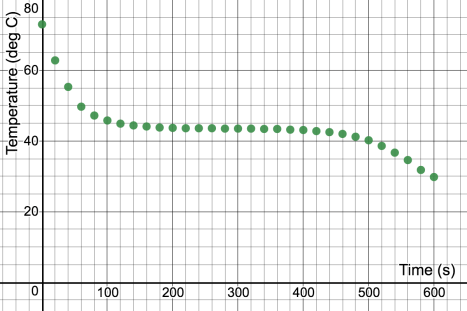
We discussed the results of yesterday’s lab. At the end of the hour yesterday, a lot of students didn’t seem convinced that temperature stays constant during a phase change, partly because they were focusing on their data tables and saw very small temperature variations. Today, I projected a graph from one of the groups for the discussion, and students saw much more clearly that the temperature is pretty constant. When students graph in Desmos, I usually allow one group member to make a graph as long as everyone sketches it (I don’t have a good way for students to print), but I think that’s making it too easy for most of the group to just glance at the graph so I need to work on ways to get students looking closer. I usually have a handout for labs in this course, so I’ll probably add some questions to prompt students to look carefully at their group’s graph to the next lab to see if that helps.

desmos-graph