Day 50: Extending Torque & Light Intensity

AP Physics: Extending Torque

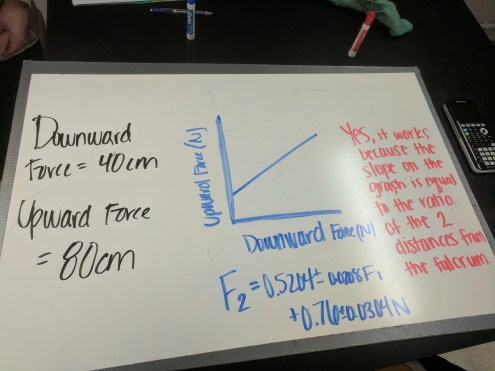
We had a board meeting to discuss yesterday’s lab with second class levers. On the lab, I simply asked whether the model we’d developed so far for a balanced lever also worked for this new type. Since the question is a bit ambiguous, groups that got similar results disagreed on whether the answer should be yes or no, which lead to some great discussion on what are the key elements of the model. I was also pleased with the way students talked about uncertainty to decide whether or not they could ignore the intercept. Over all, I’m really excited about how discussions with this group are going. I feel like I’m getting to take more of a backseat and listen to students talk to each other, rather than relying on me to guide the conversation.
wb-2

Earth Science: Light Intensity

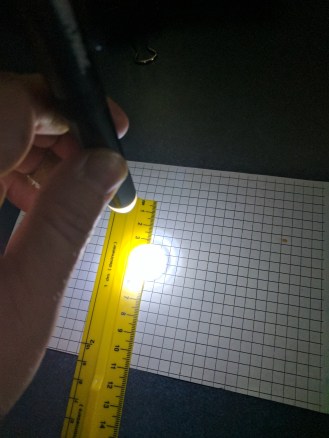
Students graphed the diameter of a light beam vs. the distance from a light source, making some qualitative observations about brightness along the way. We used the results as the basis of a discussion about why an astronomer would want a big telescope to observe very distant objects. I also did some having students observe the pen light itself from different distances to get across the idea that, even though the light beam spreads out, the light source doesn’t look any bigger.
img_20161118_102045

Day 29: Board Meeting & Hurricanes

AP Physics: Board Meeting

Students whiteboarded their results from the 2nd Law Lab and we had a board meeting. Students needed a reminder to translate the equation for their lines of best fit into “physics terms”, but they are getting more skilled at that. I was also pleased with how quickly students picked up on things like which groups had similar slopes, which made it easy to build some ideas like why the slopes would change.

img_2389

Earth Science: Hurricane Tracking

Students used some data from 1992’s Hurricane Andrew to plot its path and answer a few questions. They did a nice job connecting what they’ve learned about heat and wind so far to find some patterns in the hurricane’s path and wind speed, but the plotting took a long time. I’m debating whether I want to try and streamline the plotting next year so students can spend more time on the interpretation. It would be very easy to give them a completed map of the hurricane’s path, but I would need to revise or eliminate some of the questions where students paused their plotting to make predictions. Another option would be to put the map into Desmos as an image, then have students type in the coordinates. With the manual plotting, I overheard some conversations where students were connecting coordinates on the map to coordinates on a graph, which is a great connection for them to make and I can’t decide whether Desmos would help or hurt that connection. I also need to identify the key take-aways from this lab to help decide where I want students to spend their time.

Day 14: Board Meeting & CER

AP Physics: Board Meeting

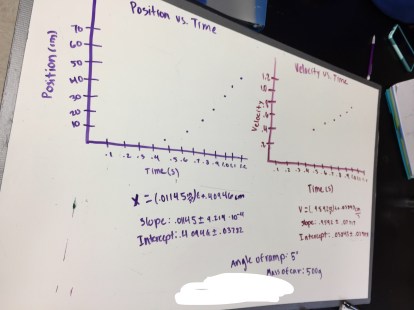
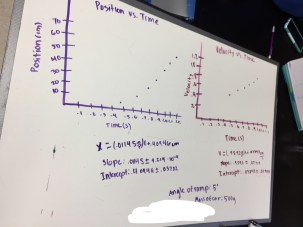
We had our board meeting on the ramp lab. This time, I had students do a gallery walk of the whiteboards prior to the discussion to give them a chance to take a close look at all of the whiteboards. That preview gave students the opportunity to make some more detailed observations, which added nicely to the discussion.

img_2232

Earth Science: Writing CERs

Both Wednesday and Thursday, we ran out of time to do any wrap-up on the labs, so that was our focus today. Students wrote CERs for both of the labs. This was a good opportunity to think about what makes good reasoning, since we were using lamps, beakers, sand, and thermometers to make statements about Earth’s atmosphere.

Day 13: Whiteboard Prep & Greenhouse Effect

AP Physics: Whiteboard Prep

We finally finished data collection on the ramp lab; using the dynamics tracks and the LabQuests for the first time along with working through uncertainty took longer than I expected. Students also prepped their whiteboards today, so tomorrow we can start by talking through the results.

IMG_2232.JPG

Earth Science: Greenhouse Effect

Students did a lab to compare heating in a covered and uncovered beaker as an analogy for the greenhouse effect. We had some great discussion beforehand about what needed to be controlled in this experiment. While there were some good contributions, they came from a limited number of students, so I may try randomly calling on some students after they’ve had a chance to think independently and talk to a neighbor the next time we look at something like this.

img_2231

Day 9: Board Meeting & Review

AP Physics: Board Meeting

Students sketched their distance vs. time and angle vs. time graphs from the rotating disk Direct Measurement Video. I’d assumed students would just use the frames displayed in the video to find the time directly, but a lot of groups decided to treat when a dot was at a position of zero as t = 0, which gave us a good opportunity to talk about some experimental design decisions, which reinforced what the intercept represents on a graph like this.


Earth Science: Review

As a school, we’ve been working on having students write meaningful questions as part of our focus on Cornell notes. While I don’t do many notes, I decided to piggy back on this by having students write possible test questions for each learning target. Periodically, I had groups trade whiteboards and work on answering the questions another group had come up with. At this point, the questions were fairly superficial, which isn’t surprising since we just skimmed the surface of the topics in this unit and students haven’t had much practice or feedback writing questions yet.

Day 4: Board Meeting & Earth’s Spheres

AP Physics: Board Meeting

We discussed the buggy lab today for our first board meeting of the year. I followed Casey Rutherford’s Observations, Claims, Evidence framework and my students were eager to dive in, but I think they didn’t know enough about what other groups did really dig into some of the discussion points. I usually just have students put their graph and equation on the whiteboard in an effort to make it readable by 30+ people, but I want them to share more about their experimental design next time and am toying with a couple ideas. I’m leaning towards either doing a gallery walk prior to the whiteboard discussion, so that we can sacrifice some readability in favor of more information on the whiteboards, or getting a few more whiteboards so that groups can have one for results and one for the set-up of their experiment. I thought about starting the discussion with each group giving a 1-2 min description of their experiment, but I worry with 8-12 lab groups in a class, that will be too much information to keep track of.

Earth Science: Earth’s Spheres

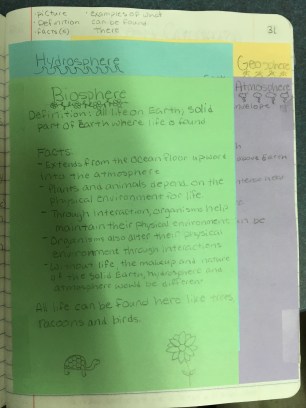
Students did a foldable interactive notebook activity to compare the biosphere, atmosphere, geosphere, and hydrosphere. I think both my students and I were a little frustrated to set aside the really good thinking they’ve done on ocean currents the last few days to work on something that didn’t feel connected. I’m teaching in a colleague’s classroom and following his sequence, in large part because we only have one class set of lab equipment and multiple sections of the course every period, so scheduling labs gets tricky, but I need to work around that to give my class more sense of coherence.

img_2165

Day 123: Board Meeting & Balancing Equations

Physics: Period of a Spring Board Meeting

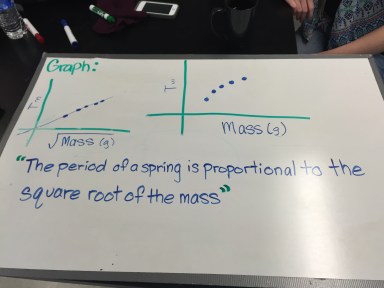
Students whiteboarded their results to yesterday’s lab. Once we get situated, I usually give students a minute or two to talk with their lab group. I watched one group use this time to furiously tap at a tablet, then edit their board to reflect a square root, rather than linear, relationship between period and mass. During the discussion, I asked them to explain the change they made and they shared that, prior to seeing they other whiteboards, they stopped after trying a linear fit because it had a really nice correlation coefficient. When they saw other groups got an intercept much closer to zero using a square root fit, they quickly tried the same fit on their data, and saw they got a better correlation and an intercept of nearly zero. We’re talking a lot in my building about how to use technology in the classroom, and this moment exemplifies how I want students to use technology. This group had to decide whether their linear fit or their classmate’s square root fit was more convincing, and Desmos made it possible to quickly and easily test the competing ideas and get the evidence they needed to be convinced.

IMG_1765

Chemistry: Balancing Equations

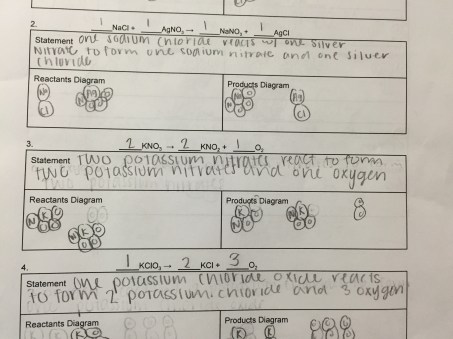
Students combined the multiple representations we worked on before break with what they figured out in yesterday’s sim to practice balancing chemical equations. I remain very impressed with how easy the reaction diagrams make this process for students.

IMG_1764

Day 77: Board Meeting & Activity Series

Physics: Electric Fields Board Meeting

Students whiteboarded their graphs from yesterday’s electric fields simulation. I was really pleased with how quick students were to bring up Coulomb’s Law as a way to check if their relationships made sense. There was also some good discussion about why linearization is useful, where several groups shared their initial attempt to linearize using a purely inverse (rather than inverse-square) relationship between field strength and distance.

IMG_1583

Chemistry: Activity Series

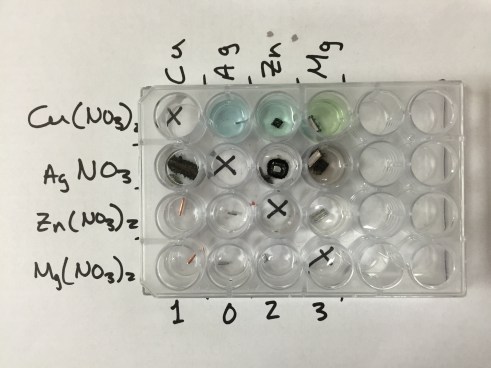
Students dropped four different metals into four different solutions to see how many times each metal reacted. They were able to rank the metals in a crude activity series, then we looked at how that activity series could explain which solutions each metal reacted with.

IMG_1586


Day 74: Board Meeting & Observations

Physics: Coulomb’s Law Board Meeting

Students whiteboarded the results of yesterday’s lab and we had a board meeting. I had students graph force vs. distance, then both an inverse and inverse-square test plot so we could compare the correlation coefficients. While both classes were able to get to the inverse-square relationship, I struggled to get students to take the lead in the discussion. I think part of the problem is, while we’ve whiteboarded lots of problems and conceptual questions, the last board meeting where we focused on graphs produced in a lab was early November. I need to either do more whiteboarding labs during projectile motion and energy, or I need to bring in more of the scaffolding I do early in the year to help students refresh their skills.

IMG_1574

Chemistry: Observations of Reaction Types

Students finished up the lab from yesterday, then we spent some time trying to connect their inferences to their observations in the lab. In the discussion, I realized I need to make explicit to my students what is a good observation and how that contrasts with an inference or claim. For example, the textbook lists gas formation as a sign of a chemical reaction, so nearly every student listed gas formation as an observation at least once, but struggled to explain what they saw that suggested a gas was formed. I can’t forgot how important it is to explicitly address the basics in a class like this.

IMG_1572

Day 35: Series vs. Parallel Circuits & Board Meeting

Physical Science: Series vs. Parallel Circuits

Students used PhET’s circuit construction kit to explore the differences between series and parallel circuits. When I’ve used batteries and bulbs, students really struggle to see (let alone articulate) what’s going on with the current, so the visible “electrons” in the simulation were a huge help in getting students to understand why certain changes happened.

Physics: Board Meeting

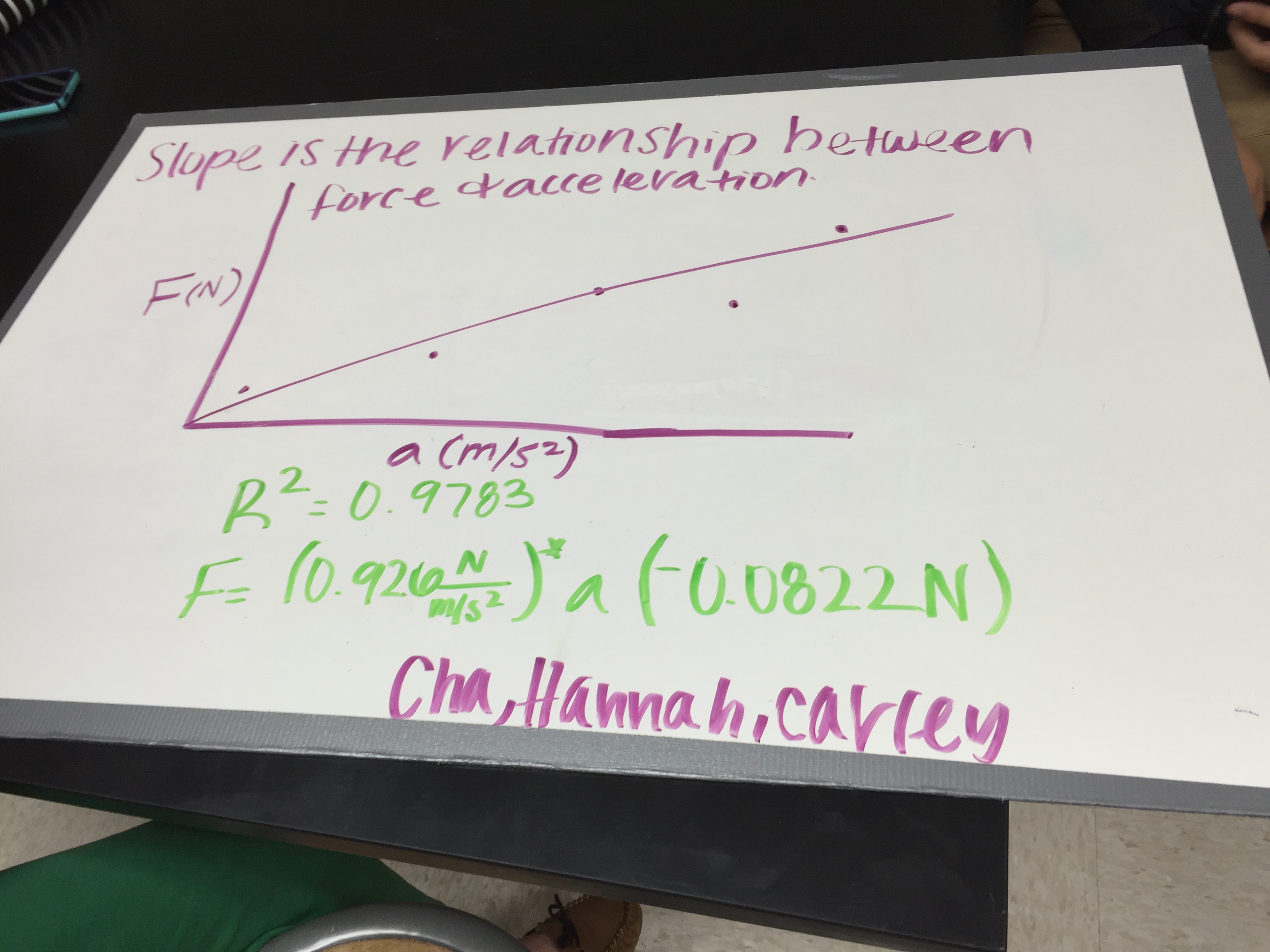
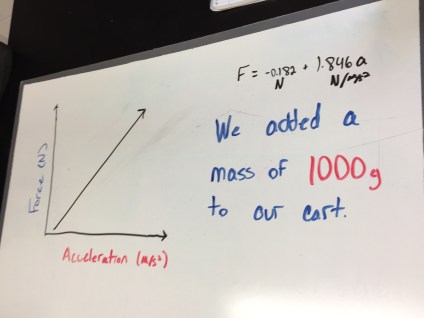
We discussed as a class the results of the Newton’s 2nd Law lab. I need to have students practice talking about the slope more; they were able to get to “The force needed to accelerate 1 m/s2“, but it took some pushing on my part; I think the issue is just lack of practice. I was pleased by the discussion; students are doing more articulating of the big ideas. I was really excited by the discussion students had about the intercept. I’d planned to declare the intercept zero and move on, but in both sections students seemed interested in talking about it. They decided it would be reasonable to have a non-zero intercept on this experiment and it would be equal to the amount of friction you have to overcome to start the cart moving.

IMG_1333