Day 115: Board Meeting & Connecting Representations to Observations

AP Physics 1: Ohm’s Law Board Meeting

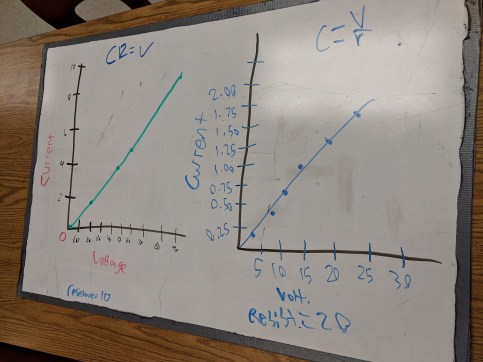
We had a board meeting for yesterday’s results. One of the things I was really happy about is not all groups used the same approach to dealing with three variables. Some did one experiment graphing current and voltage, followed by a second experiment graphing current and resistance. Others just graphed current and voltage, but did the same experiment with two different resistances.
ap ohm.jpg

Physics: Spring Period Board Meeting

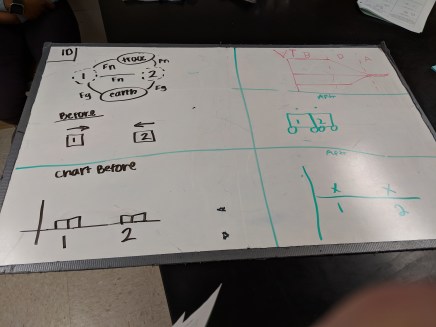
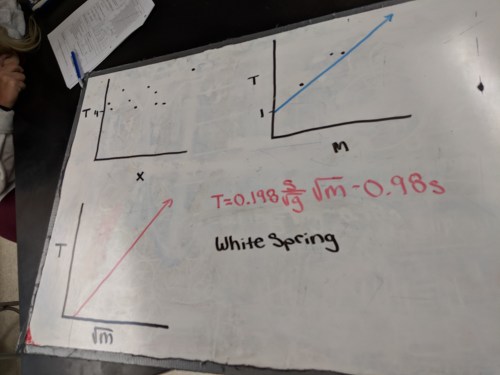
We whiteboarded the results from this week’s lab on spring period. When writing the equation, a lot of students had trouble with when to use a unit and when to use a variable, but that’s been tough throughout this year. I think a lot of students are struggling to distinguish what those two things communicate, so I need to give some thought to how to teach that difference.
phys spring.jpg

Chemistry Essentials: Connecting Representations and Observations

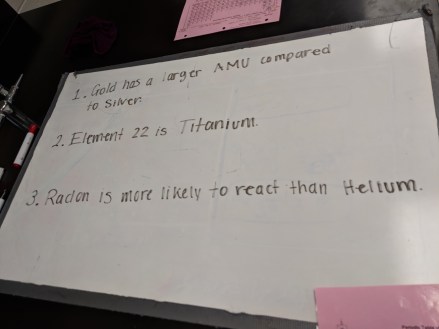
One of the things I think has been missing in the second half of this course is students draw very few connections between what they actually see in the lab and the representations they use for chemical reactions, so my co-teacher and I decided to work on that this year. Today, we did a lab where students did several simple chemical reactions, then identified observations that support specific elements of the reaction equation. For example, when students reacted copper (II) chloride with aluminum, they were able to recognize the reddish powder that replaced the aluminum was the copper predicted by the reaction equation.

chem lab (1).jpg

Day 113: Board Meeting, Spring Period, & Representing Reactions

AP Physics 1: Coulomb’s Law Board Meeting

We had a board meeting to discuss the results of yesterday’s lab. Students were quick to buy into the inverse square relationship and to recognize how their results support that like charges repel and opposites attract. I haven’t found a great way to get at the meaning of the slope, but its at least pretty intuitive that the amount of charge should affect the size of the force.

ap wb

Physics: Spring Period

Students collected data to figure out what affects the period of a mass oscillating on a spring. Today was one of the days when the progress my students have made in designing an experiment was very apparent, which made it a lot of fun to listen to them plan and troubleshoot their approaches.

spring

Chemistry Essentials: Representing Reactions

Students practiced translating between reaction equations, statements, and particle diagrams. One of the big challenges is my students were in very different places, especially when it came to particle diagrams and switching between names and formulas. About a third of my students took Chem Ess A with me last tri, so they were just extending some fairly recent learning. Another third took Chem Ess A with me tri 1, so have seen these skills, but haven’t used them in a few months. The rest of the students came to me from other teachers who don’t use particle diagrams and several haven’t had chemistry since last year, which gave them a much higher mental load. Most tables had a mix of students from each group, which meant there was a lot of peer teaching today, which helped with the variation quite a bit.

Day 102: Problems, Board Meeting, & Making a Compound

AP Physics 1: Wave Problems

Students worked on some problems dealing with waves.

Physics: Board Meeting

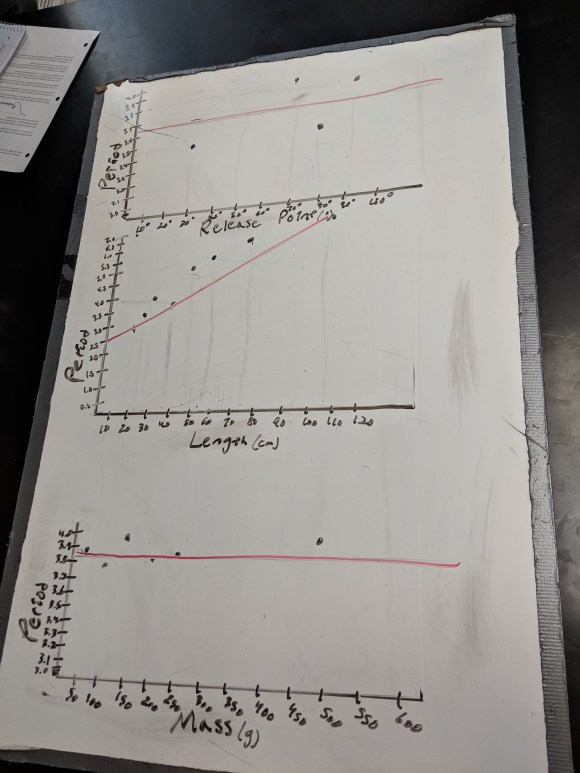
We had part 2 of a pendulum board meeting where students shared their linearized graphs. I use the units to work from the slope students got to the full pendulum equation, but I’ve never been all that happy with how it goes. I need to keep thinking about how to improve the way I approach this lab.

phys pend WB.jpg

Chemistry Essentials: Making a Compound

Students made some observations of iron and sulfur to figure out whether it formed a new compound after mixing or after being heated. Students were pretty successful at figuring out when the key change happened.

chem lab.jpg

Day 101: Board Meetings & Mistakes Whiteboarding

AP Physics 1: Wave Board Meeting

Students whiteboarded their results from Tuesday’s lab. They pretty quickly made the connection that the slope is the wave speed and saw the relationship I wanted between tension and wave speed. I’d planned to use Pivot Interactives to do some wave superposition basics, but our internet was out district wide for part of the day, so ended up doing some pretty teacher directed stuff with a snakey spring.

wave wb.jpg

Physics: Pendulum Board Meeting

Students whiteboarded their results for the pendulum lab. I didn’t have any groups decide to linearize on their own, so we had some discussion about the intercept to decide we needed to linearize.

phys pend.jpg

Chemistry Essentials: Formula Mistakes Whiteboarding

We did some mistakes whiteboarding with Tuesday’s worksheet on formula writing and particle diagrams. A lot of students seemed to be getting the hang of this skill today, which was great.

I’m seeing some students checking out, which is typical for this point in the trimester; I think students see it as set by now whether or not they will pass the course. My co-teacher and I have reduced how many students are in that place by having individual grade conferences with each student, which has been especially important for helping students who aren’t passing to make a plan.

chem formula.jpg

Day 96: Lots of Whiteboarding

AP Physics 1: Spring Period Board Meeting

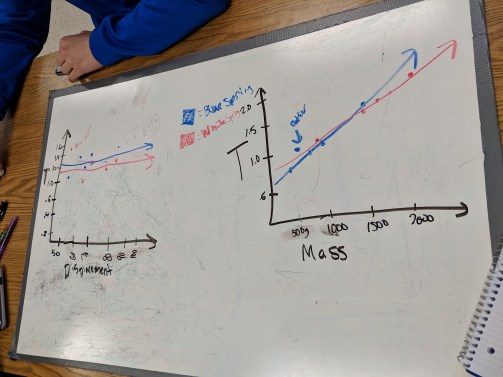
We had a board meeting for the lab on the period of a spring. With all the days we’ve lost due to weather (and the potential for more in the forecast…), I cut it a bit short. My students aren’t in a place where they linearize automatically, but we did have some good conversation about the fact that the intercepts on the period vs. mass graph don’t make sense and students were very quick to come to a consensus that it sure looks like a square root relationship.

ap spring lab.jpg

Physics: Projectile Calculations

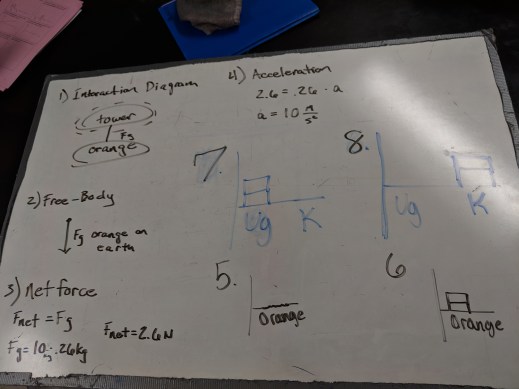
We revisited last week’s problem about an orange dropped from a tower to transition into projectile calculations. Students got into groups and whiteboarded solving for the time the orange took to fall and its final velocity. In each section, I had one group that opted to use conservation of energy to find the final velocity of the orange, which was a great way to contrast two different approaches. From there, we gave the orange some horizontal velocity to flesh out the calculations. This approach really drove home that students are being asked to remix old skills, not do something new.

phys calc.jpg

Chemistry Essentials: Bohr Model Whiteboarding

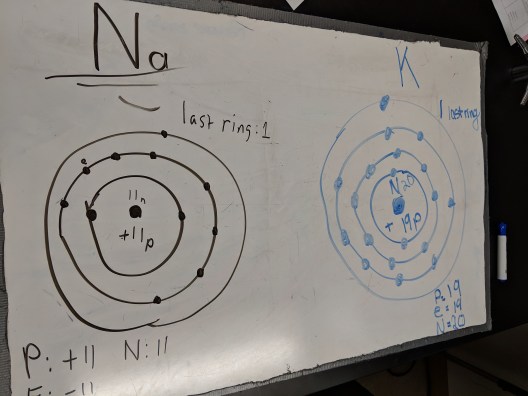
Students did a short worksheet figuring out the Bohr model structure of elements near the beginning of the periodic table. Afterward, students whiteboarded their answers for a gallery walk. I had each group do two elements from the same family to help the pattern in the number of valence electrons pop out.

bohr

Day 92: Board Meeting, Representing Free Fall, & 2 Truths and a Lie

AP Physics 1: Pendulum Board Meeting

Students whiteboarded their results from yesterday’s pendulum lab. For mass and release angle, there were a couple of groups who sketched graphs that did not start at zero, which was great for having some discussion about why the scale of your graph matters. This was also the first graph students had that wasn’t quadratic or linear, so no groups linearized initially and we had some fantastic conversation about the intercept, which actually started in some groups while they were still prepping whiteboards. By the end of the hour, every group had linearized and was on-board with a square root relationship.

ap pendulum.jpg

Physics: Representing Free Fall

Students used some questions I modified from Michael Lerner to represent a falling orange using tools from each model we’ve covered so far this year. By the end of the hour, students commenting that free fall and projectile motion really aren’t anything new, which was exactly the goal! Students were struggling to connect this activity to the graphs we discussed yesterday, so that will be something to work on tomorrow.

phys orange.jpg

Chemistry Essentials: Periodic Table 2 Truths & a Lie

After discussing some of the trends in the periodic table, we did some whiteboarding to practice reading the periodic table and recognizing the trends. Since there isn’t a whole lot of depth to the questions I could ask at this point, each group prepped a whiteboard with two correct statements and one incorrect statement. Then, they traded whiteboards with another group who had to find and correct the wrong statement.

chem 2truths.jpg

Day 87: Projectile Practical, Energy Problems, & Board Meeting

AP Physics 1: Projectile Practical

Students finished predicting where a marble rolled off a lab table will hit the floor. Once students have a success, I gave them a lighter marble and asked them to predict where it will land without taking any new measurements.

IMG_1393

Physics: Energy Problems

Students worked on calculations using conservation of energy. This was a tougher leap than I expected given how easily students got the hang of setting up conservation of momentum problems from bar charts. I think a card sort similar to the one we did for momentum would have been a good stepping stone.

Chemistry Essentials: Board Meeting

Students had a board meeting with their results from yesterday’s lauric acid lab. I had students collect data for the acid both melting and freezing, which made for a good visual of how similar those processes are. Students also made some good connections to last week’s activity in Pivot Interactives. I think starting with the cleaner data helped students to see the patterns in their data and there was some great conversation about why everyone had the same temperatures on their flat sections today while different groups got different temperatures on their graphs last week.

lauric board.jpg

Day 85: Whiteboarding, Video Analysis, & Board Meeting

AP Physics 1: Whiteboarding

Students whiteboarding yesterday’s problems. I focused on a consensus-building approach, where all groups whiteboarded the same problem, then we used the discussion to come to an agreement on what the answer should be, and why. Both my sections have a pretty good sense of class community, which made students pretty comfortable sharing work they weren’t sure about yet and building off each others’ ideas.

Physics: Video Analysis

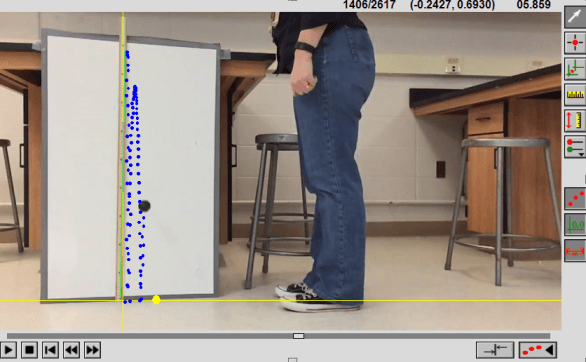
We finally got out the computers to do some video analysis of a bouncy ball to figure out what interaction is dissipating the energy. I’ve never had much luck walking the whole class through the software, so I have a video analysis guide with lots of animated screenshots that I put on the class website. Students were able to get some nice graphs of the bouncy ball’s motion and connect them to our work from the past few days.

bouncy ball va.PNG

Chemistry Essentials: Board Meeting

Students whiteboarded their results from yesterday’s lab in Pivot Interactives. During the board meeting, students continued to share observations faster than I could write them down, which is a great problem to have in this course. It was also very clear to students that the temperature stays fairly constant during the freezing process. I’m hoping having had a board on these results will help students make sense of our lauric acid lab on Tuesday.

pivot phase change.jpg


Day 78: Bouncy Balls, Kinetic Energy, & Board Meetings

AP Physics 1: Bouncy Balls

My article on this lab is in the Jan 2018 issue of The Science Teacher.

Students wrapped up their video analysis of a bouncy ball’s motion and started working on CER statements to answer what interaction dissipates the energy. I ended up doing more coaching than I usually do; I usually manage to squeeze this in before winter break, so I think it was just too long since students had been using free-body diagrams or velocity vs. time graphs. Nevertheless, students got to an answer today which was my goal.

Maker:S,Date:2017-10-21,Ver:6,Lens:Kan03,Act:Lar02,E-ve

Physics: Kinetic Energy

We had a pre-lab discussion and students collected data to work on a relationship between kinetic energy and speed. I found that a lot of students were confused about how to figure out the kinetic energy of the cart once they got into their lab groups. We went through the calculation during the whole class discussion, but I’m wondering if it would have been worthwhile to get students sketching some diagrams on whiteboards with their lab groups to figure out how they could find kinetic energy to get everyone wresting with those ideas, rather than just the students who spoke up.

ramp lab

Chemistry Essentials: Board Meeting

We held the board meeting for both of the gas laws labs students completed on Pivot Interactives this week. This trimester, my co-teacher and I have been trying to ramp up the graph interpretation we ask students to do, and today was a nice opportunity to see it pay off. Students were very successful at attaching conceptual meaning to the slopes of their graphs and, with a few questions to nudge them along, were also able to connect the intercept of the pressure vs. time graph to absolute zero.

chem board.jpg

Day 67: Board Meeting, Representations Jeopardy, & Density of a Solid

AP Physics 1: Board Meeting

Students whiteboarded their results for the elastic potential energy lab we’d done earlier this week.

Physics: Representations Jeopardy

In both my sections, we started with mistakes whiteboarding for yesterday’s problems. My 6th hour is about 1/3 the size of my other section, so they got through the mistakes whiteboarding very quickly. I tried what I called Representations Jeopardy: each group came up with a scenario, and whiteobarded a set of representations, minus the sketches and any labels that would identify what the objects involved are. Then, groups traded whiteboards and had to come up with a scenario that matched the whiteboard they received. Students said they really liked that they had to think differently in order to work backwards from the diagrams.

phys mistake

From mistakes whiteboarding

Chemistry Essentials: Density of a Solid

Students worked on finding the density of some metal dowels. I realized belatedly this is the first lab we’ve done where they didn’t need a container when measuring the mass, so it was actually a tricky leap for them to not tare something out on the balance.

volume