Days 5-9: Board Meetings & Problems

This week’s big theme was using precise, specific language in physics.

Physics: Buggy Lab & Problems

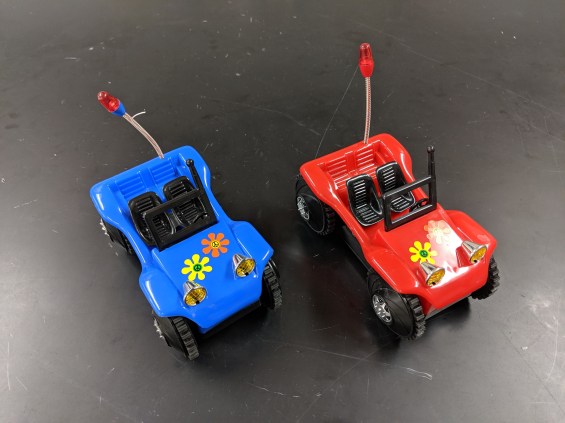
Students did the buggy lab, then worked on some problems with constant velocity representations. We went over the problems using Kelly O’Shea’s mistakes whiteboarding. Both during the buggy board meeting and during the mistakes whiteboarding, students used a lot of phrasing like “the slope is increasing” to indicate a positive slope or even just saying “the buggy was decreasing”, rather than specifying what about the buggy is decreasing, which made for some good opportunities to pick apart that wording and try to find ways to make it clearer what they meant. A few students seemed like they were frustrated by these conversations, especially during mistakes whiteboarding when a group didn’t consider that one of their mistakes, which tells me I need to keep working on emphasizing growth.

buggies

AP Physics 1: Problems & Acceleration Model-Building

AP also had their first round of mistakes whiteboarding this week. While we had some similar conversations about language, I noticed fewer students who seemed frustrated by those conversations. I don’t think I approached getting nitpicky about wording differently than I did in Physics, so I’m not sure if the AP students were doing more hiding their frustration or if they are bringing something to the class that leaves them less bothered by me getting picky about language.

After the problems, we started a model-building lab for constant acceleration where we used photogates to produce a position vs. time graph for a cart on a ramp. This lab is fairly teacher-directed since its the first time students are using any LabQuest probes, and it takes a while to get through. I’ve thought about switching to motion detectors or video analysis, but with the limited computer access I usually have, I like that photogates produce data that students can linearize. My building added a lot more laptop carts this year, so I might try one of the other options when Physics gets to acceleration.
Days 1-4: Dowels & Buggies

School started on Tuesday! This week was all about setting the culture for my classes.

AP Physics 1: Buggy Lab

We dove right in and started the buggy lab on day 1 to start building the constant velocity model. Once again, I used Frank Noschese’s take that “Any lab worth doing is worth doing twice.” On day 1, I just told students to make a graph on a whiteboard that represented their buggy’s motion. There was a lot of variation and other messiness in the whitebaords, which lead the post-lab discussion naturally into how we could prepare whiteboards in a way that set us up for a better discussion. On Day 2 and 3, we repeated the lab, but with some agreements in place to make the whiteboards easier to discuss.

Last year, this approach felt like I was doing some “expose and shame”, but I really liked that it gave an authentic reason to agree on certain details as a class before data collection. This year, I tried to address that by starting the discussion on day 1 by explicitly addressing the fact that every group met the standard set in the directions I gave and talking about the benefits of the different representations we saw. When we switched to talking about changes to the lab, I emphasized that we would be approaching the second round with a focus on being able to communicate and compare results. I also kept the focus on what students needed from me, rather than what students needed to do differently, if we were going to focus on communicating and comparing. This framing of the discussion felt much better to me.

buggies.jpg

Physics: Dowels

Partly to avoid sharing equipment and partly to limit how much students have to retain from the first lab, we started by asking students to predict the mass of a large dowel by finding a relationship between the mass and volume of smaller dowels. Similar to AP, we did the lab twice. On the first day, I just asked students to predict the mass of the large dowel, and many ended up using measurements from a single smaller dowel. That lead to some nice discussion on how measuring more small dowels would reduce uncertainty. It also lead nicely into graphs as an easy way to look at the ratio between mass and volume of several dowels simultaneously. For the second round of the lab, students used the lab template I put together for the course.

dowels.jpg


Day 159: Final Project Work, Review Whiteboarding, & Half Life Problems

AP Physics 1: Final Project Work

Students worked on polishing their final projects. One student needed to measure some angles in a video clip on Netflix, and had the brilliantly simple idea to just hold a protractor against her screen.

Physics: Review Whiteboarding

Students whiteboarded problems off the final review. A few students asked to chose their own groups since this would be our final round of whiteboarding, but I’m glad I stuck with shuffling them since there was some great conversation during the first few minutes when students were comparing answers on their problems.

Chemistry Essentials: Half Life Problems

We had a board meeting with the results of yesterday’s lab, then students worked on some half life problems. I don’t think I do a great job of linking the lab to the calculations, and I could see it in the ways students were struggling with the calculations.

half life graph.jpg

Day 152: Final Projects, Board Meeting, & Activity Series Practical

AP Physics 1: Final Projects

Final project proposals are due tomorrow, so students worked on finalizing their topic. I got to have a lot of fun conversations today to help students narrow down their topic. One student had picked out a clip from The Cat in the Hat but wasn’t sure what she wanted to do with it, so we spent some time talking about the physics involved.

Physics: Curved Mirror Board Meeting

We whiteboarded the results of yesterday’s lab to get to the mirror equation.

curved mirror board.jpg

Chemistry Essentials: Activity Series Practical

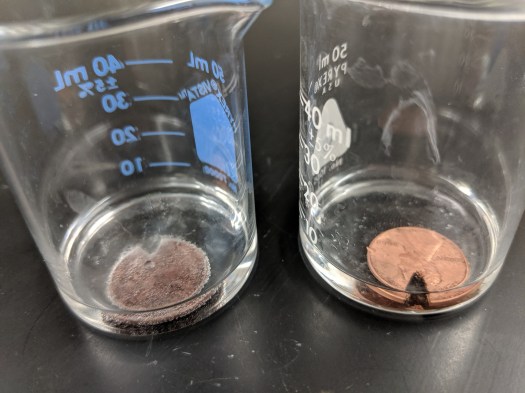
Students got a pre-1982 penny and a post-1982 penny, each with a wedge cut to expose the insides, and used an activity series to predict which would react with hydrochloric acid.

pennies in hcl.jpg

Day 144: Lab Practical, Board Meeting, & Lego Reaction Types

AP Physics 1: Lab Practical

Today was our last day of regular class before the AP exam. We worked on a lab practical where students figure out where to drop an unrolling toilet paper roll so that it will hit the ground as a roll that is simply dropped. I’ve got a worksheet where I added some questions to hit most of the topics from mechanics. I didn’t have any groups finish, but they did a lot of good thinking.


Physics: Plane Mirror Board Meeting

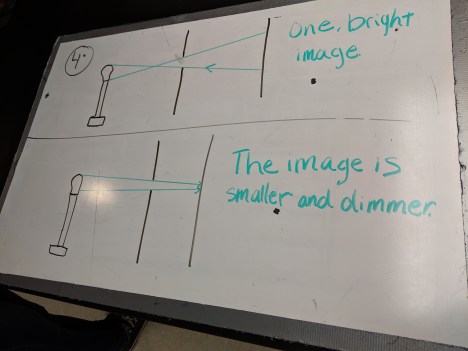
Students whiteboarded their results from Friday’s plane mirror lab. Several groups had some trouble distinguishing between units and variables in their equation because they were thrown off by the unitless slope, but we were able to work through it.

phys mirror board meeting.jpg

Chemistry Essentials: Lego Reaction Types

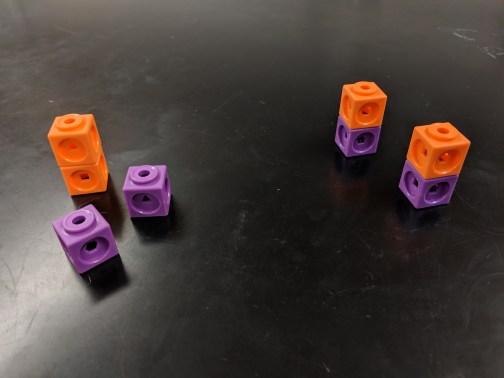
Students did a lab manipulating cubes to go from the reactants to the products for the major types of reactions we are learning to reinforce what is going on at the particle level. I usually use Legos, but forgot to ask a colleague to bring them in, so we pulled out the Mathlink cubes.

reaction types legos.jpg

Day 140: Whiteboarding & Pivot Limiting Reactants

AP Physics 1: Board Meeting

Students whiteboarded their results from yesterday to get to a definition of angular momentum, as well as the relationship between torque and angular momentum. They made nice connections to conservation of linear momentum as well as impulse.

Physics: Ray Diagram Mistakes

We did mistakes whiteboarding with yesterday’s ray diagram problems. Students were doing very well figuring out which rays were critical to the problem and catching each other’s mistakes.

physics Ray mistake.jpg

Chemistry Essentials: Pivot Limiting Reactants

I am as part of Pivot Interactive’s Chemistry Fellows program.

Students used Pivot Interactives to do a lab involving limiting reactants. Since lab data makes it tough to use particle diagrams, I tried having students convert their balanced reaction equation into “for every” statements. A lot of them were pretty successful using those statements to make sense of the other calculations I asked for.
pivot limiting.PNG

Day 136: Board Meeting, Shadows, & Limiting Reactants

AP Physics 1: Unbalanced Torque Board Meeting

Students whiteboarded their results from yesterday. They quickly and easily made the connections I was after and the idea of rotational interia seemed to click well.

AP torque.jpg

Physics: Shadows

I did a quick intro to ray diagrams. I like to clap some chalk dust over the beam from a laser pointer to show the light travels in a straight line. This year, I followed up with clapping chalk dust over a flashlight beam to see the cone of light and motivate drawing multiple rays, which worked very nicely. Students then played with shadows and drew ray diagrams to explain their observations.

Chemistry Essentials: Limiting Reactants

Students worked on some limiting reactant problems. Based on some questions students asked yesterday, we also revisited a reaction we’ve done with magnesium and hydrochloric acid. I set up one flask with indicator and hydrochloric acid to use as a reference. In the other two flasks, I also added magnesium and tasked students with making observations to determine what the limiting reactant was in flasks 2 and 3, which they answered using a CER.

chem limiting 2.jpg

Day 127: Board Meeting, Slinkys, & Molar Mass

AP Physics 1: Torque Board Meeting

We had our board meeting to get to the definition of torque. As expected, in the class where I had students plot the ratio of the forces on one axis and the ratio of the radii on the other, results were rough and I had to step in. In my other section, results came out beautifully and students were quick to figure out why their graphs had intercepts. I also introduced students to Brian Frank’s area models for torque, which students seemed to grasp.

ap lever board.jpg

Physics: Slinkys

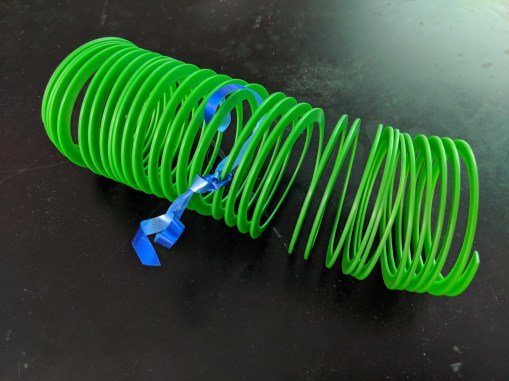
We used slinkys to start figuring out some ideas about longitudinal waves. Students were pretty successful at noticing the things I wanted them to notice. As with transverse waves, we tied some ribbons on the spring to help track the particle motion.

slinky.jpg

Chemistry Essentials: Molar Mass Lab

I got out samples of several different materials, and had students weigh a sample and figure out how many moles they had. Not the most dramatic lab, but it was some good practice.

Day 124: Gallery Walk, Board Meeting, & Mistakes Whiteboarding

AP Physics 1: Gallery Walk

Students did a gallery walk of some problems dealing with central net force and universal gravitation. There was a lot of good discussion as students worked on their problem, but I’m not sure how much students looked at the other problems.

Physics: Board Meeting

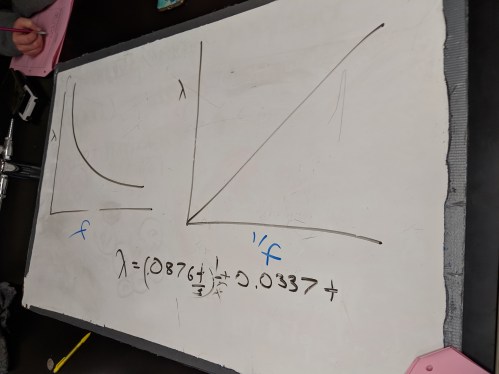
We had a board meeting for the snakey spring lab looking for a relationship between wavelength and frequency.

phys wb

This group used floor tiles as their distance measurement

Chemistry Essentials: Mistakes Whiteboarding

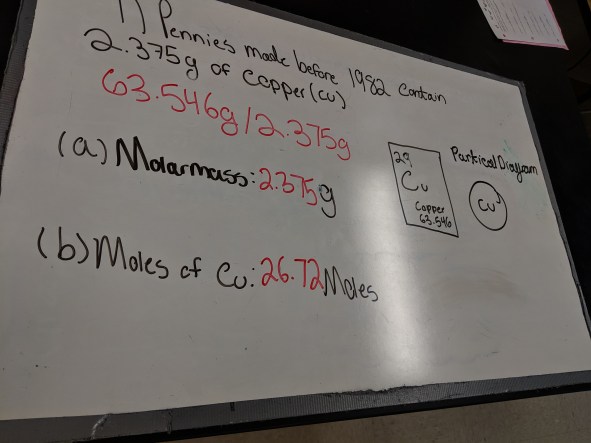
Students worked some problems translating between molar mass and moles of a substance, then did some mistakes whiteboarding to go over the problems.

chem molar mistake.jpg

Day 123: Board Meeting, Snakey Springs, & Molar Mass

Yesterday we had ACT testing for juniors. Seniors had an off-campus learning day.

AP Physics 1: Central Net Force Board Meeting

For yesterday’s off-campus learning day, my students finished collecting data in Pivot Interactives on central net forces. I really enjoyed the discussion of the force vs. mass graphs, when the class realized the units on the slope were the units on acceleration, so we had F=ma.

ap centeal force.jpg

Physics: Snakey Springs

Students used the snakey springs to collect data on a relationship between frequency and wavelength for standing waves.

Chemistry Essentials: Molar Mass

Students used nuts, bolts, and washers to represent different elements in order to discover how to find the molar mass of a compound. Afterward, they tried extending what they’d found to actual compounds. Not only were they very successful at extending their results, their work represented different ways of thinking about polyatomic ions, which was cool.