Day 20: Board Meeting & Free Fall

Physical Science: Newton’s Laws Board Meeting

Students finished collecting data, then we had a short board meeting to agree on the qualitative relationships in Newton’s 2nd Law.

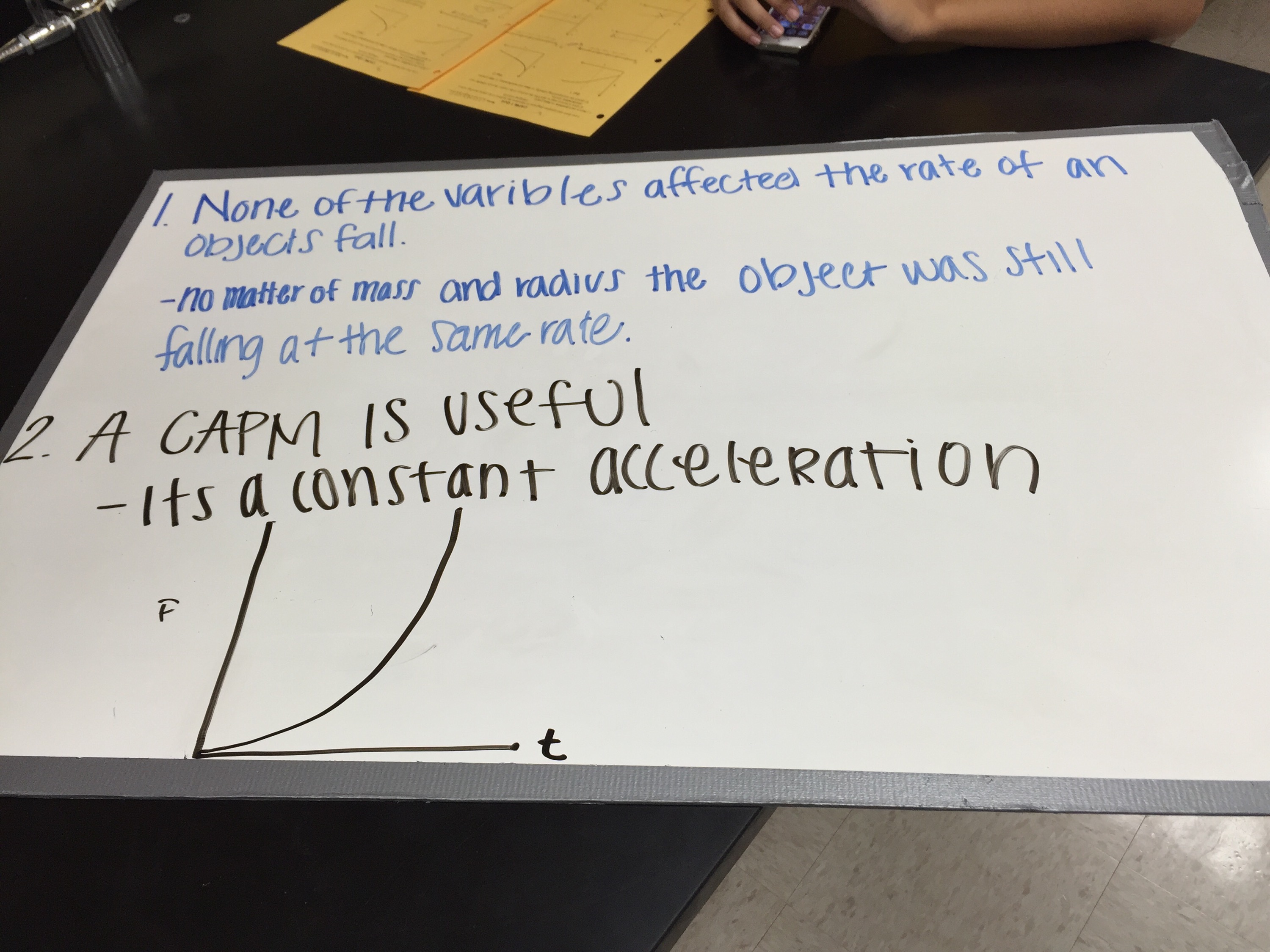
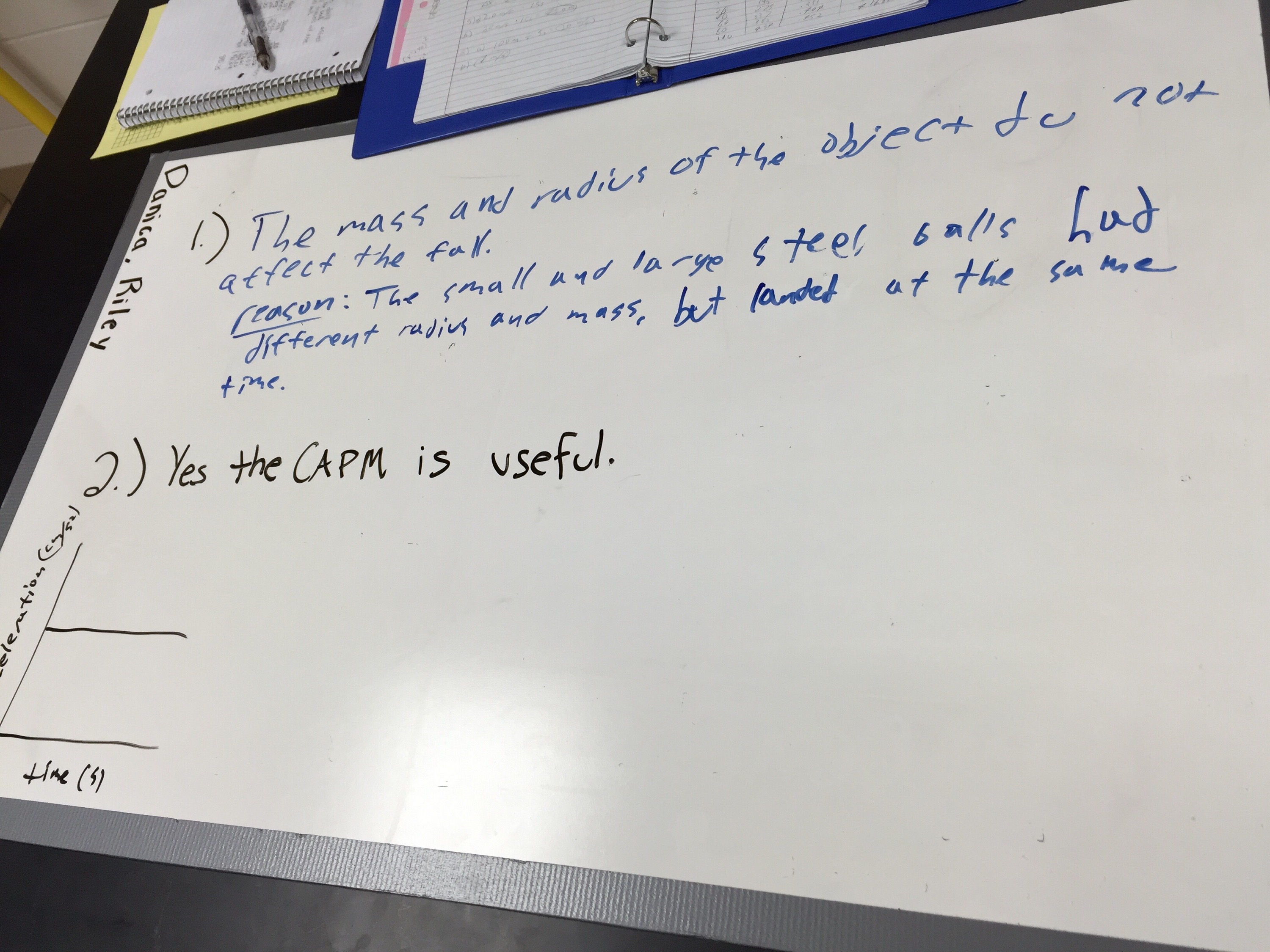
Physics: Free Fall

Students white boarded answers to a few qualitative questions about last week’s Direct Measurement Video. I emphasized having them provide evidence to support their answers, which lead to some good conversations, both in groups and in the whole class, about what makes “good” evidence. Different groups looked at different combinations of falling objects, which lead to some good disagreement about whether all objects fell at the same rate. My favorite moment was when I asked whether using the same acceleration for all objects is useful and a student quickly responded with “It depends” which lead to some good talk about uncertainty.
Day 12: Graph Matching & Board Meeting

My phone had a mishap with a drink this afternoon, so the photos I took are out of reach for now.

Physical Science: Graph Matching

Today I got out the motion detector to have students do some graph matching. My department doesn’t have enough LabQuests to do one per group, so the lesson was a mix between students in groups and testing predictions with the motion detector as a whole class. We hadn’t gone into the significance of the sign of the slope on a position time graph, so I had students start by sketching predicted position vs. time graphs for several written descriptions, with objects traveling both towards and away from the motion detector before having students walk the graphs from the Vernier activity.  Students loved the motion detector and I had no shortage of volunteers to try and walk the graphs.

Physics: Board Meeting

Students prepared whiteboards with their position vs. time graphs and linearized graphs from rolling carts down ramps. I’d hoped to include velocity vs. time graphs, as well, but the computer issues yesterday meant students just didn’t have time to produce those graphs. For the discussion, I used Casey Rutherford’s observations, claims, and evidence framework. I also took time at several points in the discussion to have students discuss with their neighbors before sharing with the whole class. Compared to the first board meeting, students did a lot more talking and I did a lot less. When I did talk, I asked much broader questions than last time. I’m pleased with the improvements both my students and I have made since the first board meeting.

Day 3: Defining Types of Energy & First Board Meeting

Physical Science: Energy Types

Students used PhET’s Energy Skate Park sim to begin exploring energy. Their directions were to open up the bar graph, then find as many ways as they could to change the size of each bar. Tomorrow, their observations will lead into the definitions for kinetic and potential energy.

Energy skate park screenshot

PhET’s Energy Skate Park

Physics: First Board Meeting

Students prepped whiteboards with their results from the Buggy Lab, then we had our first board meeting. I talked more than I wanted to during the meeting, partly because I was rushing to get students ready for a sub tomorrow and partly because I didn’t take enough time to set expectations or let students pre-discuss in smaller groups. Next time, I want to try using Casey Rutherford’s Observations, Claims, & Evidence structure to provide students with a little more scaffolding. My students were very willing to speak up and take risks during the board meetings, so I’m excited to see how future ones go!

Student whiteboard

Student whiteboard

IMG_0198

Another student whiteboard