Day 126: Universal Gravitation, Pendulums, & Quiz

AP Physics: Universal Gravitation

We discussed the results of the universal gravitation lab today. Once we got the inverse-square relationship, students quickly recognized the slope of their graphs seemed to be connected to the stellar mass. Prior to class, students entered their slopes and stellar masses into a spreadsheet, so I projected the data and sorted it to confirm the biggest slopes went with the biggest stellar masses. I also graphed students’ slopes vs. stellar mass to get a pretty good value for G.
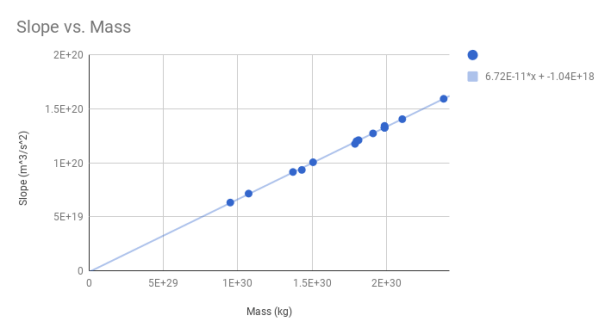
chart (1)

Physics: Pendulums

Students whiteboarded some problems from yesterday connecting pendulums to other models we’ve used so far this year, including momentum, forces, and energy. A few students needed some reminders, especially about the direction of tension forces, but were very successful in the end.
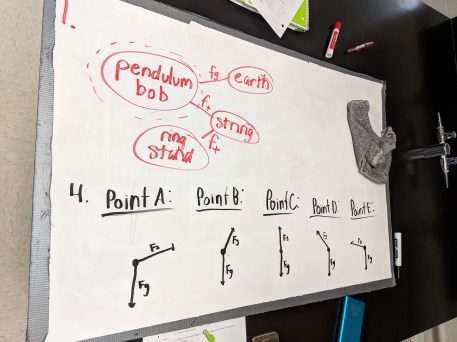
pend wb.jpg

Chemistry Essentials: Quiz

Students took a quiz on molar mass and balancing equations for chemical reactions. Based on a quick glance at their work and input from the para who worked with special education students on the quiz, I think I’m going to see a bi-modal distribution. I’m planning to start stoichiometry, and need to think about how I’m going to support the students who are still struggling with molar mass and balancing reactions when we are starting to use those skills together.

Day 123: Universal Gravitation, Pendulums, & State Testing

Today, sophomores and juniors are taking state tests, so freshmen and seniors have an off-campus learning day. This is the first time we’ve done something like this and the guidelines were pretty flexible. Both of my physics courses are mostly seniors.

AP Physics: Universal Gravitation

Students finished graphing their data from yesterday’s lab using exoplanet data. I started a thread on Google Classroom for students to post questions to try and encourage some virtual discussion, though it didn’t get any action as students opted to e-mail me, instead. Most of the questions I got related to uncertainty, which is not surprising. There were some great conversations yesterday about uncertainty, including why some measurements had different values for the plus and minus.

Physics: Pendulums

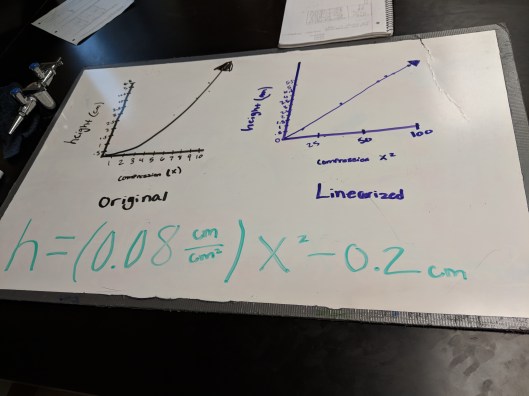
Students worked on graphing and linearizing their data from yesterday’s pendulum lab. I usually give students time in class to linearize their graphs so they talk to me or their group members, but they’ve had enough experience at this point that it shouldn’t be a huge leap to do it independently. A few groups didn’t collect all their data yesterday, so I posted a link to PhET’s pendulum lab so they could still be on track for tomorrow’s board meeting.

pendulum lab

Chemistry Essentials: State Testing

My chemistry students are juniors, so they took the ACT today to meet state testing requirements and were off the hook for the off-campus learning day.

Day 122: Universal Gravitation, Pendulums, & Formula Mass

Today was our first day back from spring break! We have kind of an odd start to the week since tomorrow freshmen and seniors have an off-campus learning day to accommodate state testing for sophomores and juniors.

AP Physics: Universal Gravitation

Students worked on an activity Lucas Walker presented at AAPT last summer using exoplanet data to find a relationship between centripetal acceleration and orbital radius. I was nervous about having students calculate the orbital velocity and acceleration in a spreadsheet since most of my students don’t have much experience with spreadsheets, but my students were very willing to dive in using the resources I provided and were very successful with the calculations.

Physics: Pendulums

Students collected data to model the impact of weight, drop angle, and mass on the period of a pendulum. I’m continuing to see students much more confident in their physics abilities than even the end of last trimester, and working more independently as a result.

pendulum.jpg

Using the environment to make measuring release angle easier

Chemistry Essentials: Formula Mass

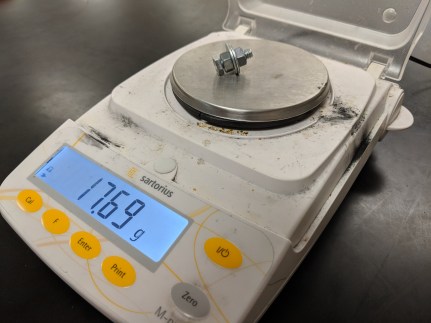
Students started making sense of formula mass by predicting the mass of various combinations of nuts, bolts, and washers. I wanted to give them something pretty concrete they could test directly in the lab before diving into true stoichiometry. When we shifted to chemical formulas at the end of the hour, a few students got tripped up if they skipped the particle diagram, but the math was pretty obvious to everyone once they got that step.

molar mass lab.jpg

Day 83: Inertial vs. Gravitational Mass, Board Meeting, & Freezing Lauric Acid

Several nearby districts had snow days today, so most of my classes were a little more off-task than usual today.

AP Physics: Inertial vs. Gravitational Mass

Students finished collecting data and making graphs for the period of a spring lab. We didn’t have enough time for a board meeting, but every group had decided mass is what matters so we took a few minutes to decide whether it is gravitational or inertial mass by comparing the period of a cart on a spring at different angles. This is the first year I’ve used the Pasco equal length springs, and several groups were able to get some pretty nice data for period and spring constant.

spring ramp.jpg

Physics: Board Meeting

Students whiteboarded their results from last week’s lab. I gave different groups different springs, and the slopes reflected that variation nicely which lead smoothly into fitting k into the formula. I had conversations with some groups about whether their results were “right” that reinforced just how uncomfortable some of my students still are with being even partially wrong. Talking to them, I think they don’t see this fear of being wrong as an obstacle to learning physics.

epe board 2.jpg

Chemistry Essentials: Freezing Lauric Acid

We worked on a lab to find the freezing point of lauric acid by melting it in a hot water bath, then making a temperature vs. time graph as it cools in a cool water bath. This is the last class of the day and we ended up getting released 13 minutes early due to a snowstorm, so only one group was able to get data. Especially since a third of the class was gone by 6th hour, I’m thinking about just repeating the lab tomorrow.

Day 73: Multiple Choice, Forces, & Gas Laws

AP Physics: Multiple Choice

After a quiz on projectile motion graphs, we spent some time using Plickers to practice multiple choice on energy and projectiles. One of my classes pretty openly started guessing, rather than thinking about the problems, so I think we may be doing multiple choice a little too regularly. I may start either alternating each week between relevant multiple choice and free response or just use quiz days for explicit AP practice less often.

Physics: Forces

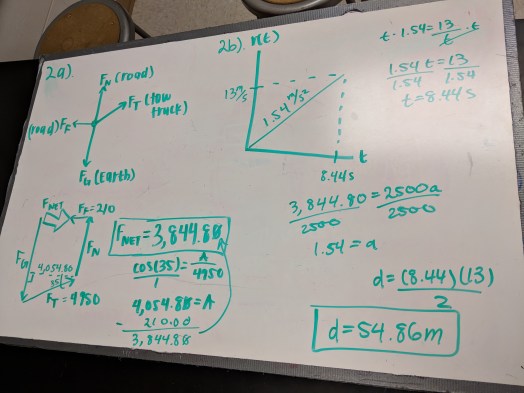
Before today’s quiz, students whiteboarded their diagrams for the problems earlier this week. Pretty consistently at this point, the students who take the time to get their diagrams right do fine on the calculations, which is not surprising. Getting students to put units in their work is still a challenge, but I saw a lot more confidence from my students today than I have in a while.

forces wb.jpg

Chemistry Essentials: Gas Laws

Before today’s quiz, we did a quick debrief of yesterday’s lab on the gas laws. Since the ice water didn’t work well yesterday, I tried putting them outside (the air temperature was -10 degrees F today!), but still didn’t see much change, so I think the syringes I have just don’t seal well enough. We’ll finish the post-lab discussion on Monday.

Maker:S,Date:2017-10-21,Ver:6,Lens:Kan03,Act:Lar02,E-ve

Day 71: Board Meeting, Practical, & Density Again

AP Physics: Board Meeting

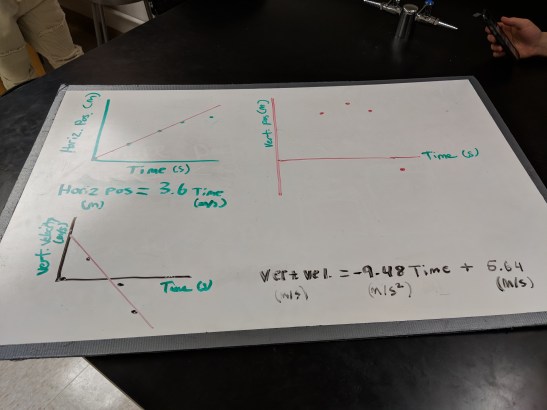
Students whiteboarded their graphs from yesterday’s video. Once I had my 2nd hour find a class average for the slopes of their vertical velocity vs. time graphs, everything fell beautifully into place and there were even gasps when one student sketched a free-body diagram. In my other hour, a lot of groups skipped the directions for making the v-t graph and tried to take shortcuts that didn’t work, so I had to step in a little more. This reinforces my thoughts yesterday that I should have spent some time discussing the midpoint method.

pm graphs.jpg

Physics: Unbalanced Forces Practical

Students started a practical to predict the time it will take a cart to roll down a ramp given the cart’s mass and the ramp angle. For the first time, I had several students ask if I could just do a diagram or calculation for them, so I left the pen I usually carry at my desk and kept my hands in my pockets to avoid encouraging that.

ramp prac.jpg

Chemistry Essentials: Density Misconceptions

Today, I have students blocks of the same material, but different volume, and asked them to determine whether volume affects density. A lot of groups had trouble funding the volume with a ruler, rather than later displacement, so I should have spent a little more time on a pre-lab discussion connecting yesterday’s volume measurements to today’s.

density (1).jpg

Day 70: Projectiles, Forces Reintroduction, & Density

AP Physics: Projectiles

Students did an activity on Pivot Interactives to watch the motion of a projectile from three different vantage points and produce position vs. time and velocity vs. time graphs. From what I saw, most groups got pretty good results. This was the first time students saw the midpoint method for finding slope of a curve, and I think I should have spent a little more time introducing that. We can have some discussion about it tomorrow.

projectile.PNG

Physics: Forces Reintroduction

Especially because a lot of students really struggled with the forces assessment right before break, we started this week getting back into the swing with some problems similar to what we worked on right before break. Before break, I was also seeing more and more students getting off-task during time with their groups, so I spent some time sharing my observations and having some discussion about how that fits with what it takes to be successful in a class like this.

Chemistry Essentials: Does shape affect density?

I had students determine whether the shape of a block affects its density using a set of aluminum blocks with different shapes, but the same volume. Last tri, I’d asked students to predict the shape of the mass vs. volume graph, but it was tricky to collect class data and the graph was kind of boring since I didn’t have much variety of volumes. This approach got the same misconceptions out on the table, but gave more meaningful results.

density.jpg

Day 69: Quizzes Galore

Today is the last day before winter break.

AP Physics & Physics: Quiz & Mystery Tubes

AP quizzed over conservation of energy while regular quizzed on Newton’s Laws in 2D. Afterward, I got out the Mystery Tubes rather than starting a new topic. Students were a little fried since they had tests in just about every class, so I think they appreciated the chance to do something low-stakes after their quiz. My students were definitely loopier than usual, and that lead to some creative models of what’s inside the tubes. Next year, it might be worth putting a lab practical on this day instead of a typical quiz.

todd the bug.jpg

This bug’s name is Todd. He lives inside the tube and moves the ropes.

Chemistry Essentials: Mistakes Game & Quiz

There was only time for one group to present their board yesterday, so we continued the mistakes game today before students took a short quiz on density. The mistakes game was fairly chaotic, but there were also some really good questions. I need to put in some more time working on norms for discussion, but I’m hopeful they will be able to have some good whiteboard discussions.

Day 68: Whiteboarding, Problem Practice, & Whiteboarding

AP Physics: Energy Predictions

Students whiteboarded drafts of their answer to which interaction dissipates a bouncy ball’s energy. One of the things I like about this activity is every group agreed the table is where most of the energy is dissipated, but there was a variety of evidence cited that gave some good opportunities for discussion. Afterward, I showed a thermal video of a weighted tennis ball and we played with the happy/sad balls and seismic accelerator.

Physics: More Problem Practice

Students got some additional practice with unbalanced forces in 2D. It was one more day than I think was truly necessary for their understanding, but confidence has been a big struggle this year and it seemed to help a lot of them feel like they can do the problems.

Chemistry Essentials: Mistakes Game

I did the mistakes game with yesterday’s problems, and it was very rocky. I think it wasn’t ideal timing to introduce whiteboarding since tomorrow is our last day before break and a lot of students are very restless. I’m also really struggling in Chemistry Essentials, more than when I’ve taught it in past years, to get students focused on chemistry during chemistry.

chem mistake.jpg

Day 67: Video Analysis, Speed Dating, & Density

AP Physics: Video Analysis

Students continued working to determine whether a bouncy ball dissipates most of its energy from impact or from air resistance (I’ll have an article about this activity in the January issue of The Science Teacher). Today, students used LoggerPro to analyze the videos they made yesterday and collect evidence. There were a lot of great conversations about connections between energy and motion, which is exactly what I’m after with this activity. Most students had a draft of a CER about where the energy was dissipated by the time they left class.


Physics: Speed Dating

As part of my effort to focus on lowering the social stakes in my class, I had students do some whiteboard speed dating to go over yesterday’s goal-less problems. There were a lot of great conversations; the best part was how many students I heard asking “How do you know?”. My 1st hour in particular did a great job of finding and correcting mistakes in each others’ work. I also am continuing to talk about my pedagogical choices more than usual, which seems to be helping students go along with what I’m asking and hold each other accountable for participating. Particularly in my 1st

speed dating.jpg

The units got fixed on the next rotation, but I forgot to snap a new photo

Chemistry Essentials: Density

We discussed the results of yesterday’s lab to get to a definition of density. I skipped doing a true board meeting because, with break looming, I was worried about time, but students didn’t have as solid a mental model of density as I would have liked when they were working on the worksheet. It was a good reminder that pedagogical shortcuts have their cost.