Day 61: Bar Charts, Mistakes Game, & Burning

AP Physics: Bar Charts

We discussed the results of yesterday’s lab in order to define kinetic energy, then I showed them the derivation for elastic potential energy. Since we’d already defined change in potential energy as the area of a force vs. displacement graph, I think I could have put that derivation on students. Afterward, I introduced students to LOL diagrams and set them to work sketching bar charts.

Physics: Mistakes Game

I love Kelly O’Shea’s mistakes game, but I’ve been having trouble getting my physics students comfortable talking as a whole class, so I decided to try lowering the stakes. I had them prep whiteboards as usual, but then they presented to another group, rather than the whole class. There were a lot of great conversations between groups and students were much more comfortable speaking up. Afterward, I gave students time to do a gallery walk of the post-discussion boards.

mistake wb.jpg

Chemistry Essentials: Burning

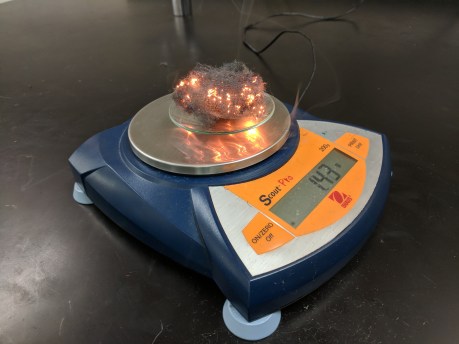
Students burned steel wool on a balance to observe the change in mass. Afterward, we used Post-It notes to make histograms of the change in mass from both yesterday’s labs and the burning. Last trimester, I skipped the class histograms, but I think the helped this group to meaningfully interpret their results. I also got excited when a student brought up conservation of mass before I did, which I don’t manage as often as I’d like in this course.
burn.jpg

Day 60: Kinetic Energy, 3rd Law, & Melting Mass

AP Physics: Kinetic Energy

To introduce kinetic energy, I had students work through a Pivot Interactives activity to find a relationship between the starting height of a puck and its velocity at the bottom of a ramp. I ran out of time to have a pre-lab discussion yesterday, so tried to have one in the computer lab today. I had more students then usual struggling with what to measure or what to graph, and I think that was because a lot of them started the activity rather than fully engaging in the discussion. Once they got rolling however, students warmed up to the interface pretty quickly.

pivot ke.PNG

Physics: 3rd Law

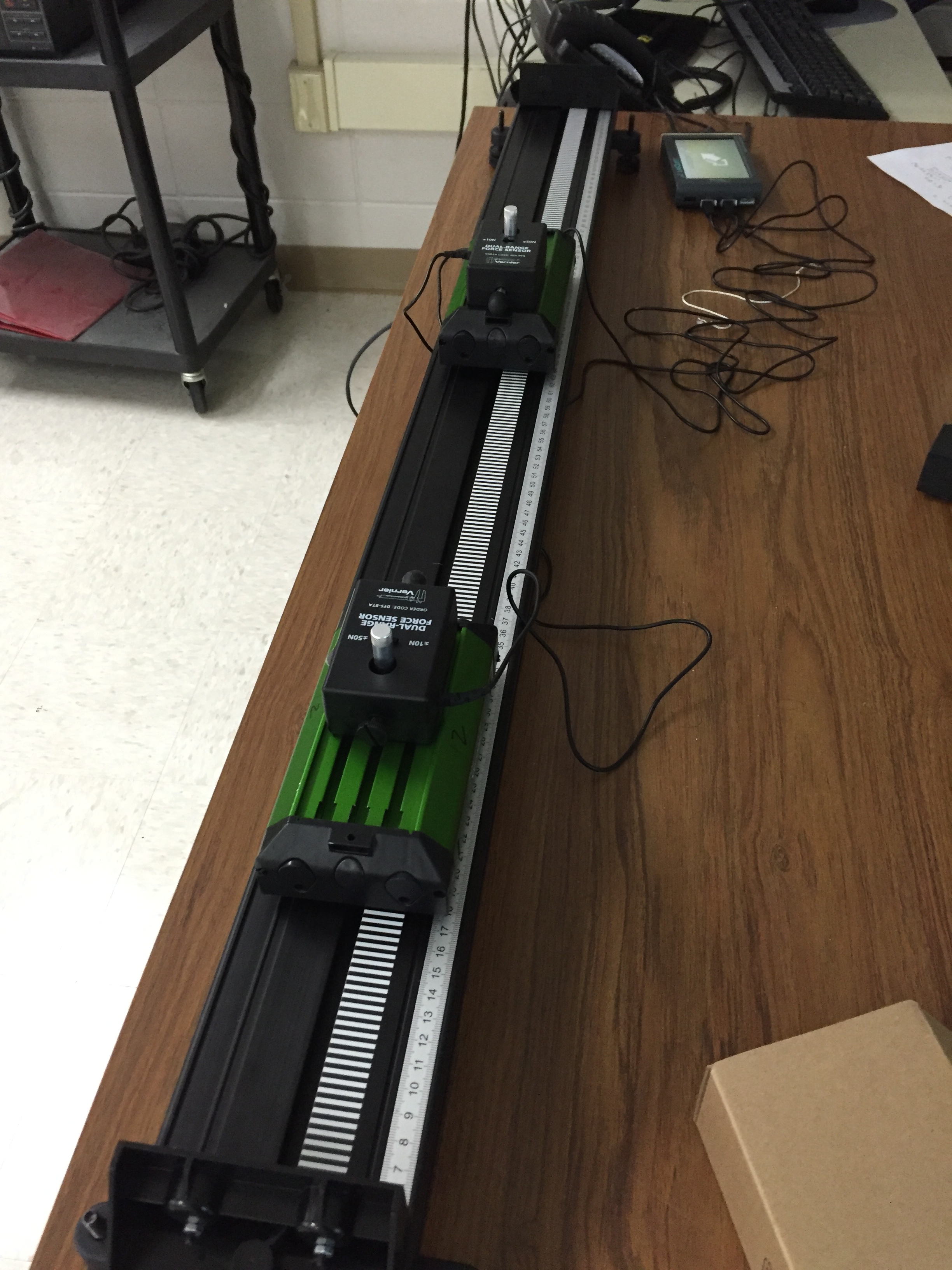
We collided carts with force sensors to check the predictions students made yesterday. I spent more time than usual talking about why I asked them to make predictions I know are likely to be wrong since confidence has been such an issue for students this year.


\

Chem Essentials: Melting Mass

Students continued the Modeling Instruction mass and change labs. Today, they melted ice and mixed sodium carbonate with calcium nitrate; a lot of students really liked that reaction and were observing close enough to notice the precipitate causing the cloudiness. I added a mini-exploration of the zero button on the balance, which I was pretty happy with. A lot of the students in the course struggle with mathematical reasoning, and taking a few minutes to play with the zero button and the readings on the balance seemed to help make its purpose more concrete.

mass change.jpg

Day 59: Energy, 3rd Law, & CER

AP Physics: Intro to Energy

Students measured the average force and the displacement required to give a cart the same change in height on several different ramps. They sketched the force vs. displacement graphs, which I used to introduce gravitational potential energy and work.

peg lab.jpg

Physics: 3rd Law

We ran out of time to hit Newton’s 3rd Law during last tri’s unit on balanced forces, so today we dove in. I showed students a pair of carts, then asked them to draw interaction diagrams and free body diagrams for various collisions, as well as to predict which cart will experience a larger force. One group gave me a hard time about how deadpan I was when they asked if their prediction was right, so we talked a little about Clever Hans the Math Horse.

3rd law.jpg

Chemistry Essentials: CER

As part of the follow-up on yesterday’s lab, I introduced students to the CER framework. I had students identify the claim and evidence in a car commercial, then come up with some potential reasoning for the evidence before they started a CER on whether the mass of steel wool should change.


Day 22: 3rd Law, Video Physics, & Thermal Expansion

AP Physics: 3rd Law

Students predicted which cart would experience a larger force for several different collisions, then we got out the force sensors and hoop springs to find out. In one of my classes, the computer was acting up, so we relied on the hoop springs and slow motion video. Fortunately, students found the video very convincing and even described watching the hoop springs compress as satisfying.

collision lab f-t graph

Physics: Video Physics

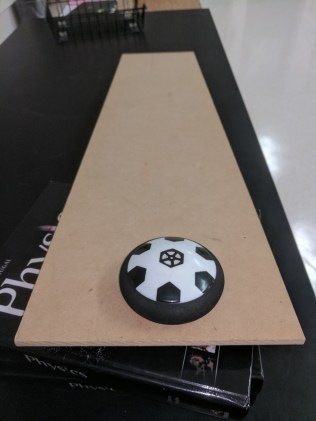
We started constant acceleration today. Students used photogates with a cart on a ramp during the first unit, so I decided to have students analyze hover disks on a ramp using Video Physics.  I’m hoping that some of the features, like seeing the points in the video, will help students connect the representations we’re using to their physical meaning.

hover

Chemistry Essentials: Thermal Expansion

I did a few demos of thermal expansion, and had students complete particle diagrams of each one. Students seem to be getting the big ideas, and I’m seeing students naturally improving how they represent key elements of their particle diagrams as time goes on. One student called me on falling into pretty teacher-centered habits during the whiteboard discussions; I have a tendency to talk to much the first time I teach a lesson, and this is my first time through Chemistry Essentials A, so that’s happening a lot. I need to spend a little more time during my lesson planning making sure I clarify the goal of each discussion and planning out some open-ended questions so I can give students more of the reigns.

chem wb

Day 38: Pushing Blocks & Kepler’s 2nd Law

AP Physics: Pushing Blocks

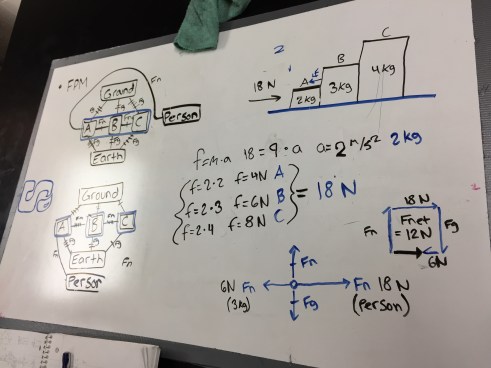
Students worked on a problem I’ve come to really like where three blocks of different masses are being pushed along by a certain force. Based on some of the struggles a few groups were having, I think it would be worthwhile to pause sometime soon to do a model summary. I loved the moment when students figured out how to use the 3rd Law to think about the normal forces between each pair of blocks. The best thing I overheard, though, was a student who said “You need to convince me you’re right! If you can explain your idea and your evidence, then I’ll believe you.”

img_2438

Earth Science: Kepler’s 2nd Law

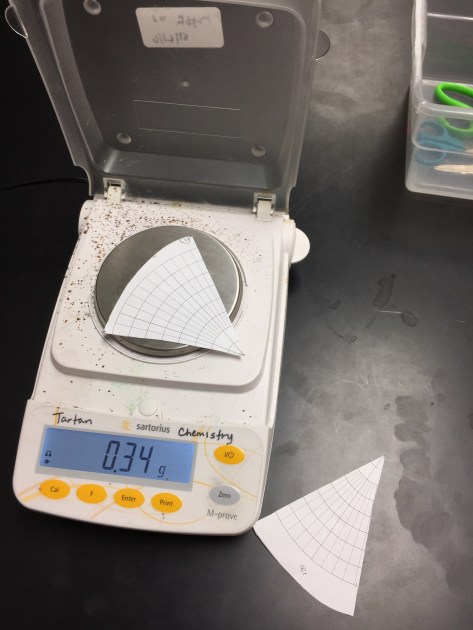
Students plotted the position of Mars along its orbit, then cut out some wedges that represent the same amount of time. We used the mass as a stand-in for area to show that an orbiting object sweeps out the same area in the same amount of time. We got really nice results; the class average for the mass was within 0.01 g for the two wedges. I think students lost track of what they were plotting, however, so I need to think about how I can reinforce what the numbers they are plotting has to do with the actual path of Mars.

img_2436

Day 37: 3rd Law & Kepler

AP Physics: 3rd Law

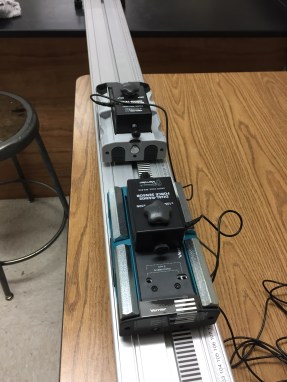
On Friday, students predicted how the force on a pair of carts would compare for various collisions. Today, we got out a pair of carts and force sensors to test out their predictions. I got pretty excited when, after seeing the first couple collisions had the same force, one student took another look at her system schema and free-body diagrams, then pointed out both forces are measuring the same interaction, so the magnitude should be consistent. Afterward, we watched Veritasium’s excellent video on the 3rd Law.
img_2435

Earth Science: Kepler’s Laws

Students drew ellipses and measured the distance between the foci and points on the ellipse to look for patterns. Students were pretty successful at finding the pattern in the distance to the focal points. I tweaked the lab as written to try to have students discover the equal areas law, but I did not account for the fact that the length of the string loops varies a lot. Tomorrow is slated for more time on this lab, so I think I’m going to try and find some data they can use to plot actual positions of one of the planets tomorrow.

img_2433

Day 36: 3rd Law & Cosmic Voyage

Today is day 2 of the NSTA Regional Conference, so students have a sub again.

AP Physics: Newton’s 3rd Law

Students drew free-body diagrams for various cart collisions and predicted how the force on each cart should compare. It usually drives students nuts that I won’t tell them whether they are right in this activity, so I think it will be less frustrating for them to do this with a sub, even if I’ll miss out on hearing them talk it through. On Monday, we’ll put some force sensors on carts and see if the students were right.

Earth Science: Cosmic Voyage

The curriculum calls for showing The Cosmic Voyage during the astronomy unit, so I took advantage of the easy sub plan.

Day 31: Van de Graaff Generator & Newton’s 3rd Law

Physical Science: Van de Graaff Generator

After sharing and discussing observations from yesterday’s lab, we played with the Van de Graaff generator. I like to end with sending a shock through a chain of students, then have two students hold onto an aluminum rod instead of holding hands. Students aren’t too surprised when they still get shocked with the rod in the chain. Next, I switch out the rod for a wooden meter stick and students aren’t too surprised when the shock stops at the meter stick, which provides a nice segue into conductors and insulators. This year, I also had students hold one of the rubber rods they’d used in their static electricity lab. Since it had been easy to give the rubber rod a static charge, students expected it to work at least as well as the metal rod. I’d tried this on a whim, and it ended up being a great reminder for me that students don’t easily differentiate between carrying a current and holding a static charge.

Physics: Newton’s 3rd Law

Students made free body diagrams for a variety of scenarios with two carts colliding, then predicted which cart would experience the greater force. After students had worked, we used a pair of force sensors to test their predictions. I’d also planned to show Frank Noschese’s great video of cart collisions, but ran out of time, so I’ll start with that on Monday. There were some great debates when students were working on their predictions, though students were more insistent than usual that I should step in and tell them who was right. This provided a good opportunity to talk with my classes about what we know is needed to really internalize a new concept, which helped alleviate some of the frustration with my non-answers.

IMG_1317