Day 61: Projectile Video Analysis & Energy Skate Park

AP Physics: Projectile Video Analysis

I gave students two videos of some students tossing a basketball and a video analysis guide I put together, then tasked them with getting the position vs. time and velocity vs. time graphs for each video of the basketball. I had a bunch of students who got genuinely excited when they looked at the velocity vs. time graphs and started putting together what they know so far to begin a model of projectile motion. One group even cheered when the slope of their y-velocity vs. time graph matched what their model so far!
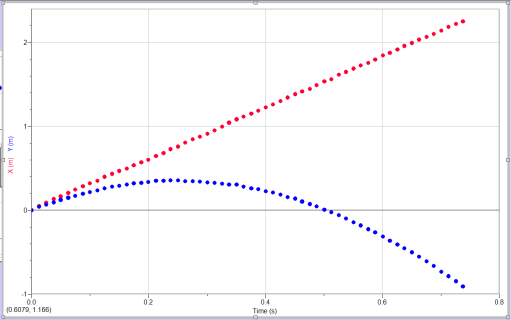
vid-analysis

Physical Science: Energy Skate Park

Students played with PhET’s Energy Skate Park simulation to look for how they could change the size of the various bars in the bar chart. Students pretty enthusiastically played with as many options as they could find, and made some nice observations, like how the motion of the skater changes when they switch to the moon or Jupiter.
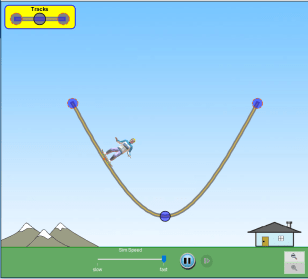
skate-park

Day 68: Work & Stoich

Physics: Work

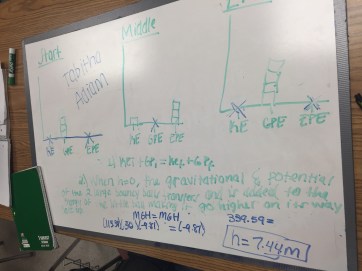
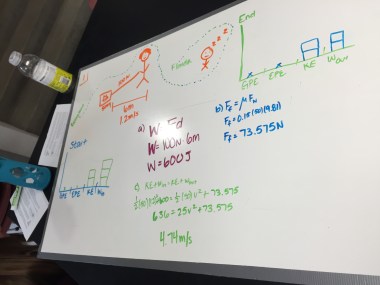
Students did some problems where the energy of the system is changing. The other physics teacher and I skipped having students define their system due to time constraints, but some of the mistakes I’m seeing could be fixed by having students take that step, so I will be going back to the full LOL diagrams next year.

IMG_1539

Chemistry: Stoich

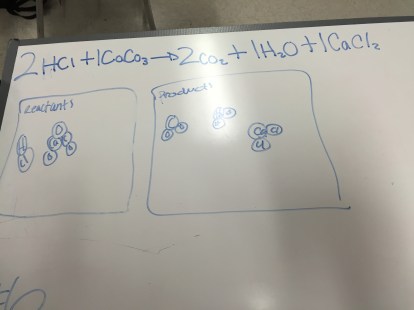
Students did some problems calculating theoretical yield for chemical reactions. When we first started balancing chemical equations, I required students to sketch a diagram of the atoms involved to emphasize that the atoms are just being rearranged. Today, I left it up to students whether they wanted to include the sketch or not, and it drove home for me how important concrete, conceptual tools are when nearly every student still drew the diagrams.

Day 67: Work & Molar Mass

Physics: Work

Students picked a specific height above the lab table and calculated how much energy a dynamics cart would have at that point. Then, they set up ramps at three different angles and sketched force vs. displacement graphs to represent pulling the cart up the ramp to the height above the table they picked earlier. Finally, they calculated the area of the force vs. displacement graphs. This lead nicely to a definition of work as the cart’s change in energy and the area of a force vs. displacement graph.


Chemistry: Molar Mass

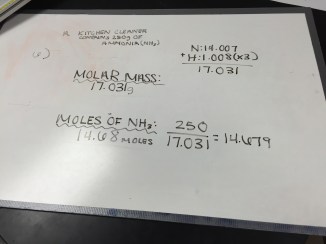
Students worked on some word problems using molar mass. While no diagrams made it onto whiteboards, a lot of students sketched molecules the same way they’d done when balancing equations to help determine when they needed to multiply a mass from the periodic table.

IMG_1532

Day 66: Bouncy Balls & Molar Mass

Physics: Bouncy Ball Energy

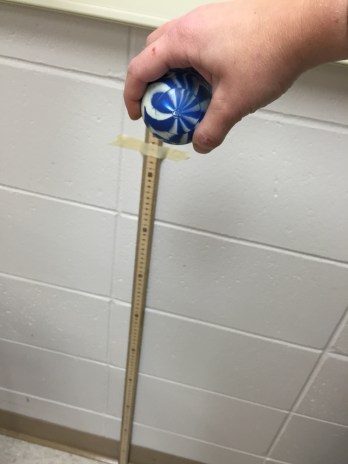
Students worked on collecting data to determine whether a bouncy ball looses more energy while its in the air or when it hits the table. There are lots of different approaches, and groups spent the majority of their time trying to figure out what might be useful to measure, which lead to some great discussions. The most elegant approach I saw was a group that did some video analysis in Logger Pro and produced a position vs. time graph. They argued that since each bounce’s parabola is symmetrical, the bouncy ball must be at the same speed for a given height on that bounce, so the energy stays the same while its in the air. Then, they compared the steepness of the parabolas for each bounce to show that the energy changes after the bouncy ball impacts the table.bounce graph

Chemistry: Molar Mass

Students practiced using electronic balances and switching between mass and moles. One of their tasks was to determine how many atoms of chalk it took to write their name on a lab table. The best part of today, however, was the ways I saw my students starting to come together as a class. I saw a lot of students, including some with a reputation for typically checking out in school, having great conversations about the quiz I returned or the day’s assignment. A few students even took over the whiteboard at the front of the room and started adding to what I’d put up there as they tried to make sense  of their measurements. I’ve been having a lot of conversations with these students about what effective collaboration looks like, since many have not really experienced it, and its great to see those conversations translating into the actions of my students.

IMG_1529

Day 65: Bouncy Balls & Molar Mass

Physics: Bouncy Balls

I gave students a bouncy ball and two tasks. First, they had to come up with their own quantitative definition of efficiency, then take measurements to determine the efficiency of their bouncy ball. Most groups are finding a ratio of the rebound height to the drop height.

Second, they need to determine whether the bouncy ball looses its energy while in the air or when it collides with the table and need to support their answer with quantitative data. Since we also had a quiz today, most groups only got to the point of deciding what kinds of energy the bouncy ball should have at different points in its path and starting to consider what they could measure related to those energies.

IMG_1527

Chemistry: Molar Mass

I’m trying to start each new concept with something concrete, so to introduce molar mass, I had students build “molecules” from bolts, nuts, and washers. They found the total mass of all the components, then compared that to the mass of the molecule.

IMG_1523

A “molecule” of NW2B2

Day 64: Energy Practical & Mistakes Game

Physics: Energy Practical

Students were given an elastic string to hang from the ceiling. Students had to find k for their string, then figure out how high above the ground to hold an action figure attached to the end so that, when they dropped it, the figure would just barely hit the ground. In the past, I’ve used a bucket of water and we go by the sound (“splash, but no thud”). This year, the other physics teacher suggested using a force plate and looking for a small spike in the force vs. time graph. While students like the splashing, the force plate is a lot easier to move around, and makes it possible to capture slow-motion video.

Chemistry: Mistakes Game

To go over Friday’s practice problems for balancing chemical equations, I had them do the mistakes game. Students focused on making their error an inconsistency in their representations of the reaction. I appreciated how willing my students were to try something new; they seemed to especially appreciate the safety inherent in the mistakes game.

IMG_1513

Day 63: Astroblaster & Balancing Equations

Physics: Astroblaster

After a quiz, students made some observations of the Astro Blaster and used conservation of energy to explain what they saw. Students also worked through some conservation of energy questions out of TIPERs.

IMG_1512

Chemistry: Balancing Chemical Equations

Students used what they found in the simulation yesterday to practice balancing chemical equations. I took a page from the Modeling Chemistry curriculum and had students sketch the molecules in the reaction, which turned out to be a really effective tool to make balancing a much more concrete process.

Day 62: Mistakes Game & Balancing Reactions

Physics: Mistakes Game

We played the mistakes game with yesterday’s conservation of energy problems. For students who had the other physics teacher last trimester, this was their first experience with the mistakes game. I was pleased with the way the students I had last tri took the lead, helping their peers come up with interesting mistakes and modeling good questions.

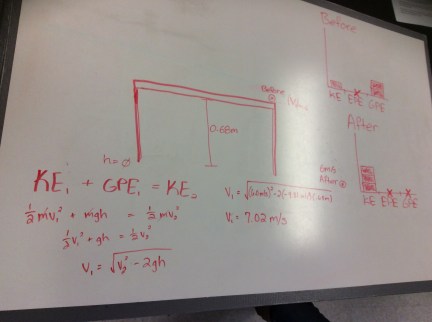
IMG_0317

The mistake is a subtle sign error, but lead to some great discussion about determining whether an answer is reasonable.

Chemistry: Intro to Balancing Chemical Equations

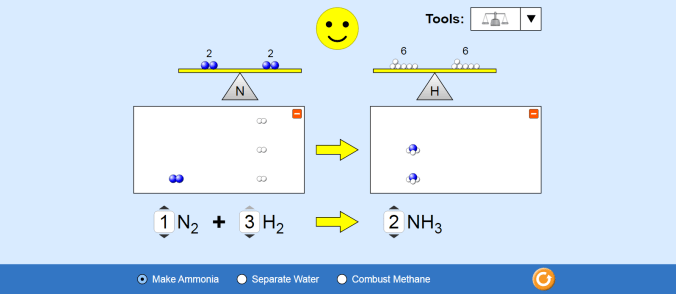
I took advantage of the visuals in PhET’s Balancing Chemical Equations sim to introduce my students to this process. I had them start by playing in the introduction to figure out what the different representations tell them about the chemical equation. After students had some time to play, we came back together. My students were able to articulate pretty clearly what it means for a reaction to be balanced, and what it has to do with conservation of mass. Students then spent some time testing their understanding by playing the game built into the simulation. Based on the conversations I overheard as they played, students were getting a much better understanding of not just how to balance chemical equations, but what all those numbers in the equation mean. I was also pleased to see the confidence my students gained while playing the game. I think a lot of them have started to assume they don’t understand things in the classroom, so seeing that immediate, consistently positive feedback from the game helped them see the way they’re thinking about these reactions really is useful.

phet balancing

Day 61: Problems & Representing Reactions

Physics: Conservation of Energy Problems

Students took their first look at conservation of energy calculations. I use a lot of problems that we could have done with earlier models to try to drive home that energy is a different way of looking at some very similar situations.

Chemistry: Representing Chemical Reactions

My students continued to practice translating between representations of chemical reactions. Several students were very confident by the end of the hour. I think we’re ready to look at balancing equations tomorrow.

Day 60: Bar Charts & Representing Reactions

Physics: Bar Charts

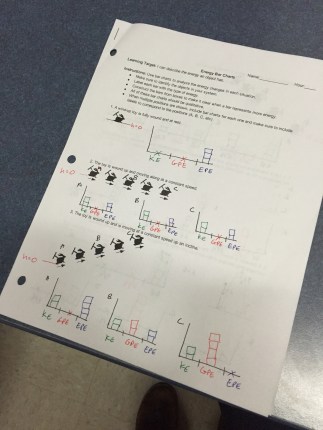
We used yesterday’s lab to define kinetic and gravitational potential energy, then students took their fist stab at drawing energy bar charts. Students took to the bar charts pretty easily.

IMG_1510

Chemistry: Representing Reactions

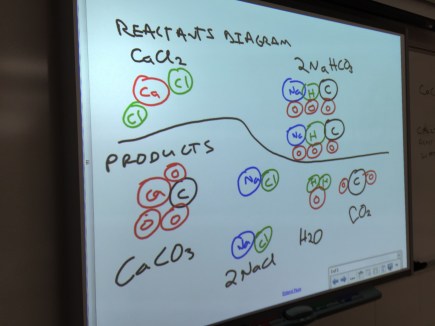
Today, students practiced translating between representations of a chemical reaction. Given a balanced equation for a reaction, I had them write a statement. This year, I took a page from the Modeling Instruction chemistry curriculum and also had them sketch a diagram that showed the atoms for both the reactants and products.

IMG_1509