Day 74: Board Meeting & Observations

Physics: Coulomb’s Law Board Meeting

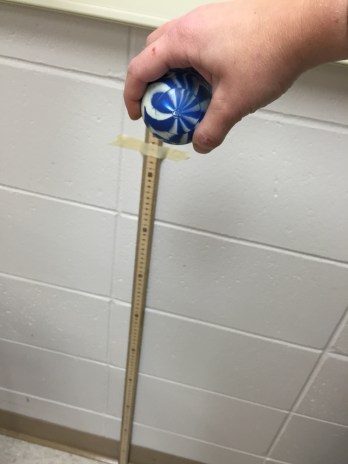
Students whiteboarded the results of yesterday’s lab and we had a board meeting. I had students graph force vs. distance, then both an inverse and inverse-square test plot so we could compare the correlation coefficients. While both classes were able to get to the inverse-square relationship, I struggled to get students to take the lead in the discussion. I think part of the problem is, while we’ve whiteboarded lots of problems and conceptual questions, the last board meeting where we focused on graphs produced in a lab was early November. I need to either do more whiteboarding labs during projectile motion and energy, or I need to bring in more of the scaffolding I do early in the year to help students refresh their skills.

IMG_1574

Chemistry: Observations of Reaction Types

Students finished up the lab from yesterday, then we spent some time trying to connect their inferences to their observations in the lab. In the discussion, I realized I need to make explicit to my students what is a good observation and how that contrasts with an inference or claim. For example, the textbook lists gas formation as a sign of a chemical reaction, so nearly every student listed gas formation as an observation at least once, but struggled to explain what they saw that suggested a gas was formed. I can’t forgot how important it is to explicitly address the basics in a class like this.

IMG_1572

Day 73: Coulomb’s Law & Reaction Types Lab

Physics: Coulomb’s Law

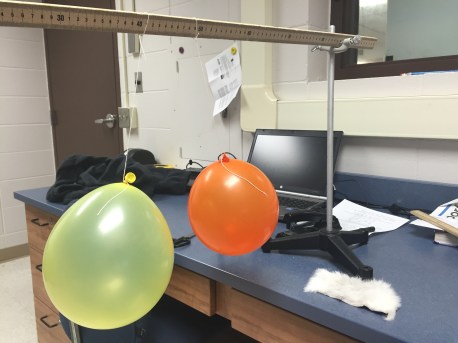
Students used fur to charge a pair of balloons hanging from a meter stick, then measured the angle the strings were at as a proxy for the force. They then collected data to find a relationship between the force the balloons exert on each other and the distance they are separated.

IMG_1568

Chemistry: Reaction Types Lab

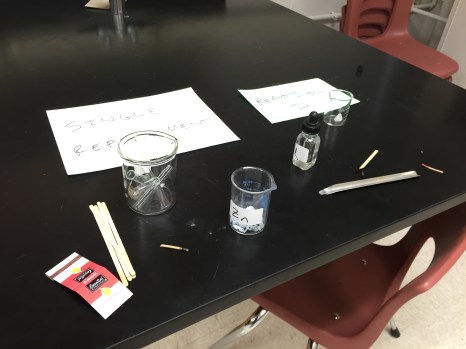
I borrowed a lab from the Modeling Instruction chemistry curriculum where students actually carried out reactions of each type, and  made some observations to connect the reaction equation to what actually happened in the lab.

IMG_1566

Day 72: Van de Graaff & Finish Review

Physics: Van de Graaff

We started by discussing the results of yesterday’s lab. It ended up much more teacher-centered than I would have liked; I had a few different concepts I wanted students to take away from the lab, and I wasn’t quite sure how to have students summarize their results on a whiteboard or how to guide the discussion to get students to those concepts. It also didn’t help that about half of my students were on a field trip and the empty room made students more self-conscious about speaking up. After discussing the lab, we played with the Van de Graaff generator. Students did a nice job of using what they’d gotten from the lab to make predictions and construct explanations of what we saw with the generator.

IMG_1564

Chemistry: Finish Review

No one managed to finish yesterday’s assignment, so we spent some time discussing together the parts students had finished, then I gave them time to finish the rest. I’d hoped to start a lab today, but many students needed the whole hour to work.

Day 71: Electrostatics Intro & Review

Physics: Electrostatics

This year, I decided to try the electrostatics labs from Eugenia Etkina’s PUM curriculum. The effects were pretty visible and just about every student, including the ones concurrently enrolled in AP Chemistry where they just finished Coulomb’s Law, made some observation they found surprising.

IMG_1563

Chemistry: Review

In preparation for tomorrow’s lab, I had students balance the equations for the reactions they’ll be doing, as well as categorize each reaction into the five types that were introduced right before break.

Day 70: Projectile Launchers & Reaction Types

Physics: Projectile Launchers

After a quiz, students continued to work on testing and refining their projectile launchers. In spite of the fact that its the last day before break, both of my classes were focused and working right up until the bell!IMG_1552

Chemistry: Reaction Types

After a quiz on molar mass, students did a jigsaw on the types of chemical reactions. Each group used the textbook to make a whiteboard with some key points about their reaction type, then students used the whiteboards to make themselves a quick reference on the reaction types.

Day 69: Projectile Launchers & More Stoich

Physics: Projectile Launchers

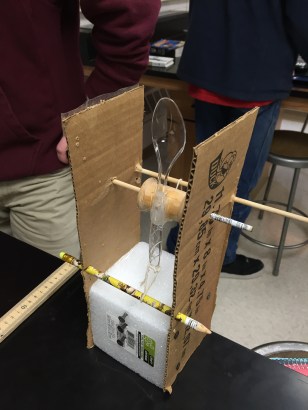
Instead of writing a lab report on an energy lab, I’m having students build projectile launchers that convert gravitational potential energy into kinetic energy. Today, students brought in their prototypes and had some time to test how well their prototype worked, as well as collect data on how at least two different variables affect the range of their launcher. When we do the final tests of the launchers, groups will need to hit a target at a randomly selected distance, though groups can chose between a small, medium, and long range. The launchers ranged from very simple, like a paper ramp with a meter stick spine, to more complicated, like the full-blown trebucet.

Chemistry: More Stoich

My plan had been to give students 15 minutes or so to work on the last two problems from Friday’s worksheet, then have them write an example problem where they would include a written description of the steps along with their work, but nearly all of my students needed the whole hour to finish Friday’s problems. Most of them were really focused on the steps they needed to follow and, not surprisingly, students are overwhelmed by how many steps there are and losing track of a lot of details. Next time, I need to start with some activities to help students to better connect the concepts to the process. I might do something with the nuts, bolts, and washers I used to introduce molar mass to make things more concrete at the start.

Day 68: Work & Stoich

Physics: Work

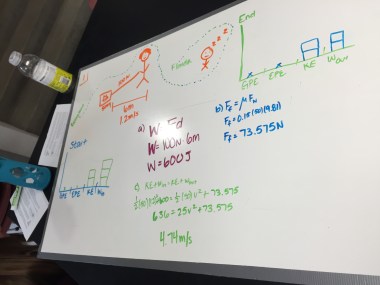
Students did some problems where the energy of the system is changing. The other physics teacher and I skipped having students define their system due to time constraints, but some of the mistakes I’m seeing could be fixed by having students take that step, so I will be going back to the full LOL diagrams next year.

IMG_1539

Chemistry: Stoich

Students did some problems calculating theoretical yield for chemical reactions. When we first started balancing chemical equations, I required students to sketch a diagram of the atoms involved to emphasize that the atoms are just being rearranged. Today, I left it up to students whether they wanted to include the sketch or not, and it drove home for me how important concrete, conceptual tools are when nearly every student still drew the diagrams.

Day 67: Work & Molar Mass

Physics: Work

Students picked a specific height above the lab table and calculated how much energy a dynamics cart would have at that point. Then, they set up ramps at three different angles and sketched force vs. displacement graphs to represent pulling the cart up the ramp to the height above the table they picked earlier. Finally, they calculated the area of the force vs. displacement graphs. This lead nicely to a definition of work as the cart’s change in energy and the area of a force vs. displacement graph.


Chemistry: Molar Mass

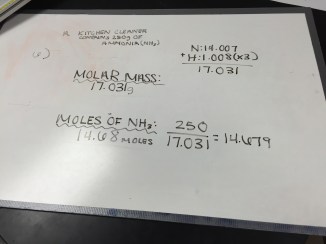
Students worked on some word problems using molar mass. While no diagrams made it onto whiteboards, a lot of students sketched molecules the same way they’d done when balancing equations to help determine when they needed to multiply a mass from the periodic table.

IMG_1532

Day 66: Bouncy Balls & Molar Mass

Physics: Bouncy Ball Energy

Students worked on collecting data to determine whether a bouncy ball looses more energy while its in the air or when it hits the table. There are lots of different approaches, and groups spent the majority of their time trying to figure out what might be useful to measure, which lead to some great discussions. The most elegant approach I saw was a group that did some video analysis in Logger Pro and produced a position vs. time graph. They argued that since each bounce’s parabola is symmetrical, the bouncy ball must be at the same speed for a given height on that bounce, so the energy stays the same while its in the air. Then, they compared the steepness of the parabolas for each bounce to show that the energy changes after the bouncy ball impacts the table.bounce graph

Chemistry: Molar Mass

Students practiced using electronic balances and switching between mass and moles. One of their tasks was to determine how many atoms of chalk it took to write their name on a lab table. The best part of today, however, was the ways I saw my students starting to come together as a class. I saw a lot of students, including some with a reputation for typically checking out in school, having great conversations about the quiz I returned or the day’s assignment. A few students even took over the whiteboard at the front of the room and started adding to what I’d put up there as they tried to make sense  of their measurements. I’ve been having a lot of conversations with these students about what effective collaboration looks like, since many have not really experienced it, and its great to see those conversations translating into the actions of my students.

IMG_1529

Day 65: Bouncy Balls & Molar Mass

Physics: Bouncy Balls

I gave students a bouncy ball and two tasks. First, they had to come up with their own quantitative definition of efficiency, then take measurements to determine the efficiency of their bouncy ball. Most groups are finding a ratio of the rebound height to the drop height.

Second, they need to determine whether the bouncy ball looses its energy while in the air or when it collides with the table and need to support their answer with quantitative data. Since we also had a quiz today, most groups only got to the point of deciding what kinds of energy the bouncy ball should have at different points in its path and starting to consider what they could measure related to those energies.

IMG_1527

Chemistry: Molar Mass

I’m trying to start each new concept with something concrete, so to introduce molar mass, I had students build “molecules” from bolts, nuts, and washers. They found the total mass of all the components, then compared that to the mass of the molecule.

IMG_1523

A “molecule” of NW2B2