Day 125: Mistakes Game & Molar Mass

Physics: Mistakes Game

Students whiteboarded yesterday’s problems including at least one mistake. Its been a little while since I last had students do this, and a lot of students were excited to do it again.

IMG_1771

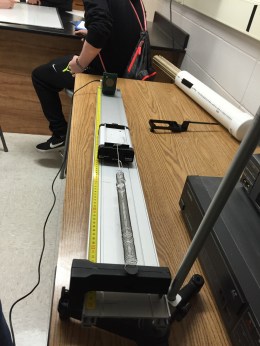
Since everything we’ve done so far has been vertical springs, I sent up a ramp with a cart attatched to a spring so we could look at position vs. time graphs compare the period at different angles as a way to see how “changing gravity” affects the spring’s period. In spite of having the equation, a lot of students expected gravity to matter because they thought there had to be a force to de-compress, not recognizing that the spring could exert that force since we’ve mostly looked at stretching springs.

IMG_1770

Chemistry: Molar Mass Introduction

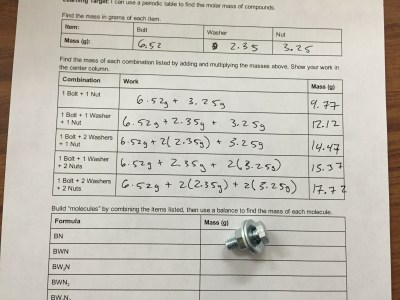
Students got the mass of individual nuts, bolts, and washers, then predicted the masses of various combinations. Compared to last trimester, I took some extra time debriefing after the lab and tried to be very explicit that the hardware was being used to represent individual atoms, since we can’t observe individual atoms directly.

IMG_1768

Day 124: Spring Problems & Mistakes Game

Physics: Spring Problems

Students worked through a Modeling Instruction worksheet using forces and energy to analyze the motion of a spring. The worksheet has students define h = 0 in a way that gives a negative gravitational potential energy at one extreme of the spring’s oscillation, and my students struggled with what a negative potential means. Both for cases like this and for negative electric potential differences, I need to adjust my energy unit to include some scenarios with negative energies.

Chemistry: Mistakes Game

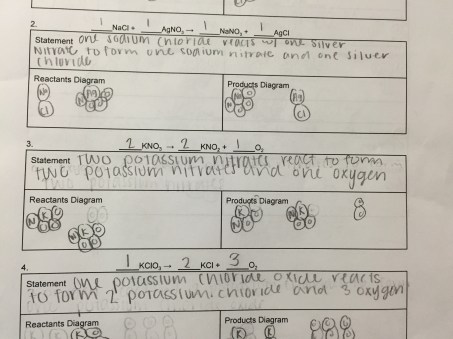
Students whiteboarded yesterday’s problems balancing chemical equations, including intentional mistakes to help spur discussion. A lot of students were gone yesterday for a blood drive, and this seemed to help them get caught up. Tomorrow, they’ll be taking a quiz on balancing, so I took some time during class to do a practice problem under quiz-like conditions. Last tri, the chemistry students who did poorly in the class tended to have trouble self-assessing and would equate having an answer with understanding the problem, even when the answer was just copied from a classmate. I have some students who look like they could go down the same path this tri and, after the practice quiz, they were interested in how to improve their understanding before tomorrow’s quiz. While this is a step in the right direction, my real challenge is to help these students self-assess much earlier in hopes of helping them shift their habits in my class.

Day 123: Board Meeting & Balancing Equations

Physics: Period of a Spring Board Meeting

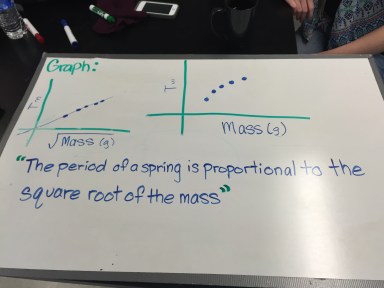
Students whiteboarded their results to yesterday’s lab. Once we get situated, I usually give students a minute or two to talk with their lab group. I watched one group use this time to furiously tap at a tablet, then edit their board to reflect a square root, rather than linear, relationship between period and mass. During the discussion, I asked them to explain the change they made and they shared that, prior to seeing they other whiteboards, they stopped after trying a linear fit because it had a really nice correlation coefficient. When they saw other groups got an intercept much closer to zero using a square root fit, they quickly tried the same fit on their data, and saw they got a better correlation and an intercept of nearly zero. We’re talking a lot in my building about how to use technology in the classroom, and this moment exemplifies how I want students to use technology. This group had to decide whether their linear fit or their classmate’s square root fit was more convincing, and Desmos made it possible to quickly and easily test the competing ideas and get the evidence they needed to be convinced.

IMG_1765

Chemistry: Balancing Equations

Students combined the multiple representations we worked on before break with what they figured out in yesterday’s sim to practice balancing chemical equations. I remain very impressed with how easy the reaction diagrams make this process for students.

IMG_1764

Day 122: Springs & Balancing Equations

Physics: Period of a Spring

Students designed experiments to determine the variables that impact the period of a spring. I was very pleased with how many students pulled up their notes and results from the pendulum lab, in spite of the fact that it was on the other side of a week-long break, to help with experimental design and make sense of their results. For next year, I want to look at getting some additional springs. A lot of groups wanted to find a way to test the impact of the spring constant, and I only have options with relatively extreme spring constants, which made it tricky to get meaningful data.

IMG_1761

Chemistry: Balancing Chemical Equations

Students used PhET’s Balancing Chemical Equations sim as an introduction to what it balancing means. Last tri, I had a lot of groups skip straight to the game and play using trial and error, missing out on most of the sense-making. This tri, I took a few minutes to talk with students about why I structured the activity the way I did and students took the sim’s introduction and the questions I’d written much more seriously. Next time around, I want to add some questions to get students to focus a bit more on the significance of the subscripts vs. the coefficients.

IMG_1760

Day 121: Pendulums & Quiz

Today was the last day of classes before spring break.

Physics: Pendulums

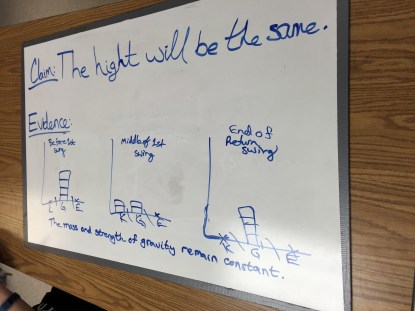
Before their quiz, I had students make predictions about a few different pendulums. First, they predicted how the maximum height on the return swing should compare to the starting height, then they made some predictions about a pendulum that uses a magnet to pick up a steel sphere at its lowest point, and finally we used a hover disc on a tilted table as a pendulum and students made predictions about what happens when the table’s angle changes.

IMG_1747

Chemistry: Quiz

Students took their first assessment of the course on representing reactions.

Day 120: Pendulum Motion Graphs & Mistakes Game

Physics: Pendulum Motion Graphs

Students whiteboarded their answers to yesterday’s worksheet. They did a nice job of using energy bar charts and free body diagrams to make predictions about what the position vs. time, velocity vs. time, and acceleration vs. time graphs should look like. We put a pendulum in front of a motion detector to get a look at the actual graphs and used both the formula and the graphs to determine the period of the pendulum.

Chemistry: Mistakes Game

Students whiteboarded their solutions to yesterday’s problem, including at least one intentional mistake. I ended up splitting each problem between groups, so one group did the statement, one did a diagram of the reactants, and one did a diagram of the products. I wish I’d had each group do a whole problem, then just limited how many present, since multiple representations gives room for richer mistakes.

IMG_1740

A partially corrected whiteboard

Day 119: Pendulum Problems & Representing Reactions

Physics: Pendulum Problems

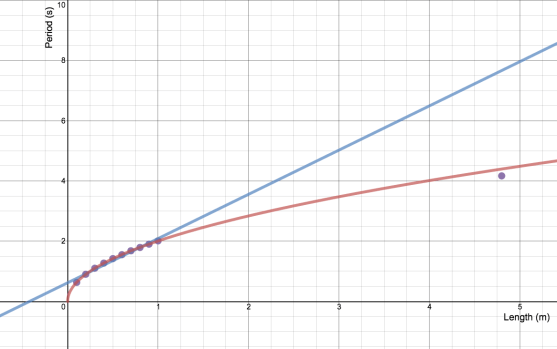
We had a brief discussion about the results of the pendulum lab, especially why a linear fit for the data my students collected usually looked pretty good, but did a very poor job of predicting the period of a large pendulum. I need to do a much better job of having my students talk about their intercepts, including whether or not an intercept of zero makes sense. Most of the groups who tried a square root function to fit their data gave it a shot because they didn’t like the intercept on the linear fit.

Afterward, students worked on a pendulum worksheet I put together where they drew energy bar graphs and free body diagrams for the pendulum at key points in its motion, then sketched position vs. time, velocity vs. time, and acceleration vs. time graphs for the pendulum.

pendulum graph

Chemistry: Representing Reactions

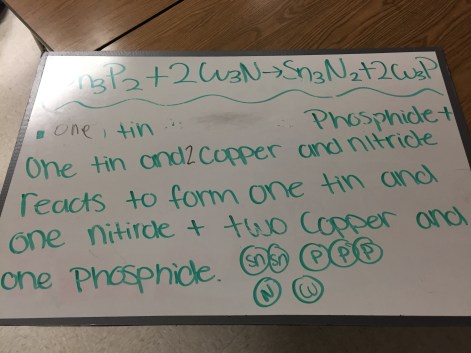
Students practiced translating between statements, chemical equations, and reaction diagrams. A lot of students needed some support to work through what a coefficient means vs. a subscript, but they did get there.

Day 118: Giant Pendulum & Conservation of Mass

Physics: Big Pendulum

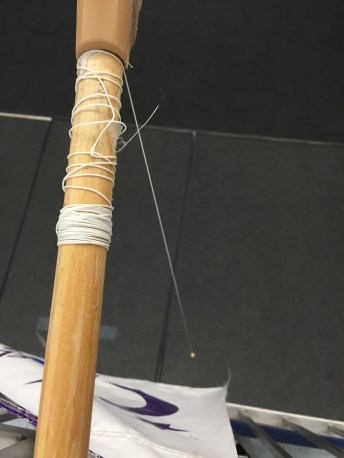
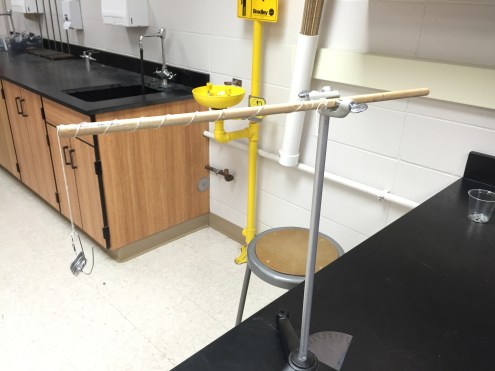
Before discussing the results of yesterday’s pendulum lab, we went to the main entrance of the school where we could hang a string from the second floor down to the first to make a 5 m long pendulum. Students used their mathematical models to predict what the period should be. Most groups used a linear fit for their data, and ended up predicting a period that was too big as a result. The really long pendulum provided a reason to refine their models by collecting more data and trying some linearization.

IMG_1736

Chemistry: Conservation of Mass

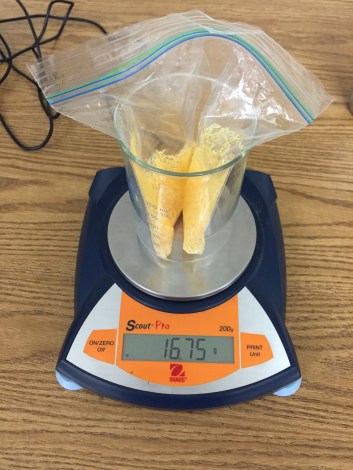
Students reacted calcium chloride, baking soda, and bromthymol blue in a Ziploc bag, making sure to take the mass of everything at various stages. This tri, I gave each group a beaker to place their bag in when using the balance, rather than having them set the bag directly on the balance pan, and the results were much better; students were able to use their results to articulate the law of conservation of mass very nicely.

IMG_1737

Day 117: Pendulums & Mystery Tubes

Physics: Pendulums

Students started collecting data to make a mathematical model for the period of a pendulum. This is the first lab that was framed more generally as make a model, rather than as to find a relationship between two variables, so we started with some discussion about what variables could matter. Today was one of those days where I felt a bit extraneous; students are getting pretty good at designing experiments and deciding how much data is “enough”, so I wasn’t fielding many questions.

IMG_1735

Chemistry: Mystery Tubes

With the start of a new tri, I restarted the course today with a new group of students. This time, I decided to start with the mystery tubes. Students practiced making observations, then forming and testing hypotheses to figure out what is going on inside the tube. We wrapped up with a brief discussion comparing the tubes to learning chemistry and I introduced the idea of chemistry as a series of models that make good predictions, rather than a set of facts.

IMG_1734

Day 116: Tri 2 Reflections

Its day 2 of final exams, so I’ve got some time before I get a nice stack of tests to grade and figured I’d use it to look back on the trimester.

Physics

This trimester, I saw many of my students truly become fearless when it comes to physics. They don’t hesitate to ask questions that go beyond how to do the day’s task and are quick to propose and try experiments just because they’re curious and not because it will be on the test. They are not only starting to think like scientists, but to embrace and enjoy the scientific process.

My biggest frustration is that I’m still talking a lot during discussions. Some students tell me they aren’t usually sure what’s worth saying or talking about and worry about taking the class on a tangent. That tells me I’m framing the discussion in a way where its about what I want them to learn from a task, not what they found confusing or interesting or what they notice looking at other whiteboards. Before the next board meeting, I want to take a few minutes to have a conversation with my students to help them see their questions and observations are the point of the discussion, not a distraction, and assure them its my problem, not theirs, if we somehow don’t get to the intended content.

Next year, I need to work on the storyline I use for electricity and magnetism. Both my students and I felt like the concepts never really came together as nicely as mechanics does. I’m not sure E&M will ever build as seamlessly as mechanics can, but I want to spend some time this summer revising my sequence to at least improve the connections. I did manage to bring in a lot more concepts from mechanics to use as a foundation for E&M, and am pleased by how that went.

Chemistry

This course as typically been taught with a fairly traditional approach, so this time around I’ve been revising or replacing a lot of materials to put much more emphasis on conceptual understanding and active learning. There were some aspects it was fairly easy to get students to embrace. A lot of them really liked some of the visual representations I borrowed from the Modeling Chemistry curriculum. Students not only used those representations unprompted, but a few came up with ways to effectively apply those representations to new situations that surprised me. It was great to see.

The biggest struggle, however, was getting students out of a very passive approach to school. Since this course is the lowest of our four levels of chemistry, it is a class filled with “those kids” and I think that’s what they’ve gotten used to. Its interesting to me how often students would show me they could reason through how to do a problem using their conceptual understanding, but not recognize what they’d done and ask me for the steps. I shied away from doing much culture-building or metacognitive reflection since the course is pretty short, but I think I need to invest that time if I’m going to continue the changes I made. I may not cover as much chemistry, but its worth it for students to truly understand the chemistry we do get to. Even more importantly, I’d love for “those kids” to leave my class believing that they can construct knowledge, and not just receive it.