Day 155: Ray Diagrams & Empirical Formulas

Physics: Ray Diagrams

Students took their first stab at drawing ray diagrams for curved mirrors. A lot of students made liberal use of colored pencils to keep the different rays straight.

IMG_1881

Chemistry: Empirical Formulas

I introduced students to empirical formulas, focusing on them as a new layer to the percent composition work we started on Friday. Students were pretty successful with the new skill.

Day 154: Curved Mirror Equation & Percent Composition

Physics: Curved Mirror Equation

Students collected a little more data from yesterday’s lab, then whiteboarded the results to get to the curved mirror equation. The graphs were not as consistent as with some labs, but students were still able to get where I wanted them to.

IMG_1876

Chemistry: Percent Composition

Last trimester, a lot of my students struggled what they knew about percents from their math classes to percent composition in chemistry. This tri, before giving any instruction, I asked students to  answer a few questions like “What percent of this class is male?” Giving students those questions, then asking them to talk about the process they used, got students to bring the math into the class themselves, which lead students to make sense of percent composition much more easily than last trimester.

Day 153: Focal Length & Whiteboarding

Physics: Focal Length

Students started collecting data to produce a plot of image distance vs. object distance for a concave mirror. A lot of students were trying to complete the lab with the mirror, candle, and screen all in a single line, so tomorrow I’ll need to review the directions and give a little more time to collect data.

IMG_1871

Chemistry: Whiteboarding

Students whiteboarded yesterday’s problems, then we played the mistakes game. Students seemed pretty confident by the end of the hour, so hopefully tomorrow’s acids and bases quiz will go well.

IMG_1870

Day 152: Curved Mirrors & Neutralization 

Physics: Curved Mirrors

We started by whiteboarding yesterday’s reflection problems. Along the way, I had a student stand in front of a nice, long horizontal mirror while someone else held a whiteboard between the student and the mirror to show a blocked object can still form an image. Afterward, students started making some qualitative observations about curved mirrors. My favorite part was when students noticed the hologram mirror I had out and start puzzling through what was going on. Even once the opened it up, students were eager to try changing the setup to see what would happen and test their ideas. I think some students were legitimately excited when I told them we’d draw the ray diagram for it later this week.


Chemistry: Neutralization Reactions

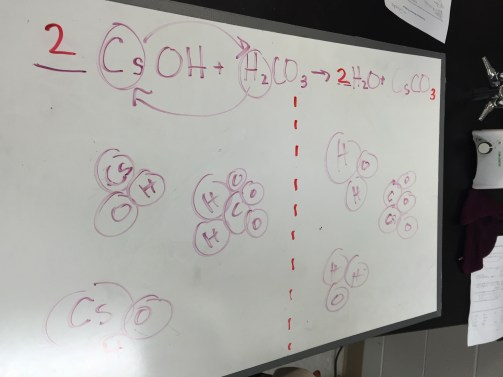
Students practiced determining the products in neutralization reaction. I was pretty pleased when a student asked “Aren’t these just double replacement reactions?” Last tri, a lot of students struggled to connect one day in class to the next, so this tri I’ve been much more intentional about trying to help students make those connections, so it’s gratifying to see students looking for links between new and old topics unprompted.

Day 151: Mirror Problems & Antacids

Physics: Mirror Problems

Students worked on some planar reflection ray diagrams from the Modeling Instruction curriculum. They seemed to be getting some important ideas in place about the ray diagrams.

Chemistry: Antacids

Students had to design an experiment to determine which of several different antacids is the most effective. It was clear that my students had not had many opportunities to design their own experiments, so there was a little panic at first, but they were able to come up with a procedure with a little nudging. I used 3 M HCl and the pH didn’t budge much with any of the antacids, so we had some conversation about what it means to have an inconclusive experiment in science. The other chem teacher used 1 M HCl, and got some very noticeable changes in pH after using the antacids and was able to make a reasonable comparison.

IMG_1867

Not much change in pH

Day 150: Reflection & Acids & Bases

Physics: Reflection

I put out some plane mirrors and reflectors, then tasked students with figuring out some rules for plane mirrors. In particular, I asked them to determine how the incident angle compared to the reflected angle, to compare and contrast the object to the image, and to determine where the image is located. The hardest question by far was where the image is located, since many students considered it “obvious” that the image is on the surface of the mirror since that’s where the light hits. The reflectors were especially effective for getting students to see the image is actually behind the mirror since the image could be covered and placing their pencil to trace the image provided a very tangible way of understanding where the image is.

IMG_1866

Chemistry: Acids & Bases

Students did a short reading on the properties of acids and bases. Looking back, I’d like to try revamping the pH lab I used last trimester, where students measured the pH of  various household chemicals. I think if I had students make more observations about the properties of the chemicals they tested, students should be able to build the same list of characteristics that shows up in the reading.

Day 149: Whiteboarding & Equilibrium

Physics: Whiteboarding

I had all of my students for the first time this week! We did some abbreviated whiteboarding of the labs and problems from this week as a way to summarize the big ideas we’ve been working on.

IMG_1861

Chemistry: Equilibrium

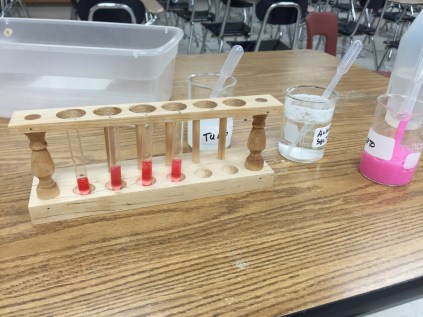
Students set up a reversible reaction in several test tubes, then experimented with how to change the equilibrium. Afterward, we spent some time discussing the role energy plays in why some of the methods to disturb equilibrium worked.

IMG_1860

Day 148: Intensity Problems & Equilibrium

Physics: Intensity Problems

Today is the last day I’ll be missing a significant number of students for AP testing. The students who were in class worked on some problems using the intensity relationship they found earlier this week. One class had a question I need to do some digging on. They were wondering if, when photons are released, they are already travelling at the speed of light, or if they have to accelerate from rest.

Chemistry: Equilibrium

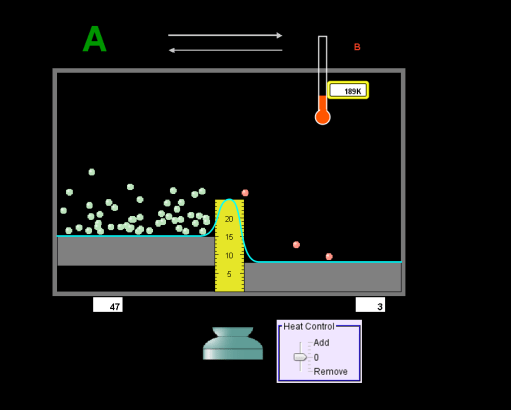
Students spend a little time with the textbook working on vocabulary for equilibrium and reversible reactions. We also spent some time playing with the PhET sim on reversible reactions and they had a lot of great observations and ideas to try.

reversible phet

Day 147: Joly Photometer & Energy in Reactions

Physics: Joly Photometer

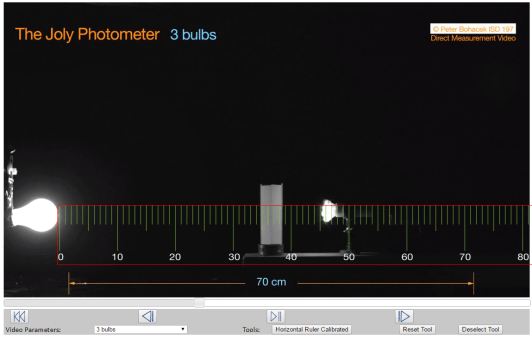
With over half of my students gone for another AP test today, I ended up giving them the hour to finish yesterday’s assignment with the Joly Photometer Direct Measurement Video. I’ll have a lot of students gone tomorrow for AP calc, so I need to figure out how I want to handle discussing the results of this and Monday’s lab.

Chemistry: Energy in Reactions

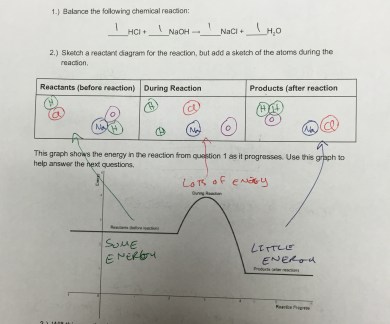
We talked about of yesterday’s lab, then took a look at energy changes in chemical reactions to start thinking about why some of the things we tried change the reaction rate.

IMG_1854

Day 146: Joly Photometer & Reaction Rates

Physics: Joly Photometer

Students used the Joly Photometer Direct Measurement Video to find a relationship between light intensity and distance from a source. I could tell a lot of my students had an AP test yesterday; I spent a lot more time than usual discussing with lab groups what variables they should graph, how they should collect data on those variables, and how to interpret and linearize the graph. I think their struggles had more to do with how mentally fried the AP chem students were than anything else.

joly photometer.PNG

Chemistry: Reaction Rates

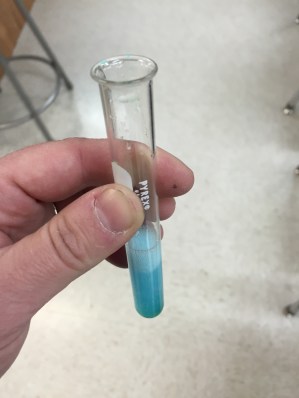
Students timed a reaction between copper chloride and hydrogen peroxide under different conditions to determine what impacts the reaction rate.

IMG_1845