Day 151: Inertial Balance, Shadows, & Activity Series

AP Physics: Inertial Balance

Since about 60% of my students are taking the AP Physics 1 exam on the make-up date, I’m adding in some review activities along with working on the final project. Today, I set up the inertial balance and asked students to make a few predictions about the motion, as well as what should happen when the mass is supported vertically. At the end of the hour, we used a motion detector to check students’ predictions.

For the final project, students’ proposal was due at the start of the school day today, and a few students told me they were hesitant about moving forward before seeing my feedback. Next time around, a Friday afternoon deadline may be better since then I can get feedback before their next class period.

Maker:S,Date:2017-10-21,Ver:6,Lens:Kan03,Act:Lar02,E-Y

Physics: Shadows

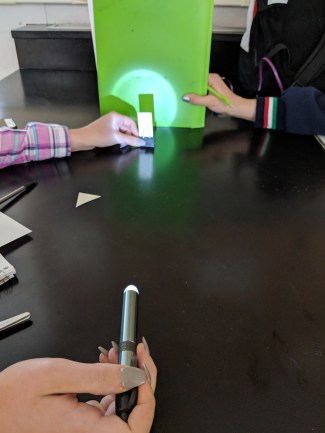
The other physics teacher and I decided to wrap up the year with some basic optics. Today, students made shadows and sketched ray diagrams to explain what they saw. A lot of students commented that the ray diagrams were a really useful tool to think about what was going on, which was nice to hear, since we’ve had to really work on buy-in on a lot of other diagrams this year.
shadows.jpg

Chemistry Essentials: Activity Series

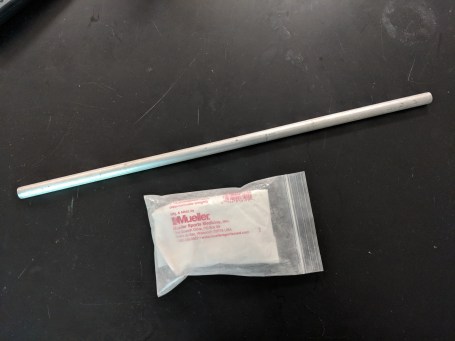
Students did a simple lab to develop an activity series for several pure metals. Most of the solutions were 0.1 M, which wasn’t strong enough to get a very visible reaction in the time we had. Next time, I need to make sure I allow time to mix stronger solutions.

activity series.jpg

Day 150: Final Project Work, Whiteboarding, & Quiz

Its been a rough week, and I spaced out on taking pictures today.

AP Physics: Final Project Work

Students finalized their proposals for the final projects. A lot of students this year are interested in the idea of digging into a movie scene to see if the physics is realistic. I got out my copy of James Kakalios’ The Physics of Superheroes for interested students to take a look at since Kakalios does something similar with comic books.

Physics: Whiteboarding

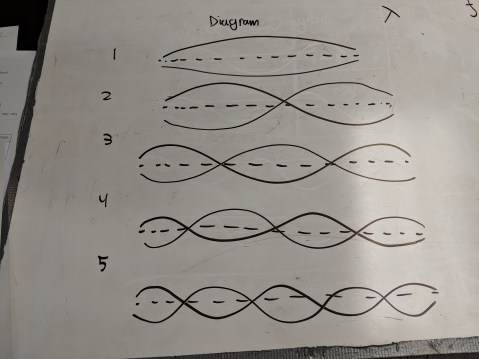
Students whiteboarded selected problems from yesterday before taking their quiz on sound. A lot of students had trouble with a problem to determine whether an organ pipe is open or closed given the first three frequencies that produce standing waves; I think they weren’t connecting the sketches of standing waves we’ve been doing to the written problems.

Chemistry Essentials: Quiz

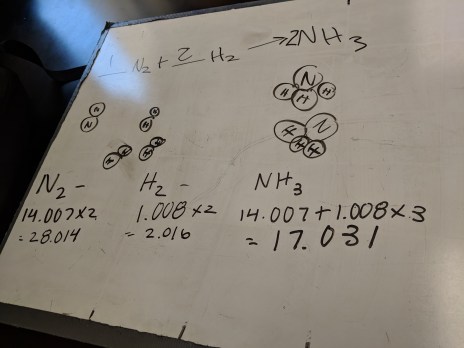
Students took a quiz on reaction types, as well as a second attempt at limiting reactant stoichiometry. Glancing over the quizzes, many of my stronger students relied heavily on particle diagrams, which is great to see. I need to keep working on helping all of my students connect those diagrams to the math.

Day 149: Final Project, Problems, & Whiteboarding

AP Physics: Final Project

Students continued refining their proposals for the final project. Lots of students have ideas I’m really excited to see. A few students are working on ideas where it may be interesting to look at dissipated energy, so we got out the infrared camera to play a little. It turns out some glasses block a lot of IR.

ir selfie

Physics: Problems

Students worked on some sound wave problems. Things seem to be clicking for most students.

Chemistry Essentials: Whiteboarding

We spent some time talking about the observations students made during yesterday’s lab and drawing explicit connections to the equation for the chemical reaction. My students don’t have a great sense for what certain chemicals look like, so it ended up being more teacher directed than I’d like. Students also weren’t sure when a chemical will show up as a gas, since I’ve dropped the subscript g in order to simplify the equations we’re looking at, but I’m not sure that is a useful simplification.

After the discussion (or, more accurately, lecture with student responses), student whiteboarded some limiting reactant problems. The students who were engaged made some good progress.

Maker:S,Date:2017-10-21,Ver:6,Lens:Kan03,Act:Lar02,E-Y

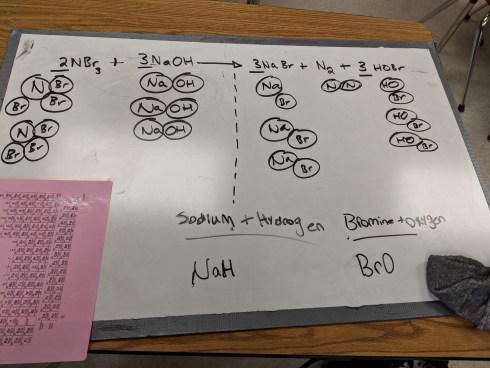
This student asked me if I could write the symbols for sodium hydride and bromine oxide

Day 148: Final Project, Superposition, & Reaction Types Lab

Today, I was missing  a lot of students from AP Physics and Physics for the AP Lit exam, so I kept those classes pretty low-key.

AP Physics: Final Project

The next few weeks are going to be tricky. About 1/3 of my students took the AP Physics 1 exam yesterday, and the rest won’t be taking it until May 24. I decided to go ahead and start the final project I’d planned, based on ideas from Casey Rutherford and Kelly O’Shea. Students are tasked with picking a scenario and using physics they’ve learned this year to describe what is going on. I pointed students to Rhett Allain’s Dot Physics for inspiration and most students spent today starting to think through potential topics.

Physics: Superposition

Students worked on a worksheet from Paul Hewitt’s Conceptual Physics sketching superpositions of triangular wave pulses. This year, students had a much easier time with the worksheet than I usually see; I think yesterday’s time playing with superposition on snakey springs made a big difference.

wave sup.jpg

Chemistry Essentials: Reaction Types Lab

Students worked through a lab to see each of the reaction types we’ve been working on in action. Students were clearly enjoyed the lab, and it was one of the most on-task days I’ve had with this group. Students made some great observations, but had trouble interpreting what those observations mean. Tomorrow, I want to spend some time making connections between observations and the equation for the reaction. I’ve also been thinking a lot this year about the purpose labs serve in a chemistry course, especially one as conceptual as this, and I think emphasizing the ways our paper and pencil representations explain what students see would be a way to add a lot of value to those labs.

single replace.jpg

Copper in silver nitrate solution

Day 147: Test Day, Board Meeting, & Reaction Types

Today was a strange day; a lot of students were impacted by some unexpected news last night.

AP Physics: Test Day

Today was the AP Physics 1 exam. However, we were able to give students the option of taking the make-up exam later this month and the majority of my students took this option. In my morning section, I’d planned to make today a game day for students to relax and have some fun before the exam, and decided to stick with that in both sections. Most students opted for some puzzles the calc teacher loaned me.

puzzle.jpg

Physics: Board Meeting

Students whiteboarded their results for yesterday’s speed of sound lab. The data came out very nice in both classes. Afterward, we had time for students to get the snakey springs out to start exploring wave superpositions. Even though I didn’t mention it in the prompts, one group got curious and tried to figure out whether the pulses reflect or pass through each other.

sound wb.jpg

Chemistry Essentials: Reaction Types

Classroom management gets tricky during labs with this class, so I decided to push back the lab I’d planned for today. Instead, I moved up a worksheet for students to practice identifying reaction types from chemical equations. One student was excited to show me an alternative representation she came up with for balancing chemical equations; its always exciting to not only have students coming up with their own ways of thinking about problems, but proud enough of their work to want to show it off.

bal shortcut.jpg

Day 146: Multiple Choice, Speed of Sound, & Whiteboarding

AP Physics: Multiple Choice

With the AP exam tomorrow, I asked students which of several options they thought would be most useful and both classes requested we use Plickers to review multiple choice. Most students weren’t at their most focused today, but there were still some good discussions.

img_2398

Physics: Speed of Sound

Students worked on the classic speed of sound lab. Since several labs lately have been pretty rough, I structured the pre-lab discussion more like the way I do in September to get back to basics of experimental design and made sure sketches of the set-up made it onto the main whiteboard. I also took advantage of the fact that students have made other wavelength vs. frequency graphs to emphasize that students should graph as they go to see if their results make sense. My 1st hour got a lot farther than my 5th, but their slopes are coming out very nicely.

speed of sound.jpg

Chemistry Essentials: Whiteboarding

The limiting reactant quiz last week did not go as well as I hoped, so we spent some time today whiteboarding a problem, emphasizing the role of particle diagrams. The students who were engaged seemed to get a lot out of the whiteboarding.

chem lr wb.jpg

Day 145: Review, Whiteboarding, & Legos

AP Physics: Review

A lot of my students will be taking the AP Chem exam on Monday, so it was the last time the whole class was together before Tuesday’s AP Physics 1 exam. One class asked if we could spend the whole hour on multiple choice, so we worked through a bunch of problems I’d loaded into Plickers. My other section asked for more time to work on the 2017 free response problems, so they got into small groups for that after 20 minutes of multiple choice practice.

Physics: Whiteboarding

Students whiteboarded some of the problems we’ve been working on prior to taking a quiz. A few students have started talking in terms of patterns for the number of notes and anti-nodes which is great. Students are also seeing the diagrams as a tool in ways they have not with previous types of diagrams.

wave diagrams.jpg

Chemistry Essentials: Lego Reaction Types

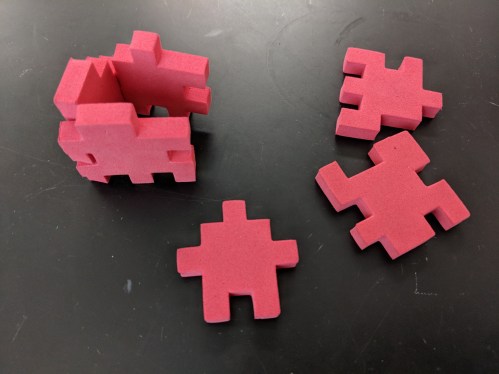
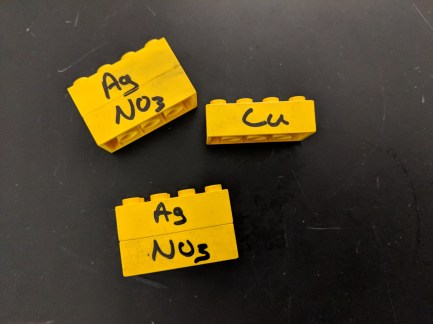
Students used Legos to represent ions in chemical reactions to get a better understanding of the different reaction types. Manipulating the blocks seemed to help students get a sense of how the ions are rearranging in a chemical reaction and tie some meaning to the terms from yesterday. I’m wondering if this lab could be reworked to start the unit and motivate the language, rather than simply being an opportunity to practice the terms.

lego.jpg

Day 144: Choice Labs, Tuning Forks, & Reaction Types Reading

AP Physics: Choice Labs

Today, I set up kits for a variety of labs targeting different topics and had students pick which labs to complete. I also had one last set of free-response problems, and most groups picked to work on those rather than the labs. I think they see a clearer link between the written problems and the test than they see between the labs and the test. In one of my classes, several students left their lab group to go talk to a peer they see as an expert on a topic they wanted to work on, which was awesome.

Physics: Tuning Forks

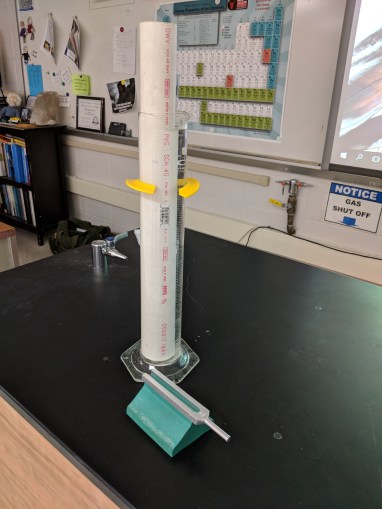
Students did a lab playing with tuning forks and singing glasses to start building some ideas about sound. This was the most animated I’ve seen my students this tri, which was a lot of fun. Students also made some great observations; one noticed that when a tuning fork vibrates in water, the water shoots mostly to the sides and use that to help justify which way the tuning fork vibrates.

tuning forks.jpg

Chemistry Essentials: Reaction Types Reading

We got out the textbooks for students to start building some vocabulary for different types of reactions. I could tell students weren’t latching on to the vocabulary in the same way they do when we establish a concept before the language. Tomorrow, we’ll be doing an activity using Legos to practice recognizing the different reaction types, but I wonder if there is a way I can rework the Lego activity to put it first and motivate naming different types of reactions.

Day 143: Mistakes Game, Wave Whiteboarding, & Assessment

AP Physics: Mistakes Game

Students put the finishing touches on their whiteboards from yesterday, then presented to the class for the mistakes game.  I gave students copies of the scoring guides to use during the discussion today. They were quieter than usual during board meetings, mostly because the whiteboard for a full free-response problem felt a little overwhelming.

IMG_20180502_121406.jpg

Physics: Wave Whiteboarding

Students whiteboarded yesterday’s problems. A lot of students were having trouble visualizing the standing waves, but sketching multiple wavelengths and marking the notes and anti-nodes seemed to help a lot of students.

stand wave wb.jpg

Chemistry Essentials: Quiz

Students took their limiting reactants quiz. I picked a problem where the numbers work out pretty nicely, and, glancing over the quizzes, it looks like the students who sketched particle diagrams nailed the problem.

Day 142: Mistakes Game, Standing Waves, & Lab Results

AP Physics: Mistakes Game

We spent about 15 minutes using Plickers to discuss some multiple choice from the practice test students took last week, then started working on the 2016 free response. Students started prepping whiteboards that we’ll use for the mistakes game tomorrow. Most groups got to the point where they felt they had a good solution on their whiteboard, so will need a few minutes tomorrow to add a mistake.

ap fr mistake.jpg

Physics: Standing Waves

We got out the singing rod to reason out what must be the pattern for standing waves on a resonator free to vibrate at both ends, then students started working on some problems. A lot of students struggled to relate wavelength to the length of the resonator, in part because many of them were looking for a specific equation rather than using the diagrams the worksheet asked for as a reasoning tool. I need to think about how I can help students see the value of their diagrams tomorrow.

singing rod.jpg

Chemistry Essentials: Lab Wrap-Up

The copper from yesterday’s lab needed some time to dry, so today students got the mass and worked on their calculations. A lot of groups had balled up their aluminum foil yesterday, which lead to some big chunks of unreacted foil, even for groups where it should have been the limiting reactant. This ended up being a great opportunity for students to use a particle model for chemical reactions to think through why that happened.

dried cu.jpg