Day 122: Springs & Balancing Equations

Physics: Period of a Spring

Students designed experiments to determine the variables that impact the period of a spring. I was very pleased with how many students pulled up their notes and results from the pendulum lab, in spite of the fact that it was on the other side of a week-long break, to help with experimental design and make sense of their results. For next year, I want to look at getting some additional springs. A lot of groups wanted to find a way to test the impact of the spring constant, and I only have options with relatively extreme spring constants, which made it tricky to get meaningful data.

IMG_1761

Chemistry: Balancing Chemical Equations

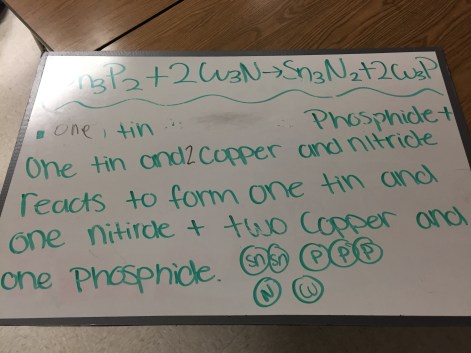
Students used PhET’s Balancing Chemical Equations sim as an introduction to what it balancing means. Last tri, I had a lot of groups skip straight to the game and play using trial and error, missing out on most of the sense-making. This tri, I took a few minutes to talk with students about why I structured the activity the way I did and students took the sim’s introduction and the questions I’d written much more seriously. Next time around, I want to add some questions to get students to focus a bit more on the significance of the subscripts vs. the coefficients.

IMG_1760

Day 120: Pendulum Motion Graphs & Mistakes Game

Physics: Pendulum Motion Graphs

Students whiteboarded their answers to yesterday’s worksheet. They did a nice job of using energy bar charts and free body diagrams to make predictions about what the position vs. time, velocity vs. time, and acceleration vs. time graphs should look like. We put a pendulum in front of a motion detector to get a look at the actual graphs and used both the formula and the graphs to determine the period of the pendulum.

Chemistry: Mistakes Game

Students whiteboarded their solutions to yesterday’s problem, including at least one intentional mistake. I ended up splitting each problem between groups, so one group did the statement, one did a diagram of the reactants, and one did a diagram of the products. I wish I’d had each group do a whole problem, then just limited how many present, since multiple representations gives room for richer mistakes.

IMG_1740

A partially corrected whiteboard

Day 119: Pendulum Problems & Representing Reactions

Physics: Pendulum Problems

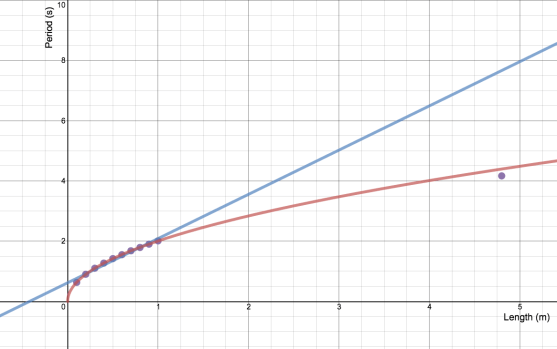
We had a brief discussion about the results of the pendulum lab, especially why a linear fit for the data my students collected usually looked pretty good, but did a very poor job of predicting the period of a large pendulum. I need to do a much better job of having my students talk about their intercepts, including whether or not an intercept of zero makes sense. Most of the groups who tried a square root function to fit their data gave it a shot because they didn’t like the intercept on the linear fit.

Afterward, students worked on a pendulum worksheet I put together where they drew energy bar graphs and free body diagrams for the pendulum at key points in its motion, then sketched position vs. time, velocity vs. time, and acceleration vs. time graphs for the pendulum.

pendulum graph

Chemistry: Representing Reactions

Students practiced translating between statements, chemical equations, and reaction diagrams. A lot of students needed some support to work through what a coefficient means vs. a subscript, but they did get there.

Day 118: Giant Pendulum & Conservation of Mass

Physics: Big Pendulum

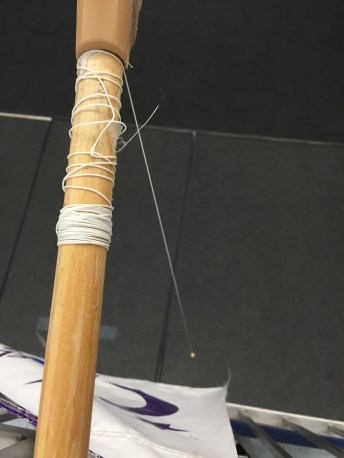
Before discussing the results of yesterday’s pendulum lab, we went to the main entrance of the school where we could hang a string from the second floor down to the first to make a 5 m long pendulum. Students used their mathematical models to predict what the period should be. Most groups used a linear fit for their data, and ended up predicting a period that was too big as a result. The really long pendulum provided a reason to refine their models by collecting more data and trying some linearization.

IMG_1736

Chemistry: Conservation of Mass

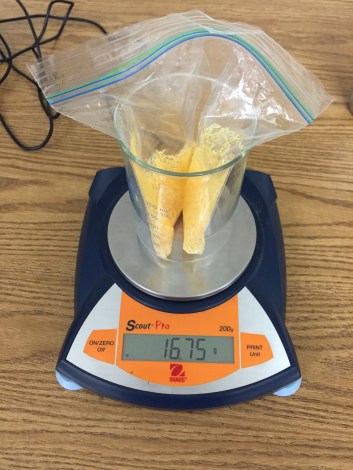
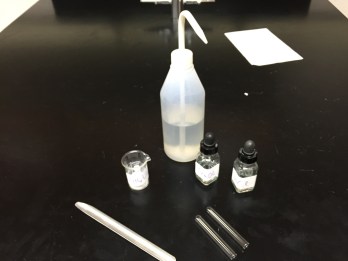
Students reacted calcium chloride, baking soda, and bromthymol blue in a Ziploc bag, making sure to take the mass of everything at various stages. This tri, I gave each group a beaker to place their bag in when using the balance, rather than having them set the bag directly on the balance pan, and the results were much better; students were able to use their results to articulate the law of conservation of mass very nicely.

IMG_1737

Day 93: Parallel Circuits & Reaction Rates

Physics: Parallel Circuits

Students did the real world version of the parallel circuits lab and put the patterns they’d come up with on whiteboards. After seeing that, in series circuits, the ratio of the resistance to the potential difference across a bulb had some significance, I saw more groups paying attention to the relationship between resistance and the current through a bulb in parallel.

IMG_1633

Chemistry: Reaction Rates

Students finished up the reaction rates lab from yesterday, and we discussed the results. Students are getting more comfortable sharing their ideas and finding their own connections to the material, which mean there were more students contributing to the discussion and I heard a greater range of ideas shared.

Day 92: Parallel Circuit Patterns & Reaction Rates

Physics: Parallel Circuit Patterns

Continuing with Kirchoff’s Laws, students went back to the PhET circuit construction kit to look for patterns in parallel circuits. I have a lot of fun listening to student conversations during this sequence. The patterns that lead to Kirchoff’s Laws are just subtle enough to lead to some great discussion (and emphatic debate), along with lots of moments where students think they’ve got it worked out, only to break their own pattern.

circuit sim

Chemistry: Reaction Rates

Students timed a reaction between copper chloride and hydrogen peroxide, then made various changes to speed up or slow down the reaction. Students were doing a nice job of connecting yesterday’s discussion about energy in chemical reactions  (aided by PhET’s reversible reactions sim) to explain why some of today’s changes impacted the reaction rate.

Day 91: Real Life Circuits & Energy in Equilibrium

Physics: Real Life Circuits

Continuing the circuit patterns set of labs from the PUM curriculum, students used power supplies and resistors to build series circuits and test the patterns they found in the simulation yesterday. Class ended with each group summarizing their rules on a whiteboard. Several groups used proportions to come up with a rule for how much potential difference goes to each resistor; for next year, I want to think about the questions I’m asking to try and get more groups to take a similar leap.


Chemistry: Energy in Equilibrium

Students did a short reading from the book to look at the role energy plays in chemical equilibrium and to help explain some of the results in yesterday’s lab. It also ended up being a nice set-up for the reaction rates lab we’ll be doing tomorrow.

Day 90: Circuit Patterns & Disturbing Equilibrium

Physics: Circuit Patterns

Today, students started working on a series of labs based on the circuit patterns activities from the PUM curriculum. Today, students built series circuits in PhET’s circuit construction kit, measured the current and potential difference at each element, and started looking for patterns in their results. When using the voltmeter, I was pleased by how many students went back to a lab we’d done moving the ground wire of the multimeter to help explain why some voltages were negative, along with what that negative voltage means. Tomorrow, we’ll pull out the power supplies and resistors to see if their patterns work in the real world.

Screen Shot 2016-02-01 at 3.12.16 PM

Chemistry: Disturbing Equilibrium

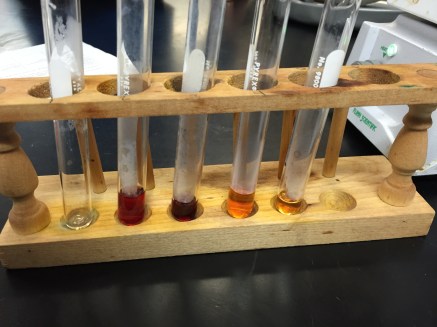
Students played with moving a reversible reaction out of equilibrium. After mixing Fe(NO3)3 and KSCN solutions in several different test tubes. Once the reaction was in equilibrium, they tried something different, such as changing the concentration or putting the test tube into a water bath, to and observed the results.

IMG_1620

Day 89: Cost Effectiveness of Light Bulbs & Vocab Intro

Physics: Cost Effectiveness of Light Bulbs

After a brief introduction to electric power, I tasked students with figuring out which of several light bulbs is the most cost effective. I provided them with the cost and estimated lifetime for each bulb and the current rate the local electric company is charging, along with some Kill-A-Watts they could use to take some measurements.

Chemistry: Reversible Reactions

After a quiz on limiting reactants, students used the textbook to start defining reversible reaction and equilibrium.

Day 79: Electric Field Lines & Energy in Reactions

Physics: Electric Field Lines

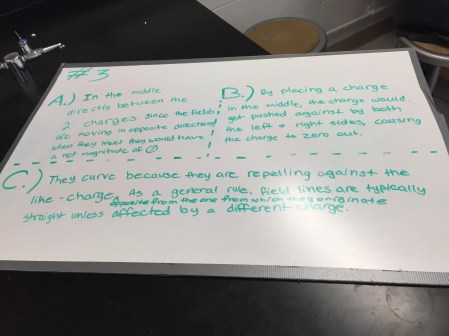
Students whiteboarded their answers to yesterday’s worksheet. The time we spent on vector addition diagrams with forces paid off as students were very successful adapting those to make sense of electric fields.

IMG_1589

Chemistry: Energy in Reactions

We started with a “mini-lab” to give students some first-hand, tactile experience with endothermic and exothermic reactions. After that, I tried having them sketch bar charts for those reactions, but it was clear I hadn’t done enough to help them understand what energy is, let alone the different types of energy that will appear in a chemical reaction, so the bar charts ended up a confusing abstraction for most students. I need to rethink how I approach reaction types next time to give students a better foundation in energy.

IMG_1588