Day 120: Kirchoff’s Laws & Rock vs. Minerals

AP Physics: Kirchoff’s Laws & Plickers

I split the class period today into two halves. In the first half, we got out resistors and power supplies to do the real-world version of the Kirchoff’s Laws lab students did on Wednesday. My directions were to see if the patterns they’d found Wednesday worked with today’s materials. I used the same slide as last year, but students had a much harder time figuring out what to do this year. I think the problem is we spent yesterday whiteboarding a different lab, while last year I kept the simulation and real-world versions of Kirchoff’s Rules back-to-back. Next year, I think I will take advantage of my department’s iPads and the HTML5 version of the sim to do it in my classroom. Then I can split up the labs by series and parallel, rather than by simulation and real-world and working around when I can get a computer lab.

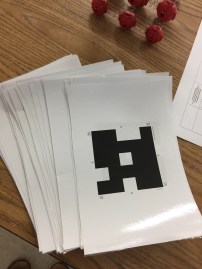
The other half of the class, we used Plickers to revisit some multiple choice problems from last tri’s final exam. One problem asked why the speed of a projectile does not change at the highest point. After talking to some other teachers, I really like thinking about that one from an energy perspective, using the idea that a force perpendicular to the motion will not change the energy. To drive that home, I used a mallet to get a bowling ball going in a circle so we could talk about whether the force from the mallet changed the bowling ball’s energy.

plicker

Earth Science: Rocks vs. Minerals

Students used their work from yesterday to identify some of the key differences between rocks and minerals. Since the book of stereograms students used yesterday also had a gem section, I included those in our discussion. Students pretty quickly recognized they had trouble identifying characteristics distinguished minerals and gemstones, which lead nicely into the idea that gems are just particularly valuable minerals.
category

Day 84: Physics Puzzles & Color

AP Physics: Physics Puzzle

My classes were pretty thin today since the senior social studies classes were watching the inauguration. I gave students who were here the opportunity to do some in-class retakes. I also picked out a couple of fun puzzles from Mad About Physics that students could work on. Students got pretty into the puzzles, especially one where they can get a marble to roll “upwards” by adjusting the space between some straws in a v.

puzzlePhysical Science: Color

Yesterday, a lot of my students were talking about standing waves and longitudinal waves as two separate things, so I started by hooking a spring up to a wave generator to produce some standing waves and show the familiar patterns. Afterwards, I showed them a short video of some demos with a pair of 3D glasses, using it to prompt some questions to motivate a lab on color.

Day 59: Reviewing Final & Marshmallow Challenge

Today was the start of a new trimester and, in the excitement, I forgot to take pictures today.

AP Physics: Reviewing Final

I wanted students to go over some problems from last week’s final exam. For one of the problems, I picked a really strong solution, as well as a few that were representative of the most common mistakes, and gave them a scoring guide to assign points. Students said this really helped them get a clear understanding of what exactly is expected, as well as to think about why the wrong answers were wrong. A lot of students realized they’d made mistakes because they did not read carefully, so I need to work on integrating some reading strategies for complex problems.

Physical Science: Marshmallow Challenge

Our 9th grade science sequence is two trimesters of earth science and one trimester of physics. This year, physics is in the middle, so today started our physical science trimester. In spite of this being a full-year course, only 3 of my 35 students had earth science with me last trimester.

Today, we did Tom Wujec’s Marshmallow Challenge, where teams build a tower out of spaghetti, string, and tape with a marshmallow on top. I really like that the TED talk and other resources make it easy to use this to talk about growth mindset, effective collaboration, and other ideas that I want to place as important right away. I also really like having students do something the very first day of class, since it drives home the message that they will need to be active in this class.

Day 30: Plickers & Ice Core Data

AP Physics: Plickers

I finally graded the first full-length test over the weekend and wanted to go over some of the questions students struggled with. I put the multiple choice questions that students got wrong most often into Plickers and had students vote individually, then discuss with other students, then vote again. There was a lot of great discussion along the way. In my 4th hour, I tried showing them the graph of responses after individual voting. That class came to a correct consensus less often than my 2nd hour where I kept the graph of individual responses hidden, but they also had much deeper conversations. I can’t decide how much of the difference I’d chalk up to the personality of each class and how much I think is a result of running the voting differently; I’ll probably experiment some more next time.

img_2398

Earth Science: Ice Core Data

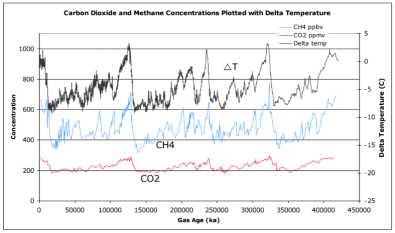
Students used a graph of temperature changes, CH4 concentration, and CO2 concentration to look for patterns. It was clearly tricky for them to make sense of multiple data sets on the same set of axes, especially since there are three different vertical scales. The first question helped orient them to the horizontal axis, so I think I will add some scaffolding to explicitly focus them on the vertical axes before looking for patterns.

ice-core-graph

Day 7: Angular Velocity & Currents

AP Physics: Angular Velocity

I’ve decided to try embedding circular motion with kinematics, rather than introducing it as a separate unit, so today I introduced constant angular velocity. Students used a Direct Measurement Video of a rotating disk to plot both angle vs. time and distance vs. time for dots at different radii. I also introduced them to doing calculations in a spreadsheet since some of the number crunching they needed to do could be repetitive. Spreadsheets, high speed video, and some new physics was a lot to take in at once, so I gave more structure than usual, and my students rolled with it well.

rotating-disk-dmv

Earth Science: Currents

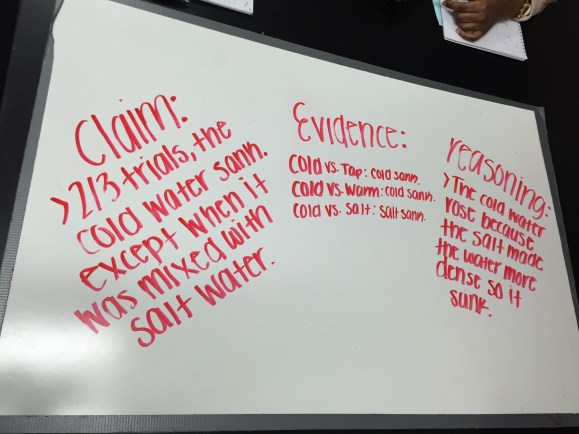
Students prepped whiteboards with their conclusions to yesterday’s lab using the claim-evidence-reasoning framework. Students seemed excited to share their work with the class. Afterward, we made some connections to ocean currents.

IMG_2184.JPG