Day 107: Experimental Design, Conservation of Momentum, & Particle Diagrams

I had a sub for half the day today.

AP Physics: Experimental Design

Students worked on an experimental design problem off the 2017 AP Physics 1 exam, then did their choice of problems from a packet involving multiple models.

Physics: Conservation of Momentum

Students started working on some problems using conservation of momentum. In the hour I was here for, students were much more confident than I’ve seen them on new problem types all year, which was exciting. When I talked to groups, a lot of them were using connections to energy conservation to think through the problems.

Chemistry Essentials: Particle Diagrams

Students reviewed sketching particle diagrams. A lot of students have struggled with these this year and tend to loose track of what a particle diagram is intended to represent, so I want to make sure they get one more shot before the final

Day 106: Model Summaries, Collisions, & Gas Laws Review

AP Physics: Model Summaries

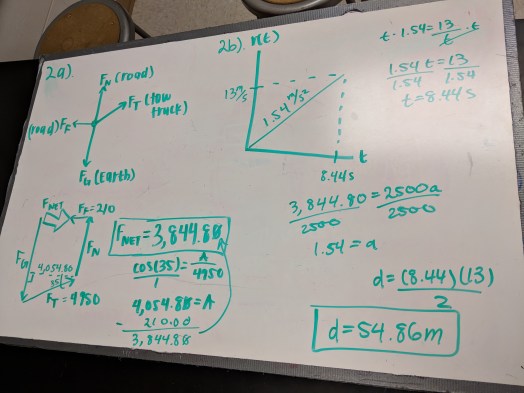
To help review for the final, students whiteboarded model summaries for the mechanics topics we’ve done so far. I just asked for key diagram types, along with relevant annotations, and key equations. For the first time, I saw a lot of groups including pieces of the force models, including free-body diagrams, system schema, and Newton’s 2nd Law, in summaries for other models. I’m excited that students are seeing and valuing the connections between different models.

Physics: Collisions

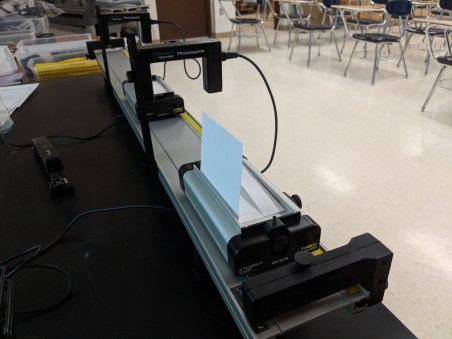
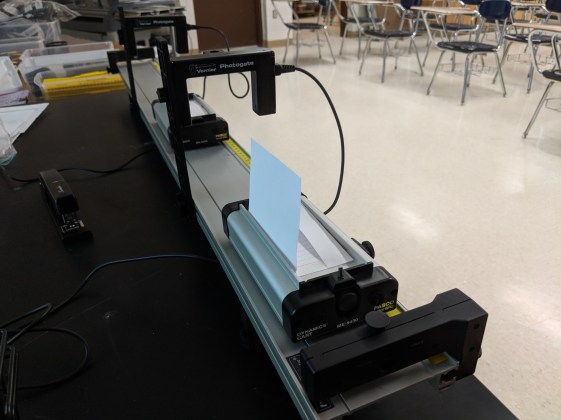
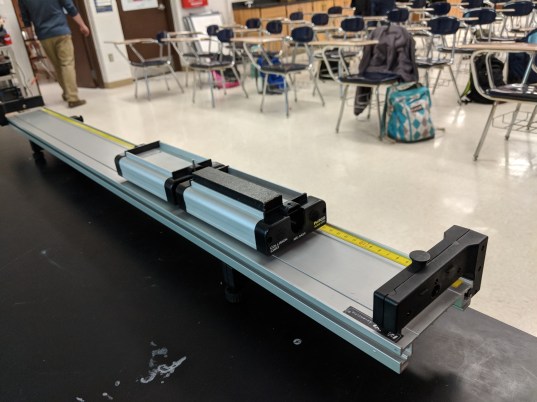
Students continued the cart collisions lab from the Modeling Instruction materials. A lot of groups struggled with interpreting the graphs produced by the photogates, which has been pretty common this year. The classic graph matching lab always seems to help students make sense of what the motion detectors are recording; I’m wondering if it would be worthwhile to have a lab that’s essentially play with photogates next year.

Maker:S,Date:2017-10-21,Ver:6,Lens:Kan03,Act:Lar02,E-Y

Chemistry Essentials: Vacuum Chamber

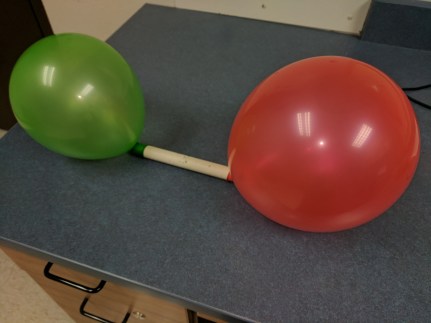
I got out the vacuum chamber and a few other demos, including balloons linked by a pipe, to revisit gas laws and pressure today. Sticking with pretty hands-on review seems to be helping a few students stay engaged as we approach the final exam.
balloons

Day 105: Multiple Models, Collisions, & Density Review

AP Physics: Multiple Models

With finals next week, students started working on some problems that require them to use multiple models simultaneously. We also spent some time talking through strategies for these kinds of problems; my students are a little more resistant than usual to sketching diagrams, so I made sure to emphasize the value of that step.

Physics: Collisions

Students started working on a lab with colliding carts to get at conservation of momentum. The lab is going more slowly than I’d hoped, which has me nervous about whether students will be ready to assess on this topic by the end of the week.

collisions.jpg

Chemistry Essentials: Density Review

I have a little more time for review than normal in this class, so I decided to use some potential labs I skipped over this tri. Today, to review density, I had several unknown liquids students had to identify by making a mass vs. volume graph. I had them write their own procedure, which I haven’t done in a while, and students needed a lot more pre-lab discussion to be ready for that.

I’m also starting to struggle more to keep students on task during the lab and to keep them from having side conversations during whole-class instruction. I’ve seen it before with this course; I think a lot of students see it as settled whether they will pass or fail the course once final review begins and get off track as a result.

Day 104: Plickers, Explosions, & Quiz

AP Physics: Plickers

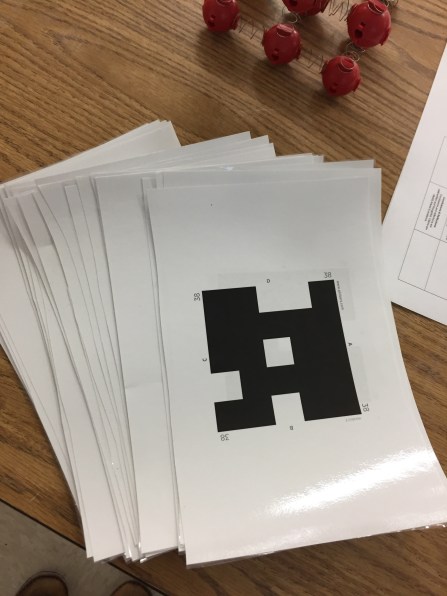
After a quiz, we used Plickers for some multiple choice practice. We happened to do several that involved the slope or area of different graph types, and it was clear from the conversations that a lot of students were having trouble keeping them all straight, so we spent some time looking at how to work backwards from the formula sheet to get what a slope or area represents.

img_2398

Physics: Explosions

Students took a quiz on impulse, then worked on analyzing their data for the cart explosion lab. Linearization has been a struggle in this course this year, but it seems to be clicking for a lot of students, which is good since plotting ratios means there’s a lot to think through.

One class brought up their anxieties about a drill we’re planning in conjunction with the local police department, which lead into a discussion about their fears about school shootings in general. With the drill already making students nervous, I’m going to need to carefully monitor the mood in my classes and make a concerted effort to make students feel as safe as possible.

Maker:S,Date:2017-10-21,Ver:6,Lens:Kan03,Act:Lar02,E-Y

Chemistry Essentials: Quiz

Today’s formula writing quiz took the full hour, which was much longer than I expected. I had a lot of students come up to me during the quiz to ask questions that indicated they were struggling to differentiate the different types of diagrams as well as the meaning of subscripts and superscripts on atomic symbols. I need to think about what kinds of scaffolds I can provide to help students develop those skills; one option may be to have students help name the diagram types, rather than using a standard name.

Day 90: Multiple Choice, Practical, & Bohr Model

AP Physics: Multiple Choice

Students took a quiz, then we used Plickers to practice some multiple choice. I intentionally picked some problems that go back to topics from earlier this year. I also spent some time reviewing what it looks like to take full advantage of this activity, and saw students more engaged than last time. I think doing multiple choice less often was a good call.

img_2398

Physics: Practical

Students wrapped up the energy practical they started yesterday. I added a couple of conceptual questions to the task, and was pleased with the conversations I overheard. I think next time I’ll make explaining your group’s answer to those questions part of testing out the result.

Maker:S,Date:2017-10-21,Ver:6,Lens:Kan03,Act:Lar02,E-ve

Chemistry Essentials: Bohr Model

Students used PhET’s Build an Atom simulation to play with the Bohr model and explore how it connects to the periodic table. A few students wanted to know why we are using the Bohr model when the quantum model from yesterday’s reading is more complete, which is a great opener for conversation about what makes a useful scientific model.

build atom.PNG

Day 73: Multiple Choice, Forces, & Gas Laws

AP Physics: Multiple Choice

After a quiz on projectile motion graphs, we spent some time using Plickers to practice multiple choice on energy and projectiles. One of my classes pretty openly started guessing, rather than thinking about the problems, so I think we may be doing multiple choice a little too regularly. I may start either alternating each week between relevant multiple choice and free response or just use quiz days for explicit AP practice less often.

Physics: Forces

Before today’s quiz, students whiteboarded their diagrams for the problems earlier this week. Pretty consistently at this point, the students who take the time to get their diagrams right do fine on the calculations, which is not surprising. Getting students to put units in their work is still a challenge, but I saw a lot more confidence from my students today than I have in a while.

forces wb.jpg

Chemistry Essentials: Gas Laws

Before today’s quiz, we did a quick debrief of yesterday’s lab on the gas laws. Since the ice water didn’t work well yesterday, I tried putting them outside (the air temperature was -10 degrees F today!), but still didn’t see much change, so I think the syringes I have just don’t seal well enough. We’ll finish the post-lab discussion on Monday.

Maker:S,Date:2017-10-21,Ver:6,Lens:Kan03,Act:Lar02,E-ve

Day 65: Multiple Choice, Elevator Wrap-Up, & Mystery Tubes

AP Physics: Multiple Choice

Today was a quiz day. This tri, I’m making quizzes the last thing we do for the day to build in a natural time limit. Before the quiz, we used Plickers to go over some multiple choice questions that were tricky on the final exam. I had one class where scores on the final came up, and that seemed to put a damper on some of the conversations. I’ll have some conversation with them on Monday to reinforce that we are after everyone’s success.

plicker

Physics: Elevator Wrap-Up

I gave students some time to do a summary table from Casey Rutherford’s elevator situations. Afterward, they took their quiz on Newton’s 2nd Law.

Chemistry Essentials: Mystery Tubes

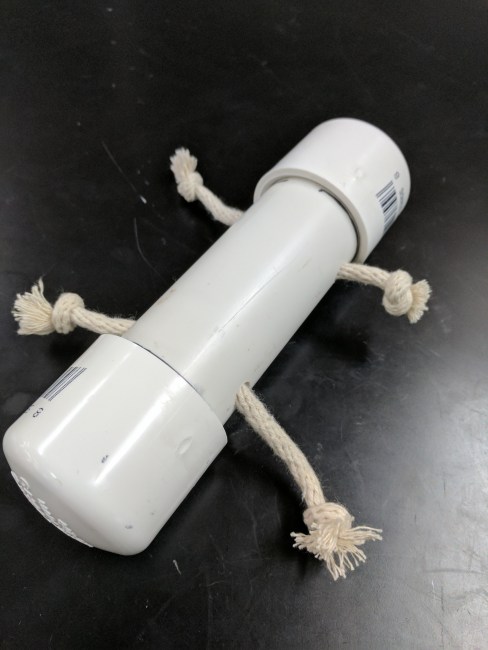
Today was a quiz day. About half of my students take their assessments elsewhere due to IEPs or 504s and most of them need the whole hour, but the students who stay in the room usually only need about half the period, so I’ve been doing nature of science activities once all the students in the room are done. Today, I pulled out the mystery tubes. Compared to last trimester, my current students were less interested and quicker to look for answers online. I think if I’m going to do it early in the trimester, I need to spend a little more time than I did today introducing it and brainstorming strategies.

mystery tube

Day 58: Scoring Guide, Broken Circles, & Steel Wool

AP Physics: Scoring Guide

The tri 1 final exam included some free response problems off past AP tests, so today I gave students the scoring guides and some student samples to make sense of the scoring before letting them see their own tests. One of the problems was problem 3 off the 2016 free response and, inspired by a participant in Greg Jacob’s AP Summer Institute, I used rubber bands to make a bumpy ramp so we could actually try out the experiment in the problem. The class had some good discussion about key takeaways, like the importance of explaining EVERYTHING. Students also noticed that the student samples with high scores had a lot of marking the text.

Physics: Broken Circles

I struggled to get the class culture I wanted in my physics class last trimester and, with students shuffling between hours and about half coming from the other physics teacher, the new tri is a great opportunity to try again. Students worked on a broken circles activity from Designing Groupwork  by Lotan & Cohen, then we had some discussion about what it took to succeed and how that fits with what effective groups in physics look like.

broken circles.jpg

Chemistry Essentials: Steel Wool

This course is two trimesters long, and we only offer the second half during tri 3, so I’m restarting the first half of the course with a new group of students. Students measured the mass of steel wool before and after pulling it apart. To help students focus on good lab practice, I had them do the experiment once with minimal instructions. Then, we had a brief discussion to get at some sources of error before students completed the lab again with a handout and a paper plate to help catch stray bits of steel wool. Just like tri 1, I made a class histogram with Post-Its, but the results were much nicer this time.

chem histo


Day 31: Multiple Choice, Problems, & Bar Charts

I was home sick today, so wasn’t able to take any photos.

AP Physics: Multiple Choice

Students worked on some multiple choice problems off practice AP exams. I usually have students answer individually with Plickers, then talk to each other and answer again before we have some whole-class discussion.  To try and replicate that, I gave students two spaces to answer the questions so they can do all of them individually, then talk about each one with their group. I put in my notes to have some whole-class discussion about the answers at the end, which I’ll be curious to hear how it goes.

Physics: Problems

Students took the plunge to start calculations  with constant acceleration. As part of their worksheet annotating graphs, I had students sketch and annotate v-t graphs given just the statement part of some of today’s problems. I’ll be curious to see if that is a useful bridge.

Chemistry Essentials: Bar Charts

Students worked on some bar charts for objects heating up and going through phase changes. We ran out of time to discuss the lab, so I ended up recording a video lecture that gives away the big ideas from the lab.

Day 19: Plickers, Dueling Buggies, & Quiz

AP Physics: Plickers

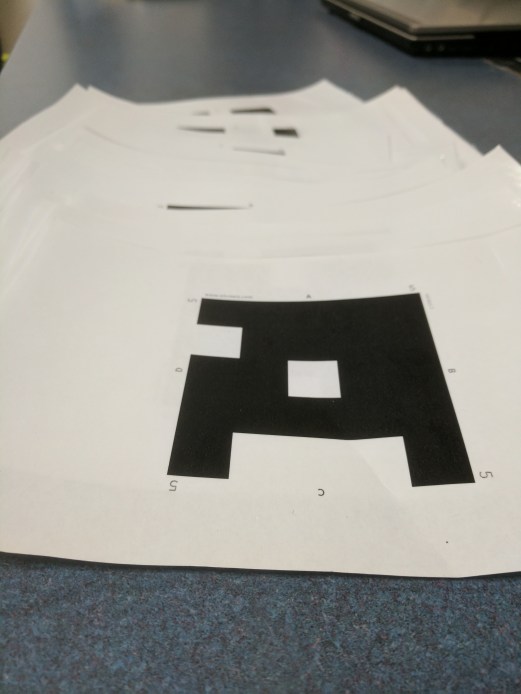
After a quiz, I introduced students to Plickers. One piece of feedback I got from students last year was that they would have liked to practice multiple choice earlier in the year so, this year, I’m planning to spend part of each Friday on that. I have students read the question silently and vote on an answer, then vote again after talking to their peers. My 4th hour had some great, spirited discussion and was actually disappointed when I told them it was time to put the cards away and head to lunch.

plicker

Physics: Dueling Buggies

We wrapped up the dueling buggies lab practical. For the rear end collision, most of my groups got a crash position behind where both of the buggies started, so I paused the class to look at what results would make sense. I’m debating whether its worth having that conversation sooner next year, or if it is better to wait until there is a need. This fits with a pattern I’ve noticed this year where more students than usual are struggling to connect their graphs and math to what is physically happening.

I couldn’t get a volunteer to release the second buggy or to film the collisions for me, so here’s a video from a couple years ago.


Chemistry Essentials: Quiz

Students spent most of the hour on their density quiz. While I haven’t graded them yet, there were some stark differences in how students did on the quiz. Several students immediately made a connection to some of the worksheets and labs we’d done and found the quiz extremely easy. Others thought the quiz was completely unfamiliar and really struggled. I need to keep working on helping students to make connections across different days, as well as supporting my students in developing as independent thinkers.