Days 35-37: Lab Practicals

The Minnesota teacher union has our convention on this week, so we only had school Monday through Wednesday. I think staff and students alike are feeling pretty run down, so this is good timing for everyone to take a break.

Physics: CAPM Practical

This week, students worked on the “catch the loot” lab practical for constant acceleration. After how smoothly paper and pencil problems went last week, I expected the practical to go very smoothly, but students really struggled. I also found a lot of groups were not interested in testing their calculation with the materials. I think I underestimated how difficult it is for my students to draw connections between what happens in the lab and what happens on paper. I teach all of my physics sections in the morning, so when my colleague who teaches physics in the afternoon saw how challenging the practical was, he added a brief whiteboarding activity to help bridge the paper and pencil problems to the practical, which seemed to really help his classes. Going forward, I need to make sure I plan how I will help students make better connections between what happens in the lab and what happens on paper.

Students also had their quiz over constant acceleration calculations this week and many of my students were really worried after having their confidence shaken by the lab practical. On the quiz day, I took the first half of the class to have students whiteboard a word problem, which they were able to nail with minimal help from me and seemed to really improve the tone of the class before the quiz. I shared my reasoning for doing that problem, and a student made sure to tell me how much she appreciated that I am paying attention to where they are at and trying to adjust to what they need, which was a good reminder that talking about my reasoning for instructional decisions can do a lot to help students feel less frustrated in my classroom.

AP Physics 1: Balanced Forces Lab Practical

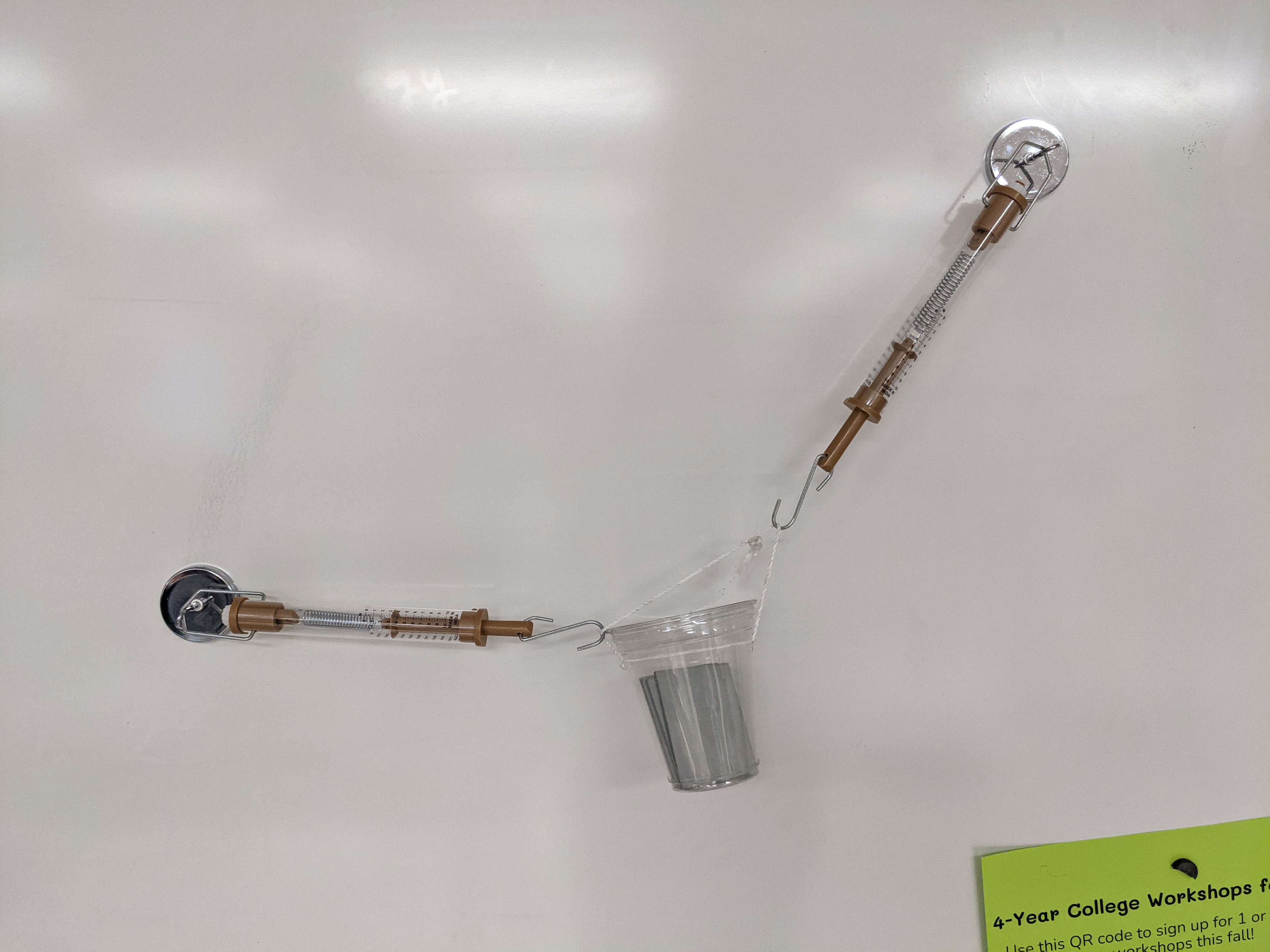
Students did a lot of practice with applying math to vector addition diagrams, including a lab practical to find an unknown mass. My students were quick to recognize the math that would be useful, but weren’t always comfortable with how to use the math. I really appreciated the small class size I have in AP since I think that has helped the class feel more cohesive, which has meant students are very comfortable asking each other for help and very willing to patiently work with their peers when asked for help. The small class size has also made it easier for me to step in before students start to experience any serious frustration and has helped me build trust with my students that I will be able to coach them through things if needed. Knowing the positive impact the strong relationships students have with each other and have with me, I need to keep thinking about how I can do a better job of building relationships in my much larger physics classes.
Days 30-34: CAPM Problems & Force Equations

Physics: CAPM Problems

This week was mostly about working problems using the constant acceleration model, which I have students do almost entirely from velocity vs. time graphs. We started with some problems I got from Kelly O’Shea where students are given some velocity vs. time graphs they annotate and write area equations for. Next, we shifted to word problems. I was blown away by how easy these problems were for students. Doing calculations with the constant velocity model had been very challenging for a lot of students, but something really clicked this week. Students were even including units on all of their work with almost no prompting and showing their work really clearly. I’m not sure what it was, but it was nice to have a week where students were nailing what I gave them!

AP Physics: Force Equations

We did labs to find the equations for the force of gravity and for spring force. Most years, my students are most comfortable with mathematical representations and it’s a challenge to get them comfortable with other representations, but this year my students are defaulting to other representations in some really cool ways. At this point in the year, when I have groups make a graph on a whiteboard, they usually default to including an equation for the line of best fit whether or not I ask for it. Instead, my students this year have been writing “for every” statements about their slope unprompted. For example, on the force of gravity lab, every group wrote some variation of “The force goes up 10 N for every 1 kg” on their own. That tells me that my students find the “for every” statements useful and intuitive, which is a great place to be developing physics knowledge from.

Days 25-29: Mistakes Whiteboarding & Free-Body Diagrams

Physics: Mistakes Whiteboarding

This week we did a lot of practicing with constant acceleration diagrams. The highlight was doing mistakes whiteboarding. Based on a recent conversation with Kelly O’Shea, I was much more explicit that the role of the group presenting is merely to facilitate the discussion while the role of the rest of us is to help them get to the right answer. In two of my classes, this seemed to be really freeing for a lot of groups as they presented, and lots of students were quick to ask their peers to justify changes to the whiteboard when they were presenting. There was also some fantastic back and forth where the students who weren’t presenting disagreed about what to change on a whiteboard and had exactly the kind of discussion I’m after with mistakes whiteboarding. In my third section, the discussion was still pretty rough, so I need to give more thought to how I can support them in having deeper student-to-student discussions.

AP Physics 1: Free-Body Diagrams

This week we focused on drawing system schema and free-body diagrams. I was reminded how much I love framing forces in terms of interactions and the discussion that comes out of even the very basic free-body diagram problem set in the Modeling Instruction materials. I love that on a problem about a skater sliding across frictionless ice at a constant velocity, I get to hear students internalize Newton’s 1st Law as they wrestle with what interaction could be giving the skater a forward force. This year, my students also got into Newton’s 3rd Law during the discussion as one student pointed out the ice is pushed downward by the skater’s foot, so the class wrestled with how that impacts the normal force before agreeing that same interaction pushes the skater up and the ice down. We also did Kelly O’Shea’s force diagrams card sort, which I use as students’ first introduction to vector addition diagrams. I was really pleased by how easily they connected the vector addition diagrams to the free-body diagrams and by how they started contrasting balanced and unbalanced force scenarios with minimal input from me.

This year has felt unusually draining so far, but my students are doing some great work in my class and reminding me why this job is worth it.

Days 20-24: Constant Acceleration & Forces

Physics: Constant Acceleration

Physics started constant acceleration this week. We used video analysis to get position vs. time and velocity vs. time graphs for a cart on a ramp, then worked on Kelly O’Shea’s CAPM card sort. This was my first time using video analysis to introduce constant acceleration, and I’m really happy with the results overall.

The big thing I’m thinking about right now is when students are in groups. The first week of school, students were almost timid and weren’t engaging with each other, but tended to stay at their tables, which made it easy for me to pull the full group in when I came to answer a question. Over the past few weeks, things have shifted in a few of my classes. Students are still not engaging much with their groups, but are also leaving their group to go see their friends, which is making it harder for me to gather the whole group when I’m answering a question. I think a lot of it is students are out of practice working with each other after last year and simply aren’t seeing value in staying with their group. I think I need to make much more use of group roles and spend much more time working with students on how to interact with each other and building community so students feel like they can connect with more people in the class.

I think these issues have been compounded by the fact that I have larger class sizes than usual, so I’m juggling 10 groups in each of my classes. That means that if I’m having meaningful conversations with each group, it can be a while between my visits to a given group. I’m realizing that many of my students don’t feel like there is much they can do besides wait for me when they are stuck, which I think is contributing to some of the behavior I’m seeing. I think part of what I need to address is helping students recognize the strategies they have to work through moments of confusion or challenge.

AP Physics: Forces

We started the week with the catch the loot practical, which is one of my favorites since it is a challenging calculation at this point in the year, but so satisfying. This class is only 12 students, so I’ve had a much easier time building a positive class culture and helping students with strategies for when they are stuck. One thing I loved is when the first group finished, they decided each of them should join one of the other groups to help their classmates with the lab practical.

We shifted into forces with some mallet ball followed by Brian Frank’s interaction stations. So far this year, I’ve been really intentional that when we show the shortcomings of a common preconception, I also ask students about what reasonable thinking might lead a person to that idea and explicitly validating that thinking. My goal is to make it so that adopting a new idea doesn’t mean you are wrong or don’t understand physics, it just means you didn’t have all of the information when you formulated your old idea. I saw some payoff with the mallet ball as my students were quicker than usual to let go of the idea that they needed to keep tapping the bowling ball to keep it moving with a constant velocity and talking about the useful aspects of that idea even once they’d adopted a new one. We’ll see next week how that carries over into drawing free-body diagrams.

Days 15-19: Problems & Technology Tools

AP Physics 1: Problems

A lot of this week was working on calculations for constant acceleration. My students are struggling more with the algebra than in a typical year and it sounds like other teachers are seeing similar things. They are doing some great mathematical thinking, but just aren’t as comfortable as usual with common processes like making a quick graph based on an equation or doing algebraic manipulation. I tend to trust that once students see what math they need to do, I can expect them to get through the math without much support. This year, I need to make sure I’m putting attention to helping students develop their math skills alongside the physics. My course on STEM integration theories last fall got me thinking about how I can go beyond math as a tool in my classroom to instead support meaningful math sensemaking, and this year will be a good push to put what I’ve been thinking about into practice.

I also graded the first lab write-up this week, and my students did much better than I usually see on the first lab write-up. In general, this group of students are stronger than usual at explaining their thinking and the kind of writing I usually look for, which is fantastic in a course like AP Physics 1. I’m really excited to be able to help students build their already strong skills.

Physics: Technology Tools

This week, we wrapped up constant velocity by having students do activities with Vernier Video Analysis and Pivot Interactives. For the video analysis assignment, we had students record a short example of something they thought was constant velocity, then use the video analysis results to test the claim. Since the focus of this activity was on interpreting the position vs. time and velocity vs. time graphs, I think it would have worked well when we were preparing to transition from interpreting diagrams to doing calculations to help break up the stretch we had of paper and pencil problems.

A big goal of these activities was to introduce students to tools we’d been using in a context where students were already pretty solid on the content. When introducing technology, I do a minimal demo and instead provide students with a user guide or other detailed instructions on how to use the tool. I have a lot of students who are more comfortable with a walkthrough, so I spend most of the hour on my feet answering questions by reminding students to use the resources I provided them. These days are tiring, but they pay off with students quickly becoming very independent with these tools as they learn to navigate the user guide or help documents. However, I’ve developed some new back issues in the last year and a half and am very aware today that I can’t currently bounce around the room as much as I used to. We are using video analysis again on Monday, and I need to give some thought to how I will balance ensuring students have the support they need and feel like I’m available for questions with managing my own health.

Days 10-14: Problems & Ramps

Physics

For the second week in a row, students did a lot of problems on paper and whiteboards. This week, the focus was on using constant velocity representations for calculations. I like the way we gradually add complexity to the model and students definetly need time to practice and discuss, but this has felt like a long stretch where students are doing mostly one kind of activity. I think next year I want to look at our storyline for the unit to see if we can break up the problems a bit with the dueling buggies lab practical, video analysis, and other activities that have a different feel. We also added more problems to our packet a few years ago, so students first work through what we consider the core problems, which includes problems where students are working out how to apply what they found in the lab to the written problems. We found students often didn’t have a lot of confidence after just these problems, so we added a second problem set to the constant velocity packets that are mostly about practicing what students have already figured out. I’m wondering if there are ways we could approach the early problems differently to help students build more confidence and how we could reimagine the second set of problems to focus more on lab practical types of activity.

AP Physics 1

This week was all about constant acceleration representations. We purchased some motion encoder systems last spring, so I used them to have students do a lot more exploring the graphs for ramps than I normally do. My students are getting direction on position vs. time and velocity vs. time graphs much more easily than my students usually do, and I think the tracks are helping a lot. It is still challenging for some students to visualize what is happening to the slope of a position vs. time graph to predict what the velocity vs. time graph will look like, but their struggles are pretty consistent with what I see at this point in the year, so I trust that they will get it down.

I also have a single, very small section and, while I’m sad that more students aren’t taking AP Physics 1, I am really enjoying how cohesive this class is. During mistakes whiteboarding, the students presenting have been admitting unintentional mistakes and the students not presenting have been asking questions about things they don’t understand but don’t think are mistakes, both of which are signs of the kind of class culture I strive for.

Days 6-9: Problems

This week, both of my classes spent a lot of time working problems to practice translating between different representations of constant velocity. In Physics, velocity vs. time graphs seemed to either click immediately for students, or to be a big struggle. Usually, I have a lot more students with an experience somewhere in between. Regardless, by the end of the week even the students who found velocity vs. time graphs really challenging were getting the hang of them. In my AP Physics 1 class, most students seemed to be in a place where the velocity vs. time graphs were clicking pretty quickly.

AP Physics 1 also was able to do the dueling buggies lab practical. We had some great conversation about the sources of uncertainty in their predictions. Each group took a different approach, but got the same predictions for where the collision would happen, which is always fantastic. I’m also starting to see more of my students’ personalities in this class, which is making this class a lot of fun. AP is a lot smaller than my Physics classes, so I’m not surprised that is starting to feel like a cohesive class sooner than Physics.

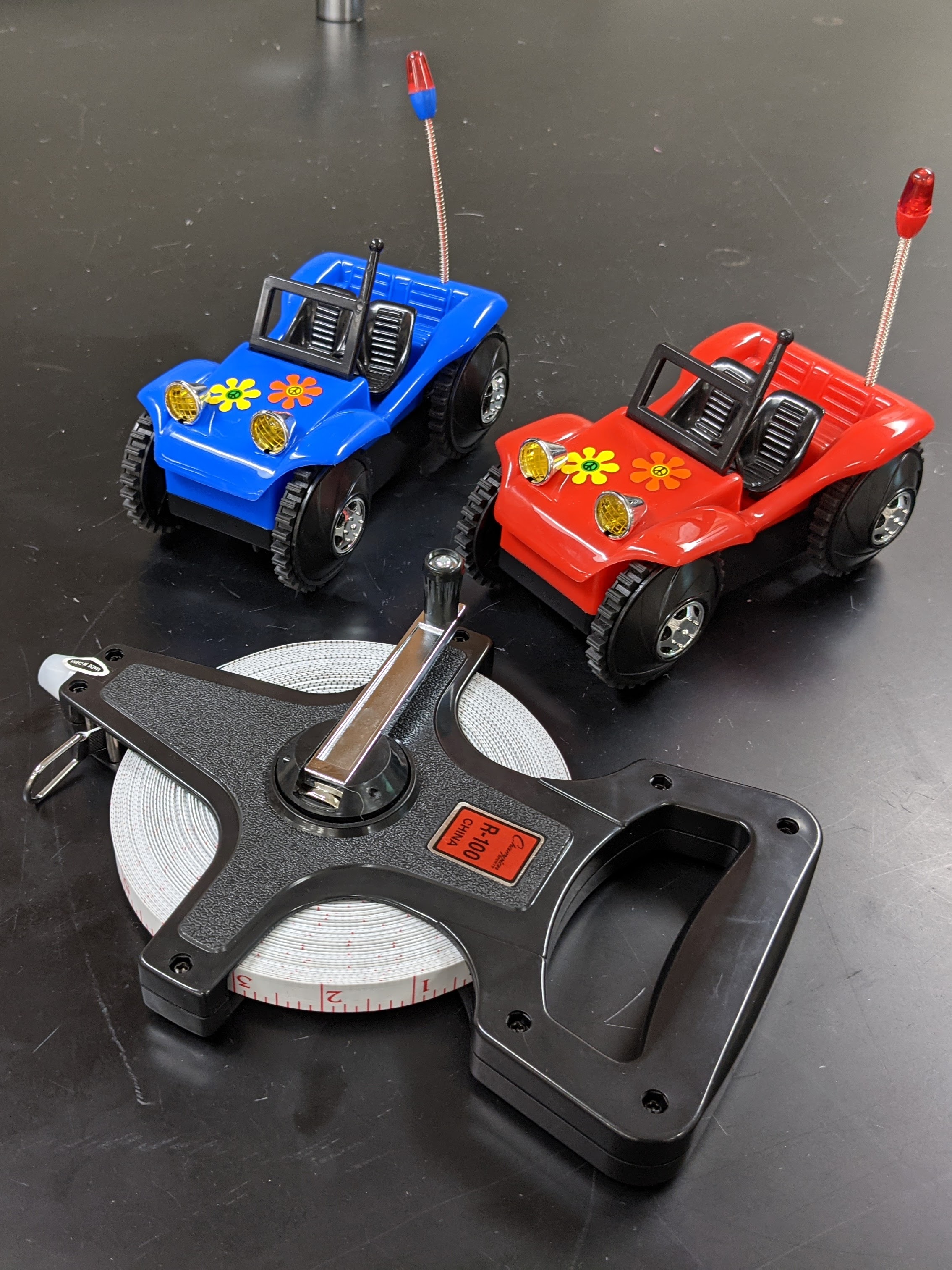
A red buggy and a blue buggy with a measuring tape.

This week, I also had a lot more conversations than usual with students who said they “aren’t a science person” or “aren’t good at science”. I suspect some of it is rooted in all the challenges of what science classes looked like last year, but that doesn’t make it any less important for me to address. I’ve been slow to start discussions of what skills groups needed to complete a task, but I need to make sure I’m making time for those. I also found myself telling students if their answers were right a lot more than usual in order to help them get some immediate confidence to keep them moving forward on problems, but the downside is it really limits the discussion students have once one of them knows they have the right answer. I need to figure out how I’m going to balance the need to keep the door open for student discussion with how I’m going to help students feel more confident in my classroom.

Days 1-5: Tumble Buggies

After a year away, I am back in the classroom this year, teaching Physics and AP Physics 1. This past week was our first week back. Between having been away for a year and the continuing dangers of COVID-19, I have been very nervous about going back to the classroom, but this week reminded me why I decided to come back. It felt so good to be in a classroom with a bunch of teenagers doing physics together.

This year, I convinced the other physics teacher we should skip a short “intro to physics” unit and we dove straight in to the buggy lab, so both my courses looked pretty similar. On the first day, students were just given the vague direction to make some kind of graph or chart on a whiteboard that modeled the motion of the buggy, then we talked about what was making it easy or hard to compare results across groups. Throughout the activity, I emphasized that the choices students made were correct and valid in the context of the activity, but I needed to do more as a facilitator to prepare them to compare across groups.

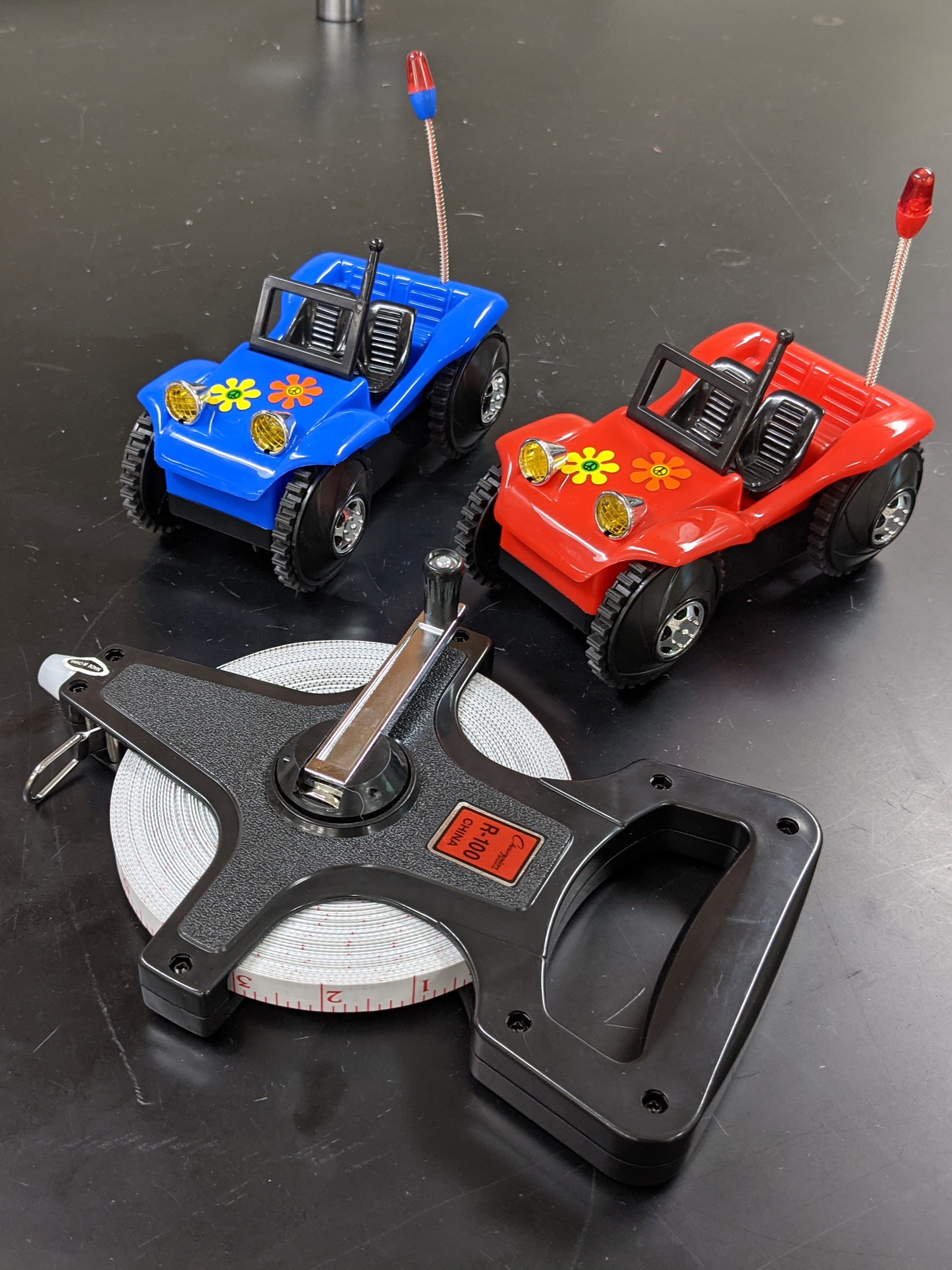
A blue tumble buggy and a red tumble buggy sitting next to a measuring tape

We then did a second round of buggy data collection with more structure. I also had students do a linear regression for their data and “translate” the resulting equation into physics by adding units and substituting variables that matched their experiment. Interestingly, for all of the rhetoric about learning loss and concern about the gaps students will have this year, this is the smoothest the “translation” has ever gone for me. Even better, my students were thinking about what their regression line actually meant without any prompting from me. I had several groups call me over concerned because they had already figured out on their own that their intercept should match their buggy’s starting position, but the two values were different by 5-10 cm, which meant I got to have some great conversations about uncertainty much earlier than usual. I also had a student who was struggling with adding units to her slope. As I was asking her questions to try to better understand what she was having trouble with, her face suddenly changed and she said “Oh! The units mean the slope is how many centimeters the buggy travels every second!” and I realized she wasn’t struggling with the mechanics of placing the unit in her equation, she was struggling because she knew a number with a unit needs to mean something, which is a fantastic reason to be struggling.

My classes have been quieter and more still than usual, even in the first week, but I’m guessing they are also feeling nervous and overwhelmed about being in a full classroom again. But given the sensemaking they are doing without any direct pushes from me, I think my classes this year are going to be pretty great as long as we all stay healthy.

Distance Learning Week 9

This week has been very hard. Many of the people in our school’s community are feeling the killing of George Floyd very deeply. Yesterday, the rioting extended into the neighborhoods surrounding my school. Many of the stores in town closed due to fears of looting and many of my students and colleagues could see smoke from their homes. My heart is breaking for everyone in my community who is afraid right now. But it is breaking even more for my black friends, students, and neighbors who once again have to reckon with a life lost to white supremacy and the reality of just how elusive anything resembling justice is. I’ve been thinking a lot about Martin Luther King Jr.’s words “A riot is the language of the unheard.” This is not a moment to criticize the protesters expressing their anger and fear; this is a moment for those of us with white privilege to listen to what has gone unheard and use our privilege to amplify that message and promote structural change.

AP Physics 1: Wrapping Up

Today is officially the last day of school for seniors. I left this week for students to finish any missing work and complete an end of year survey. A few students who’ve been struggling without the structure and connection come from being in the classroom were able to not only take the remaining assessments, but do well on them. Even under normal conditions, I consider whether a student learns the physics more important than when they learn the physics. I’m especially glad right now that students felt like they had the opportunities they needed to learn right now.

Physics: Wrapping Up

Today is the last day for this class, as well. Similar to AP Physics, we left this week for students to finish any missing work and do a short end-of-course survey. A lot of students let us know that they would have preferred more lecture and less groupwork, which suggests we have room to do better on building a good classroom culture and equipping students to be successful in physics.

Chemistry Essentials: Balancing Summative

This class is mostly juniors, which means next week is their time for catching up. This week, I had students submit their balancing chemical reactions summative. Only around a third of the class has submitted work for the module on balancing, so I’m not expecting to see very many assessments turned in. But I have seen a lot of students turning in old work this week. Consistent, personal contacts seem to be the most important thing in helping my chem kids make progress in the course. It’s been very time-consuming and draining, but it’s good to see it paying off.

Distance Learning Week 8

We’re nearing the end of the school year. Seniors finish on May 29, and we’ve been asked to finish instruction by today so that next week can be reserved for students to work on missing work and reassessments.

AP Physics 1: Wrap-Up

Rather than start anything significant after the AP exam, I decided to keep this week fairly easy. I asked students to fill out an end-of-course survey and posted a discussion board where they can share how their family is celebrating graduation. Based on the responses so far, the most useful questions I put on the survey are about what other teachers did during distance learning that helped students learn and helped them feel connected to their class. I’ve had very few conversations about teaching with other staff in my building during distance learning, so it’s been very helpful to hear what’s happening in other classes and identify some teachers who’s brains I need to pick. Assuming we have some distance learning next year, I want to ask my building leadership to figure out ways for teachers to do a better job of sharing with each other.

Physics: Spring Period Calculations

Students finished up a lab to figure out what affects the period of a spring. It was a little frustrating that, just like in the period vs. length graphs on pendulum lab, most students described their period vs. mass graphs as linear, even after recognizing the intercept should be zero. While I was frustrating, it isn’t surprising that students struggled here. When we’re face-to-face, most students usually describe their graph as linear, too, until someone brings up the intercept during the board meeting. I think there are two main issues leading to this.

First, even though we have a question on our standard lab packet about whether the intercept makes sense, we haven’t done a great job of helping students connect the expected intercept to the shape of the graph. As a result, students treat questions about the intercept as completely separate from questions about the shape. Face-to-face, even if kids aren’t ready to make that connection independently, the conversation during the board meeting gets everyone there. I think I could make better use of discussion boards to get something similar in an online environment.

Second, we don’t talk much about uncertainty in this course, so students have trouble deciding whether an intercept is big enough to matter. At the start of the year, I see students giving a lot of weight to very small intercepts and, by the end of the year, I see the opposite with students quick to say fairly large intercepts are effectively zero. I think it would help if we incorporated some very basic uncertainty next year. One option may be to have students estimate how far they may be off on measurements on the vertical axis, then compare that to the intercept they get.

Chemistry Essentials: Balancing Practice

Students continued working on balancing chemical reactions by doing another set of practice problems, this time including some formulas with polyatomic ions. I haven’t heard from any kids with questions this week, so I assume it’s going smoothly. I’m focusing a lot of my time on students who haven’t been engaging in the course, and have gotten a few of the kids who weren’t on track to get a credit to turn some things in. Today is the last round of parent phone calls, so hopefully I can help a few more kids get on track to at least pass the class.