Day 133: Goal-less Problem, Forces Revisited, &

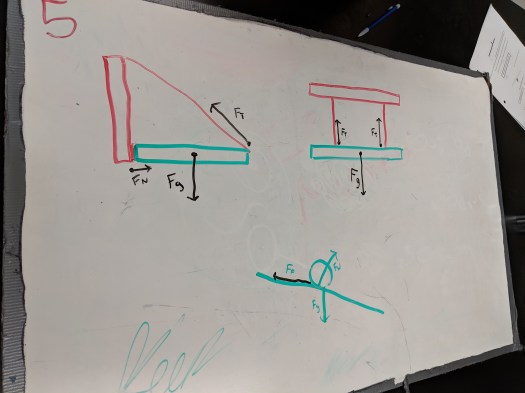
AP Physics 1: Goal-less Problem

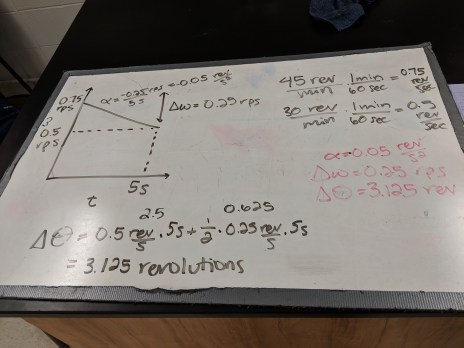
We started with some mistakes whiteboarding of yesterday’s problems, which went very quickly and smoothly thanks to the connections my students were making to linear motion. Afterward, I gave them a goal-less problem for accelerated circular motion, and those connections continued to serve students well
AP goal less.jpg

Physics: Forces Revisited

We’d originally planned on taking a few days to close out the mechanics part of the course after oscillating springs, but the other physics teacher and I both forgot. Now that we’ve done what we’re going to with mechanical waves, we decided now would be a good time. Students worked on some problems revisiting the links between force, motion and other concepts from this year. There was lots of good discussion as they worked.

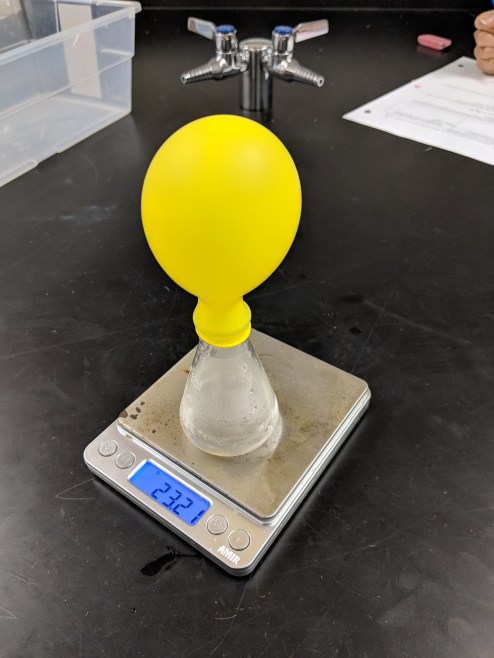
Chemistry Essentials: Gallery Walk

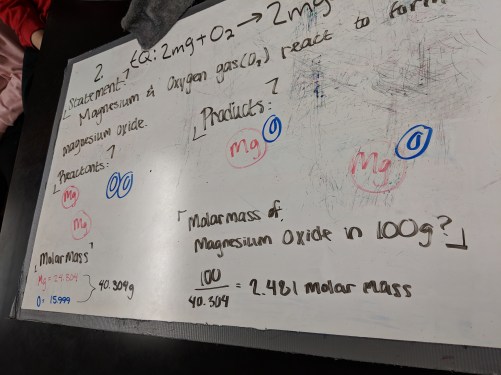
We did a gallery walk of some stoichiometry problems. Students have been doing well with the problems and seem to understand WHY they are doing the math they are, which I’m really excited about. I’m thinking about switching to BCA tables in the future; I need to spend some time trying problems with them. We’ll be starting work on some curriculum revisions for the course next year, and that might be a good time to take a closer look.
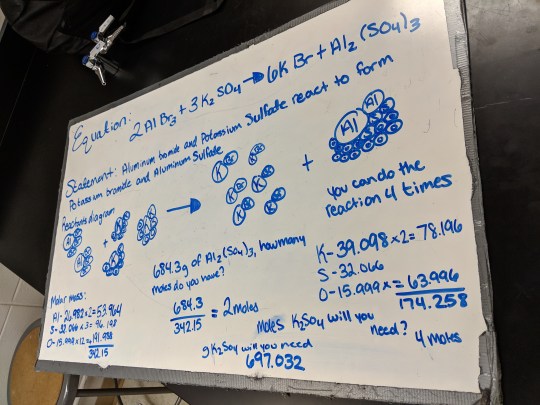
chem gallery (1).jpg

Day 132: Angular Motion Representations, Whiteboarding, & Stoich Problems

AP Physics 1: Angular Motion Representations

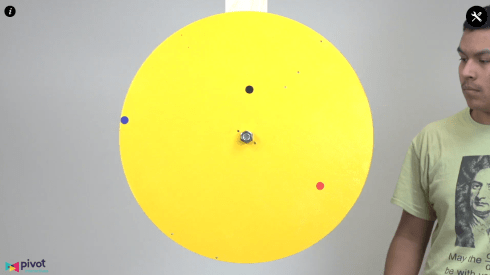
We started by discussing yesterday’s activity to introduce angular velocity; there was some great debate about which dot on the disk was moving the fastest, which lead exactly where I wanted it to. Afterward, students worked on some problems translating between different representations of angular motion. Students fell very easily back into the kind of thinking we’d done with linear motion, which made the problems a breeze.

Physics: Whiteboarding

We finished going over the standing wave problems and took a quiz on the topic.

Chemistry Essentials: Stoichiometry Problems

Students worked some stoichiometry problems that included polyatomic ions. Most students are doing very well with the problems, which has me very optimistic about tomorrow’s quiz.

Day 131: Pivot Angular Motion, Whiteboarding, & Pivot Stoich

I am a part of the Pivot Interactive’s Chemistry Fellows program.

AP Physics 1: Pivot Interactives Angular Motion

As students finished their torque quiz, I had them use Pivot Interactives to look at the motion of a spinning disk and come up with two different answers to which dot on a spinning disk is moving the fastest. Tomorrow, we’ll use those two answers to get into angular velocity vs. tangential velocity.Pivot angular.PNG

Physics: Whiteboarding

We spent some time whiteboarding yesterday’s problems. Students resisted drawing the diagrams for standing waves, but, once they got the diagrams, they were able to solve the problems.

Chemistry Essentials: Pivot Interactives Stoichiometry

Students used Pivot Interactives to compare their prediction for how much hydrogen gas should be produced in a reaction to how much was actually produced. I ran into an issue where a few students were very insistent that a prediction is a guess, so their calculation could not be a prediction. I didn’t have a great response in the moment aside from in science, a prediction should have something to back it up, which can be a calculation.

Another hurdle I ran into today is I have one section where a lot of students really resist talking to their group members, and the computers made it easier for them to work in isolation. As a result, I realized partway through the hour I was frequently answering the same questions multiple times with a given group and I was helping individual students with portions of the activity their partners knew how to do. I need think about how I can help my students have more productive collaboration within their group.

Pivot stoich.PNG

Day 130: Whiteboarding, Problems, & Lab

AP Physics 1: Whiteboarding

We did some whiteboarding of last week’s torque problems. Students aren’t confident, but they are getting the hang of extended free-body diagrams and successfully solving problems. With the clock ticking, that will have to be good enough for balanced torques.

AP wb.jpg

Physics: Problems

Students did some problems with standing waves. It was tricky for a lot of them to connect the wavelength to the length of the resonator, so that will be something to work on during whiteboarding tomorrow.

Chemistry Essentials: Lab

Students did a lab with magnesium and hydrochloric acid. We stuck with purely qualitative observations today and will get into the actual stoich tomorrow.

chem lab.jpg

Day 129: Problems, Standing Waves, & Problems

AP Physics 1: Torque Problems

I was much more teacher-directed today than I typically shoot for. I ended up walking students through how to approach balanced torque problems; students were pretty into the idea that they can pick a pivot point for the problem that lets them solve for different quantities. We had a few minutes at the end for some whiteboarding. While students aren’t confident yet, I think they are doing just fine on balanced torques.

Physics: Standing Waves

We went through a guided discussion to get at the patterns for standing waves using first a wave generator with a string, then a singing rod, and ending with a tuning fork. When there were some good points for small group discussion, I had students work in their packets, but I think it would have been better to have them use whiteboards.

Chemistry Essentials: Stoichiometry Problems

Students worked some stoichiometry problems. We stuck to whole number ratios so students could draw particle diagrams as a tool to work through the problems.

Day 128: Problems, Tuning Forks, & Stoichiometry

I was on a field trip today, so had a sub.

AP Physics 1: Balanced Torque Problems

Students worked some problems with balanced torques. I wish I’d edited the worksheet to include some problems revisiting forces, but ran out of time last week. I’ll be interested to see if and how my students used the area model I showed them yesterday.

Physics: Tuning Forks

Students did a lab playing with tuning forks to start building some ideas about sound waves. There’s usually some good discussion that I’m a little sorry I missed.

Chemistry Essentials: Stoichiometry

Students started doing stoichiometry by using nuts, bolts, and washers to represent different types of atoms, making it possible for them to “see” how many moles they have and measure the masses very directly.

Day 127: Board Meeting, Slinkys, & Molar Mass

AP Physics 1: Torque Board Meeting

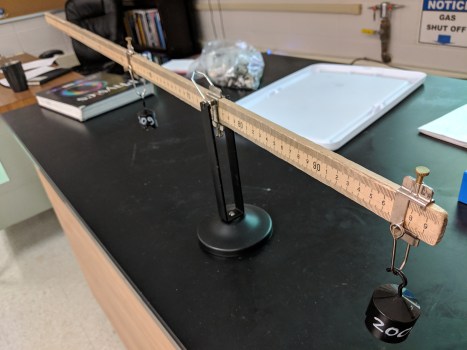
We had our board meeting to get to the definition of torque. As expected, in the class where I had students plot the ratio of the forces on one axis and the ratio of the radii on the other, results were rough and I had to step in. In my other section, results came out beautifully and students were quick to figure out why their graphs had intercepts. I also introduced students to Brian Frank’s area models for torque, which students seemed to grasp.

ap lever board.jpg

Physics: Slinkys

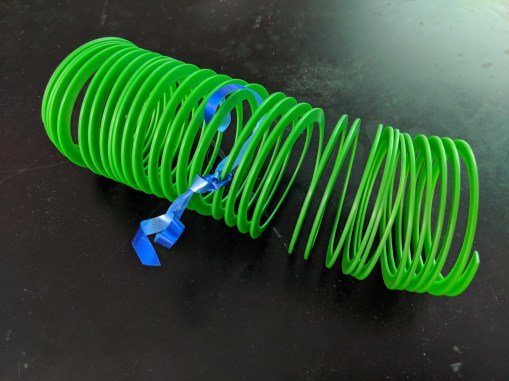
We used slinkys to start figuring out some ideas about longitudinal waves. Students were pretty successful at noticing the things I wanted them to notice. As with transverse waves, we tied some ribbons on the spring to help track the particle motion.

slinky.jpg

Chemistry Essentials: Molar Mass Lab

I got out samples of several different materials, and had students weigh a sample and figure out how many moles they had. Not the most dramatic lab, but it was some good practice.

Day 126: Levers & Whiteboarding

AP Physics 1: Levers

Students did a lab with levers to introduce torque. I usually take 3-4 days on lever labs, so tried to shorten it. In my 2nd hour, I had students graph the ratio of the forces on one axis and the ratio of the radii on the other; the results so far are looking messy, so I think I tried to accomplish too much with that approach. In my other section, I had half the class keep the positions constant and graph the two forces, while the other half of the class keep the forces constant and graphed the distances from the pivot. The results are looking really nice, so I think that was a better abbreviation.

ap lever.jpg

Physics: Whiteboarding

We whiteboarded and discussed a couple of wave problems from TIPERs. Students seemed to find the problems pretty straightforward.

Chemistry Essentials: Gallery Walk

We did a gallery walk to go over Friday’s problems that combined balancing with molar mass. Students are starting to be able to shift away from the blocks we’ve been using for balancing and rely more on their particle diagrams, which is great to see.

chem gallery.jpg

Day 125: Assessment & Problems

AP Physics 1: Assessment

Students took their central net force quiz. Most seemed to feel pretty good about it, even though we moved through the content quickly.

Physics: Wave Problems

Students worked on problems using what we’ve learned this week. The problems went very smoothly.

Chemistry Essentials: Molar Mass Problems

Students worked on some problems combining molar mass with balancing chemical reactions.

Day 124: Gallery Walk, Board Meeting, & Mistakes Whiteboarding

AP Physics 1: Gallery Walk

Students did a gallery walk of some problems dealing with central net force and universal gravitation. There was a lot of good discussion as students worked on their problem, but I’m not sure how much students looked at the other problems.

Physics: Board Meeting

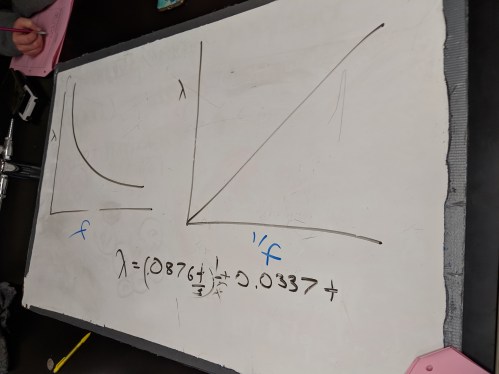
We had a board meeting for the snakey spring lab looking for a relationship between wavelength and frequency.

phys wb

This group used floor tiles as their distance measurement

Chemistry Essentials: Mistakes Whiteboarding

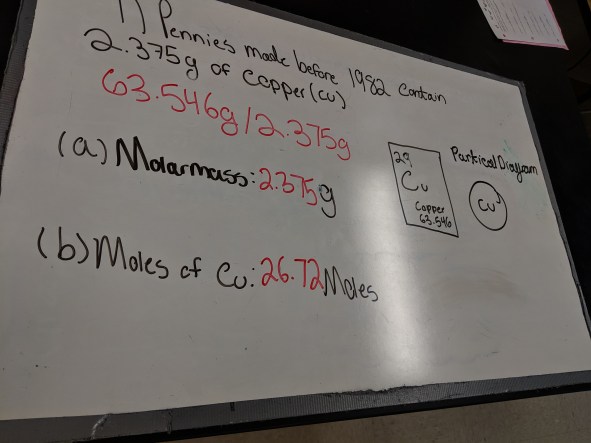
Students worked some problems translating between molar mass and moles of a substance, then did some mistakes whiteboarding to go over the problems.

chem molar mistake.jpg