Day 143: Model Summaries, Reflection Lab, & Reading

AP Physics 1: Model Summaries

My favorite dedicated review activity is model summaries, where students whiteboard key diagrams and formulas for each model. Students have those diagrams in their toolkits, so today was mostly about reminding students to use them and reassuring them they know how to use these tools.

IMG_20190503_114029.jpg

Physics: Reflection Lab

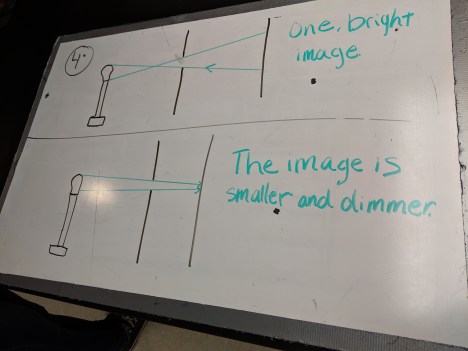
Students collected data for a relationship between the incident angle and reflected angle in a mirror. We did the pre-lab discussion yesterday, and I did have to get ornery about reminding students to go back to their notes from that discussion to get started, but the lab went very smoothly from there. We’d bought some laser pointers a year or two ago, so I had students use those instead of pins in cardboard, and I really like that students could see the light rays directly.

reflection lab.jpg

Chemistry Essentials: Reaction Types Reading

I’ve got some ideas for a card sort to introduce reaction types, but ran out of time to put something together and went back to a reading in our textbook. I had students write definitions for each reaction type using both the textbook language and their own words and I had students come up with their own larger categories for the reaction types, both of which lead to some good discussion.

Day 142: Assessment, Reflection Lab, & Backwards Problem

AP Physics 1: Assessment

Students took their quiz over angular momentum, and we have now officially finished content. Wooo! 2 class days to spare!

Physics: Reflection Lab

We got out the geo mirrors and some plane mirrors to start exploring reflection. I like to start each optics topic with a lab making qualitative observations. The instructions I gave students today need some work; students had trouble parsing the wording to make meaningful observations.

reflection2

Chemistry Essentials: Backwards Problem

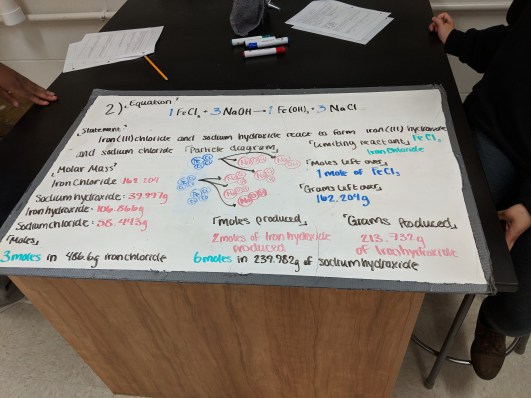
As a quick warm-up before taking the limiting reactants quiz, I had students whiteboard what I called a backwards problem. I gave them a reaction and told them what should be the limiting reactant, then had them sketch a particle diagram for a situation showing starting conditions that would lead to the right limiting reactant.

A few kids were feeling stressed out about this quiz, so we also took a few minutes to revisit the reassessment policy, including the fact that I’m putting retakes into our normal assessment process, which helped lower the stakes and let students feel a little calmer about the quiz.

chem backwards prob.jpg

Day 141: Free Response, Quiz, & Limiting Reactants Lab

AP Physics 1: Free Response

We worked a few released free response problems related to angular momentum. I also set up a couple of angular momentum demos, including a spinning Hoberman sphere. Students seem to be grasping the big ideas, which is good since we only have a few more class days before the AP exam!


Physics: Quiz

Students compelted a groupwork reflection, then took their quiz on ray diagrams for shadows and pinholes. I’ve only glanced at their work, but I’m pleased with how the quizzes look.

Chemistry Essentials: Limiting Reactants Lab

Students did a reaction with copper chloride hydrate and aluminum. I had different groups use different quantities so that the limiting reactant varied by group; students were really intrigued by the stark differences in some of the finished reactions. Students did very well using “for every” statements to do stoichiometry when the particle diagrams don’t work. I am glad I introduced the statements yesterday with Pivot; I think starting that skill without having to worry about good lab technique helped it sink in better.

chem limiting (3).jpg

Day 140: Whiteboarding & Pivot Limiting Reactants

AP Physics 1: Board Meeting

Students whiteboarded their results from yesterday to get to a definition of angular momentum, as well as the relationship between torque and angular momentum. They made nice connections to conservation of linear momentum as well as impulse.

Physics: Ray Diagram Mistakes

We did mistakes whiteboarding with yesterday’s ray diagram problems. Students were doing very well figuring out which rays were critical to the problem and catching each other’s mistakes.

physics Ray mistake.jpg

Chemistry Essentials: Pivot Limiting Reactants

I am as part of Pivot Interactive’s Chemistry Fellows program.

Students used Pivot Interactives to do a lab involving limiting reactants. Since lab data makes it tough to use particle diagrams, I tried having students convert their balanced reaction equation into “for every” statements. A lot of them were pretty successful using those statements to make sense of the other calculations I asked for.
pivot limiting.PNG

Day 139: Angular Momentum, Ray Diagrams, & Limiting Reactants

AP Physics 1: Angular Momentum

I am as part of Pivot Interactive’s Chemistry Fellows program.

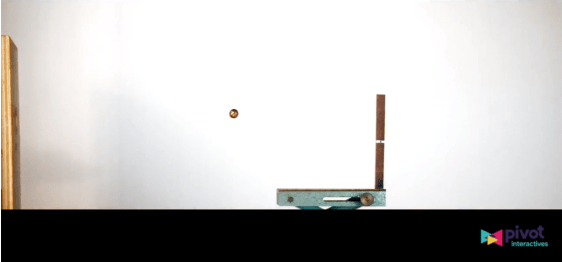
Students used Pivot Interactives to explore collisions that involve angular momentum. I especially like the activity they have with a marble fired at a wood block since it provides an opportunity to review linear momentum, as well as discover a relationship between torque and angular momentum.

Pivot rot collision.PNG

Physics: Ray Diagrams

Students sketched ray diagrams to explain their observations in Friday’s lab. Students were able to make good connections between their ray diagrams and their observations.

physics ray (1).jpg

Chemistry Essentials: Limiting Reactants

Students whiteboarded some limiting reactant problems, emphasizing the particle diagrams that could be used to solve the problems.

chem limiting (2).jpg

Day 138: Multiple Choice, Pinholes, & More Limiting Reactants

AP Physics 1: Multiple Choice

After a short quiz, we used Plickers to review some multiple choice. There was a lot of good discussion about the problems and some good test-taking strategies also came out of the conversations.

Physics: Pinholes

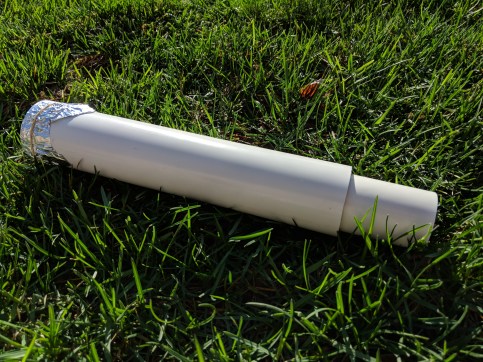
Students made observations and dew ray diagrams for some pinhole viewers. They had some trouble getting images at first, but, once they got the hang of it, seemed to enjoy the lab. It was a nice, sunny morning, so we went out the back door of my classroom to look at things, but it was also chilly, so most students went back inside when they were drawing ray diagrams.

pinhole viewer.jpg

Chemistry Essentials: More Limiting Reactants

Students did some limiting reactant problems involving polyatomic ions. All of the problems were ones that could be solved by drawing a particle diagram, and students seem to be embracing those as a problem-solving tool.

Day 137: Lots of Whiteboarding

AP Physics 1: Unbalanced Torque Whiteboarding

We did some mistakes whiteboarding with some torque problems. Students made great connections to what they already know about unbalanced forces, which is making it possible to move quickly through the topic.

AP torque mistake.jpg

Physics: Ray Diagram Whiteboarding

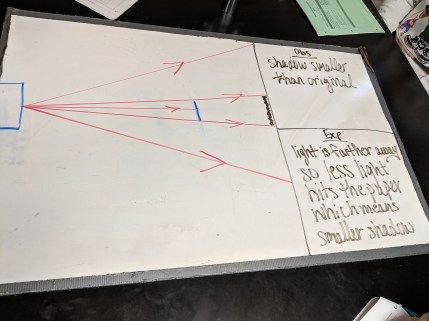
Students whiteboarded some ray diagrams from yesterday’s shadow lab. They made the connections I wanted them to make and were making sense of how the ray diagrams fit with what they saw.

physics ray.jpg

Chemistry Essentials: Limiting Reactant Whiteboarding

We did some whiteboarding of limiting reactant problems emphasizing the particle diagrams as a problem-solving tool. I haven’t pushed the diagrams as much this year as in the past, and it showed on a quiz I graded earlier today. Now is time to start rectifying that mistake!

chem limiting (1).jpg

Day 136: Board Meeting, Shadows, & Limiting Reactants

AP Physics 1: Unbalanced Torque Board Meeting

Students whiteboarded their results from yesterday. They quickly and easily made the connections I was after and the idea of rotational interia seemed to click well.

AP torque.jpg

Physics: Shadows

I did a quick intro to ray diagrams. I like to clap some chalk dust over the beam from a laser pointer to show the light travels in a straight line. This year, I followed up with clapping chalk dust over a flashlight beam to see the cone of light and motivate drawing multiple rays, which worked very nicely. Students then played with shadows and drew ray diagrams to explain their observations.

Chemistry Essentials: Limiting Reactants

Students worked on some limiting reactant problems. Based on some questions students asked yesterday, we also revisited a reaction we’ve done with magnesium and hydrochloric acid. I set up one flask with indicator and hydrochloric acid to use as a reference. In the other two flasks, I also added magnesium and tasked students with making observations to determine what the limiting reactant was in flasks 2 and 3, which they answered using a CER.

chem limiting 2.jpg

Day 135: Pivot Angular Acceleration, FCI, & Limiting Reactants

AP Physics 1: Pivot Angular Acceleration

I am as part of Pivot Interactive’s Chemistry Fellows program.

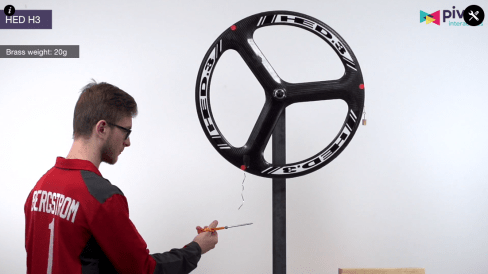
Students used Pivot Interactives to find a relationship between unbalanced torque and angular momentum for several different bicycle wheels. I had them start by setting up a formula they could use to calculate the angular acceleration from the change in angular position and the time. My 2nd hour had a much easier time with this; I think the difference is they worked yesterday’s problems in small groups and quickly connected this task to some of the problems they’d done. My 4th hour had a sub yesterday who was a former physics teacher that decided to go through the problems as a lecture, so I think those students didn’t have as firm a grasp on the calculations.

pivot unbalanced torque.PNG

Physics: FCI

Students took the Force Concept Inventory as a post-test. We normally give it before moving into simple harmonic motion, so they were a little rusty on thinking with forces, but I’m satisfied with the results.

Chemistry Essentials: Limiting Reactants

Students used nuts, bolts, and washers to start connecting mass to what I’d planned for them to see about limiting reactants yesterday. While both my sections were able to get through today’s activity without trouble, I need to figure out how to adjust for some issues yesterday. My 5th hour is co-taught, so my co-teacher ran the class and the majority of students easily finished yesterday’s activity and had the ideas I wanted them to have at this point. In my 6th hour, the sub decided to go over the answers to the accompanying worksheet as a lecture without projecting the simulation, which my students really struggled to follow. Several students helped themselves to a computer and worked through the activity as intended, and I’m having trouble getting mad at them for defying the sub. I think the activity with the simulation is worth doing, but between demand for the school computers and trying to keep both sections in the same place, I’m not sure how to give my 6th hour time in-class.

limiting.jpg

Day 134: Problems, Mistakes Whiteboarding, & PhET Limiting Reactants

I had a sub for half the day today, so only saw two of my sections.

AP Physics 1: Problems

Students worked on some problems with angular acceleration. I was at school for my smaller section, and the problems went very smoothly. They worked very independently and I overheard a lot of great discussion and connections to linear motion.

Physics: Mistakes Whiteboarding

I was at school for my only section, so we did some mistakes whiteboarding with Thursday’s problems. Students had some great mistakes and great discussion about the problems. One of the interesting things is when students were asked to sketch a v-t graph and divide it into sections, most groups did before, during, and after, mirroring the way we’d used velocity vs. time graphs during momentum transfer (inspired by Brian Frank). Asking them to tell me about what was happening to the box during each phase was pretty effective at shifting them.

physics fbd mistake.jpg

Chemistry Essentials: PhET Limiting Reactants

I was gone for both sections of this class, so it was a great day for students to use PhET to introduce limiting reactants. My co-teacher sent me a message that the kids who got started got the ideas pretty quickly, but a lot had trouble getting started. The para who supports the class was also out today, so I think some students felt like they didn’t have the support they needed; I need to keep working on how to support my chem students in developing independence in the classroom.

phet limiting.png