Day 169: Final Review

Chemistry: Final Review

Friday was the last day of school for seniors, so this week I only have my chemistry class and about one-third of those students are done. The remaining students started working on their final review, which is essentially reworking problems from this trimester’s assessments. I was a little concerned that students would check out since several pushed back pretty vocally when I gave them a task on senior skip day, but they worked pretty well today.

Day 168: Final Exam & Radiation Dose

Physics: Final Exam

Today is the last day of school for seniors, so we finished the final exam. For the lab practicals, students completed four stations, one for each of the major topics we covered this trimester. Students worked individually and had about 10 minutes at each station.


Chemistry: Radiation Dose

Students used some information from the Department of Energy to calculate their average dose of radiation in a year, then we took the assessment on nuclear reactions. A little less than a third of my class is seniors; to keep things simple, I decided to excuse those students from the final and make today’s quiz the last entry in their grades.

Day 167: Final Exam & Nuclear Reactions

Physics: Final Exam Part 1

We decided to give two parts to the final exam; a set of lab practicals and the Classroom Test of Scientific Reasoning, which they took as a pre-test way back in September. Half the class worked on each portion today, and tomorrow they’ll switch. I had students submit their answers to the CTSR on a Google Form. Based on the very preliminary results, the class average has gone up about 1.5 points, which I’m pretty happy to see.

IMG_1942

Chemistry: More Nuclear Reactions

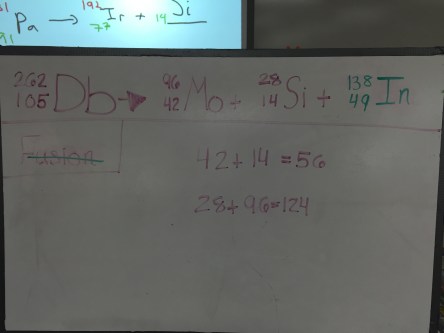
Today, I introduced students to alpha and beta decay, then had them start write nuclear reaction equations based on partial statements.

Day 166: Random Presenter & Mistakes Game

Physics: Random Presenter

I had each lab group whiteboard and present their solution to one of the lab practical stations. I assigned which practical each group would present so I could make sure we saw all four stations. I also, when possible, tried to pick groups that used different approaches, like the two groups in the photo who had to find the mass of some washers using a known mass, a spring, a ruler, and a stopwatch. In one of my classes, I tried rolling a dice to decide who would talk on behalf of the group, and I saw some students who tend to let someone else in their group figure things out really engaging to make sure they knew enough to present if picked. I need to use this strategy more often.


Chemistry: Mistakes Game

Students worked on writing equations for nuclear reactions, then we played the mistakes game with some problems.

IMG_1930

Day 165: Final Review & Isotopes

Physics: Final Review

Students continued working through the lab practicals to review for the final exam. Overall, I’m pretty happy with how the review has been doing, though a lot of groups were confused about what they were being asked to do on the standing waves practical. I need to revise the directions to make it clearer that they should calculate the length of the tube needed to resonate, then use the materials to test it.


Chemistry: Isotopes

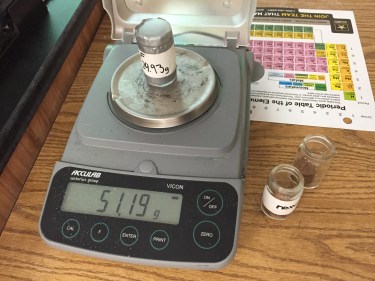
Students used what they know about isotopes to determine how many pennies in a sealed container were made before 1982 vs. after. They struggled to make the connection between the lab and what we’ve done so far on isotopes, so I need to make some changes to help students better build that link.

IMG_1916

Day 164: Senior Skip Day & Half Life Whiteboarding

Physics: Senior Skip Day

Today was the unofficial senior skip day, so I had less than a third of my students in class. I normally limit students to two reassessments per week, but gave students who were in class today an opportunity to do some additional reassessments. A few came to my class just to take advantage of that. A couple of students who were in school so they could play in a baseball game this weekend asked if they could work on the final review.

Chemistry: Half Life Whiteboarding

Only a few of my students in chemistry are seniors, so we continued as usual. Students finished the problems from yesterday and whiteboarded their solutions. I got some pushback from a few students who were very vocal about their opinion that if the seniors are gone, they shouldn’t have to work on chemistry. This may make the last week of school tough since seniors are dismissed a week early, so I need to start thinking about how I will keep my juniors motivated.

IMG_1905

Day 163: Final Review & Half Life Data Analysis

Physics: Final Review

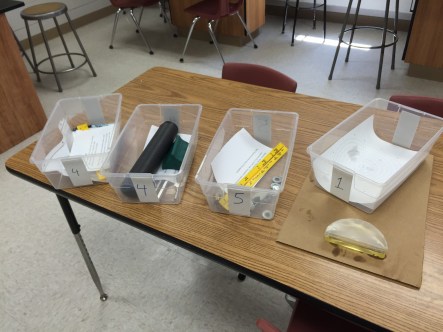
Students started reviewing for next week’s final exam. I put together a lab practical for each of the four major topics from this trimester, and groups can pick and chose which ones they complete.

  • Simple Harmonic Motion: Given a 50 g mass, spring, ruler, and stopwatch, find the mass of a set of washers.
  • Mechanical Waves: Predict what length an adjustable tube needs to be for a given tuning fork to resonate when (a) both ends are open and (b) one end is plugged.
  • Reflection: Given the placement of a laser pointer and a target, use at least three mirrors to direct the beam to the target.
  • Refraction: Determine the index of refraction of oil.

There was a lot of demand for the simple harmonic motion and mechanical waves practicals since those were the oldest content. I’d prepared three sets of equipment for each practical, and ended up putting together a few more simple harmonic motion sets during my largest class, especially since they just did the index of refraction task for water yesterday.
IMG_1901

Chemistry: Half Life Data Analysis

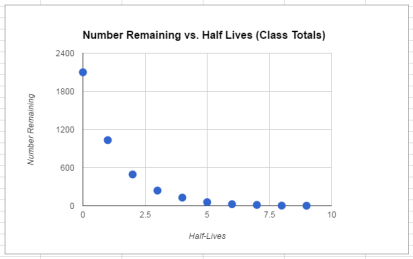
Students graphed their half life data from yesterday, then we compared their results to their predictions and the class totals, including data from previous years. We had some good conversation about the role randomness plays in the lab and why its useful to have data that relies on thousands of pennies, rather than just the 100 students had.
half life class data

Day 162: Snell’s Law & Half Life

Physics: Snell’s Law

I got out the refraction dishes and showed students how to use them to find a refracted angle. Then, I asked them to get me a graph where the slope is the index of refraction of water. This is the first time I asked students to start with an equation (in this case, Snell’s law) and pick their axes to get a certain value as the slope, but they were pretty successful.

IMG_1899

Chemistry: Half Life

Students measured the “decay” of pennies by shaking them up, then setting aside any that came up tails. Each group make a graph of pennies remaining vs. half lives and submitted their results via a Google Form so we could produce a graph of the class average. Tomorrow, we’ll use that to have some conversations about randomness.

Day 160: Lens Misconceptions & Solubility

Physics: Lens Misconceptions 

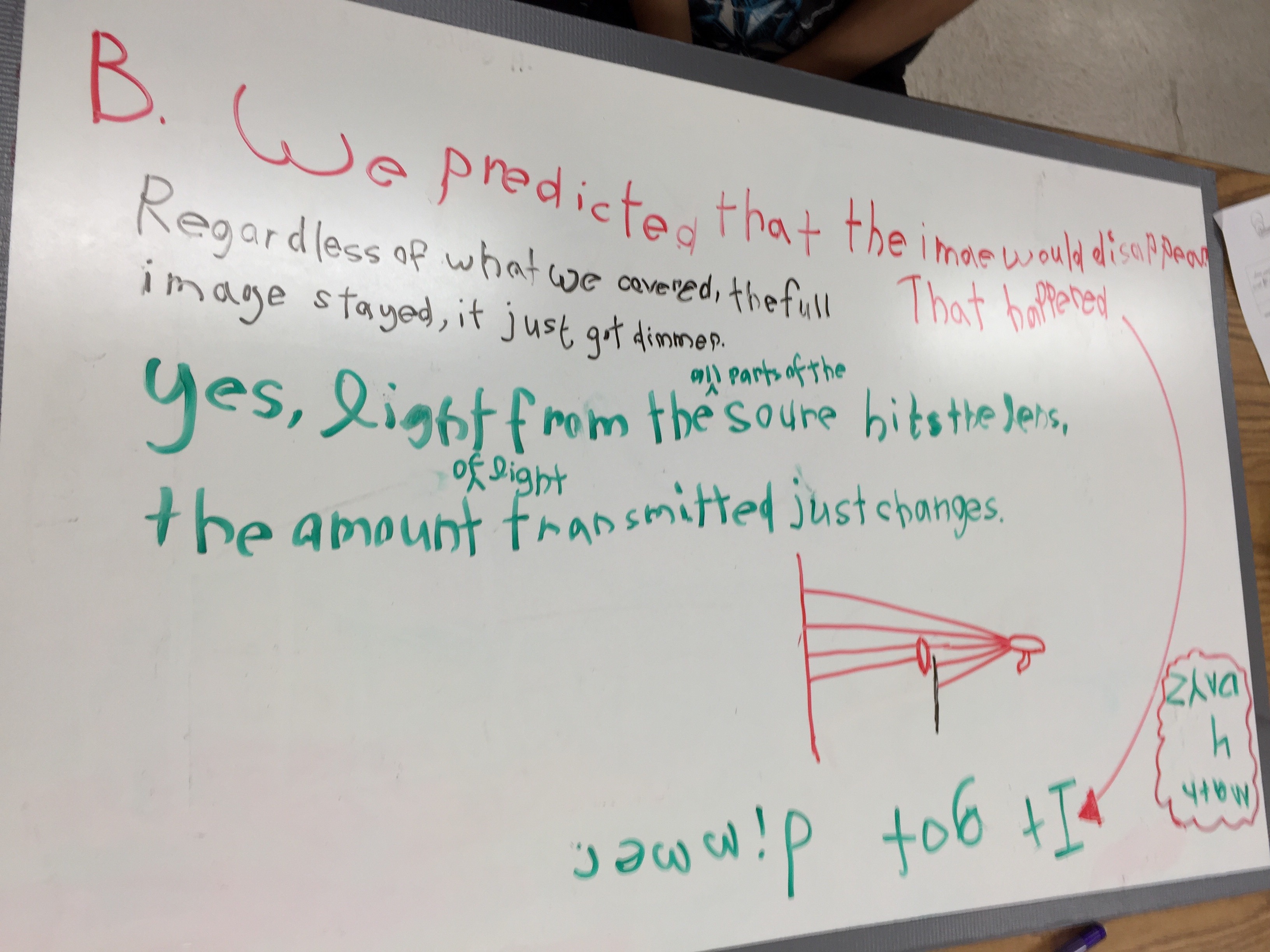
Students whiteboarded and discussed the results of Friday’s lab. I’m always intrigued by the conversations about the image formed when part of the lens is covered up. Students consistently express the common misconception that blocking the lens will block part or all of the image with very little analysis of that idea. Once they saw the full image, however, they quickly and easily made connections to partially covered mirrors to declare a dimmer, but whole image is exactly what they should see. Without the unexpected observations in the lab, my students felt no need to consider related observations or apply tools like ray diagrams to challenge their ideas. I know this is exactly how misconceptions tend to play out (Derek Mueller’s video on Newton’s 3rd law is a great example), but there’s seeing this process happen always fascinates me.

Chemistry: Solubility

Students did a simple solubility lab where they measured how much sugar could be dissolved in water at different temperatures.