Day 27: Elevators & Turbine Interference

AP Physics: Elevators

I showed students a video I made riding the elevator with a balance and asked them to determine whether the elevator was going up or going down and support their answer with free-body diagrams. I was pleased with how many groups started their conversation with “What’s our system?” I could tell from the conversations that a lot of students are still not entirely solid on the idea that an acceleration can be in the opposite direction of the motion, but thinking about the bowling ball lab from a few days ago seems to be helping. Next year, I want to do a better job of using the change in velocity arrows that show up in Etkina to help solidify the direction of acceleration.


Earth Science: Turbine Interference

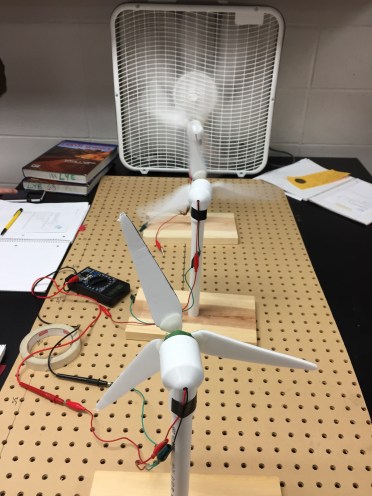
In the next step towards designing a wind farm, students experimented with several turbines, comparing the amperage produced with different arrangements. This lab got my students asking some great questions that had me wishing that the trimester on physics came first rather than second this year. A lot wanted to know why the last turbine in a line wasn’t spinning, which is easy to explain with conservation of energy. A few others wanted to know what’s inside the turbine, which fits great with the build-a-motor lab we do in 9th grade physics. When we work on next year’s schedule, I’ll make sure to advocate for physics-earth-earth rather than this year’s earth-physics-earth sequence.
img_2336

Day 26: Defining Systems & Topography

AP Physics: Defining Systems

We played the mistakes game with yesterday’s free-body diagrams. In both my hours, there was some great discussion about a problem with a skydiver attached to a parachute and whether the upward force should be a tension force from the straps of the parachute or a normal force from the air on the parachute, which lead beautifully into the importance of defining your system.

IMG_2328.JPG

Earth Science: Topography & Wind

As the next stage of their project to plan a wind farm, students built a simple “topography” using textbooks and used simple flags to make observations about how that impacted wind speeds. Afterwards, students tried placing a turbine at some of the locations where they’d left flags and measuring the current produced.

img_2324

Day 25: FBDs & Wind Maps

AP Physics: Free-Body Diagrams

I gave a short lecture on the types of forces, then had students work on drawing some free-body diagrams. I’m being really picky about including the interaction when labeling forces this year (i.e. Fg (Earth on object)) which I’m hoping will pay off in deciding whether a force should be there as well as with the 3rd law. There were some great conversations about which forces need to be accounted for as well as what causes an object to move forward after the force is done.

Earth Science: Wind Maps

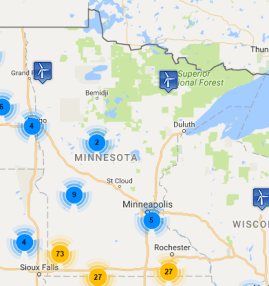
Students used some maps to look for a relationship between average wind speeds and topography. Then, they picked what locations in Minnesota might make sense for a wind farm. This lead to some good conversations about trade-offs in engineering, such as why  there are some wind farms near big cities, even in parts of the state with relatively slow average wind speeds.

wind-turbine-map

Day 24: Bowling Balls & Problem Scoping

AP Physics: Bowling Balls

Students did a lab I borrowed from Frank Noschese hitting bowling balls with rubber mallets to look for a relationship between force and acceleration. I really like the conversations that happen when students are working out how to get a bowling ball to move at a constant velocity. When one group was wondering how to check, we ended up pulling out the Motion Shot app to make a motion map. Another group decided they needed to use gentle forward taps to maintain the constant velocity combined with even gentler backwards taps to counteract the forward ones; as they made their taps gentler and gentler, they eventually realized they could do away with them entirely. My 4th hour also got very excited about balancing things on their bowling balls.


Earth Science: Problem Scoping

On Thursday, students only had time to answer the problem scoping questions individually. Today, I had them answer the questions with their lab groups using a different colored pencil to differentiate individual ideas from group ideas. After that, we discussed as a class what kinds of things students will need to know for the engineering design challenge, which lead nicely into introducing and previewing the learning targets for the unit.

Day 23: Test & Problem Scoping

AP Physics: Test

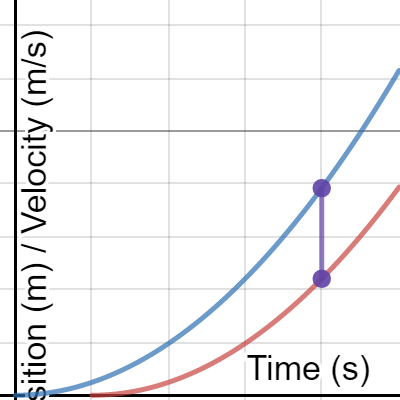
I use standards-based grading and this year, I’m giving each student two scores on each standard. What I’m calling the tier 1 score is from an assessment similar to what I gave in honors physics and the tier 2 score is from a full-period test with problems modeled on the AP Physics 1 exam. Today was the first tier 2 test. I’m not very focused today, so I spent too much time playing with a solution I made in Desmos to one of the multiple choice problems.

Earth Science: Problem Scoping

We’re starting a unit on wind that includes an engineering design challenge to plan a wind farm, so I decided to take a project-based learning approach to this unit. Today, I introduced the design challenge using a problem scoping process I picked up at EngrTEAMS. Students read a short memo from our “client”, then wrote individual answers to some questions about the specifics of the design challenge. We ran out of time for students to meet with their groups, so on Monday, they’ll share those answers in their groups and record a group answer in their notebook alongside the individual answers.

Day 22: Wrap-Up & Review

AP Physics: Lots of Wrap-Up

Today was a lot of wrapping things up. We started by whiteboarding both the accelerated disk and free fall Direct Measurement Videos with some brief discussions about each. At this point, I was just trying to get students to recognize the parallels between angular acceleration and linear acceleration, so that didn’t feel too rushed. The discussion on free fall did skip over some important points, so I’ll be revisiting that topic next week. This is the first year I’ve included uncertainty in my class, and I could tell during the discussion that my students are starting to internalize those concepts, which added some nice layers to the discussion.

We also took some time to try and finish the lab practical we started Monday. Students are rolling a steel marble down a ramp with the goal of landing it in a tumble buggy driving by. Today, I threw them for a loop by adding that they need to pull off the same thing with glass and acrylic marbles, but the only new measurements they can take are mass. With the time for discussions, only a few groups got to test, so I’ll be making some adjustments next week to make sure students have a chance to finish.


Earth Science: Review

Students have another quiz tomorrow, so I repeated my review activity from last time. Students worked in groups to write a few questions for each learning target, then periodically traded whiteboards with another table to try and answer another group’s questions. This time, students were coming up with some deeper questions, which was great to see.

Day 21: Angular Acceleration & Satellite Data

AP Physics: Angular Acceleration

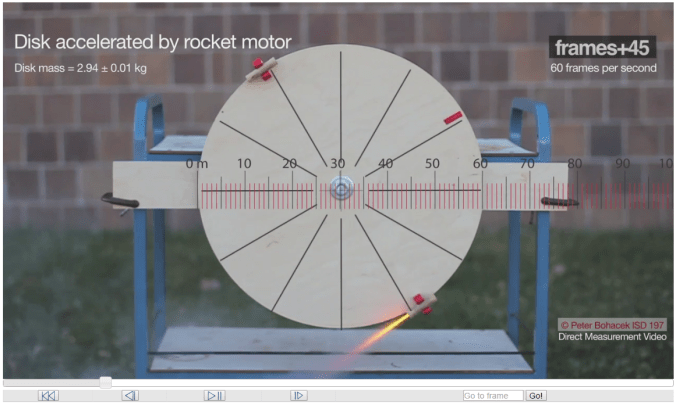
This year, I’m embedding circular motion concepts as we wrap up their linear motion analogues, so today students took their first look at angular acceleration. Students used a Direct Measurement Video to plot angle vs. time for a disk with a rocket motor attached. Students were quick to notice their graph looked a lot like position vs. time for an object with linear acceleration, and were able to extrapolate a lot from there.

rotating disk.PNG

Earth Science: Satellite Data

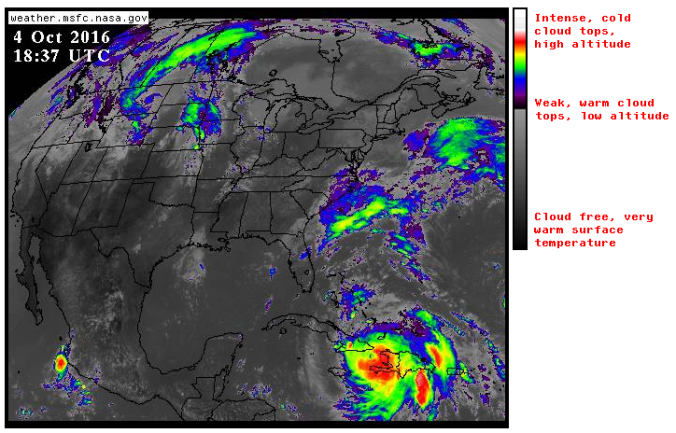
Students looked at some images of cloud cover produced by NASA’s GOES satellite to make some claims about the cloud cover and associated weather in a few areas of North America. I didn’t use my evidence-based reasoning graphic organizer today, and I don’t think its a coincidence that many students just stated their claims without any evidence. I need to keep being explicit about what good reasoning looks like and stay on students to keep including that in answers.

goes-infrared

Day 20: Lab Practical & Clouds

AP Physics: Lab Practical

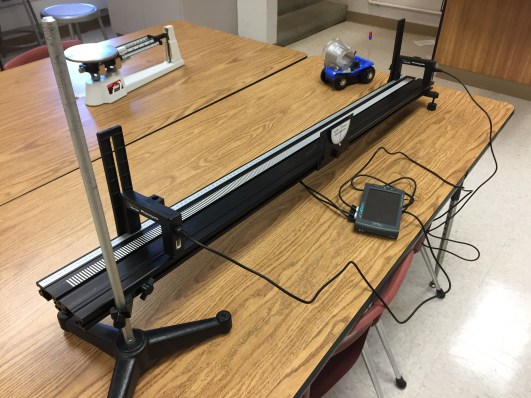
We started working on a constant acceleration lab practical today. A marble will roll down a track while a constant speed buggy drives past. Given the starting point of one, students need to find the starting position of the other such that the marble will land in a cup taped to the buggy. I had a couple of administrative things to deal with at the start of class, so we only got to collect the data students need to complete the calculation. I’ve got a computer lab reserved tomorrow, so we’ll test their calculations on Wednesday.

img_2265

Earth Science: Clouds

Students were introduced to the different types of clouds today. I added some questions to focus on patterns in the names of the cloud types. Students were pretty successful at picking out the key roots and prefixes that show up in cloud names and reasoning out what they must mean.

Day 19: Free Fall & Humidity

AP Physics: Free Fall

Students worked on plotting position vs. time using a Direct Measurement Video of five different spheres in free fall. This is the first year I’ve had students use uncertainty, and I’m finding I really like how it shapes conversations. A lot of students were looking for specific times in the video, then estimating the position of the sphere at those times, but a quick conversation about the large uncertainty that produces in position quickly got them to see the value in switching their approach.

five objects.PNG

Earth Science: Humidity Analogy

Students worked through some questions using beakers of water as an analogy for air at different temperatures and how that impacts humidity. It was pretty tricky for many students to predict what should happen to the water level when a given amount was moved to a larger or smaller beaker, so I think I’d like to get out actual beakers and water the next time I do this activity to make it a little more concrete. They did seem to get the analogy and were able to make some good predictions about humidity and dew points by the end of the hour.

Day 18: Group Roles & Relative Humidity

AP Physics: Group Roles

I assigned students to groups for the day, rather than letting them choose their usual groups, to get them talking to some new people. To help with that, I randomly assigned them to roles I borrowed from the University of Minnesota’s Physics Education Research group. We also talked a little about some of the ways race and gender affect group dynamics, and how group roles can be a way to combat that. In their groups, students whiteboarded their solution to yesterday’s Equation Jeopardy problem, which lead to some great discussions about the physical meaning of terms in the equation. Afterwards, I tasked each group with finding at least two different solutions to the XKCD substitute problem. A few students grumbled that finding two solutions meant they had to try something besides their preferred approach, but also realized that was probably the point 🙂


Earth Science: Relative Humidity

Students used hygrometers to measure the relative humidity of the classroom, then spent some time looking for patterns in the chart used for reading a hygrometer to look for patterns. Once they were looking for those patterns, my students were more off-task than usual. I think part of the problem is they were having more trouble than I expected interpreting the chart, but I also think I need to revisit expectations for when students are in the lab.