Distance Learning Week 5

AP Physics 1: Unbalanced Torque

Students used Pivot Interactives to find a relationship between torque and angular acceleration. The activity has several different bicycle wheels, which lead to some good discussion on the forum as students first compared their results to someone with the same wheel, then compared results to someone with a different wheel.

In both the questions I got about the activity and in the grading I was doing this week, I saw a lot of students struggling with the distinction between different terms related to gravity. That’s been an on-going challenge this year that I think is related to having some students who use a lot of verbal shortcuts. We’ve made a lot of progress on that front this year, and a lot of students were joining me in pushing back whenever someone used imprecise language. I think with out that consistent feedback on language, some students are falling back to old habits. I’m giving feedback on language in students’ written work and sent out a vocab review to all of my students, but am thinking about other options.

Physics: Pendulums

Students used Pivot Interactives to collect data we’ll use to get the equation for the period of a pendulum. This week, we had students collect data, then post their graphs and answers to a few questions to a forum. Next week, they’ll start by linearizing the period vs. length graph. Based on the forum, I’m glad we split the lab up. In the questions, students recognized angle and mass don’t affect the period and correctly explained why the period vs. length graph should have a zero intercept. However, most students described their period vs. length graphs as linear in spite of the large intercepts. Using the discussion and splitting up the lab gave me a chance to catch the issue and record a short video before students started their linearization. It’s been hard to be responsive when I have almost no contact with my students right now, so it felt good to have this opportunity to shift my instruction based on students’ current thinking.

Chemistry Essentials: Pressing Pause

The representing reactions summative was due on Tuesday, and only two of my students had turned in work for the module. Rather than sticking to my plan to start balancing, I pushed everything back so that students have an extra week to catch up before their next assignment is due. I also spread out the remaining work in an effort to reduce the workload. We’re shooting for each class to have around 90 min of work per week, so I’ve been assigning what would take around 30 to 45 min in the classroom each week, but the students I’ve heard from are spending around 3 hours a week on chem. I’ve only gotten work or heard from a few kids since Tuesday, but even if just a few more kids get a credit required for graduation as a result of this week’s adjustments, I’m happy with my decision.

Distance Learning Week 4

Based on how we’re being encouraged to approach distance learning, I’ve been posting at least one full week of material for students at once. This week, the mental switching it takes to grade last week’s work, answer questions about this week’s work, and plan next week’s work, especially with three different courses, started to get to me. I’m working on planning out my work tasks better so that I’m not switching gears quite as often.

Thursday and Friday were especially tough this week. Governor Walz announced on Thursday that schools will be continuing distance learning through the end of the school year. While it is absolutely the right call and we’ve been expecting it for a while, it was tough for staff and students to hear for sure that we won’t be back together this year.

AP Physics 1: Balanced Torques

Students used PhET’s Balancing Act simulation to develop rules that lead into balanced torque. Based on the discussion board, students were pretty successful at getting the ideas I wanted them to get. They also seemed to have a lot of success applying their rules to the problems.

I also saw signs of some fatigue setting in among my students. Some kids were missing written information I think they would normally catch and many are quicker to get frustrated than I’m used to. Based on a survey I gave my students to see about how many hours per week they are spending on school, it is no wonder they are getting worn out. While students consistently said my class has a relatively light workload, I need to do what I can to keep it light and even reduce it. It’s hard when I still have content to cover and the AP exam is close, but my students’ well-being is more important than a test score.

Physics: Pendulum Representations

Students did some video analysis of a pendulum to start thinking about motion graphs and other representations, including free-body diagrams and energy bar charts, for simple harmonic motion. Students struggled to make some of the connections I usually ask for, which I think is a result of most kids working independently rather than having the opportunity to talk things over with each other.

I’m seeing fewer signs of strain from my physics students. Most are putting in 1-2 hours per week on Physics, which they consider reasonable. I’m also hearing from students that they really appreciate having deadlines every few days, rather than having everything due on Friday as a lot of classes are doing, since it helps them spread out their work.

Chemistry Essentials: Representing Reactions

This week, we continued working on translating between words, formulas, and particle diagrams for complete chemical reactions. The students I’ve talked to are making good connections with what they learned in the formula writing module and mostly need confidence and reassurance rather than significant help with the content.

This is the class where I’m feeling the absence of face-to-face instruction the most. About half of my students haven’t done anything on the Schoology site or responded to my emails or phone calls, which is tough to see. I had a conversation with the para who supports the course this week, and we see two major challenges. First, we see a lot of students who get off-task when they are confused or stuck. In the face-to-face classroom, we can not only redirect them, but sit down with the student to work through their questions. Based on what we’ve heard from a few parents, we think some students are getting stuck in this avoidance. Second, I find I have to earn the trust of students in this course before they are comfortable asking me questions, but it’s been tough to earn that trust when we’ve never met. I’ve had some success texting with kids since it is a very low-stakes interaction, but teaching chemistry by text message is hard. The good news is the para has good relationships with many of the kids struggling and is very comfortable with the curriculum for this class, so she’s been able to step in with some kids too nervous to ask me questions.

Distance Learning Week 3

I think my students and I are getting into routines and things are starting to run smoother.

AP Physics 1: Central Net Force

Students worked on central net force and universal gravitation this week. We moved through the content fairly quickly since the AP exam is looming. On the summative assessment, a lot of students talked about a force pushing outward on objects moving along a circular path, which is a common preconception. It’s frustrating to know exactly what questions and discussion moves I would use to address this in a face-to-face classroom, but to feel like my options are limited in an asynchronous setting. With the remaining topics, I need to think about how I can proactively get students thinking in ways that challenge preconceptions rather than relying on my ability to react in the moment.

Physics: Pendulum Representations

Students did some video analysis of a pendulum to start thinking about the motion graphs for a pendulum. In the discussion board where students shared their graphs, I also had students respond to some questions about similarities and differences between the posted graphs. This seemed to help students get past the superficial differences in graphs and focus on the major concepts shown by the graphs.

Chemistry Essentials: Formula Writing

This week wrapped up formula writing. On the summative assessment, a few students included a comment along the lines that they’d never learned to draw particle diagrams. Checking in with those kids, they are relying on the Schoology calendar, which shows assignments that are due, rather than visiting the course page where I’ve posted some instructional videos and other resources. I’m not interested in using an assignment to verify students use those resources, so need to think about other ways I can make sure students are aware of materials on the course page. In my email for Monday morning, I added a reminder to use the resources in the folder for each topic. I’ve been putting together an overview of all the tasks for each learning target, and may start including that in the weekly email.

Days 85-88: SHM Representations & Momentum Card Sort

AP Physics 1: SHM Representations

This week was mostly about working problems for simple harmonic motion. I kept the focus on representations, including free-body diagrams, energy bar charts, and motion graphs, which made it a good review of a lot of mechanics topics. I also was really pleased when a student was checking out the topics we have left to cover on the AP Physics 1 Your Course at a Glance and asked if our unit on mechanical waves will have anything to do with the simple harmonic motion we’ve been working on.

Physics: Momentum Card Sort

This week, we worked on transitioning to calculations with conservation of momentum. We started with a collision lab from the Modeling Instruction curriculum, then did Kelly O’Shea’s momentum representations card sort. I’ve had a lot of students asking for me to do example problems before they work problems on paper, which I try to avoid. The card sort seemed to fill that need for a lot of students, while keeping the focus on their sense-making. I definitely want to work on a similar card sort for energy.

Days 80-84: SHM Labs & Momentum Bar Charts

AP Physics 1: SHM Labs

We worked on labs to determine what affects the period of objects in simple harmonic motion. I had half the class experiment with pendulums, while half the class used springs. During the board meeting, we did a lot of jumping back and forth between the two experiments; this lead to some good discussion about energy when we saw that mass mattered for the springs, but not for pendulums. I had each spring group use a spring with a different spring constant, which also lead to some good discussion about why the pendulum groups all got the same slope on their linearized graphs, while each spring group got a different slope.

Physics: Momentum Bar Charts

This week, we developed conservation with cart explosions, then worked on using momentum bar charts to represent conservation of momentum problems. After last week, I spent some time talking about the purpose of giving students time to work all (or most) of the problems on paper and warned them I would be unhelpful when they were preparing their whiteboards, then held to it. When we got to mistakes whiteboarding, I required groups to make at least one of their mistakes in the bar charts. While students were working on paper and preparing their whiteboards, I saw a lot more small-group discussion than usual, both within groups and across groups, which was fantastic. During the whole-class discussion, I also got some students speaking up who are usually pretty quiet and one of my classes even got some really good student-to-student exchanges, which have been very rare this year. On Friday’s quiz, students consistently felt really good about their performance. I’m hoping that the positive experience students had whiteboarding these problems coupled with good performance on the quiz will move the class culture in the right direction.

Day 120: Mistakes Whiteboarding & Lab Practical

AP Physics 1: Circuits Mistakes Whiteboarding

I forgot to take a picture, but students did some mistakes whiteboarding with yesterday’s problems. We moved quickly enough through circuits that I think I’ll need to make sure I have some circuit materials worked into our review, but students are feeling pretty good about this topic.

Physics: Spring Lab Practical

Students finished up a lab practical finding an unknown mass using both Hooke’s Law and the period on a spring. Students who didn’t include units in their work tended to get two different answers; most groups got a spring constant in N/cm and without units in the calculations, they tended to miss the need to convert. It was a good lesson in the value of units. It also occurred to me I should incorporate this lab into my AP review since students are finding both gravitational mass and inertial mass.

spring practical

Chemistry Essentials: Balancing Mistakes

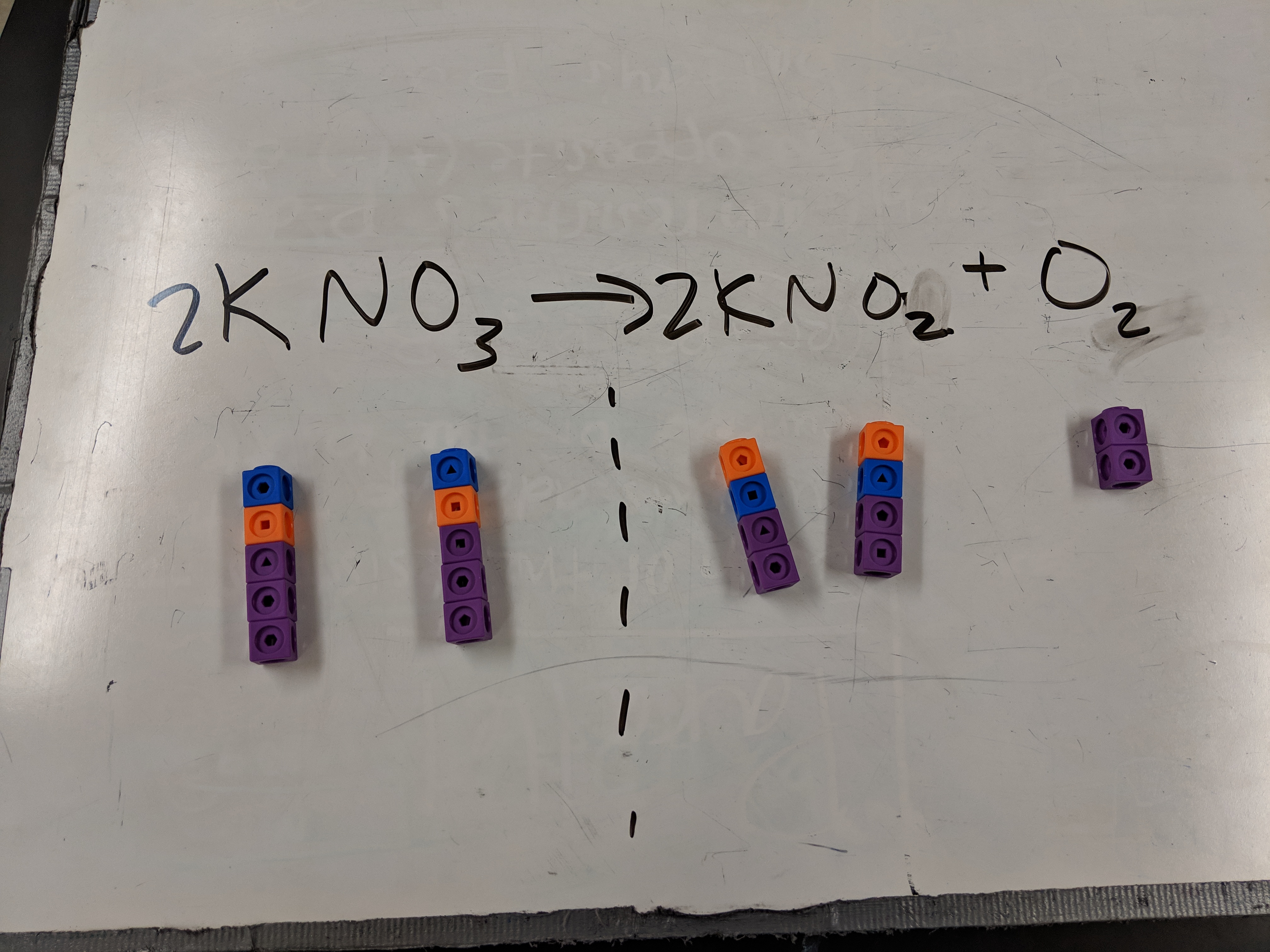
We did mistakes whiteboarding with yesterday’s balancing problems. Right now, students mostly seem to be understanding what to do, but need to build up some confidence. I’m really pleased with how well the Mathlink cubes have been working as a manipulative; they are even helping students quite a bit with going between formulas and particle diagrams.

chem mistake.jpg

Day 119: Problems, Lab Practical, & Balancing

I had a sub today.

AP Physics 1: Circuit Problems

I introduced students to Trevor Register’s KVL diagrams yesterday. Today, I had them work on some problems using the diagram and Kirchhoff’s Laws.

Physics: Lab Practical

Students started a lab practical where they using a spring to find an unknown mass two different ways. I gave them some structure that should steer them to use Hooke’s Law, then the period of the spring. I’ll be curious to see how it went.

spring practical.jpg

Chemistry Essentials: Balancing

Students worked on some problems balancing chemical reactions. At my co-teacher’s suggestion, we got some Mathlink cubes for students to use as a manipulative. I’m curious to see how it goes; when I used some on Tuesday, they seemed to help make balancing more concrete for students.
balancing.jpg

Day 118: Board Meeting, Mistakes Whiteboarding, & Conservation of Mass

AP Physics 1: Kirchhoff Board Meeting

We had a board meeting where students shared the rules they’d come up with for current and potential difference, which lead into Kirchhoff’s rules. My students missed some details, especially around current, that I wanted them to see; normally, I would have sent them back to the lab to experiment a little more, but I ended up pointing out the info in the interest of time.

Physics: Mistakes Whiteboarding

We did some mistakes whiteboarding with yesterday’s problems. There are some students who haven’t had me before, so this was their first exposure to mistakes whiteboarding. A few of them started laughing and making some comments when a group clearly had some clearly unintentional mistakes, so I stepped in more than usual and, with help from students who’ve done this before, managed to shift the tone pretty quickly. I’ve been more conscious this year overall that I need to reset the culture in my classroom each trimester, but I dropped the ball today and didn’t revisit what it looks like to contribute during this kind of whiteboard discussion.

phys mistake (1).jpg

Chemistry Essentials: Conservation of Mass Lab

Students did a reaction in a Ziploc bag to see the conservation of mass in action. Students got good results, but balancing the reaction was tricky. The reaction is one of the trickier ones I ask students to balance in this course, so this may have been better near the end of the unit.

reaction in bag.jpg

Day 117: Kirchhoff’s Laws, Problems, & Balancing

AP Physics 1: Kirchhoff’s Laws

Students used PhET’s circuit construction kit to look for patterns in series and parallel circuits. Students were pretty successful at noticing the things I wanted them to notice and I’m looking forward to tomorrow’s discussion of the results.

circuit kit parallel

Physics: Problems

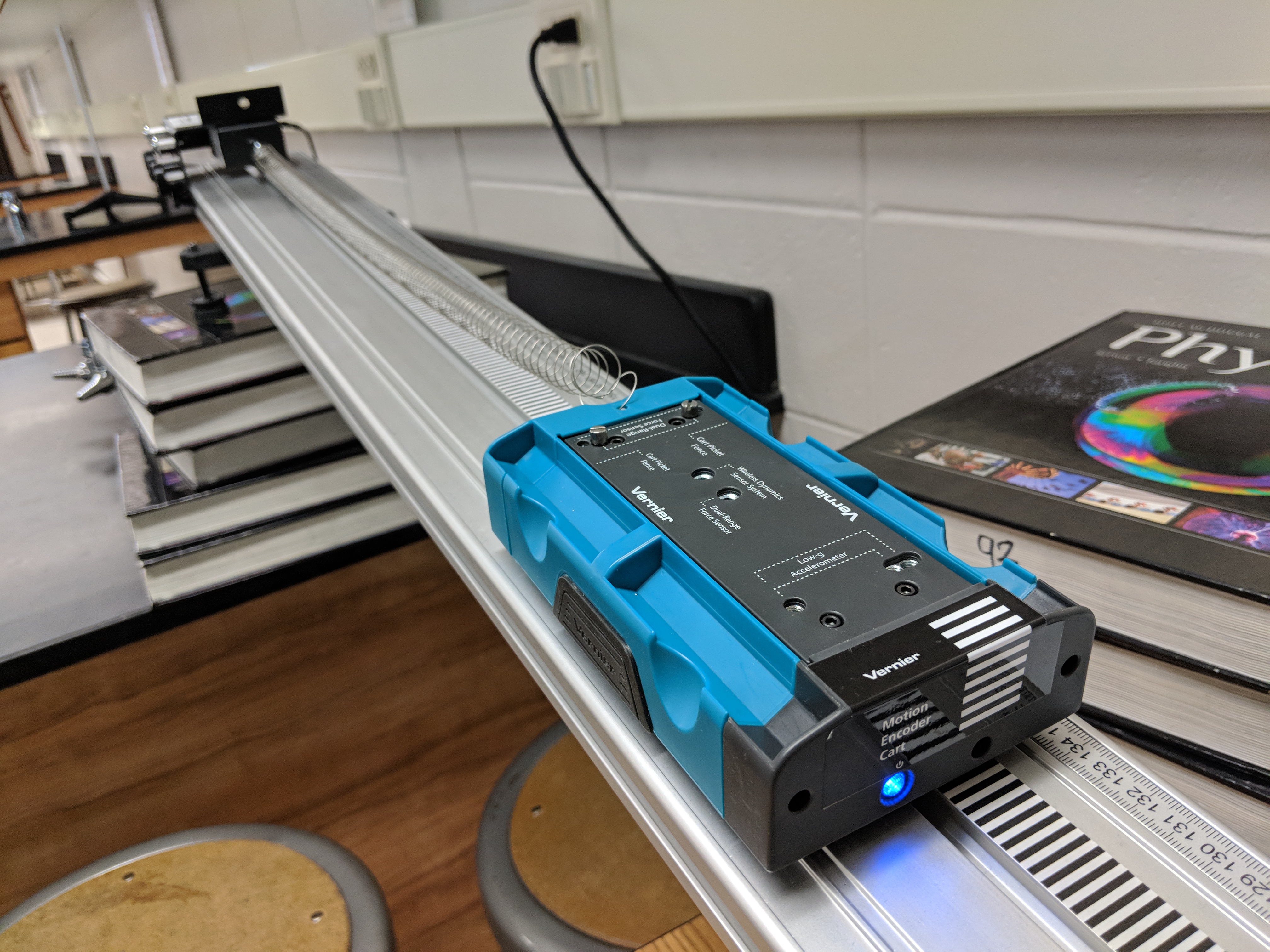
Students worked on some problems using the spring period equation. We also spent some time on whole-class discussion about the motion graphs for an object on a spring, and tested a lot of ideas using a motion encoder cart hooked to a force sensor with a spring.

Maker:S,Date:2017-10-21,Ver:6,Lens:Kan03,Act:Lar02,E-Y

Chemistry Essentials: Balancing Reactions

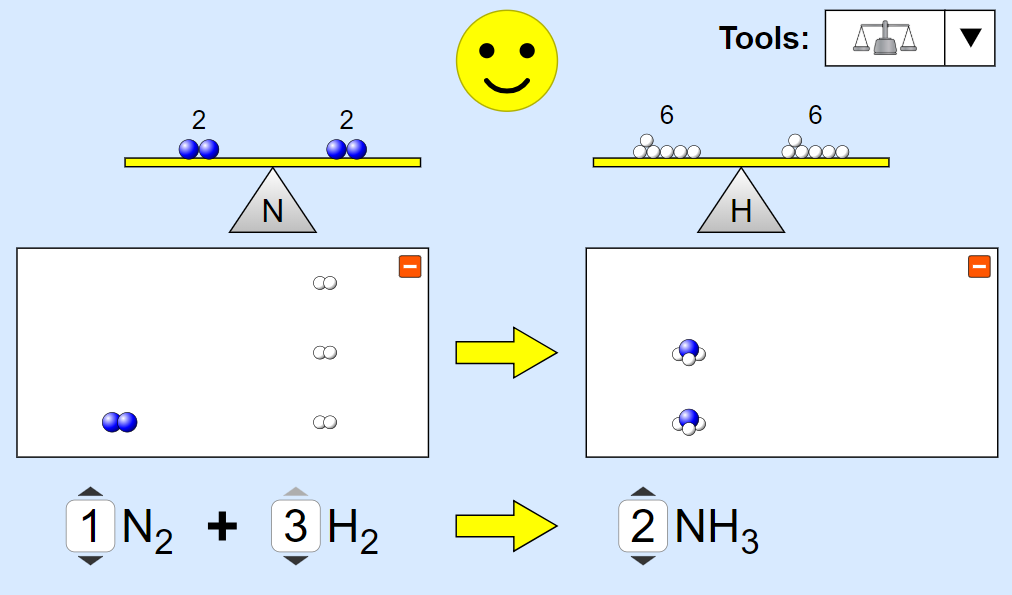
Students used PhET’s balancing chemical equations simulation to start figuring out what it means for a reaction to be balanced. Students were pretty successful at working out the significance of each of the tools the PhET activity provided, along with what it means to be balanced. Even though I didn’t assign the game, a few students decided to play and ended the hour with a lot of confidence and enthusiasm for balancing problems.

phet blanacing.PNG

Day 116: Whiteboarding

AP Physics 1: Coulomb’s Law Whiteboarding

We spent some time doing some practice multiple choice problems, then used whiteboards for a gallery walk of yesterday’s problems on Coulomb’s Law and Ohm’s Law.

Physics: Spring Representations Whiteboarding

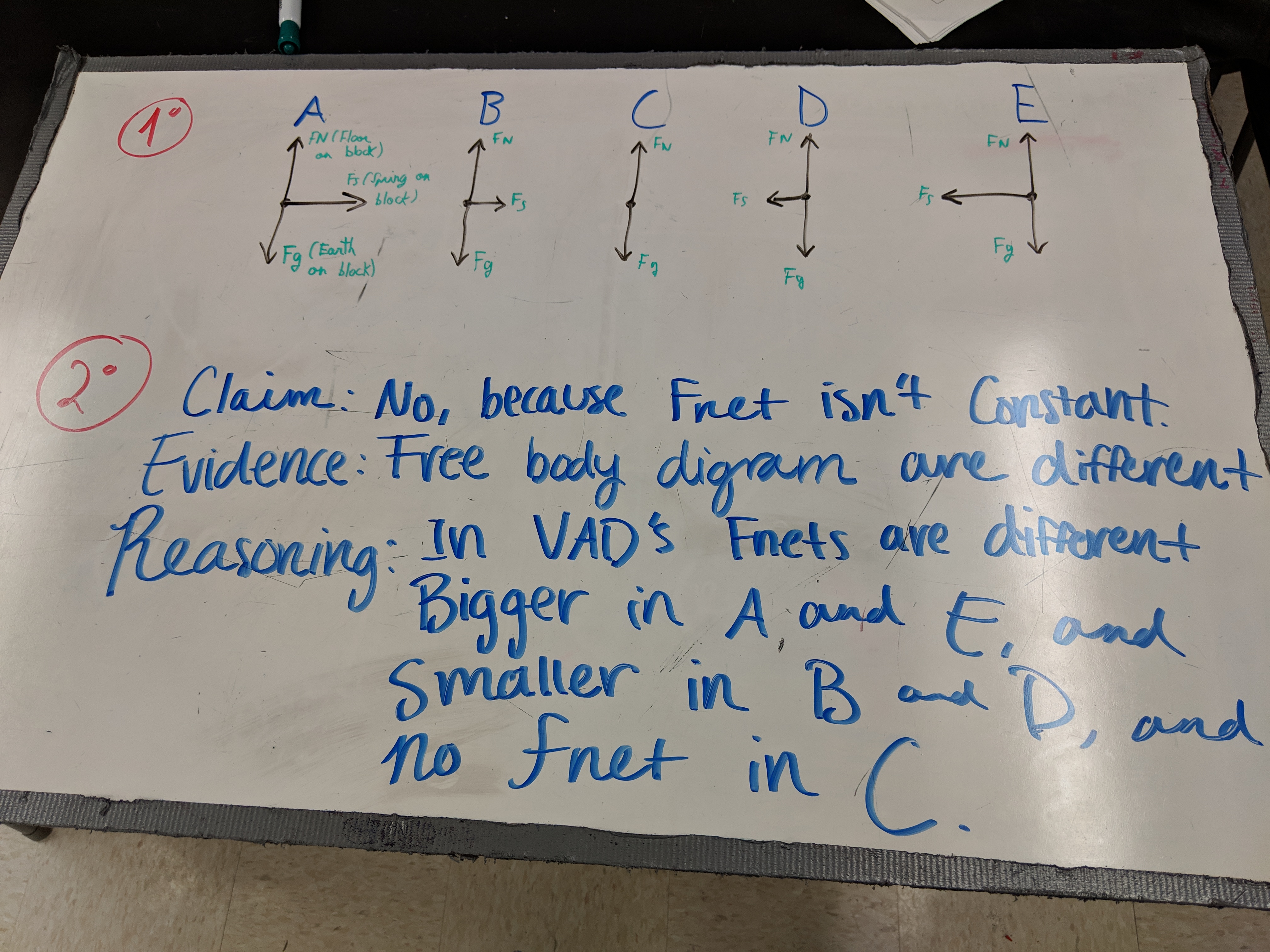
Students whiteboarded various representations for an object vibrating on a spring, then we did some discussing to come to an agreement on what those representations should look like.

phys spring (1).jpg

Chemistry Essentials: Mistake Whiteboarding

We finished going through the whiteboards students prepped earlier this week for a round of mistakes whiteboarding. I’m getting excited to start balancing chemical equations with these students next week; several students have started pointing out when the number of a given element changes between the products and reactants as a sign that something is wrong.