Day 136: Longitudinal Waves & Leftovers

Physics: Longitudinal Waves

We had some discussion about a high-speed video of a glass breaking due to sound waves to establish that sound is a new type of wave. Afterwards, students made longitudinal waves on slinkys to explore what aspects of our models for mechanical waves so far apply to longitudinal waves.IMG_1806

Chemistry: Leftovers Sim

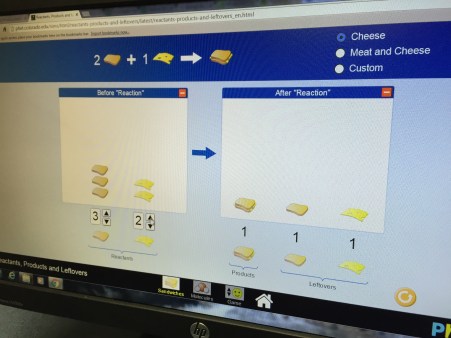
I was gone on Thursday and Friday and it turns out that on Thursday, while I planned for my students to work on PhET’s Reactants, Products, & Leftovers simulation,  the school’s wi-fi went out. We did that lab today, instead. Students were pretty successful applying ideas from Friday’s lab to the simulation and seemed to build some nice bridges to the more abstract chemical reactions.
Day 122: Springs & Balancing Equations

Physics: Period of a Spring

Students designed experiments to determine the variables that impact the period of a spring. I was very pleased with how many students pulled up their notes and results from the pendulum lab, in spite of the fact that it was on the other side of a week-long break, to help with experimental design and make sense of their results. For next year, I want to look at getting some additional springs. A lot of groups wanted to find a way to test the impact of the spring constant, and I only have options with relatively extreme spring constants, which made it tricky to get meaningful data.

IMG_1761

Chemistry: Balancing Chemical Equations

Students used PhET’s Balancing Chemical Equations sim as an introduction to what it balancing means. Last tri, I had a lot of groups skip straight to the game and play using trial and error, missing out on most of the sense-making. This tri, I took a few minutes to talk with students about why I structured the activity the way I did and students took the sim’s introduction and the questions I’d written much more seriously. Next time around, I want to add some questions to get students to focus a bit more on the significance of the subscripts vs. the coefficients.

IMG_1760

Day 92: Parallel Circuit Patterns & Reaction Rates

Physics: Parallel Circuit Patterns

Continuing with Kirchoff’s Laws, students went back to the PhET circuit construction kit to look for patterns in parallel circuits. I have a lot of fun listening to student conversations during this sequence. The patterns that lead to Kirchoff’s Laws are just subtle enough to lead to some great discussion (and emphatic debate), along with lots of moments where students think they’ve got it worked out, only to break their own pattern.

circuit sim

Chemistry: Reaction Rates

Students timed a reaction between copper chloride and hydrogen peroxide, then made various changes to speed up or slow down the reaction. Students were doing a nice job of connecting yesterday’s discussion about energy in chemical reactions  (aided by PhET’s reversible reactions sim) to explain why some of today’s changes impacted the reaction rate.

Day 90: Circuit Patterns & Disturbing Equilibrium

Physics: Circuit Patterns

Today, students started working on a series of labs based on the circuit patterns activities from the PUM curriculum. Today, students built series circuits in PhET’s circuit construction kit, measured the current and potential difference at each element, and started looking for patterns in their results. When using the voltmeter, I was pleased by how many students went back to a lab we’d done moving the ground wire of the multimeter to help explain why some voltages were negative, along with what that negative voltage means. Tomorrow, we’ll pull out the power supplies and resistors to see if their patterns work in the real world.

Screen Shot 2016-02-01 at 3.12.16 PM

Chemistry: Disturbing Equilibrium

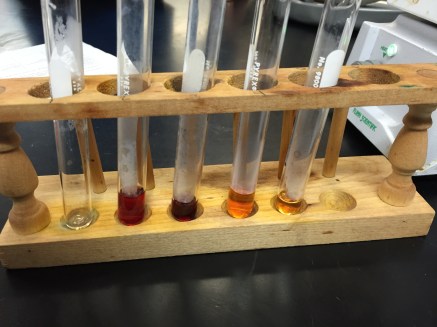
Students played with moving a reversible reaction out of equilibrium. After mixing Fe(NO3)3 and KSCN solutions in several different test tubes. Once the reaction was in equilibrium, they tried something different, such as changing the concentration or putting the test tube into a water bath, to and observed the results.

IMG_1620

Day 88: Ohm’s Law & Limiting Reactants

Physics: Ohm’s Law

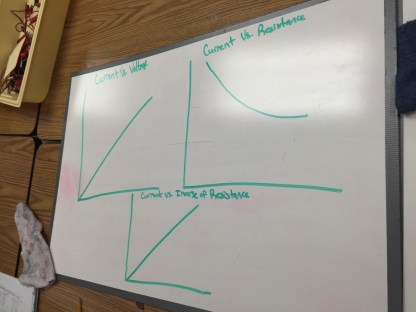
Students wrapped up using the PhET circuit construction kit to develop Ohm’s Law. Students were able to pretty easily reason out the formula based on their graphs. Looking back, I wish I’d had students put their experimental conditions and equations on the boards, as well. I usually try to keep the boards pretty simple since I have some big classes, but I think that information would have added a lot of value to the conversation in this case.

IMG_1610

Chemistry: Limiting Reactant Practice

Today, students did some limiting reactant problems where the given and desired information is in grams, rather than moles. I was really pleased at how easily most of them worked through the problems. A lot of my students were struggling to connect ideas between different days earlier in the trimester, so it was great to see how many readily pulled out earlier skills and problem solving strategies to help today. I also saw a big jump in the quality of the questions I’m getting from my students; one student in particular was really focusing on the why when she was talking to me, when in the past she seemed most interested in getting something to write down. I’ve been having a lot of conversations with this class about how learning works and sharing why I do things the way I do, and I’m hoping I can get students to continue with the things I saw today.

Day 87: Ohm’s Law & Limiting Reactants

Physics: Ohm’s Law

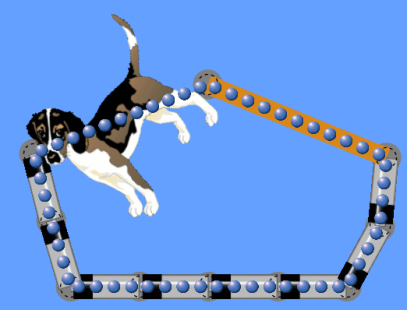
Students used PhET’s circuit construction kit to do a short activity based on the PUM materials to help orient them to the sim, then started looking for a relationship between current and potential difference. I loved it when, during the orientation activity, several groups got curious about the mysterious resistors in the kit, and immediately tried adding them to a circuit to see what they do, without any prompting or intervention on my part. There was also some great discussion and debate in one class about what exactly the blue dots represent. There were also many attempts to electrocute the dog.

dog circuit

Chemistry: Limiting Reactants

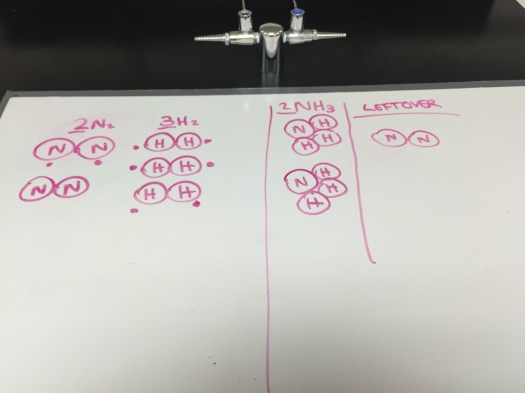
After a short percent yield quiz, we had some class discussion to formalize what students found in yesterday’s PhET sim on limiting reactants. I picked some reactant quantities for one of the reactions in the simulation, then had students get into groups and try to predict what they would produce and what the leftovers would be. Before students went to their groups, we had some conversation about what I was looking for. I tried to emphasize that I wasn’t after right answers; instead, I wanted them to share different approaches so we could decide on some useful ways to think about this kind of problem. There was a nice mix of students who focused on the equation given for the reaction and students who sketched diagrams.

IMG_1609

Day 86: Intro to Circuits & Limiting Reactants

Physics: Intro to Circuits

I gave each group a bag with a mix of various items and asked them to use those items to try and light up an LED. In the past, I’ve told students their task is to light up the bulb, but they should keep track of what doesn’t work. This year, I was more conscious of stating the goal was simply to document what does and does not work so we could look for patterns, and I was much happier with how the exploration went. This was also the first time I used LEDs for this lab, instead of miniature incandescent light bulbs, and I liked the opportunity to reinforce that current has a direction. As an added bonus, the LEDs I have required two AA batteries, which gave the students more options to try. We wrapped up by watching a short excerpt from from the Private Universe series of MIT and Harvard grads trying a similar task.

IMG_1608

Chemistry: Limiting Reactants

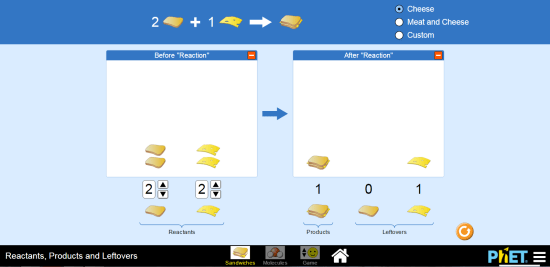
Students worked through PhET’s Reactants, Products, and Leftovers simulation to introduce the idea of limiting reactants. I found a lot of students were looking for confirmation that their answers were right, even when the simulation showed the answer. When I talk to many of them, it sounds like they’ve gotten into the habit of assuming they are wrong in school. I need to continue to work on building a culture where my students feel like their ideas have value and to work on strategies to help students analyze their answers, right or wrong.

IMG_1607

Day 78: Electric Field Lines & Energy in Reactions

Physics: Electric Fields

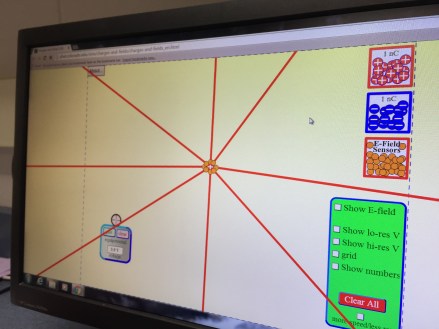
Students built off what they can see in the PhET Charges & Fields to develop the idea of what electric field lines represent. Students mostly got into trouble when they  thought their answers were too obvious and tried to come up with something more complicated.

IMG_1587

Chemistry: Endothermic & Exothermic Reactions

To introduce endothermic and exothermic reactions, we broke the terms down and talked about other words with the “therm” root and what that says about what these new terms might mean. Students then did some reading about endothermic and exothermic reactions. While the textbook doesn’t emphasize the role of energy in these reactions, I tried to bring that out in the short discussion after the reading.

Day 76: Electric Fields & Interpreting Reactions

Physics: Electric Fields

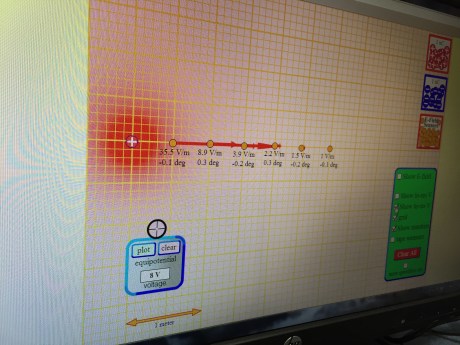
Students used PhET’s Charges and Fields sim to look at how the size of a charge and the distance from a charge impact the magnitude of an electric field. Tomorrow, we’ll get from their data to the equation for electric field strength and draw some parallels between electric fields and gravitational fields.

IMG_1582

Chemistry: Interpreting Reaction Equations

Students worked on using chemical equations to determine which of the five reaction types was happening. I was really pleased by the way students started to talk about what is actually happening in the reaction, rather than just talking about the abstractions represented in the equation.