Day 147: Project Work & Plate Tectonics

AP Physics: Project Work

Students continued working on their final projects for physics. I had a fun conversation with a student who plays baseball and is planning to analyze hitting a baseball. I’m extremely ignorant about sports, so wanted to make sure there would be enough meat for him to dig into and, as he talked about everything that goes into an effective swing, it quickly became clear he will need to pick some aspects of the swing to focus on.

Earth Science: Plate Tectonics

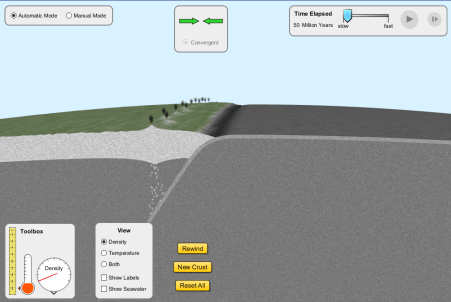
Students played with PhET’s plate tectonics simulation to reinforce what is going on at plate boundaries. I think if I fleshed out what students are doing in the simulation, I could significantly reduce (or get rid of completely) the notes I did yesterday.

sim

Day 132: Problems & Glaciers

AP Physics: Problems

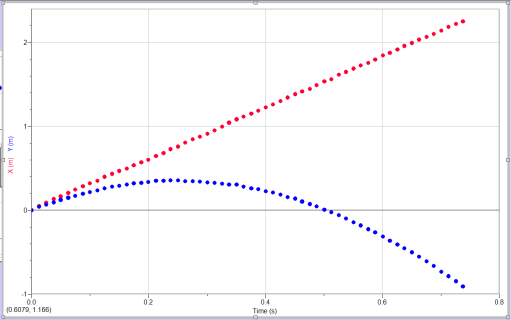
Students worked on some oscillating particle problems. Students had some really good discussion about a cart on an angled ramp oscillating on a spring; a lot of groups really dug into what should happen when the angle of the ramp changes. At the end of the hour, we tested their predictions. I wasn’t paying much attention to when I started data collection, but still got a set of graphs my 2nd hour considered applause-worthy.


Earth Science: Glaciers

I gave students a brief overview of some glacial features, then had them use some sand in the stream tables to make a recreational area with a variety of glacial features. Students liked the activity, but they did not connect the vocabulary to how the features form or how they are related. I think I’d prefer to do this at the end of a glacier unit, where students would have the background to tie the features they are using together. At this point in the unit, I’d rather focus on how these features form to give some basis for naming them.

glacier

Day 119: Whiteboarding & Mineral Intro

AP Physics: Whiteboarding

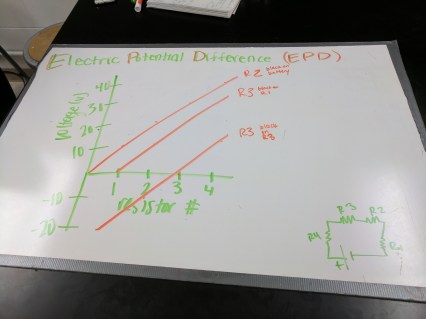
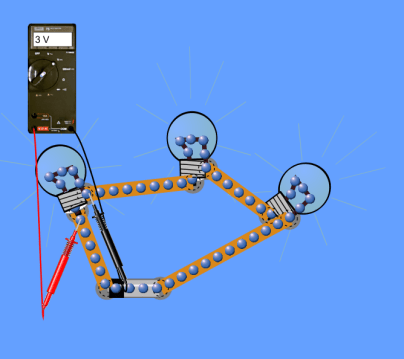
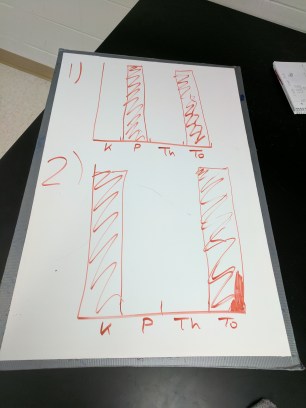
Students whiteboarded their results for the Ohm’s Law lab and an electric potential difference activity I had them try in yesterday’s sim. Students plotted voltage vs. resistor with the multimeter’s ground probe in several different positions to see the change is always the same. The analogy between gravitational potential and electric potential doesn’t seem as clear for my students as in the past, so next year I might go back to having students map electric potential.epd

Earth Science: Mineral Stereograms

I did a few notes on what caused the early Earth to melt and form layers. Afterward, students spent some time with books of stereograms of rocks, minerals, and gemstones. I wrote some questions to get students thinking about the key characteristics of each category and it was fun to listen to some of the things students were noticing.

stereo

Day 118: Circuit Sim Again & Earth’s Layers

AP Physics: Circuit Sim Again

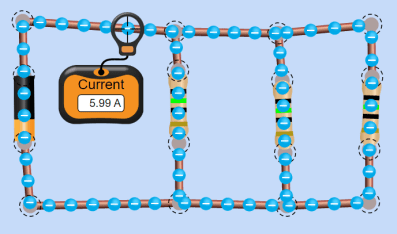
Students used PhET’s circuit construction kit to explore Kirchoff’s Laws in series and parallel circuits. I also tried to mimic an extension of an electric field mapping lab by having students place the ground probe of the voltmeter at different points in the circuit, then move the measuring probe around the circuit. I liked that this got students noticing that the total change in voltage is always the same and it got them thinking about what a negative voltage means. On the Kirchoff’s Laws portion of the activity, I saw a lot more variation in how students thought about the patterns than in the past, which was a lot of fun. I was especially impressed when one student pretty much derived the equivalent resistance for a parallel circuit.

parallel.PNG

Earth Science: Earth’s Layers

Today, we built on the scale diagrams students made yesterday, adding some information on the properties of each layer. I tried to get some deeper thinking by asking questions like how two layers could have similar composition, but different densities, and it was a little tougher than I expected. I think if I’d primed students with some questions about pressure, that task may have been easier. It bothered me to just state give students information about the interior of the Earth, so I spent a few minutes talking about seismic tomography with my students. Next time I teach the course, I’d love to come up with a lesson to give students an analogous experience.

Day 116: Circuit Sim & Mystery Tube

AP Physics: Circuit Sim

Students used the PhET Circiut Construction Kit to start exploring circuits. Students had some great conversations around a few questions about the blue dots I took from the PUM curriculum. I was surprised to hear some students say the blue dots must get used up since batteries die over time, but students were able to test that idea by removing their battery. This lead a few students to connect back to momentum, thinking of the battery as a source of impulse, which I thought was an interesting connection.

circuit

Earth Science: Mystery Tubes

With the start of a new trimester, students got shuffled again. A little over 75% of my 9th graders haven’t had me yet this year, so I will need to make sure I am paying attention to classroom culture and helping students understand what I want from them.

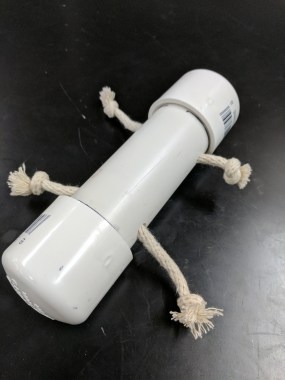
To get students practicing observations and inferences, I had them play with the mystery tubes. In their notebooks, I asked students to explicitly connect each inference to at least one of their observations with an arrow. Several groups were surprised when I told them their sketch of the inside of the tube was a useful inference, so I know I’ll need to do some work with this group explicitly valuing non-verbal representations. Tomorrow, I’ll take some time to connect this activity to the scientific process and how I want to approach this course.

mystery tube.jpg

Day 70: Hoop Practical & Circuits

AP Physics: Hoop Practical

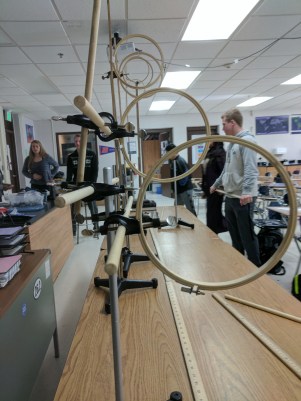
We finished up a lab practical on angled projectiles. Each group had a different distance from the launcher and figured out how high above the ground to place a hoop. In both classes, some groups had to shift their hoop to one side or the other, but eventually managed to get the projectile though all the hoops. I also had some goal-less problems to try and shift students away from needing to be able to picture the full solution to be able to progress. The problems mostly got ignored, because it was more exciting to watch the parabola of hoops come together and it took most of the hour to get all the hoops in place.practical

Physical Science: Series vs. Parallel Circuits

Students used the PhET circuit construction kit again, this time using a lab on series and parallel I modified from Eugenia Etkina’s PUM curriculum. I think students  were getting the big ideas, but its very tough to circulate with a full class in the computer lab, so I feel a little blind. Last year, I was able to do the PhET sims on netbooks in the classroom, so it was easy for me to listen i on student conversations and pull them together at the end of the hour to discuss some big ideas. Next year, I might re-work my calendar to make time for a day in the classroom so my students and I have a chance to make sure they are on track.

circuit

Day 69: Angled Projectile Practical & Ohm’s Law

AP Physics: Angled Projectile Practical

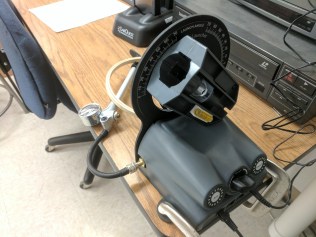
We wrapped up yesterday’s mistakes game, then started a lab practical. Each group got a different distance from the launcher, and needs to determine how high off the ground to place a hoop so that the projectile will travel through it. Tomorrow, we’ll setup the hoops so students can see the results. In both this practical and the problems we’ve been doing, I’ve found some of my strongest students get stuck. They usually know what they’re doing, but don’t see their way to the answer yet. I need to keep reminding my students that they can play with the pieces, even if they don’t know what the full picture will look like yet. I might look for a good goal-less problem to combine with the practical tomorrow to help push them towards thinking about what else they can do, rather than what the answer must be.
launcher

Physical Science: Ohm’s Law

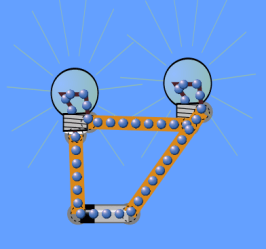
I’ve found I really like having students use PhET’s circuit construction kit before we get out the batteries and bulbs, so today we went to the computer lab to find a relationship between current, voltage, and resistance. I left the directions fairly open so that students would be designing their own experiments. Since I don’t talk much about units in this course, the simulations ammeter felt like a black box to a lot of the students. I was really intrigued by one student who measured current by counting how many blue dots passed a selected point in one minute, which connects really nicely to the definition of current as the flow of electric charge.ohms-law
Day 63: Projectile Problems & Energy Conservation

AP Physics: Projectile Problems

For most of the hour, students worked on some problems for projectiles launched horizontally. A few students needed reminders to start by sketching and annotating their velocity-time graphs, but students were pretty successful once they remembered to use the graphs. Students also checked to make sure I’m not going to do anything crazy tomorrow, like go over the problems, when they’ve much rather do the Mistake Game.

On Friday, students requested slow-motion video of the race between a horizontally launched marble and a marble in free-fall, so I recorded some video before school.


Earth Science: Energy Conservation

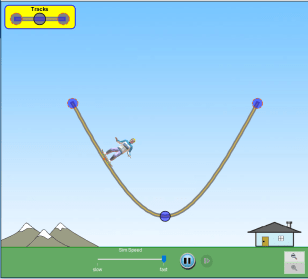
Students whiteboarded their predictions for the scenarios in PhET’s Energy Skate Park I’d given them Friday, then we tested predictions and discussed the results. We especially focused on the total energy bar to get the idea of conservation of energy.

img_20161212_082543

Day 61: Projectile Video Analysis & Energy Skate Park

AP Physics: Projectile Video Analysis

I gave students two videos of some students tossing a basketball and a video analysis guide I put together, then tasked them with getting the position vs. time and velocity vs. time graphs for each video of the basketball. I had a bunch of students who got genuinely excited when they looked at the velocity vs. time graphs and started putting together what they know so far to begin a model of projectile motion. One group even cheered when the slope of their y-velocity vs. time graph matched what their model so far!

vid-analysis

Physical Science: Energy Skate Park

Students played with PhET’s Energy Skate Park simulation to look for how they could change the size of the various bars in the bar chart. Students pretty enthusiastically played with as many options as they could find, and made some nice observations, like how the motion of the skater changes when they switch to the moon or Jupiter.

skate-park

Day 157: Refraction & Empirical Formula Lab

Physics: Refraction

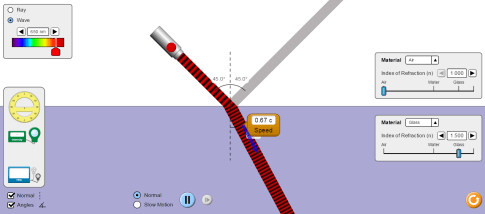
Students played with PhET’s Bending Light simulation to start building some ideas about refraction. I tried to keep the questions very broad and focused on conceptual understandings. Students really took advantage of all the tools available and made a lot of very detailed observations that would have been tough or impossible in a more traditional lab.

Bending Light

Chemistry: Empirical Formula Lab

Students worked on a lab that terrifies me (I once had a careless student singe his eyebrows), but gives really nice results. Students started with a sample of copper II oxide, then burned off the oxygen to get pure copper. They then used their initial and final mass to determine how much oxygen was in the original sample and find an empirical formula.

IMG_1886

So much fire!