Day 135: Pivot Angular Acceleration, FCI, & Limiting Reactants

AP Physics 1: Pivot Angular Acceleration

I am as part of Pivot Interactive’s Chemistry Fellows program.

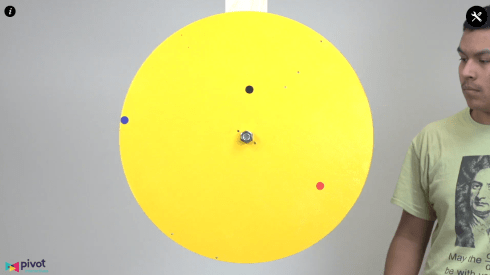
Students used Pivot Interactives to find a relationship between unbalanced torque and angular momentum for several different bicycle wheels. I had them start by setting up a formula they could use to calculate the angular acceleration from the change in angular position and the time. My 2nd hour had a much easier time with this; I think the difference is they worked yesterday’s problems in small groups and quickly connected this task to some of the problems they’d done. My 4th hour had a sub yesterday who was a former physics teacher that decided to go through the problems as a lecture, so I think those students didn’t have as firm a grasp on the calculations.
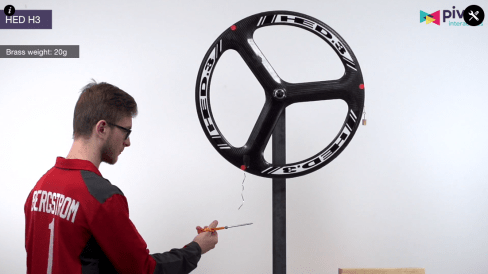
pivot unbalanced torque.PNG

Physics: FCI

Students took the Force Concept Inventory as a post-test. We normally give it before moving into simple harmonic motion, so they were a little rusty on thinking with forces, but I’m satisfied with the results.

Chemistry Essentials: Limiting Reactants

Students used nuts, bolts, and washers to start connecting mass to what I’d planned for them to see about limiting reactants yesterday. While both my sections were able to get through today’s activity without trouble, I need to figure out how to adjust for some issues yesterday. My 5th hour is co-taught, so my co-teacher ran the class and the majority of students easily finished yesterday’s activity and had the ideas I wanted them to have at this point. In my 6th hour, the sub decided to go over the answers to the accompanying worksheet as a lecture without projecting the simulation, which my students really struggled to follow. Several students helped themselves to a computer and worked through the activity as intended, and I’m having trouble getting mad at them for defying the sub. I think the activity with the simulation is worth doing, but between demand for the school computers and trying to keep both sections in the same place, I’m not sure how to give my 6th hour time in-class.

limiting.jpg

Day 134: Problems, Mistakes Whiteboarding, & PhET Limiting Reactants

I had a sub for half the day today, so only saw two of my sections.

AP Physics 1: Problems

Students worked on some problems with angular acceleration. I was at school for my smaller section, and the problems went very smoothly. They worked very independently and I overheard a lot of great discussion and connections to linear motion.

Physics: Mistakes Whiteboarding

I was at school for my only section, so we did some mistakes whiteboarding with Thursday’s problems. Students had some great mistakes and great discussion about the problems. One of the interesting things is when students were asked to sketch a v-t graph and divide it into sections, most groups did before, during, and after, mirroring the way we’d used velocity vs. time graphs during momentum transfer (inspired by Brian Frank). Asking them to tell me about what was happening to the box during each phase was pretty effective at shifting them.

physics fbd mistake.jpg

Chemistry Essentials: PhET Limiting Reactants

I was gone for both sections of this class, so it was a great day for students to use PhET to introduce limiting reactants. My co-teacher sent me a message that the kids who got started got the ideas pretty quickly, but a lot had trouble getting started. The para who supports the class was also out today, so I think some students felt like they didn’t have the support they needed; I need to keep working on how to support my chem students in developing independence in the classroom.

phet limiting.png

Day 132: Angular Motion Representations, Whiteboarding, & Stoich Problems

AP Physics 1: Angular Motion Representations

We started by discussing yesterday’s activity to introduce angular velocity; there was some great debate about which dot on the disk was moving the fastest, which lead exactly where I wanted it to. Afterward, students worked on some problems translating between different representations of angular motion. Students fell very easily back into the kind of thinking we’d done with linear motion, which made the problems a breeze.

Physics: Whiteboarding

We finished going over the standing wave problems and took a quiz on the topic.

Chemistry Essentials: Stoichiometry Problems

Students worked some stoichiometry problems that included polyatomic ions. Most students are doing very well with the problems, which has me very optimistic about tomorrow’s quiz.

Day 131: Pivot Angular Motion, Whiteboarding, & Pivot Stoich

I am a part of the Pivot Interactive’s Chemistry Fellows program.

AP Physics 1: Pivot Interactives Angular Motion

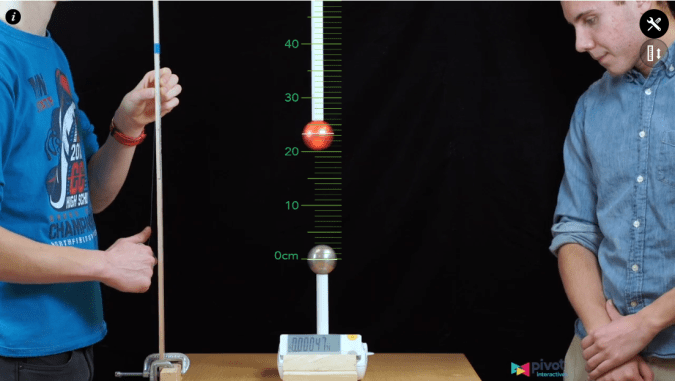
As students finished their torque quiz, I had them use Pivot Interactives to look at the motion of a spinning disk and come up with two different answers to which dot on a spinning disk is moving the fastest. Tomorrow, we’ll use those two answers to get into angular velocity vs. tangential velocity.Pivot angular.PNG

Physics: Whiteboarding

We spent some time whiteboarding yesterday’s problems. Students resisted drawing the diagrams for standing waves, but, once they got the diagrams, they were able to solve the problems.

Chemistry Essentials: Pivot Interactives Stoichiometry

Students used Pivot Interactives to compare their prediction for how much hydrogen gas should be produced in a reaction to how much was actually produced. I ran into an issue where a few students were very insistent that a prediction is a guess, so their calculation could not be a prediction. I didn’t have a great response in the moment aside from in science, a prediction should have something to back it up, which can be a calculation.

Another hurdle I ran into today is I have one section where a lot of students really resist talking to their group members, and the computers made it easier for them to work in isolation. As a result, I realized partway through the hour I was frequently answering the same questions multiple times with a given group and I was helping individual students with portions of the activity their partners knew how to do. I need think about how I can help my students have more productive collaboration within their group.

Pivot stoich.PNG

Day 123: Board Meeting, Snakey Springs, & Molar Mass

Yesterday we had ACT testing for juniors. Seniors had an off-campus learning day.

AP Physics 1: Central Net Force Board Meeting

For yesterday’s off-campus learning day, my students finished collecting data in Pivot Interactives on central net forces. I really enjoyed the discussion of the force vs. mass graphs, when the class realized the units on the slope were the units on acceleration, so we had F=ma.

ap centeal force.jpg

Physics: Snakey Springs

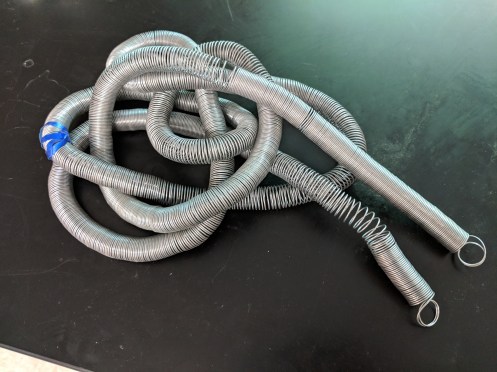
Students used the snakey springs to collect data on a relationship between frequency and wavelength for standing waves.

Chemistry Essentials: Molar Mass

Students used nuts, bolts, and washers to represent different elements in order to discover how to find the molar mass of a compound. Afterward, they tried extending what they’d found to actual compounds. Not only were they very successful at extending their results, their work represented different ways of thinking about polyatomic ions, which was cool.

Day 122: Central Net Force, Snakey Springs, & Gallery Walk

AP Physics 1: Central Net Force

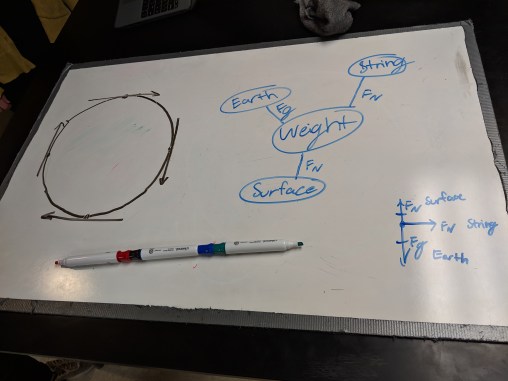
Tomorrow is an off-campus learning day for seniors and freshmen, so I assigned my students to collect and graph data from a Pivot Interactives to determine what affects the force required to keep an object moving in a circle. To prime them, we spent some time today whiteboarding to get at the idea that an object moving in a circle must be experiencing unbalanced forces. Both sections came to a consensus on the free-body diagram pretty quickly and had exactly the conversations I wanted them to on the way.

ap wb.jpg

Physics: Snakey Springs

Students played with snakey springs to start building some ideas about waves. We had them tie a ribbon onto the spring to make it easier to track the particle motion of a small piece of the wave.

phys snakey.jpg

Chemistry Essentials: Gallery Walk

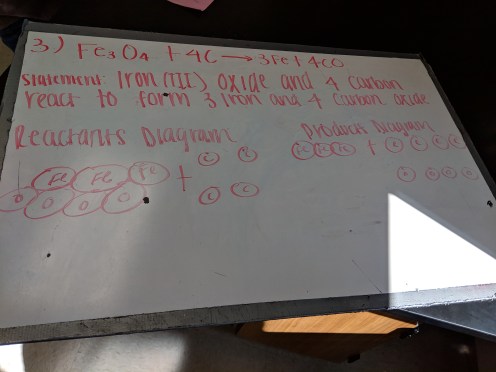
We did a gallery walk of Friday’s problems before moving on to the balancing quiz. A lot of students opted to use the Mathlink cubes during the quiz, which I decided I’m okay with.

chem wb.jpg

Day 117: Kirchhoff’s Laws, Problems, & Balancing

AP Physics 1: Kirchhoff’s Laws

Students used PhET’s circuit construction kit to look for patterns in series and parallel circuits. Students were pretty successful at noticing the things I wanted them to notice and I’m looking forward to tomorrow’s discussion of the results.

circuit kit parallel

Physics: Problems

Students worked on some problems using the spring period equation. We also spent some time on whole-class discussion about the motion graphs for an object on a spring, and tested a lot of ideas using a motion encoder cart hooked to a force sensor with a spring.

Maker:S,Date:2017-10-21,Ver:6,Lens:Kan03,Act:Lar02,E-Y

Chemistry Essentials: Balancing Reactions

Students used PhET’s balancing chemical equations simulation to start figuring out what it means for a reaction to be balanced. Students were pretty successful at working out the significance of each of the tools the PhET activity provided, along with what it means to be balanced. Even though I didn’t assign the game, a few students decided to play and ended the hour with a lot of confidence and enthusiasm for balancing problems.

phet blanacing.PNG

Day 114: Ohm’s Law, Spring Period, & Mistakes Whiteboarding

AP Physics 1: Ohm’s Law

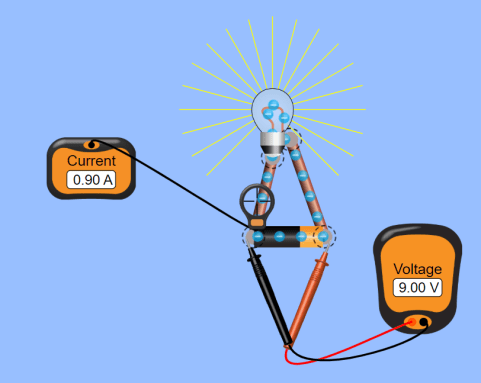
Students used PhET’s circuit construction kit to find a relationship between current, voltage, and resistance. It was the first time students were asked to work with three variables at once on a pretty open-ended lab, but they were very successful at coming up with ways to approach the task.

circuit construction.PNG

Physics: Spring Period

Students finished their data collection and graphing for the period of a spring lab. A lot of groups went straight to a quadratic relationship to linearize their graph, which makes me think they were treating it as an automatic process, rather than thinking through what their graph suggests. It didn’t take much coaching to get students to switch to a square root linearization, but I’ll need to keep working on what it actually means to linearize a graph.

Chemistry Essentials: Mistakes Whiteboarding

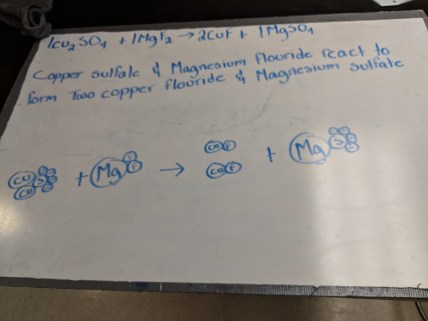
We did some mistakes whiteboarding using yesterday’s problems on representing reactions. Students were very successful at figuring out the mistakes and they are gradually getting the hang of the various details they need to carefully represent.

chem mistake.jpg

Day 112: Coulomb’s Law, Spring Force Revisited, & Skew Dice

Today was our first day back from spring break and the first day of a new trimester.

AP Physics 1: Coulomb’s Law

I am a part of the Pivot Interactive’s Chemistry Fellows program.

We dove right in with a lab on Pivot Interactives to discover Coulomb’s Law. We’re going to be cutting it pretty close on squeezing everything in before the AP exam, so I was much more direct than usual about what needed to be done by the end of the hour and how long I expected tasks to take, and that seemed to help students meet the timeline I had in mind. I need to make that a habit for the next few weeks.

pivot coulomb.PNG

Physics: Spring Force Revisited

We’re getting ready to start vibrating springs, so today we revisited Hooke’s Law. I asked students to make some predictions about how the slope of two different springs should compare before collecting any data, which was tricky since they haven’t thought about what the spring constant actually means for a while, but I think they got where I want them to be.

Chemistry Essentials: Skew Dice

A lot of my students either haven’t had chemistry since trimester 1 or came to me from the other Chemistry Essentials teacher, so I treated today like the first day of school and tried to set a tone for the term. I tasked students with writing a CER to answer whether skew dice are fair. In the past with this activity, I’ve had some trouble convincing students they need a lot of data, so I started by asking students to collect evidence that a regular dice is fair before we got out the skew dice, and students pretty easily recognized they needed a lot of rolls with the regular dice to get a distribution that makes sense.

skew dice.jpg

Day 110: Final Exams

Today was day 1 of final exams. The classes with odd hours met today and the rest will meet tomorrow.

AP Physics 1: AP Practice Exam

Students took a practice AP exam from the College Board. They did the free-response earlier this week, and the 90 minute final exam period was perfect for the multiple choice. I really pushed that I’ll be entering this into the gradebook very generously partly because the AP exams tend to have low percentage scores and partly because I want to use it very formatively. My two goals are for students to experience an (almost) complete AP exam and for me to see what topics I need to make sure we revisit before the real exam.

Physics: Lab Practical

For the first half of the exam, students took a fairly traditional individual final. For the second half, they worked on one of three lab practicals; every station asked students to find the mass of an unknown object, but we came up with stations using three different models. While all of the lab practical stations were related to labs we did in class this trimester, I got a lot of questions about how to use the LabQuests. The other physics teacher and I are thinking about what it might look like to have students build themselves a reference for key probeware skills. I also think this would have been a fun one to whiteboard and share results since groups were figuring out the same thing three different ways.

Chemistry Essentials: Lab Practical

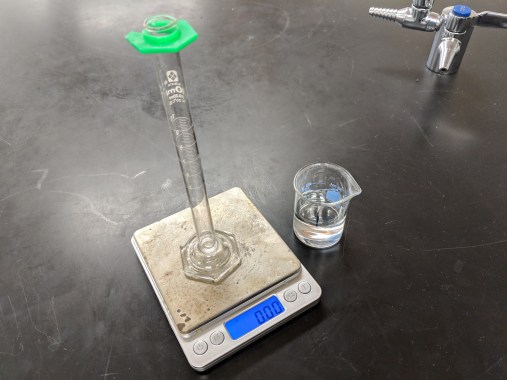
Similar to the physics class, the chemistry students took a pretty traditional individual final, then completed a lab practical. This tri, I had students identify a liquid based on the density. I was really pleased by how many students naturally used other observations to decide whether their result made sense.

chem final.jpg