Day 9: Board Meeting & Review

AP Physics: Board Meeting

Students sketched their distance vs. time and angle vs. time graphs from the rotating disk Direct Measurement Video. I’d assumed students would just use the frames displayed in the video to find the time directly, but a lot of groups decided to treat when a dot was at a position of zero as t = 0, which gave us a good opportunity to talk about some experimental design decisions, which reinforced what the intercept represents on a graph like this.


Earth Science: Review

As a school, we’ve been working on having students write meaningful questions as part of our focus on Cornell notes. While I don’t do many notes, I decided to piggy back on this by having students write possible test questions for each learning target. Periodically, I had groups trade whiteboards and work on answering the questions another group had come up with. At this point, the questions were fairly superficial, which isn’t surprising since we just skimmed the surface of the topics in this unit and students haven’t had much practice or feedback writing questions yet.

Day 7: Angular Velocity & Currents

AP Physics: Angular Velocity

I’ve decided to try embedding circular motion with kinematics, rather than introducing it as a separate unit, so today I introduced constant angular velocity. Students used a Direct Measurement Video of a rotating disk to plot both angle vs. time and distance vs. time for dots at different radii. I also introduced them to doing calculations in a spreadsheet since some of the number crunching they needed to do could be repetitive. Spreadsheets, high speed video, and some new physics was a lot to take in at once, so I gave more structure than usual, and my students rolled with it well.

rotating-disk-dmv

Earth Science: Currents

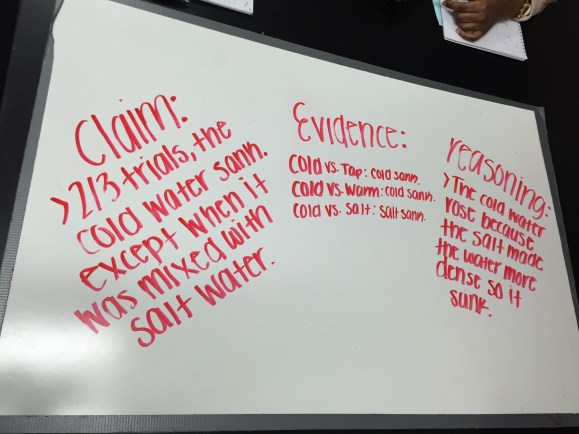
Students prepped whiteboards with their conclusions to yesterday’s lab using the claim-evidence-reasoning framework. Students seemed excited to share their work with the class. Afterward, we made some connections to ocean currents.

IMG_2184.JPG

Day 157: Refraction & Empirical Formula Lab

Physics: Refraction

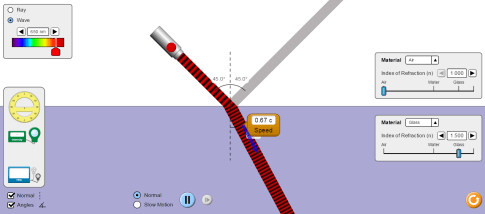
Students played with PhET’s Bending Light simulation to start building some ideas about refraction. I tried to keep the questions very broad and focused on conceptual understandings. Students really took advantage of all the tools available and made a lot of very detailed observations that would have been tough or impossible in a more traditional lab.

Bending Light

Chemistry: Empirical Formula Lab

Students worked on a lab that terrifies me (I once had a careless student singe his eyebrows), but gives really nice results. Students started with a sample of copper II oxide, then burned off the oxygen to get pure copper. They then used their initial and final mass to determine how much oxygen was in the original sample and find an empirical formula.

IMG_1886

So much fire!

Day 147: Joly Photometer & Energy in Reactions

Physics: Joly Photometer

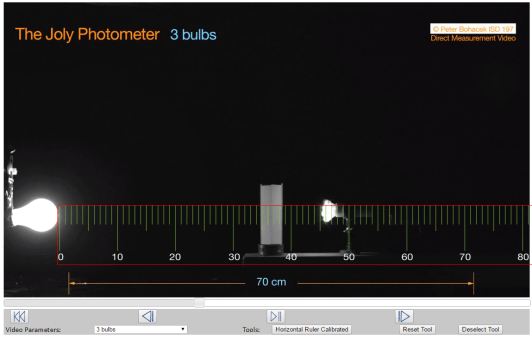
With over half of my students gone for another AP test today, I ended up giving them the hour to finish yesterday’s assignment with the Joly Photometer Direct Measurement Video. I’ll have a lot of students gone tomorrow for AP calc, so I need to figure out how I want to handle discussing the results of this and Monday’s lab.

Chemistry: Energy in Reactions

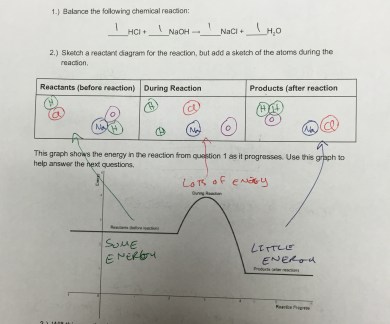
We talked about of yesterday’s lab, then took a look at energy changes in chemical reactions to start thinking about why some of the things we tried change the reaction rate.

IMG_1854

Day 146: Joly Photometer & Reaction Rates

Physics: Joly Photometer

Students used the Joly Photometer Direct Measurement Video to find a relationship between light intensity and distance from a source. I could tell a lot of my students had an AP test yesterday; I spent a lot more time than usual discussing with lab groups what variables they should graph, how they should collect data on those variables, and how to interpret and linearize the graph. I think their struggles had more to do with how mentally fried the AP chem students were than anything else.

joly photometer.PNG

Chemistry: Reaction Rates

Students timed a reaction between copper chloride and hydrogen peroxide under different conditions to determine what impacts the reaction rate.

IMG_1845

Day 136: Longitudinal Waves & Leftovers

Physics: Longitudinal Waves

We had some discussion about a high-speed video of a glass breaking due to sound waves to establish that sound is a new type of wave. Afterwards, students made longitudinal waves on slinkys to explore what aspects of our models for mechanical waves so far apply to longitudinal waves.IMG_1806

Chemistry: Leftovers Sim

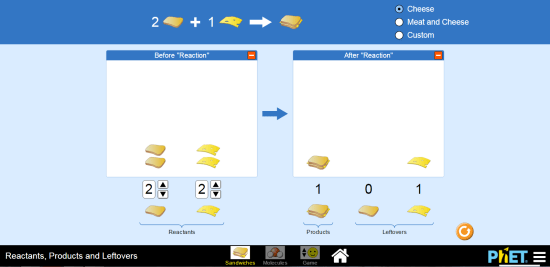
I was gone on Thursday and Friday and it turns out that on Thursday, while I planned for my students to work on PhET’s Reactants, Products, & Leftovers simulation,  the school’s wi-fi went out. We did that lab today, instead. Students were pretty successful applying ideas from Friday’s lab to the simulation and seemed to build some nice bridges to the more abstract chemical reactions.

Day 132: Closed Pipes & Percent Yield

Physics: Closed Pipes

Students whiteboarded their results from yesterday’s lab and we discussed the results. Afterward, students started working on finding a relationship between wavelength and the length of an air column needed for a standing wave, using the speed of sound from the video to get the wavelength of a tuning fork.

Chemistry: Percent Yield

I introduced the concept of percent yield and students started working through some problems. They also took a quiz on stoichiometry, which didn’t go as well as I hoped. Looking at their work, I think a lot of students lost track of what all the different numbers mean, so I’m tweaking some lessons for later this week to try and get back to the physical meaning of the numbers they are using.

Day 131: Speed of Sound & Speed Dating

Physics: Speed of Sound

After some time playing with the wave generator to confirm Thursday’s lab results, students used a Direct Measurement Video to produce a position vs. time graph and find the speed of sound. Tomorrow, they’ll put that speed to use in closed pipe resonators.

speed of sound DMV.PNG


Chemistry: Speed Dating

Students needed just a little more practice to firm up their stoichiometry skills, so we did some whiteboard speed dating with problems similar to what will be on tomorrow’s quiz. I was really pleased at the number of groups who were really talking through problems , taking turns with the marker, and taking other steps to ensure that both students really understood what was going on.

Day 130: Standing Waves & Stoich Practice

Physics: Standing Waves

Students used a Direct Measurement Video to look for patterns in the wavelengths and frequencies that can produce a standing wave on a string. I’d set up the wave driver this morning to try some ideas for Monday, and several students asked if they could try it to answer some questions the videos raised for them, but didn’t have a great way to answer.

Chemistry: Stoich Practice

Students finished up their stoichiometry practice problems today. I’m trying to really focus conceptually on what the math means, so we spent some time drawing repeated reaction diagrams to better connect the math to the lab they did a few days ago.

IMG_1791