Day 21: Angular Acceleration & Satellite Data

AP Physics: Angular Acceleration

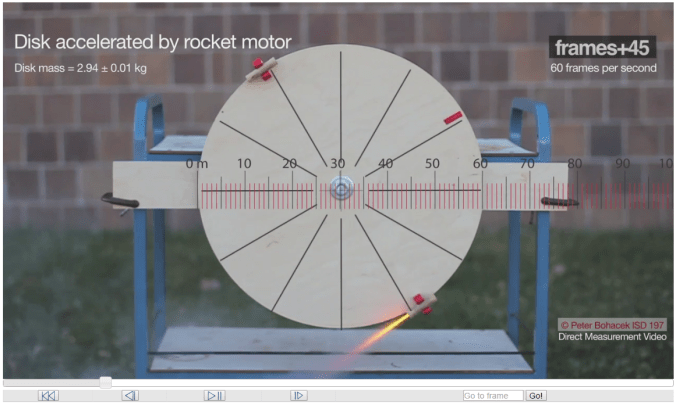
This year, I’m embedding circular motion concepts as we wrap up their linear motion analogues, so today students took their first look at angular acceleration. Students used a Direct Measurement Video to plot angle vs. time for a disk with a rocket motor attached. Students were quick to notice their graph looked a lot like position vs. time for an object with linear acceleration, and were able to extrapolate a lot from there.
rotating disk.PNG

Earth Science: Satellite Data

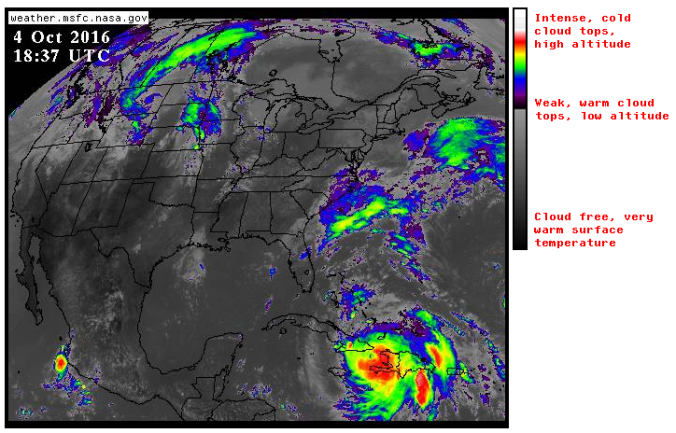
Students looked at some images of cloud cover produced by NASA’s GOES satellite to make some claims about the cloud cover and associated weather in a few areas of North America. I didn’t use my evidence-based reasoning graphic organizer today, and I don’t think its a coincidence that many students just stated their claims without any evidence. I need to keep being explicit about what good reasoning looks like and stay on students to keep including that in answers.
goes-infrared

Day 7: Angular Velocity & Currents

AP Physics: Angular Velocity

I’ve decided to try embedding circular motion with kinematics, rather than introducing it as a separate unit, so today I introduced constant angular velocity. Students used a Direct Measurement Video of a rotating disk to plot both angle vs. time and distance vs. time for dots at different radii. I also introduced them to doing calculations in a spreadsheet since some of the number crunching they needed to do could be repetitive. Spreadsheets, high speed video, and some new physics was a lot to take in at once, so I gave more structure than usual, and my students rolled with it well.

rotating-disk-dmv

Earth Science: Currents

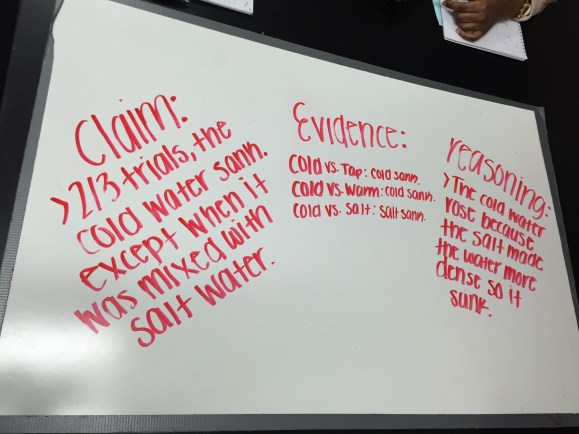
Students prepped whiteboards with their conclusions to yesterday’s lab using the claim-evidence-reasoning framework. Students seemed excited to share their work with the class. Afterward, we made some connections to ocean currents.

IMG_2184.JPG