Day 112: Coulomb’s Law, Spring Force Revisited, & Skew Dice

Today was our first day back from spring break and the first day of a new trimester.

AP Physics 1: Coulomb’s Law

I am a part of the Pivot Interactive’s Chemistry Fellows program.

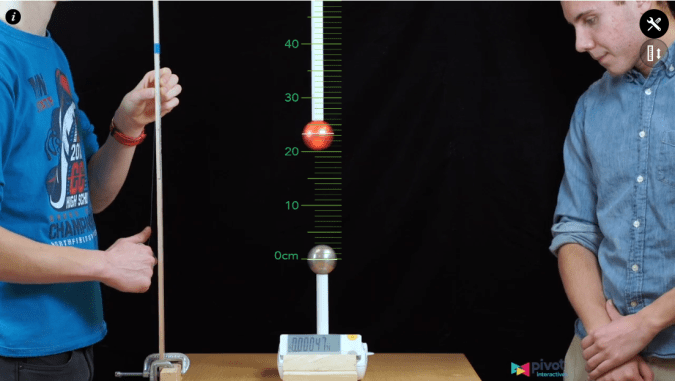
We dove right in with a lab on Pivot Interactives to discover Coulomb’s Law. We’re going to be cutting it pretty close on squeezing everything in before the AP exam, so I was much more direct than usual about what needed to be done by the end of the hour and how long I expected tasks to take, and that seemed to help students meet the timeline I had in mind. I need to make that a habit for the next few weeks.
pivot coulomb.PNG

Physics: Spring Force Revisited

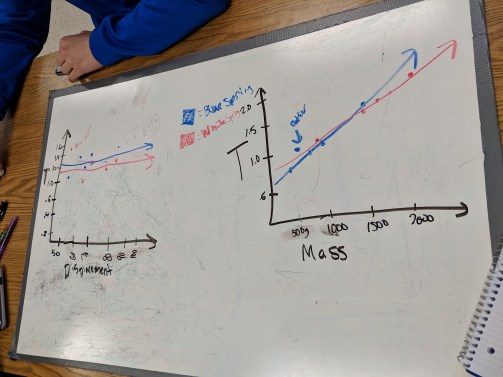
We’re getting ready to start vibrating springs, so today we revisited Hooke’s Law. I asked students to make some predictions about how the slope of two different springs should compare before collecting any data, which was tricky since they haven’t thought about what the spring constant actually means for a while, but I think they got where I want them to be.

Chemistry Essentials: Skew Dice

A lot of my students either haven’t had chemistry since trimester 1 or came to me from the other Chemistry Essentials teacher, so I treated today like the first day of school and tried to set a tone for the term. I tasked students with writing a CER to answer whether skew dice are fair. In the past with this activity, I’ve had some trouble convincing students they need a lot of data, so I started by asking students to collect evidence that a regular dice is fair before we got out the skew dice, and students pretty easily recognized they needed a lot of rolls with the regular dice to get a distribution that makes sense.

skew dice.jpg

Day 109: Free Response & Mistakes Whiteboarding

Today was our last day of regular classes before final exams.

AP Physics 1: Free Response

For my tri 2 final, I like to give most of a practice AP exam. Since our final periods are 90 minutes long, I had my students do the free response portion today. I took out the problems on circuits and rotation since my students haven’t seen those topics yet. Students seemed to feel pretty good afterward; I think they are internalizing that its okay not to nail the problems.

Physics: Mistakes Whiteboarding

We used some problems from the final review for mistakes whiteboarding. Students in this course have really bought in to the value of mistakes whiteboarding and I end up saying very little during these discussions. Its a lot of fun to listen to students during these discussions.

phys mistake.jpg

Chemistry Essentials: Mistakes Whiteboarding

We used some problems from the final review for mistakes whiteboarding. A lot of students were having some trouble focusing, which is not unusual for this course at the end of a tri; I think a lot of them are anticipating spring break and the start of the next trimester. My co-teacher and I made some changes to how we talked about particle diagrams this tri to emphasize them as a thinking tool, and it was a lot of fun to see some of that work pay off during the discussion today.

Day 105: Standing Waves, Whiteboarding, & Covalent Bonding

AP Physics 1: Standing Waves

Students worked on some problems for standing waves in pipes. Students seemed to be getting the hang of waves, which is good since we need to wrap up this topic tomorrow!

Physics: Whiteboarding

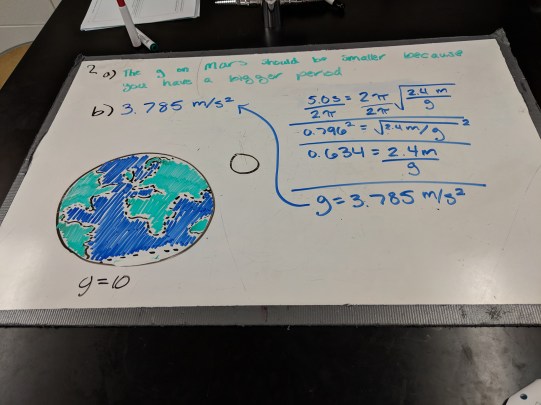
Students whiteboarded yesterday’s pendulum problems. One problem describes g on the ISS as “close to zero”, with the intention that students treat it as if g were zero, but the wording was enough to trip up a lot of students. I’ve been pushing them to read carefully and pay attention to details in the problem, so this was a good problem to have.

phys wb (1).jpg

Chemistry Essentials: Covalent Bonding

Students worked on translating between names, formulas, and particle diagrams for compounds with covalent bonds. We didn’t get into how to figure out the formulas from the number of valence electrons, so this ended up being pretty easy compared to the ionic bonding we’ve been working on.

Day 103: Whiteboarding

AP Physics 1: Waves Whiteboarding

Students whiteboarded problems from Friday. There was some great discussion about particle motion in a longitudinal wave in one class, and we ended up getting out a slinky and tieing a ribbon to one of the rings to try and see the motion first-hand.

Physics: Pendulum Representations Whiteboarding

We whiteboarded and discussed some problems sketching representations of a pendulum’s motion, including free-body diagrams, energy bar charts, and motion graphs. Students made a lot of good connections over the course of the discussion. On some of the questions, there were multiple approaches to the answer, which was great to see.

phys fbds.jpg

Chemistry Essentials: Chemical Formula Whiteboarding

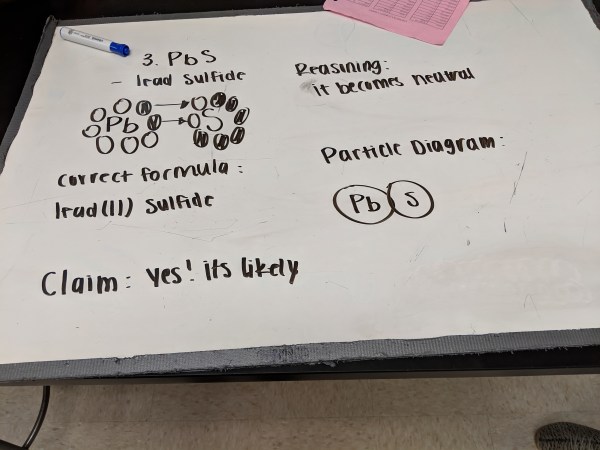
I gave students some problems where they had to decide whether a given chemical formula is likely, then we whiteboarded their answers for some discussion and a gallery walk. I especially liked the discussion that came out of a a couple of problems that included metals, like lead and copper, that can form multiple charges during ionic bonding.chem formula wb.jpg

Day 101: Board Meetings & Mistakes Whiteboarding

AP Physics 1: Wave Board Meeting

Students whiteboarded their results from Tuesday’s lab. They pretty quickly made the connection that the slope is the wave speed and saw the relationship I wanted between tension and wave speed. I’d planned to use Pivot Interactives to do some wave superposition basics, but our internet was out district wide for part of the day, so ended up doing some pretty teacher directed stuff with a snakey spring.

wave wb.jpg

Physics: Pendulum Board Meeting

Students whiteboarded their results for the pendulum lab. I didn’t have any groups decide to linearize on their own, so we had some discussion about the intercept to decide we needed to linearize.

phys pend.jpg

Chemistry Essentials: Formula Mistakes Whiteboarding

We did some mistakes whiteboarding with Tuesday’s worksheet on formula writing and particle diagrams. A lot of students seemed to be getting the hang of this skill today, which was great.

I’m seeing some students checking out, which is typical for this point in the trimester; I think students see it as set by now whether or not they will pass the course. My co-teacher and I have reduced how many students are in that place by having individual grade conferences with each student, which has been especially important for helping students who aren’t passing to make a plan.

chem formula.jpg

Day 98: Whiteboarding Galore

AP Physics 1: Oscillating Spring Whiteboarding

Students whiteboarded some problems for a mass on a vibrating spring. They are recognizing the parallels to pendulums and successfully connecting a lot of the ideas I want them to connect.

ap bar charts.jpg

Physics: Projectile Whiteboarding

Students whiteboarded some problems for horizontally launched projectiles. A lot of students are making good use of energy to simplify the math on the vertical motion and things seemed to click for a lot of students today.

phys wb.jpg

Chemistry Essentials: Bohr Model Whiteboarding

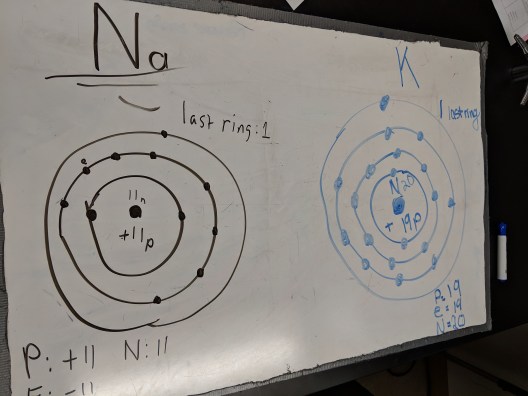
Students used the Bohr model of the atom to whiteboard structures for some of the first 20 elements, also bringing in what we figured out yesterday about isotopes. I ask students to predict the two most common isotopes, which requires rounding the average mass both up and down, and a few students had some trouble with rounding to predict isotopes like H-2, but they were able to get there with some support.

chem bohr.jpg

Day 96: Lots of Whiteboarding

AP Physics 1: Spring Period Board Meeting

We had a board meeting for the lab on the period of a spring. With all the days we’ve lost due to weather (and the potential for more in the forecast…), I cut it a bit short. My students aren’t in a place where they linearize automatically, but we did have some good conversation about the fact that the intercepts on the period vs. mass graph don’t make sense and students were very quick to come to a consensus that it sure looks like a square root relationship.

ap spring lab.jpg

Physics: Projectile Calculations

We revisited last week’s problem about an orange dropped from a tower to transition into projectile calculations. Students got into groups and whiteboarded solving for the time the orange took to fall and its final velocity. In each section, I had one group that opted to use conservation of energy to find the final velocity of the orange, which was a great way to contrast two different approaches. From there, we gave the orange some horizontal velocity to flesh out the calculations. This approach really drove home that students are being asked to remix old skills, not do something new.

phys calc.jpg

Chemistry Essentials: Bohr Model Whiteboarding

Students did a short worksheet figuring out the Bohr model structure of elements near the beginning of the periodic table. Afterward, students whiteboarded their answers for a gallery walk. I had each group do two elements from the same family to help the pattern in the number of valence electrons pop out.

bohr

Day 95: Springs, Graph Jeopardy, & Build an Atom

AP Physics 1: Spring Period

Students collected data to determine what impacts the period of a spring. I always get a kick out of how often I overhear students predicting that the mass won’t matter since it didn’t for a pendulum, only to be surprised.spring.jpg

Physics: Graph Jeopardy

I have this class the first and last hours of the day, which means it was more impacted by last week’s weather than my other classes. I had a quiz on sketching graphs for projectiles today and decided to do some Jeopardy whiteboarding to make sure everyone was in the groove. Each group sketched a pair of velocity vs. time graphs for a projectile, then another group had to come up with a situation that matched the graphs.

phys jeopardy wb.jpg

Chemistry Essentials: Build an Atom

Students used PhET’s Build an Atom simulation to explore the Bohr model. This was their first exposure to atomic models in the course, but students were able to pick up on all of the big ideas I wanted by playing with the simulation.

phet build atom.PNG

Day 94: Whiteboarding Galore

Today was a tricky day. Between yesterday’s snowstorm and this morning’s wind chill warning, a lot of the districts around here closed. We stayed open, but announced that weather-related absences would be excused (they normally aren’t). I ended up with around half my students gone each hour and had to adjust on the fly.

AP Physics 1: Pendulum Whiteboarding

We had a quiz on deck for today, but I was concerned about how many students would need to make it up. Instead, we spent today whiteboarding some conceptual questions about pendulums.

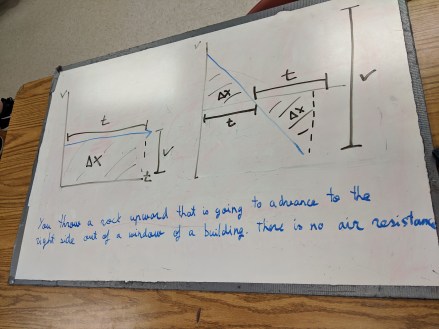
Physics: Projectile Whiteboarding

Students whiteboarded some problems sketching and interpreting velocity vs. time graphs for projectiles. I also got out the demo to show an object dropped and a horizontal projectile hit the ground simultaneously.


Chemistry Essentials: Phase Change Whiteboarding

We’d planned an in-class retake of the phase change quiz today, since last week’s weather meant we took the original late and some students really struggled as a result, so it seems to be a quiz destined for weather interference. We went ahead with giving the in-class retake today, but also spent some time whiteboarding practice bar charts to review beforehand.

Day 92: Board Meeting, Representing Free Fall, & 2 Truths and a Lie

AP Physics 1: Pendulum Board Meeting

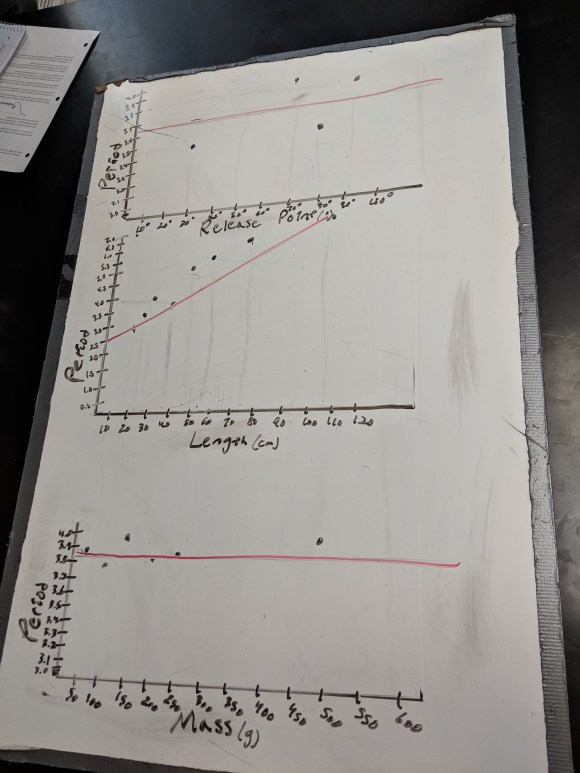
Students whiteboarded their results from yesterday’s pendulum lab. For mass and release angle, there were a couple of groups who sketched graphs that did not start at zero, which was great for having some discussion about why the scale of your graph matters. This was also the first graph students had that wasn’t quadratic or linear, so no groups linearized initially and we had some fantastic conversation about the intercept, which actually started in some groups while they were still prepping whiteboards. By the end of the hour, every group had linearized and was on-board with a square root relationship.

ap pendulum.jpg

Physics: Representing Free Fall

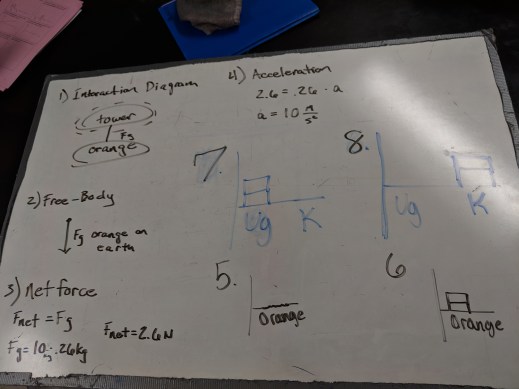
Students used some questions I modified from Michael Lerner to represent a falling orange using tools from each model we’ve covered so far this year. By the end of the hour, students commenting that free fall and projectile motion really aren’t anything new, which was exactly the goal! Students were struggling to connect this activity to the graphs we discussed yesterday, so that will be something to work on tomorrow.

phys orange.jpg

Chemistry Essentials: Periodic Table 2 Truths & a Lie

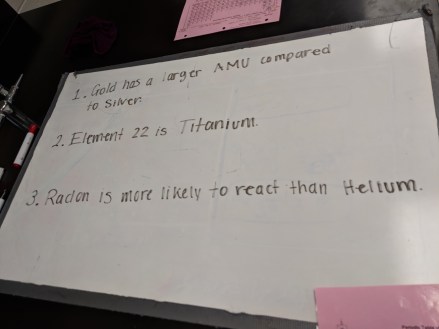
After discussing some of the trends in the periodic table, we did some whiteboarding to practice reading the periodic table and recognizing the trends. Since there isn’t a whole lot of depth to the questions I could ask at this point, each group prepped a whiteboard with two correct statements and one incorrect statement. Then, they traded whiteboards with another group who had to find and correct the wrong statement.

chem 2truths.jpg